wayground logo

Free Printable Worksheets

Font size

S
M
L
XL
Worksheets

ACP Chemistry Final Exam Review

Total questions: 153

Worksheet time: 9hrs 20mins

Name
Class
Date
1.
How many significant figures: 153.0 mL
a)
1
b)
2
c)
3
d)
4
2.
How many significant figures: 0.012 km
a)
1
b)
2
c)
3
d)
4
3.
How many significant figures: 1000 mL
a)
1
b)
2
c)
3
d)
4
4.
How many significant figures: 100.000 cL
a)
1
b)
3
c)
5
d)
6
5.
How many significant figures: 0.010 L
a)
1
b)
2
c)
3
d)
4
6.
A scientific ____________ is a broad explanation for events that is widely accepted as true.
a)
law
b)
theory
c)
observation
d)
method
7.

An educated guess to a problem that has not yet been tested. 

a)
data
b)
theory
c)
hypothesis
d)
fact
8.

3.05 + 0.013

a)

3.063

b)

3.06

c)

3.1

d)

3

9.

100 + 30.6

a)

130.6

b)

131

c)

130

d)

100

10.

5.9 x 6.01

a)

35.459

b)

35.46

c)

35.5

d)

35

11.

0.06x 6.28

a)

0.3768

b)

0.377

c)

0.38

d)

0.4

12.

How would you write 0.0005 in scientific notation?

a)

50 x 10-5

b)

5 x 10⁻⁴

c)

5 x 10³

d)

.5 x 103

13.

Express the following in scientific notation:


.000457

a)

457 x 106

b)

457 x 10-6

c)

4.57 x10⁴

d)

4.57 x 10⁻⁴

14.
Zed went to the store and bought a bag of chips.  He estimated there would be 350 chips in the package, but realized there were only 210 chips in that package.  What was his percent error?
a)
35%
b)
67%
c)
85%
d)
92%
15.
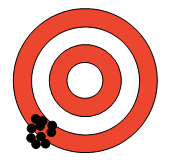
This bullseye demonstrates...
a)
High Accuracy & High Precision
b)
High Accuracy & Low Precision
c)
Low Accuracy & High Precision
d)
Low Accuracy & Low Precision
16.
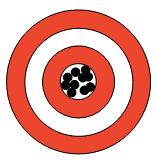
?
a)
High Accuracy & High Precision
b)
High Accuracy & Low Precision
c)
Low Accuracy & High Precision
d)
Low Accuracy & Low Precision
17.

How close a measurement is to the accepted value is called..

a)

Accuracy

b)

Precision

c)

Significant

d)

Estimate

18.
A set of data are all close to each other, but they are not close to the actual value.  This set of data can be described as...
a)
accurate
b)
precise
c)
both precise and accurate
19.
Frank has an eraser. It has a mass of 4g, and a volume of 2cm3. What is its density?
a)
8 g/cm3
b)
2 g/cm3
c)
1/2 g/cm3
d)
24 g/cm3
20.
Why do some substances float on water?
a)
they are warmer than water
b)
they are cooler than water
c)
they are more dense than water
d)
they are less dense than water
21.
Ice melting
a)
Chemical Change
b)
Physical Change
22.
Shredding a piece of paper
a)
Chemical Change
b)
Physical Change
23.
All of the following processes cause physical changes in matter except
a)
Burning
b)
Melting
c)
Freezing
d)
Boiling
24.
A change in matter that forms one or more new substances with new chemical properties is a/an...
a)
Physical Change
b)
Chemical Change
25.

Matter is anything that.....

a)

Has mass and takes up space

b)

Has mass and is visible

c)

Takes up space and has energy

d)

Has energy and is visible

26.

What is the best classification for this substance?

a)

An element

b)

A compound

c)

A mixture

27.

Is this a pure substance?

a)

Yes

b)

No

28.

What is the best classification of this substance?

a)

An element

b)

A compound

c)

A mixture of 2 elements

d)

A mixture of 2 compounds

29.

What is the best classification of this substance? H2SO4

a)

An element

b)

A compound

c)

A mixture

30.

What is the best classification of this substance? CO2 & H2S

a)

An element

b)

A compound

c)

A mixture of 2 compounds

d)

A mixture of many elements

31.
Which two particles make up the nucleus of an atom?
a)
Protons and Electrons
b)
Protons and Neutrons
c)
Molecules and Compounds
d)
Neutrons and Electrons
32.
The positively charged particles of an atom are the ________.
a)
electrons
b)
protons
c)
neutrons
d)
protons & neutrons
33.
The negatively charged particles of an atom are the ______.
a)
electrons
b)
protons
c)
neutrons
d)
protons & neutrons
34.
A neutron has this charge
a)
negative
b)
positive
c)
neutral
35.
What is the mass number?
a)
the number of protons
b)
the sum of the number of protons and the number of neutrons in the nucleus of an atom 
c)
the number of electrons
d)
the number of neutrons
36.
What is the atomic number?
a)
number of protons
b)
number of neutrons
37.
 What is the mass number of this element?
a)
5
b)
27
c)
32
d)
59
38.

An atom has an atomic number of 15 and a mass number of 31. How many protons are there in the atom?

a)

15

b)

31

c)

16

d)

47

39.
An atom has an atomic number of 19 and a mass number of 29. How many neutrons are in the atom?
a)
30
b)
19
c)
10
d)
38
40.
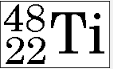
How many protons does this isotope of titanium have?
a)
48
b)
22
c)
26
d)
70
41.

How many neutrons does this isotope of titanium have?

a)

48

b)

22

c)

26

d)

70

42.

The name of this isotope of titanium is

a)

titanium-48

b)

titanium-22

c)

titanium-26

43.

If X is the symbol for an element, select the two symbols represent isotopes of the same element.

a)

7735X77_{35}X   

b)

7937X79_{37}X   

c)

8136X81_{36}X  

d)

8135X81_{35}X  

44.

What is an anion?

a)

a positive ion

b)

a negative ion

c)

a dsylexic onion

45.

What is a cation?

a)

a positive ion

b)

a negative ion

c)

an electrically charged cat

46.
An atom becomes _______ when it loses electrons.
a)
Positive
b)
Negative
c)
Neutral
d)
Invinsible
47.
An atom becomes _________ when it gains electrons.
a)
Positive
b)
Negative
c)
Neutral
d)
Invinsible
48.
What is the charge of an atom that has lost one electron?
a)
-1
b)
-2
c)
+1
d)
+2
49.
What does the symbol -10e represent
a)
alpha
b)
beta
c)
gamma
d)
the zero element
50.
What is the symbol for an alpha particle?
a)
42He
b)
0-1e
c)
0+1 e
d)
10n
51.
Balance the following equation:
146C --> 0-1e + ________
a)
145B
b)
146C
c)
147N
d)
42He
52.

Complete the nuclear reaction

85209At = ___ + 24He

a)

83205Bi

b)

86209Rn

c)

81207Tl

d)

85208At

53.
What is Half-life?
a)
The amount of time it takes for some of the nuclei in a sample of the isotope to decay
b)
The amount of time it takes for half the electrons in a sample of the isotope to decay
c)
The amount of time it takes for half the nuclei in a sample of the isotope to decay
d)
the amount of time it takes to double the nuclei in a sample of the isotope to decay
54.
If 10 mg of iodine 131 is given to a patient, how much is left after 24 days? The half-life of iodine-131 is 8 days.
a)
1.25mg
b)
1.25g
c)
10g
d)
10mg
55.
If the half-life of uranium-232 is 70 years, how many half-lives will it take for 10 g of it to be reduced to 1.25 g?
a)
1 half-life
b)
2 half-lives
c)
3 half-lives
d)
4 half-lives
56.
What atom matches this electron configuration?
1s2s2p3s2
a)
Neon
b)
Magnesium
c)
Aluminum
d)
Potassium
57.
Which is the electron configuration for an oxygen atom?
a)
1s22s22p63s23p64s2
b)
1s22s22p4
c)
1s22s22p6
d)
1s22s22p63s23p6
58.
What is the shorthand electron configuration for Sulfur atom?
a)
[Ar] 3p4
b)
[He] 3s23p4
c)
[Ne] 3s23p4
d)
[Na] 3s23p3
59.
What is the frequency of UV light that has an energy of 2.39 × 10 -18 J? 
a)
2.32 x 10Hz
b)
3.60 x 10¹⁵ Hz
c)
1.58 x 10-51 Hz
d)
3 x 10⁸  m/s
60.
What is the energy of light whose wavelength is 4.06 x 10⁻¹¹ m? 
a)
2.69 x 10-44 J
b)
1.63 x 10⁻²³ J
c)
4.90 x 10⁻¹⁵ J
d)
8.97 x 10-53 J
61.

The diagram below shows the electromagnetic spectrum. Which letters represent radio and gamma waves?

a)

A F

b)

F C

c)

A G

d)

C G

62.

What is the name of group number 1?

a)

halogens

b)

noble gases

c)

alkali metals

d)

alkaline earth metals

63.

What is the name of group number 2?

a)

transition metals

b)

halogens

c)

metaloids

d)

alkaline earth metals

64.

Periodic law states that the elements are arranged according to their atomic ________ so that elements with similar chemical properties are in the same ________ and properties repeat periodically.

a)

numbers, rows

b)

masses, rows

c)

masses, column

d)

numbers, column

65.
What are elements in groups 3-12 called?
a)
nonmetals
b)
metals
c)
halogens
d)
transition elements
66.

Name the following: MgO

a)

Magnesium Oxide

b)

Monomagnesium monoxide

c)

Magnesium monoxide

d)

Magnesium (II) oxide

67.

Name the following: NO2

a)

Nitrogen oxide

b)

Mononitrogen dioxide

c)

Nitrogen dioxide

d)

Nitrogen (II) oxide

68.

Name the following: N2O5

a)

Nitrogen oxide

b)

Dinitrogen pentoxide

c)

Nitrous oxide

d)

Nitrogen pentoxide

69.

Name the following: CuO

a)

Copper oxide

b)

Copper (II) oxide

c)

Monocopper monoxide

d)

Copper monoxide

70.
The chemical formula for an ionic compound of aluminum and chlorine is
a)
AlCl.
b)
ClAl.
c)
AlCl3.
d)
Al3Cl.
71.

What are the seven diatomic elements?

a)

H2, Cl2, Br2, O2, N2, I2, F2

b)

H2, Cl2, I2, F2, Hg2, Br2, Fe2

c)

H2, Cu2, Ni2, B2, O2, I2, Fe2

72.

What are diatomic elements?

a)

Elements that form two-atom molecules when not combined in a compound.

b)

Two elements that combine with one atom from each element.

c)

Elements that are always in pairs no matter what.

73.
According to the octet rule most elements need _______ valence electrons.
a)
2
b)
8
c)
6
d)
18
74.
Hydrogen needs _____ electrons in its valence shell to be stable.
a)
4
b)
6
c)
8
d)
2
75.

What is the correct Lewis Dot Structure for ammonia NH3

a)
b)
c)
d)
76.

Which is the correct molecular structure for carbon dioxide?

a)
b)
c)
d)
77.
What molecular shape is the structure shown here? (H2O)
a)
tetrahedral
b)
trigonal planar
c)
bent
d)
trigonal pyramidal
78.

What is the molecular geometry/shape of a molecule with 4 shared pairs and 0 unshared pairs?

a)

Linear

b)

Bent

c)

Trigonal Pyramidal

d)

Tetrahedral

79.

What is the molecular geometry/shape of a molecule with 3 shared pairs and 0 unshared pairs?

a)

Linear

b)

Trigonal Planar

c)

Trigonal Pyramidal

d)

Tetrahedral

80.
How are covalent bonds formed?
a)
Sharing of electrons
b)
Transfer of electrons
81.
What two types of atoms make a covalent bond?
a)
2 Nonmetals
b)
1 Nonmetal and 1 Metal
c)
2 Metals
d)
2 Noble Gases
82.

Which bond involves an unequal sharing of electrons?

a)

Ionic bond

b)

Nonpolar covalent bond

c)

Polar covalent bond

d)

Metallic bond

83.

__________ bonds involve an unequal sharing of electrons, while __________ bonds involve an equal sharing of electrons.

a)

Nonpolar, polar

b)

Polar, metallic

c)

Metallic, nonpolar

d)

Polar, nonpolar

84.

The difference in electronegativity affects the type of bond will be formed. What type of bond would be formed with a difference of 0.8?

a)

Nonpolar Covalent

b)

Polar Covalent

c)

Ionic

85.

Is this molecule polar or non-polar?

a)

Polar

b)

Non-polar

86.

Is this molecule polar or non-polar?

a)

Polar

b)

Non-polar

87.
Hydrogen bonding occurs when hydrogen is bonded to N, O, or F.  Which of the following has hydrogen bonding?
a)
CBr4
b)
NO2
c)
H2S
d)
NH3
88.

Intermolecular forces for: NH3

a)

London Dispersion Force

b)

Dipole dipole

c)

Hydrogen bonding

89.

Intermolecular forces for: CO2

a)

London Dispersion Force

b)

Dipole dipole

c)

Hydrogen bonding

90.
Intermolecular forces are the forces
a)
within molecules
b)
between molecules
91.

What type of reaction is Fe + Cl2 → FeCl3

a)

Synthesis

b)

Decomposition

c)

Single Replacement

d)

Combustion

e)

None of these

92.

What type of reaction is C2H2 + O2 → CO2 + H2O

a)

Synthesis

b)

Decomposition

c)

Single Replacement

d)

Combustion

e)

None of these

93.

What type of reaction is Ag2O → Ag + O2

a)

Synthesis

b)

Decomposition

c)

Single Replacement

d)

Combustion

e)

None of these

94.

What type of reaction is Zn + HCl → H2 + ZnCl2

a)

Synthesis

b)

Decomposition

c)

Single Replacement

d)

Combustion

e)

None of these

95.
__Na + __Cl2 --> __NaCl
a)
1,1,2
b)
2,1,2
c)
2,1,1
d)
already balanced
96.
Balance this reaction: ____ NaF + ____ Br2 ---> ____ NaBr + ____ F2
a)
3,1,2,1
b)
1,2,3,4
c)
2,1,2,1
d)
1,2,1,2
97.
Balance this equation:
Al2O3 -> Al + O2 
a)
2Al2O3 -> 2Al + 3O2 
b)
2Al2O3 -> 4Al + 3O2 
c)
3Al2O3 -> 2Al + O2 
d)
2Al2O3 -> 3Al + 2O2 
98.
How many molecules are in 2.5 mol of NaCl?
a)
1.51x10²³
b)
146
c)
4.15
d)
1.51x1024
99.
How many atoms of iodine are in a mole of iodine?
a)

53

b)

63.55g

c)

126.9

d)

6.02 x 10²³

100.

A mole = Avogadro's number = 6.022x10²³

a)

true

b)

false

101.
What is the mass percentage of Carbon in Carbon dioxide?
a)
27.3%
b)
42.9%
c)
57.1%
d)
72.7%
102.
A formula with the lowest whole # ratio of elements in a compound is called
a)
Molecular Formula
b)
Chemical Formula
c)
Empirical Formula 
d)
Distance Formula
103.

What is the empirical formula for C4H6?

a)

CH

b)

CH3

c)

C2H3

d)

C4H6

104.
Which pair has the same empirical formula?
a)
NaCrO4 and Na2Cr2O7
b)
C2H4O2 and C6H12O6
c)
C3H6Oand C2H6O2
d)
CH4 and C2H6
105.
What is the molecular formula if the empirical formula is CH2O and the molecular molar mass is 180.18?
a)
CH2O
b)
C2H4O2
c)
C4H8O4
d)
C6H12O6
106.

The molar mass is found by

a)

adding the masses of all the atoms in the molecule.

b)

dividing the total mass of all the atoms in the molecule by 6.02 x 10²³.

c)

multiplying the total mass of all the atoms in the molecule by 6.02 x 10²³.

d)

dividing the total mass of all the atoms in the molecule by the total number of atoms.

107.

What is the molar mass of H2O?

a)

6.02 x 10²³ grams

b)

17.007 grams

c)

18.015 grams

d)

15.999 grams

108.

You have 150 grams of Oxygen (O2)? How many moles is this?

a)

9.38 mol

b)

4.69 mol

c)

0.21 mol

d)

4,799.70 mol

109.

How many molecules are in 100 g of NaCl?

a)

6.02 x 10²³

b)

58.44

c)

1.03 x1024

d)

1.97 x 10²²

110.
The ______________ yield is the maximum amount of product possible in a reaction. This determines the amount of product that should be produced in a perfect setting
a)
Percent
b)
actual
c)
stoichiometry
d)
theoretical
111.
Cl2 + 2KBr → Br2 + 2KCl
How many grams of potassium chloride (KCl) can be produced from 356 g of potassium bromide (KBr)?
a)
749 g
b)
223 g
c)
479 g
d)
814 g
112.

The melting point of the sample is

a)

-60 ºC

b)

20 ºC

c)

60 ºC

d)

100 ºC

113.

Describe the substance at letter A.

a)

Solid

b)

Liquid

c)

Melting

d)

Evaporating

114.
Which segment represents the heat of fusion?
a)
A-B
b)
B-C
c)
C-D
d)
D-E
115.

100 Celsius is ? Kelvin (K = Celsius + 273)

a)

173 K

b)

373K

c)

273 K

d)

0 K

116.

volume and pressure are

a)

directly proportional

b)

inversely proportional

117.

Which of the follow is NOT equal to 1 atm?

a)

14.7 psi

b)

760 mmHg

c)

101325 Pa

d)

101.325 torr

118.

A gas is at a pressure of 95 kPa. What is its pressure in atmospheres?

a)

1.5 atm

b)

1.09 atm

c)

0.94 atm

d)

0.82 atm

119.

Which of the following variables is NOT correctly matched with its value for this problem:

What pressure is required to contain 0.023 moles of nitrogen gas in a 4.2 L container at a temperature of 20⁰C?

a)

V = 4.2 L

b)

R = 0.0821 L⋅atm∕mol⋅K

c)

n = 0.023 mol

d)

P = 20⁰C

120.

Choose the correct set of variables to solve the following problem: What is the volume of a balloon if it contains 3.2 moles of helium at a temperature of 20⁰C and 1.2 atm?

a)

P = x (unknown), V = 3.2 mol, n = 1.2 atm, T = 20⁰C K

b)

P = 1.2 atm, V = 3.2 mol, n = 20⁰C, T = x (unknown)

c)

P = 293 K, V = 3.2 mol, n = x (unknown), T = 1.2 atm

d)

P = 1.2 atm, V = x (unknown), n = 3.2 mol, T = 293 K

121.
Calculate the volume that a 0.323-mol sample of a gas will occupy at 265 K and a pressure of 0.900 atm.
a)
7.18 L 
b)
7.81 L
c)
4.63 L
d)
4.36 L
122.

Solve the following probem:

What pressure is required to contain 0.23 moles of nitrogen gas in a 4.2 L container at a temperature of 20⁰C?

a)

1.32 atm

b)

0.048 atm

c)

2.49 atm

d)

19.32 atm

123.

If I initially have 4.0 L of a gas at a pressure of 1.1 atm, what will the volume be if I increase the pressure to 3.4 atm?

a)

1.29 L

b)

12.36 L

c)

1.29 atm

d)

12.36 atm

124.

Hydrogen gas was cooled from 150oC to 50oC. Its new volume is 75 mL. What was its original volume?

a)

98 mL

b)

98 K

c)

98oC

d)

98 L

125.
A gas is heated from 263K to 298K. The volume is increased from 24.0L to 35.0L. If the original pressure was 1.00 atm, what is the new pressure?
a)
0.78 atm
b)
1.65 atm
c)
1.28 atm
d)
0.61 atm
126.
This solution would be considered
a)
Unsaturated
b)
Supersaturated
c)
Saturated
d)
Undefined
127.
Contains the maximum amount of dissolved solute
a)
unsaturated solution
b)
supersaturated solution
c)
saturated solution
128.
This graph represents a(n) ___ solution
a)
saturated
b)
supersaturated
c)
unsaturated
d)
undefined
129.
What is the molarity of  420 mls of a KCl solution that contains 16.0 grams of KCl
a)
625 M
b)
0.51 M
c)
3.19 M
d)
0.00563 M
130.

Jackson is making dinner and is trying to dissolve salt into a pot of water. The salt is dissolving slowly. What should Jackson do to speed up the rate of dissolving?

a)

He should put larger salt particles in the water.

b)

He should heat the water to a higher temperature.

c)

He should completely stop stirring the pot of water.

d)

He should slow down the speed he is stirring the pot.

131.

At what temperature can you fully dissolve 140g of NaNO3?

a)

62

b)

73

c)

81

d)

You cannot determine this

132.

Which of the following statements best describes the principle of "like dissolves like" in terms of solubility?

a)

Polar solvents dissolve nonpolar solutes.

b)

Nonpolar solvents dissolve polar solutes.

c)

Polar solvents dissolve polar solutes.

d)

Nonpolar solvents dissolve ionic compounds.

133.

What is the primary reason that oil and water do not mix?

a)

Oil is denser than water.

b)

Oil is polar and water is nonpolar.

c)

Oil is nonpolar and water is polar.

d)

Oil has a higher boiling point than water.

134.

What is the molality of a solution made by dissolving 2 moles of NaOH in 400 grams of water?

a)

5 mol/kg. solvent

b)

4 mol/kg solvent

c)

3 mol/kg. solvent

d)

2.5 moles /kg solvent

135.
What is the molarity of 3 mole of hydrochloric acid in 3 L of water. 
a)
3
b)
1
c)
6
d)
9
136.
The freezing point of a solution is ____ the freezing point of the pure solvent.
a)
the same as
b)
lower than
c)
higher than
d)
no relation to
137.
The boiling point of a solution is ______ the boiling point of the pure solvent.
a)
higher than
b)
the same as
c)
lower than
d)
higher or lower than
138.

How many mL of 1.0M KBr solution would you need to prepare 250 mL of a 0.2M dilution?

a)

175 mL

b)

250 mL

c)

50 mL

d)

5 mL

139.

What volume, in milliliters, of 10.0 M NaOH is needed to prepare 300.0 mL of 2.00 M NaOH by dilution?

a)

0.067 mL

b)

60.0 mL

c)

100 mL

d)

125 mL

140.

Which of the following is the weakest acid?

a)

bananas (pH 5)

b)

tomatoes (pH 4)

c)

cheese (pH 6)

d)

orange juice (pH 3)

141.
A(n) ______ is a substance with a pH less than 7
a)
Acid
b)
Alkaline
c)
Base
d)
Buffer
142.
A(n) _______ is a substance with a pH greater than 7.
a)
Base
b)
Acid
c)
Buffer
d)
Water
143.

Compared to a solution with a pH value of 7, a solution with a thousand times greater hydronium ion concentration has a pH value of

a)

10

b)

7

c)

3

d)

4

144.

What would be the pH of a solution with an [H+] of 0.001?

a)

3

b)

1

c)

-3

d)

-1

145.

What would be the pOH of a solution with [H+] of 0.024?

a)

1.6

b)

-1.6

c)

12.4

d)

0.95

146.
If the pH of a solution is 5.6 the pOH is
a)
6.5
b)
12.4
c)
8.4
d)
5.6
147.
acid + base ₋>
a)
salt + hydrogen
b)
salt + water
c)
salt + carbon dioxide + water
d)
salt
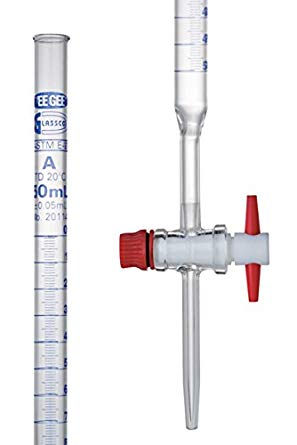
148.

What is this piece of apparatus called

a)

Pipette

b)

Burette

c)

Janette

d)

Cuvette

149.

If it takes 54 mL of 0.1 M NaOH to neutralize 125 mL of an HCl solution, what is the concentration of the HCl? (record you answer with the correct unit)

a)

0.043 M

b)

0.034 M

c)

0.065 M

d)

0.77 M

150.
a)

Burette

b)

Clamp

c)

Beaker

d)

Hood

151.

Which one is volumetric flask ?

a)
b)
c)
d)
152.
What kind of glassware is pictured here?
a)
Pipette
b)
Flask
c)
Beaker
d)
Graduated Cylinder
153.

Used to hold and mix chemicals. The small neck is to facilitate mixing without spilling.

a)

beakers

b)

erlenmeyer flasks

c)

watch glass

d)

petri dishes