
 Worksheets
Chapter 2 Health status quiz
Total questions: 18
Worksheet time: 9mins
What is the term used to describe the number of new cases of a disease in a population over a specific period?
Prevalence
Incidence
Morbidity
Mortality
What is meant by health status?
An individual's overall level of health and wellbeing
A measure of physical fitness
A person's mental health condition
A community's economic status
What are health indicators used for?
To assess educational outcomes
To determine economic growth
To measure and compare health status
To evaluate environmental changes
How much has the life expectancy for males increased from 1901–1910 to 2020–2022?
15 years
20 years
25 years
30 years
Explain the following health status indicators: self-assessed health status and life expectancy.
Self-assessed health status is a measure of economic status; life expectancy is a measure of educational attainment.
Self-assessed health status is a personal evaluation of health; life expectancy is the average number of years a person is expected to live.
Self-assessed health status is a measure of environmental quality; life expectancy is a measure of economic growth.
Self-assessed health status is a measure of educational success; life expectancy is a measure of literacy rate.
What are the leading causes of mortality among youth according to the provided document?
Infectious diseases and malnutrition
Injuries and poisoning
Cardiovascular diseases and diabetes
Respiratory diseases and allergies
How is YLL calculated for a person who dies prematurely?
By subtracting 10 years from their age
By adding 5 years to their age
By subtracting their age at death from the predicted life expectancy
By adding their age at death to the predicted life expectancy
What is meant by 'mortality'?
The rate of birth in a population
The number of illnesses in a population
The average lifespan of a population
The number of deaths in a population
Of the following conditions, identify which is more likely to cause mortality: asthma, acne, migraine or cancer?
Asthma
Acne
Migraine
Cancer
How can incidence data be useful for governments and health organizations?
To determine the total number of cases of a condition
To identify which conditions are increasing or decreasing
To calculate the number of deaths caused by a condition
To find the number of cured cases of a condition
What does YLD stand for in the context of health statistics?
Years Lived with Disease
Years Lost to Disability
Years Lived with Disability
Years Lost to Disease
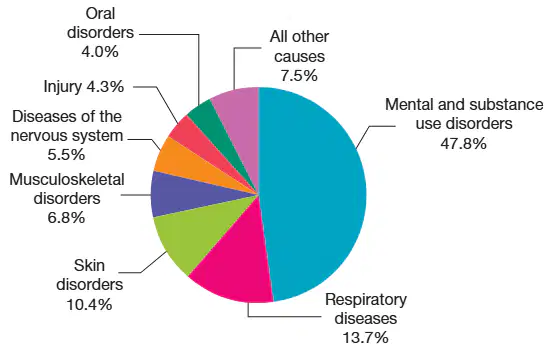
What is the primary cause of YLD for 10- to 14-year-olds according to Figure 2.14?
Mental and substance use disorders
Respiratory diseases
Skin disorders
Oral disorders
Explain why it is useful to examine morbidity data in addition to mortality data.
It provides information on birth rates
It helps understand the overall health of a population
It focuses only on the number of deaths
It is only relevant for infectious diseases
What are the three main areas of core activities?
Self-care, Mobility, Communication
Eating, Sleeping, Working
Reading, Writing, Arithmetic
Walking, Talking, Listening
What is the term used to describe the total number of cases of a disease or illness in a population at a given time?
incidence
morbidity rate
mortality rate
prevalence
This term gives an indication of how long a person can expect to live if the current death rates stay the same.
mortality rate
morbidity rate
life expectancy
self-assessed health status
A general movement or pattern in data is commonly known as:
a trend
incidence
prevalence
mortality
YLL + YLD is the formula for what?
Mortality
Morbidity
Burden of disease
DALY

