
 Worksheets
HS20 - Final Review - Unit 4 - Circulatory System
Total questions: 57
Worksheet time: 43mins
Which of the following is NOT one of the seven functions of the circulatory system?
Transports nutrients
Regulates temperature
Produces hormones
Forms clots to prevent blood loss
What is the main function of the heart in the circulatory system?
To filter waste from the blood
To pump blood throughout the body
To produce red blood cells
To absorb nutrients from food
Which chambers of the heart receive blood?
Ventricles
Atriums/Atria
Valves
Nodes
What is the purpose of valves in the heart?
To produce hormones
To keep the blood flowing in the right direction
To absorb nutrients
To regulate temperature
Which valve is located between the left atrium and the left ventricle?
Tricuspid valve
Pulmonary valve
Mitral valve
Semilunar valve
Explain why the ventricles have larger muscles than the atriums.
Because they need to pump blood a shorter distance
Because they need to pump blood out of the heart to the body
Because they receive blood from the body
Because they regulate temperature
Describe the path of blood through the heart, starting from the body.
Right Atrium → Right Ventricle → Lungs → Left Atrium → Left Ventricle → Body
Left Atrium → Left Ventricle → Lungs → Right Atrium → Right Ventricle → Body
Right Ventricle → Right Atrium → Lungs → Left Ventricle → Left Atrium → Body
Left Ventricle → Left Atrium → Lungs → Right Ventricle → Right Atrium → Body
Which node sends an electric pulse to the atriums causing them to beat?
Atrioventricular (AV) node
Purkinje fibers
Sinoatrial (SA) node
Mitral valve
What is the role of the Purkinje fibers in the heart?
To carry blood to the lungs
To send an electrical pulse causing the ventricles to beat
To regulate temperature
To transport nutrients
Why must all cells be within 2 cells of a blood vessel?
To receive hormones
To allow diffusion of nutrients and waste over short distances
To regulate temperature
To form clots
What is the main function of arteries in the circulatory system?
To carry blood away from the heart
To carry blood towards the heart
To filter waste from the blood
To produce red blood cells
Which type of blood vessel is described as being thick and elastic to accommodate increased blood pressure?
Veins
Capillaries
Arteries
Venules
What is the primary reason capillaries are so small?
To increase the rate of diffusion
To carry blood under high pressure
To store blood
To prevent blood from flowing backwards
Which vessels have valves to keep blood flowing in the right direction?
Arteries
Capillaries
Veins
Arterioles
Arrange the following blood vessels in the correct order of blood flow starting from the heart: Arteries, Arterioles, Capillaries, Venules, Veins.
Arteries → Arterioles → Capillaries → Venules → Veins
Veins → Venules → Capillaries → Arterioles → Arteries
Capillaries → Arteries → Arterioles → Veins → Venules
Arterioles → Arteries → Capillaries → Veins → Venules
Why do veins have thinner walls compared to arteries?
Because veins carry blood under lower pressure
Because veins need to be more elastic
Because veins transport oxygen-rich blood
Because veins are closer to the heart
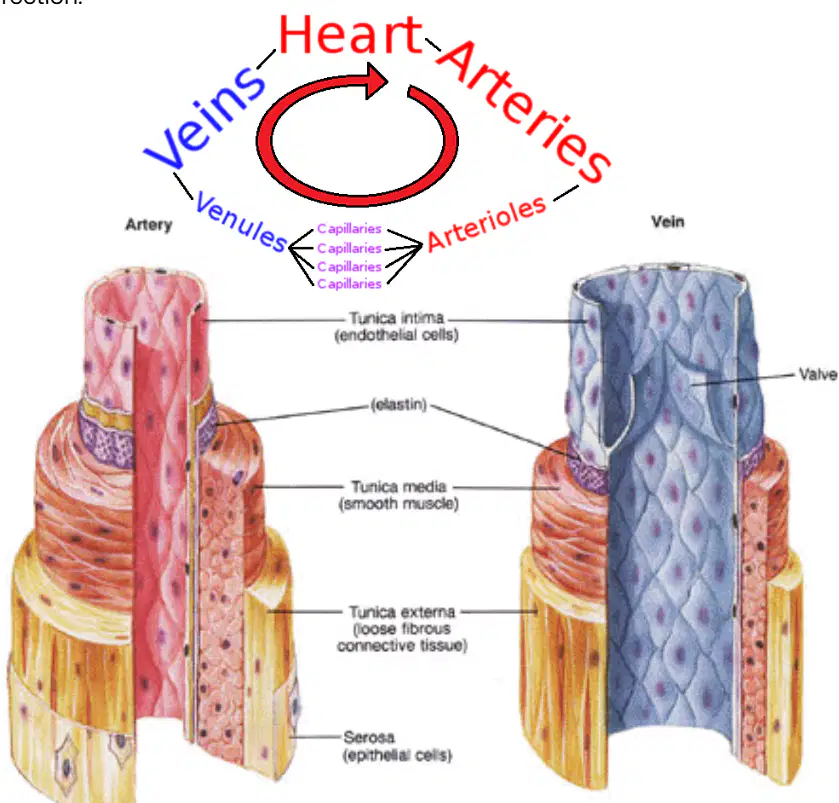
What structural feature is present in veins but not in arteries, as shown in the diagram?
Thick tunica media
Valves
Elastic fibers
Smooth muscle
What percentage of blood is composed of plasma?
55%
45%
25%
75%
Which of the following are the cellular components of blood?
Red blood cells, white blood cells, and platelets
Plasma, water, and proteins
Antigens, antibodies, and enzymes
Oxygen, carbon dioxide, and glucose
What is the function of antigens on red blood cells?
To help the body identify the blood as its own
To transport oxygen
To produce antibodies
To clot the blood
Which blood group has both A and B antigens on the red blood cells?
Group AB
Group A
Group B
Group O
Which blood group has no antigens on the red blood cells?
Group O
Group A
Group B
Group AB
What type of antibodies are found in the plasma of Group B blood?
Anti-A
Anti-B
Both Anti-A and Anti-B
None
What does it mean if a person is Rh positive?
The Rh antigen is present in their blood
The Rh antigen is absent in their blood
They have both A and B antigens
They have no antigens
Why are A and B blood types considered co-dominant?
Both A and B antigens are expressed when present together
Only one antigen is expressed at a time
Neither antigen is expressed
They are both recessive
Why does the heart need oxygen and nutrients?
Because it is a muscle and requires them to function, like any other muscle
To produce hormones
To filter waste from the blood
To store energy
Which of the following is considered a heart disease?
Anything that interferes with your heart's ability to pump blood
Any condition that affects your lungs
Any disease that affects your bones
Any infection in the digestive system
What is a myocardial infarction more commonly known as?
Stroke
Heart attack
Anemia
Leukemia
Which heart disease is characterized by an irregular heartbeat?
Angina
Arrhythmia
Aneurysm
Hypertension
What happens in atherosclerosis?
The arteries (walls) harden
The heart stops beating
The blood clots excessively
The blood pressure drops
Which of the following is a symptom of congestive heart failure?
The heart is not strong enough to pump efficiently
The blood vessels are blocked in the brain
The blood cells do not transport oxygen
The blood pressure is low
What is the main characteristic of anemia?
Red blood cells do not transport enough oxygen
Blood vessel wall bulges outward
Blood pressure is high
Heartbeat is irregular
Which tool is used to listen to the heart beat for diagnosing heart conditions?
Electrocardiogram
Stethoscope
Thermometer
Sphygmomanometer
What does an electrocardiogram (EKG) record?
Blood pressure
Electrical activity in the heart
Oxygen levels in the blood
Heart size
Why do doctors analyze blood when diagnosing blood conditions?
To check for symptoms present in the blood
To measure heart rate
To listen to the heartbeat
To check for bone density
What is the most common type of EKG?
Posterior 6 lead EKG
Anterior 12 lead EKG
Lateral 3 lead EKG
Inferior 5 lead EKG
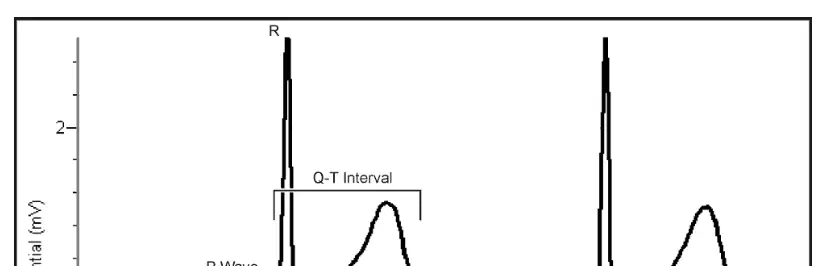
Which part of the EKG represents the Q-T interval?
The segment between the start of the Q wave and the end of the T wave
The peak of the R wave
The beginning of the P wave
The end of the S wave
What does the P wave represent in an EKG/ECG?
The beating of the ventricles
The resetting of the ventricles electrically
The beating of the atriums (electrical depolarization)
The closing of the heart valves
Which acronym is used to remember the signs of a stroke?
STOP
FAST
HELP
SAFE
Which of the following is NOT a symptom of a heart attack?
Chest pain or discomfort
Shortness of breath or nausea
Arm weakness
Pain in the jaw, neck, back, arm, or shoulders
What is the purpose of taking blood thinners as a medication?
To increase blood pressure
To help the blood clot more easily
To prevent clots from forming
To increase heart rate
Which of the following lifestyle changes is recommended to help lower cholesterol?
Eating high-fat foods
Reducing stress
Avoiding all exercise
Increasing salt intake
What is a stent used for in heart surgery?
To replace a heart valve
To reinforce and hold open a blocked blood vessel
To regulate the heartbeat
To remove blood clots
When analyzing an EKG/ECG, why do doctors check if the intervals between each component and each complex are consistent?
To determine if the patient has high cholesterol
To check for regular heart rhythm and function
To see if the patient needs surgery
To measure blood pressure
Why is it important for the heart to have more lean tissue than fatty tissue?
Lean tissue makes the heart beat faster
Fatty tissue helps the heart pump more efficiently
It takes more effort for the heart to pump through fatty tissue than lean tissue
Lean tissue increases cholesterol levels
Which of the following is a procedure where surgeons replace valves inside the heart?
Heart transplant
Valve replacement
Blood transfusion
Angioplasty
What is the main function of a thoracic surgeon as mentioned in the text?
Operate on the heart only
Operate on the lungs, trachea, or esophagus
Diagnose blood disorders
Perform diagnostic imaging
Which of the following careers focuses on the internal organs and the diseases that affect them?
Cardiologist
Internist
Hematologist
Radiologist
Which of the following is NOT a type of valve that can be used to replace a heart valve?
Animal valve
Human valve
Mechanical valve
Plastic valve
Why might a surgeon perform a bypass operation on the heart?
To replace a damaged valve
To attach blood vessels that go around a blockage
To transplant a new heart
To diagnose heart disease
Which of the following careers is most likely to be involved in diagnostic technology?
Perfusionist
Medical Laboratory Technologist
Cardiologist
Internist
Explain the difference between a cardiac surgeon and a thoracic surgeon based on the information provided.
Cardiac surgeons operate on the heart, while thoracic surgeons operate on the lungs, trachea, or esophagus.
Cardiac surgeons diagnose diseases, while thoracic surgeons treat blood disorders.
Cardiac surgeons focus on diagnostic technology, while thoracic surgeons focus on internal organs.
Cardiac surgeons only work with children, while thoracic surgeons only work with adults.
Which of the following professionals would most likely be involved in drawing blood from a patient?
Echocardiographer
Phlebotomist
Internist
Radiologist

Identify:
Vena Cava
Aorta
Pulmonary veins
Pulmonary artery


Identify:
Left Ventricle
Right Atrium
Right Ventricle
Left Atrium


