wayground logo

Free Printable Worksheets

Font size

S
M
L
XL
Worksheets

SS 6 FINAL EXAM Practice PART 1 ~ 2025

Total questions: 32

Worksheet time: 16mins
Name
Class
Date
1.
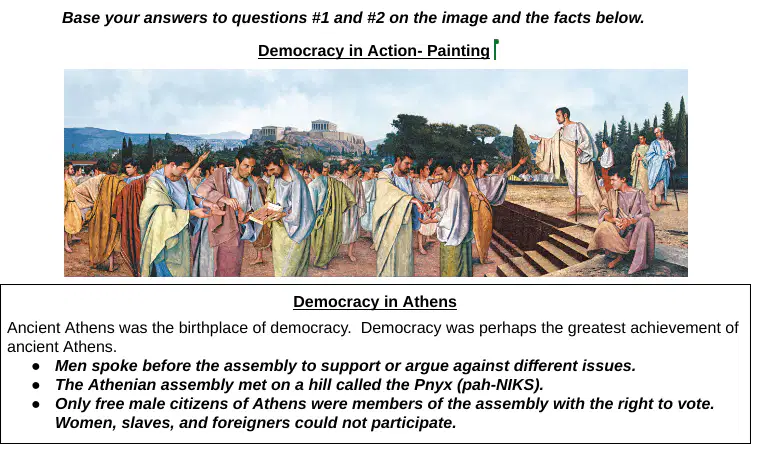
1. Based on the painting, “Democracy in Action”, one can infer or conclude:
a)
1. That democracy encouraged debate on issues, where people tried to persuade others to their point of view.
b)
2. That women were active participants in Athenian democracy.
c)
3. Foreigners were all welcome to debate the issues at the assembly.
d)
4. Debates were closed off to the public and done in the privacy of people’s homes.
2.
2. A historian would find this document most useful for:
a)
1. A detailed description of women’s rights in ancient Athens
b)
2. How slaves and foreigners were considered to be equal to Athenian citizens
c)
3. An explanation as to the world’s first democratically formed government
d)
4. To describe what a Pnyx was
3.
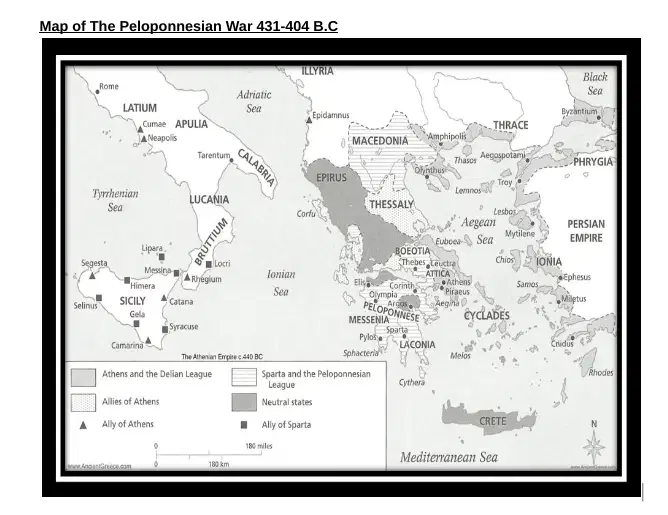
3. The best use for this map source would be to
a)
1. detail the bodies of water that surround Greece.
b)
2. show which areas of the Greek world joined with Athens and Sparta for the Peloponnesian War.
c)
3. demonstrate the size of the Persian Empire.
d)
4. show the distance from Italy to Greece.
4.
4. The soldier in this document
a)
1. has been successful at expanding the empire
b)
2. has been killed in the most recent battle he fought
c)
3. Is a general in the Greek army
d)
4. has been fighting battles near his homeland and his family
5.
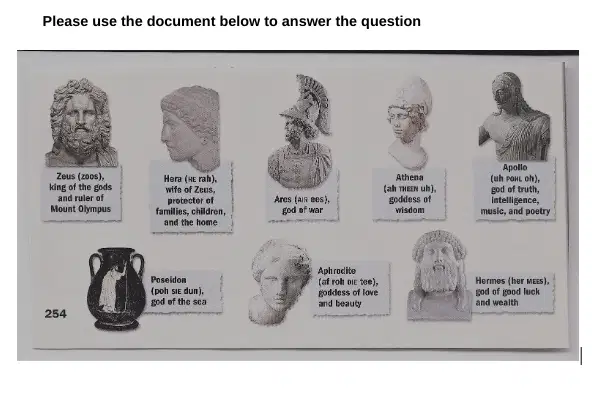
5. What does the picture below tell us about Greek religion?
a)
1. They were monotheistic.
b)
2.They were polytheistic.
c)
3. They believed in an aristocracy.
d)
4. They were Christian.
6.
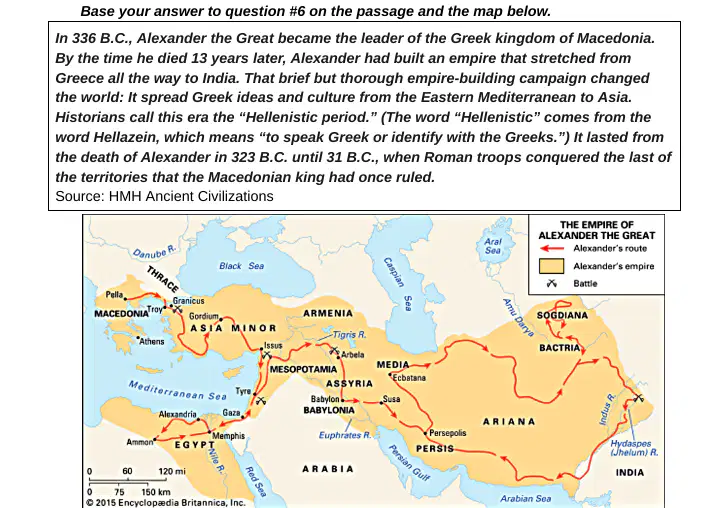
6. Which answer best reflects the words and picture in this document?
a)
1. Alexander’s army conquered lands from Greece to India.
b)
2. Alexander’s men traveled across the Black Sea.
c)
3. The army of Alexander traveled more than 10,000 miles.
d)
4. There was a major battle in Alexandria, Egypt.
7.
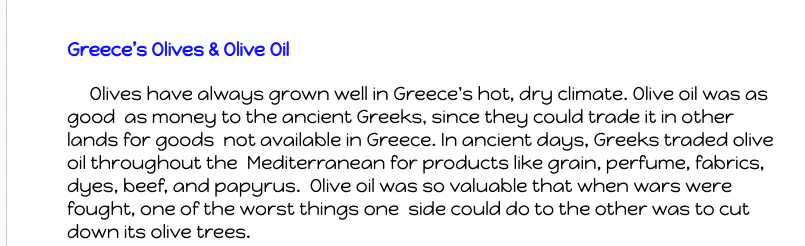
7. Based on the passage below, why was olive oil so valuable in ancient Greece?
a)
Olives grew well in Greece's hot and dry climate.
b)
Olive oil was able to be traded for other goods.
c)
Wars were fought over olive oil.
d)
All of the above.
8.
8. Based on the discovery of the above three objects together, you could make the following conclusion about Hellenistic art:
a)
1. Art was designed for everyday use.
b)
2. Hellenistic works of art are fancy, decorated, and detailed.
c)
3. People worshiped a single god on a daily basis.
d)
4. Very little time was devoted to the creation of art.
9.
9. Based on the information provided in this source, which claim about Roman Roads is most accurate?
a)
1. Roman roads were created throughout the empire to make Rome rich and powerful.
b)
2. Roman roads were weak and unstable and a waste of time and energy.
c)
3. Roman roads were built by slaves.
d)
4. Romans did not benefit at all by creating 50,000 miles of roads throughout the empire.
10.
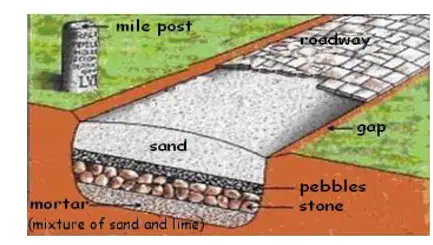
10. A historian could best use the document below to study
a)
1. where the Romans got the materials for making the many roads throughout the empire.
b)
2. which emperor ordered the roads to be constructed.
c)
3. how the Roman roads were constructed.
d)
4. who paid for the Roman roads to be constructed.
11.
11. Based on the document below, which is TRUE about the Pax Romana?
a)
1. The empire became smaller.
b)
2. It was a period of peace for Rome.
c)
3. The people in the empire were rebelling or going against the Emperor.
d)
4. Rome was constantly getting attacked.
12.
12. Based on the information given, which of the following would be a valid conclusion about the lives of Roman women?
a)
1. had the right to vote
b)
2. had no rights
c)
3. had some rights
d)
4. could hold political offices
13.
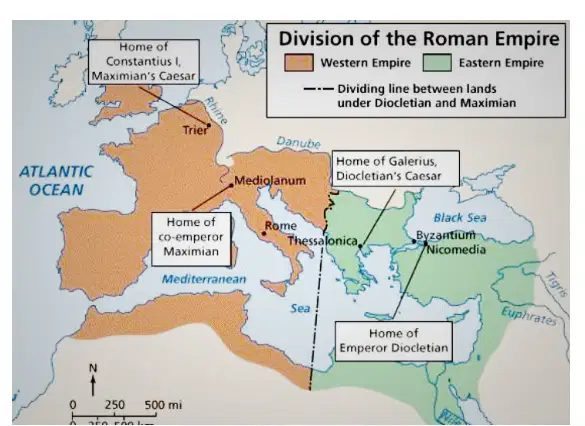
13. Which conclusion about the Roman world around AD 526 can be drawn from the information on the map below?
a)
1. The Gauls dominated trade on the Mediterranean Sea.
b)
2. Rome was located in the Eastern Empire
c)
3. The western and eastern regions were split between lands under Emperors Diocletian and Maximilian.
d)
4. The Black Sea divides the eastern and western parts of the Roman Empire.
14.
14. Which claim is best supported by the text below?
a)
1. Jews believed in many gods, but the Messiah was the most important of these gods.
b)
2. Christianity was not connected to Judaism.
c)
3. Many Jews believed that by following strict religious laws, the Messiah would be encouraged to appear.
d)
4. King David restored the kingdom of Israel back to greatness.
15.
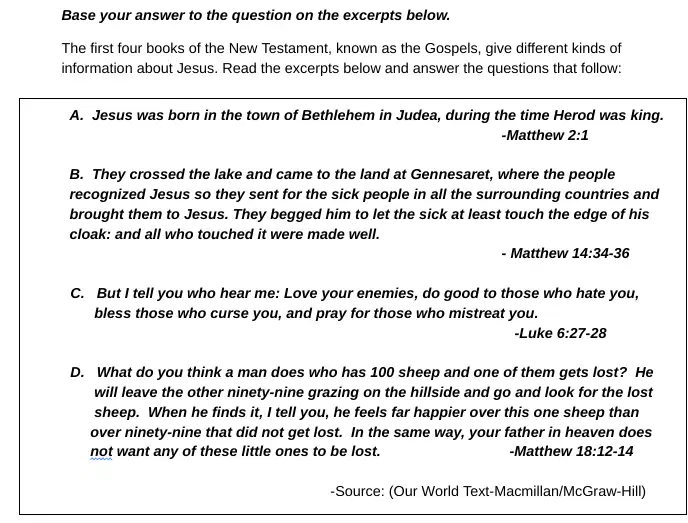
15. Which excerpt shows Jesus teaching people the right way to live?
a)
1. Excerpt A
b)
2. Excerpt B
c)
3. Excerpt C
d)
4. Excerpt D
16.
16. The passage below explains why Muslims both preserved existing knowledge and extended it. What claim is best supported by the evidence in this passage?
a)
1. Muslims believed that science would improve their lives.
b)
2. Muslims wanted to end the chaos.
c)
3. Muslims did not support the advancement of science.
d)
4. Muslims were not interested in different cultures and beliefs.
17.
17. A major belief of Muslims is that they believe they should pray_______.
a)
1. whenever it is convenient
b)
2. five times a day
c)
3. only on Saturday
d)
4. only during Ramadan
18.
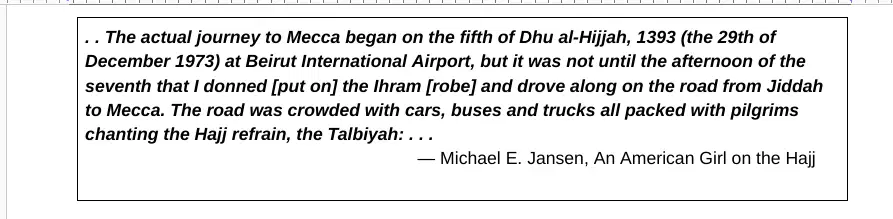
18. The passage below was created to give a first hand account of beliefs relating to the religion of _____.
a)
1. Christianity
b)
2. Islam
c)
3. Hinduism
d)
4. Judaism
19.
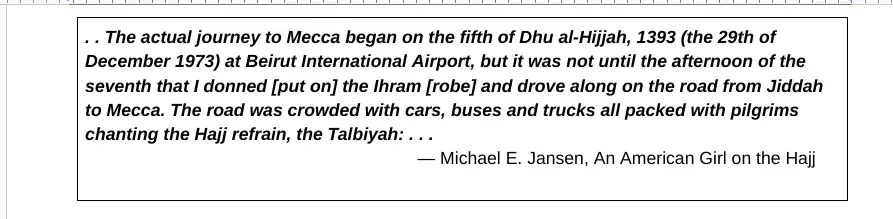
19. The journey described by the author in the passage below refers to a _____.
a)
1. trip to the Beirut Airport
b)
2. pilgrimage to Mecca
c)
3. drive to the city of Jiddah
d)
4. trip to America from Mecca
20.
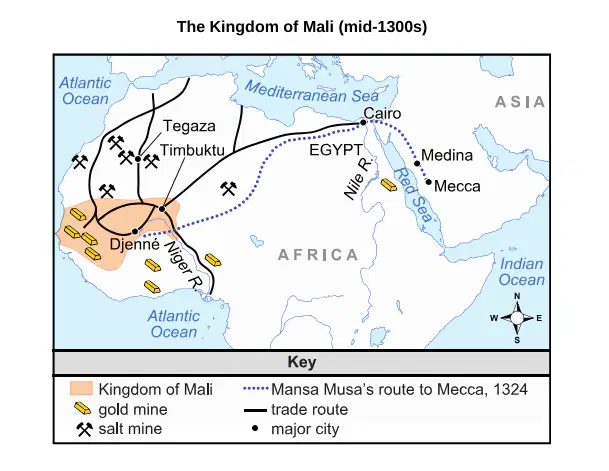
20. According to the map, which statement explains why people most likely migrated to the West African Kingdom of Mali?
a)
It was located near mountain ranges that prevented attacks.
b)
It was located near a major river and had gold deposits.
c)
It was located in the center of the African continent, which made trade easier.
d)
It was located in an African desert, which made growing and selling crops easier.
21.

Based on the passage, what was a key feature of Athenian democracy?

a)

4. Decisions were made solely by the king.

b)

1. Only the wealthy could participate in government.

c)

3. Women and slaves had equal rights as citizens.

d)

2. Citizens were encouraged to debate and vote on issues.

22.

Which statement best describes the religious beliefs of ancient Greeks?

a)

3. They rejected all forms of religious practice.

b)

2. They worshipped many gods and goddesses.

c)

4. They followed the teachings of Christianity.

d)

1. They believed in a single, all-powerful god.

23.

What was one major reason for the prosperity of the West African Kingdom of Mali?

a)

4. Its focus on agriculture in desert regions.

b)

3. Its mountainous terrain that protected it from invasions.

c)

2. Its isolation from other civilizations.

d)

1. Its location near important trade routes and gold resources.

24.

Which statement best explains the importance of trade in the development of the West African Kingdom of Mali?

a)

4. Trade was not significant in Mali's history.

b)

1. Trade routes brought wealth and cultural exchange to Mali.

c)

2. Trade isolated Mali from neighboring regions.

d)

3. Trade led to the decline of Mali's power.

25.

Based on the passage, what was a key characteristic of Hellenistic art?

a)

4. It was only used in religious ceremonies.

b)

3. It avoided depicting human figures.

c)

2. It was known for its elaborate and detailed decoration.

d)

1. It focused on simple and practical designs.

26.

According to the information provided, which statement is most accurate about the religious beliefs of ancient Greeks?

a)

1. They believed in a single, all-powerful god.

b)

4. They followed the teachings of Islam.

c)

2. They worshipped many gods and goddesses.

d)

3. They rejected all forms of religious practice.

27.

Which factor most contributed to the spread of Greek culture during the Hellenistic period?

a)

4. The rise of the Roman Empire.

b)

1. The isolation of Greek city-states.

c)

2. The conquests of Alexander the Great.

d)

3. The decline of trade in the Mediterranean.

28.

What was a significant achievement of the Roman Empire during the Pax Romana?

a)

3. The division of the empire into city-states.

b)

4. The abandonment of trade routes.

c)

1. The construction of an extensive network of roads.

d)

2. The end of all religious practices.

29.

Which statement best describes the role of trade in the development of ancient Greece?

a)

1. Trade was discouraged by Greek leaders.

b)

4. Trade was only allowed with the Roman Empire.

c)

3. Trade led to the decline of Greek religion.

d)

2. Trade helped Greek city-states gain wealth and share ideas.

30.

Which statement best explains how trade influenced the culture of ancient Greece?

a)

1. Trade led to the isolation of Greek city-states.

b)

2. Trade introduced new ideas and goods from other civilizations.

c)

3. Trade was banned by Greek leaders.

d)

4. Trade caused the decline of Greek art and literature.

31.

What was a major impact of the construction of Roman roads?

a)

3. It discouraged trade with neighboring regions.

b)

4. It caused the empire to become more isolated.

c)

2. It limited the movement of Roman armies.

d)

1. It made travel and communication easier across the empire.

32.

Which factor most contributed to the wealth of the Kingdom of Mali?

a)

4. Its focus on fishing industries.

b)

2. Its lack of contact with other civilizations.

c)

1. Its control over gold and salt trade routes.

d)

3. Its mountainous geography.