
 Worksheets
8th grade Astronomy
Total questions: 60
Worksheet time: 32mins
What is the force of attraction between two objects that holds planets, moons, and galaxies together?
Gravity
Magnetism
Friction
Electricity
What is the distance between two wave crests, which determines the energy and color of light?
Wavelength
Amplitude
Frequency
Photon
What term describes how often a wave passes a point in a certain amount of time, where higher frequency means more energy?
Frequency
Amplitude
Wavelength
Velocity
What is the height of a wave from rest to crest, where bigger amplitude means brighter light?
Amplitude
Wavelength
Frequency
Speed
What is the name for all types of light energy, including radio waves, microwaves, visible light, and more, where only visible light can be seen by humans?
Electromagnetic Spectrum
Visible Spectrum
Infrared Radiation
Ultraviolet Rays
What is it called when light from a galaxy is stretched (shifted toward red), showing it's moving away and used to tell if an object is old and far?
Red Shift
Blue Shift
Doppler Effect
Parallax
What do we call a large group of stars, gas, and dust held together by gravity, with types including spiral, elliptical, and irregular?
Galaxy
Asteroid
Comet
Nebula
What is the average distance between the Earth and the Sun called?
AU (Astronomical Unit)
Light Year
Parsec
Kilometer
What is the distance light travels in one year, used to measure distances between stars and galaxies?
Lightyear
Parsec
Astronomical Unit
Kilometer
What term describes any object in space, such as a planet, moon, star, or asteroid?
Celestial Body
Molecule
Continent
Organism
What are explosions on the Sun’s surface that send energy into space, causing auroras and disrupting satellites on Earth called?
Solar Flares & CMEs
Sunspots
Comet Tails
Lunar Eclipses
What is the term for energy and particles from the Sun that affect Earth's magnetic field, satellites, and atmosphere?
Space Weather
Solar Wind
Cosmic Rays
Aurora
What do we call the changing shapes of the Moon we see as it orbits Earth, including new moon, crescent, quarter, gibbous, and full moon?
Moon Phases
Solar Flares
Eclipses
Tides
What is it called when the Sun, Earth, and Moon line up and block light, such as a solar eclipse when the Moon blocks the Sun?
Eclipses
Phases
Rotation
Constellations
What is a lunar eclipse?
The Sun blocks sunlight from the Moon
The Earth blocks sunlight from the Moon (Full Moon)
The Moon blocks sunlight from the Earth
The Earth blocks sunlight from the Sun
What is the umbra?
The lightest part of a shadow
The darkest part of a shadow — where a total eclipse is visible
The area where a partial eclipse is visible
The area with no shadow
What is the penumbra?
The darkest part of a shadow
The lighter part of a shadow — where a partial eclipse is visible
The area with no shadow
The area where a total eclipse is visible
What causes tides?
The Sun's heat
The rise and fall of ocean water levels caused by the Moon's and Sun's gravitational pull
The wind
The Earth's rotation
Spring tides are:
Mild tides
Extreme tides — highest high tides and lowest low tides. Happens during new and full moons.
Tides that happen during the spring season
Tides caused only by the Sun
Neap tides are:
Extreme tides
Mild tides — happen during first and last quarter moons, when the Moon and Sun are at right angles.
Tides that happen during the summer
Tides caused only by the Moon
Gravity is an attractive force between any two objects. The amount of gravity depends on:
Mass and distance
Temperature and color
Speed and direction
Size and shape
Gravity is strongest between:
Small and distant objects
Massive and close objects, like Earth and the Sun
Light and far objects
Small and close objects
Light is an electromagnetic wave. We can only see visible light with our _______.
eyes
hands
ears
nose
Which color of visible light has the longest wavelength, lowest frequency, and lowest energy?
Red
Blue
Green
Violet
Which color of visible light has the shortest wavelength, highest frequency, and highest energy?
Red
Blue
Green
Violet
What does 'wavelength' mean?
How often waves pass
Distance between crests
Height of the wave
Object moving away
What does 'frequency' mean?
Distance between crests
How often waves pass
Height of the wave
Object moving away
What does 'amplitude' mean?
Height of the wave — related to brightness
Distance between crests
How often waves pass
Object moving away
What does 'red shift' mean?
Object moving away (older, farther away)
Height of the wave
Distance between crests
How often waves pass
What is a galaxy?
A small group of planets
A huge collection of stars, dust, gas, and dark matter
A single star
A type of planet
Gravity keeps stars together inside a galaxy.
True
False
Put the following in order from smallest to largest: Solar System, Galaxy, Universe.
Solar System, Galaxy, Universe
Galaxy, Solar System, Universe
Universe, Galaxy, Solar System
Galaxy, Universe, Solar System
Distances in space are measured by AU (Astronomical Units) and Lightyears. What does a lightyear measure?
The distance from Earth to the Sun
The distance light travels in 1 year
The distance between two planets
The size of a galaxy
Where is the Asteroid Belt located?
A) Between Earth and Mars
B) Between Mars and Jupiter
C) Between Jupiter and Saturn
D) Beyond Neptune
Which of the following is NOT a requirement for a celestial body to be classified as a planet?
A) Orbit the Sun
B) Be spherical (round)
C) Have rings
D) Clear its orbit
Why is Pluto classified as a dwarf planet?
Because it doesn't clear its orbit.
Because it is the largest planet.
Because it is closer to the Sun than Neptune.
Because it has no moons.
What are the causes of space weather on the Sun?
Solar flares, Coronal Mass Ejections (CME), Solar wind
Earthquakes, Tornadoes, Hurricanes
Rain, Snow, Hail
Lightning, Thunder, Clouds
Which of the following is NOT an effect of space weather on Earth?
Disrupting satellites
Creating auroras
Impacting radio and GPS signals
Causing earthquakes
Earth's magnetic field protects us from space weather.
True
False
What does 'waxing' mean in terms of the Moon's phases?
The Moon is getting brighter.
The Moon is getting smaller.
The Moon is disappearing.
The Moon is turning red.
What does 'waning' mean in terms of the Moon's phases?
The Moon is getting darker.
The Moon is getting brighter.
The Moon is full.
The Moon is new.
Why do we always see the same side of the Moon from Earth?
Because the Moon completes one rotation as it completes one orbit, resulting in the same face always being pointed towards us.
Because the Moon does not rotate at all.
Because the Earth's gravity pulls the Moon's far side away from us.
Because the Moon's orbit is perfectly circular.
Which phase of the Moon does a solar eclipse occur during?
Full Moon
New Moon
First Quarter
Last Quarter
Which phase of the Moon does a lunar eclipse occur during?
Full Moon
New Moon
Waxing Crescent
Last Quarter
During a solar eclipse, what blocks the Sun?
The Moon blocks the Sun.
The Earth blocks the Sun.
Clouds block the Sun.
Mars blocks the Sun.
During a lunar eclipse, what blocks sunlight from reaching the Moon?
Earth blocks sunlight from reaching the Moon.
The Sun blocks sunlight from reaching the Moon.
Mars blocks sunlight from reaching the Moon.
Clouds block sunlight from reaching the Moon.
What is the nickname for the Moon when it looks red during a lunar eclipse?
Blood Moon
Harvest Moon
Blue Moon
Wolf Moon
What is the definition of 'Umbra'?
Full shadow (darkest part)
Partial shadow (lighter part)
Brightest point of light
Reflection of light
What is the definition of 'Penumbra'?
Partial shadow (lighter part)
Complete shadow (darkest part)
Brightest point of light
Reflection of light
Tides are caused by the gravitational pull of the: Choose the correct answer.
Moon (main cause)
Sun
Earth
Which has more influence on tides, the Moon or the Sun?
The Moon has more influence because it's closer to Earth than the Sun.
The Sun has more influence because it's much larger than the Moon.
Both have equal influence on tides.
Neither the Moon nor the Sun influence tides.
What type of tide has the highest high tides and lowest low tides, and happens during New Moon and Full Moon?
Spring Tide
Neap Tide
Diurnal Tide
Mixed Tide
During which moon phases do neap tides occur?
First Quarter and Last Quarter
New Moon and Full Moon
Waning Crescent and Waxing Crescent
Waning Gibbous and Waxing Gibbous
In a spring tide, what is the position of the Sun, Moon, and Earth?
Sun, Moon, and Earth in line
Sun and Moon at right angles to Earth
Sun between Earth and Moon
Moon between Sun and Earth

In a neap tide, what is the position of the Sun and Moon?
Sun and Moon at right angles
Sun and Moon in a straight line
Sun directly above the Moon
Moon between Earth and Sun
Match wave properties to star brightness and color.
Wave properties determine both the brightness and color of a star.
Star brightness is only affected by distance, not wave properties.
Color of a star is unrelated to wave properties.
Wave properties only affect the size of a star.
Identify spring and neap tides based on their characteristics.
Spring tides have the highest high tides and lowest low tides, occur during New and Full Moon, and the Sun, Moon, and Earth are in line. Neap tides have moderate tides, occur during First and Last Quarter, and the Sun and Moon are at right angles.
Spring tides have the lowest high tides and highest low tides, occur during First and Last Quarter, and the Sun and Moon are at right angles. Neap tides have the highest high tides and lowest low tides, occur during New and Full Moon, and the Sun, Moon, and Earth are in line.
Spring tides and neap tides both occur only during eclipses, with no difference in their characteristics.
Spring tides occur during the day and neap tides occur at night, regardless of the Moon's phase.
Mass and distance affect gravity in which of the following ways?
Gravity increases with mass and decreases with distance.
Gravity decreases with mass and increases with distance.
Gravity increases with both mass and distance.
Gravity decreases with both mass and distance.
Space weather affects Earth by:
Causing auroras and disrupting communication systems
Increasing rainfall
Decreasing Earth's gravity
Making days longer
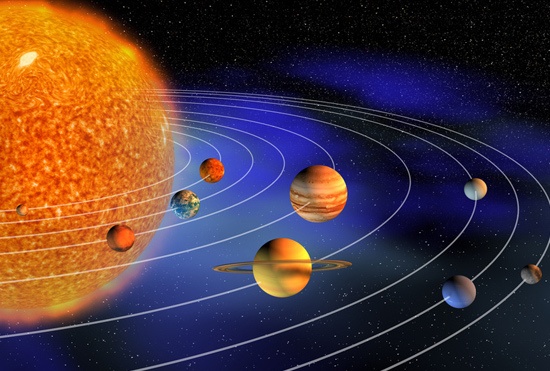
Why do all of the planets orbit the sun rather than Earth?
the sun has more mass
the sun is a star
the Earth is heavier
the sun is in the middle of the milky way

