
 Worksheets
Astro Quiz 2025
Total questions: 25
Worksheet time: 19mins
To explain the remarkably uniform temperature of the cosmic microwave background, despite vast distances between regions, cosmologists invoked an ultra-brief yet monumental expansion.
What theory addresses this early “smoothing” of the universe?
Quantum tunneling
Big Crunch
Cosmic inflation
String cosmology
When a star slightly larger than the Sun dies, its end isn't explosive but elegant. It exhales glowing gas shells, leaving a dense core behind.
What do we call this brief luminous phase during stellar death?
Nova
Coronal ejection
Planetary nebula
Red supergiant bloom
.In the infant universe, just minutes old, nuclear fusion began stitching atomic nuclei. Yet only certain light elements formed in appreciable amounts before the universe cooled too much.
Beyond hydrogen, which element emerged in significant abundance during this primordial nucleosynthesis?
Lithium
Helium
Oxygen
Carbon
As a white dwarf accumulates mass from a binary companion, a critical threshold exists beyond which electron degeneracy pressure can no longer support it. Surpassing this mass doesn't merely increase its size, it triggers catastrophic collapse.
What is this theoretical mass boundary known as?
Roche limit
Schwarzschild radius
Chandrasekhar limit
Hawking boundary
During the Planck epoch, the universe existed at extreme temperatures and densities, where known laws of physics break down. Around 10⁻⁴³ seconds after the Big Bang, a key event is believed to have occurred that marked the end of this epoch and the beginning of a more structured universe .What is this pivotal event?
Onset of stellar nucleosynthesis
Gravity decoupling from the other fundamental forces
Formation of the first galaxy clusters
Reionisation of the intergalactic medium
Astronomers observe a certain type of star that, after a long quiet phase, suddenly flares up dramatically brightening by many magnitudes almost overnight. Over the following weeks to years, it slowly dims back to its usual faint state. This explosive event involves material accreting onto a white dwarf in a binary system, triggering a runaway nuclear reaction on its surface.
What four-letter word, starting with N, describes this stellar phenomenon?
Neap
Node
Nova
Nuke
At the heart of our galaxy, an invisible force anchors stars in tight, rapid orbits, despite emitting no visible light. Known only through its gravitational influence and faint radio emissions, this enigmatic object defies direct observation. Which of the following best explains what lies at the center of the Milky Way?
A massive neutron star cluster
A dormant quasar
A supermassive black hole named Sagittarius A*
A dark matter core
In 2015, scientists recorded faint distortions in space-time itself—ripples generated by the violent merger of two black holes over a billion light-years away. This historic first direct detection of gravitational waves validated a century-old prediction by Einstein’s theory of general relativity. What was this groundbreaking event known as?
WMAP
LISA Pathfinder
Hubble Constant
GW150914 (LIGO Detection)
‘X’ was a planet Galileo initially mistook for a star. The irregular orbit of ‘Y’ puzzled astronomers until mathematicians applied ‘Z’ to predict ‘X’'s existence years before it was visually confirmed by telescopes. This discovery challenged classical astronomy and reshaped planetary science. Identify X, Y, and Z
X: Uranus, Y: Saturn, Z: Kepler’s Laws
X: Neptune, Y: Uranus, Z: Newton’s Law of Gravitation
X: Pluto, Y: Neptune, Z: General Relativity
X: Jupiter, Y: Earth, Z: Tidal Theory
In the 1930s, while most astronomers were focused on expanding universe theories and white dwarf physics, two scientists proposed a bold idea: that supernova explosions could compress matter so densely that electrons and protons would merge to form neutrons, creating an entirely new type of stellar remnant. Though the concept lacked observational backing and seemed extreme compared to white dwarfs or black holes, it laid the foundation for what we now call neutron stars. Who were the first to propose this groundbreaking theory in 1934?
) Edwin Hubble & Georges Lemaître – known for expanding universe theory
Max Planck & Niels Bohr – pioneers of quantum and atomic structure
Walter Baade & Fritz Zwicky – theorized neutron stars from supernovae
Arthur Eddington & Subrahmanyan Chandrasekhar – known for stellar structure and mass limits
‘X’ was the first hypothetical object proposed to explain anomalies in Mercury’s orbit, but it was never observed. The mystery was resolved with the theory of ‘Z’, which revolutionized gravitational physics and predicted phenomena like black holes. Identify X and Z:
X: Nibiru, Z: Gravitational Waves
X: Vulcan, Z: General Relativity
X: Planet Nine, Z: Keplerian Correction
X: Mercury II, Z: Einstein Field Equation
Achieving angular resolutions impossible for any single dish, which instrument uses phase-linked beam often over kilometre-scale baselines to synthesize a virtual aperture?
Adaptive coronagraph
Fabry-Pérot spectrometer
Interferometer
Fabry lenslet array
The Sun fuses hydrogen into helium in a process that powers its core. What mechanism drives this fusion?
Gravitational ignition
Proton-proton chain reaction
Neutron decay
Deuterium collapse

The image shows a space telescope launched decades ago , featuring an iconic primary mirror of segmented hexagonal gold-coated panels designed for infrared observation at the Earth-Sun L2 point, far beyond low Earth orbit. Despite sharing some design features with its predecessors ,it vastly surpasses them in resolution and wavelength coverage. Identify this telescope .
Spritzer Space Telescope
Hubble Space Telescope
James Webb Space Telescope(JWST)
Herschel Space Observatory
Though many galaxies surround the Milky Way, only one large spiral is on a direct path toward us.Despite poetic names like Whirlpool and Triangulum, this galaxy’s gravitational tango with the Milky Way is expected to climax billions of years from now.
Which galaxy is on a collision course with us?
Triangulum Galaxy
Whirlpool Galaxy
Andromeda Galaxy
Centaurus A
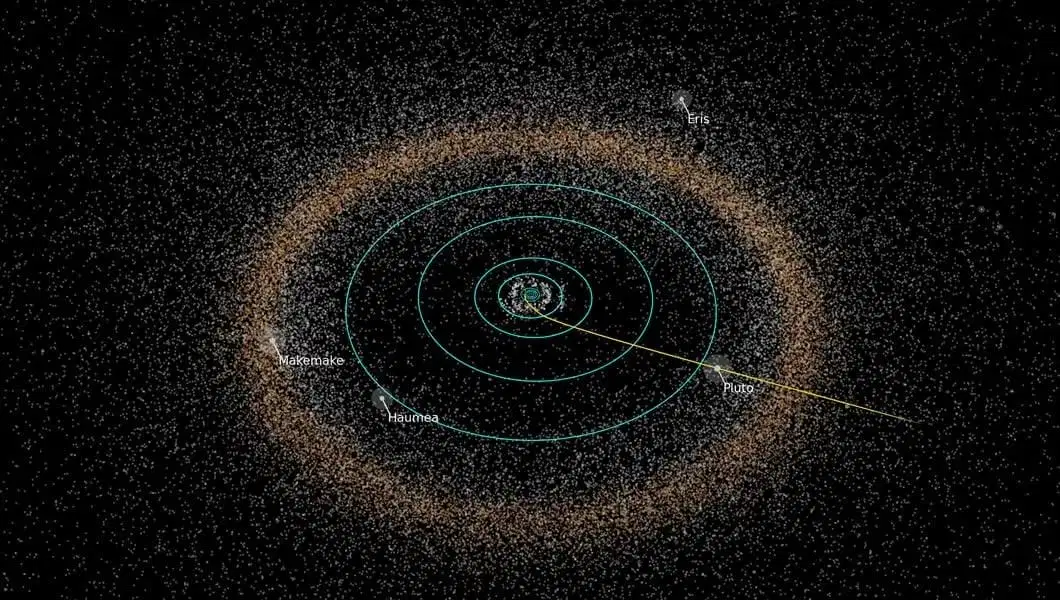
In the diagram above:
X is the flat, disc-shaped region just beyond Neptune that contains icy bodies and dwarf planets like Pluto.
Y is the spherical shell far beyond the Solar System, believed to be the source of long-period comets.
Identify X and Y.
X: Asteroid Belt Y: Kuiper Belt
X: Kuiper Belt Y: Oort Cloud
X: Oort Cloud Y: Kuiper Belt
X: Planetary Disk Y: Comet Shell
The SOHO spacecraft once recorded oscillatory patterns in the Sun’s photosphere that were interpreted as “sound waves” traveling beneath the solar surface. While the term “helioseismology” became popular, public misunderstandings equated these waves with literal sounds, leading to viral claims of the Sun “singing.” In scientific terms, what are these oscillations most accurately classified as?
Ionization resonance loops
Acoustic pressure (p-mode) oscillations
Electromagnetic standing wave nodes
Magnetohydrodynamic coronal blooms

This stunning cosmic ring isn't a galaxy or a portal—it's actually light from a galaxy that has been bent into a circle by another galaxy's mass lying directly in front of it. What is this rare phenomenon called?
Halo Reflection
Cosmic Mirage
Einstein Ring
Wormhole Echo
Einstein originally proposed a static, closed universe — a view later challenged by Hubble’s expansion discovery. Many now believe the universe is flat based on WMAP and Planck data. However, curvature is often confused with topology. Which of the following statements about the shape of the universe is currently the most accurate according to modern cosmology?
The universe is perfectly flat and infinite, as proven by gravitational lensing.
The universe appears flat on large scales, but its topology may still be multiply connected.
The universe loops back on itself like a 3D torus, causing repeated galaxy patterns.
The observable universe is flat, but the unobservable portion curves positively.
NASA’s interest in the Moon’s south pole surged due to discoveries of permanently shadowed regions (PSRs) that may harbor water ice. However, many early readings were falsely interpreted due to signal noise from neutron spectrometers and interference from solar flares. What genuine piece of evidence led scientists to now believe that ice does exist in these shadowed craters?
Observations of scattered UV light using the LAMP spectrometer aboard LADEE
Detection of hydration absorption bands by the Moon Mineralogy Mapper (M3)
Elevated gamma ray bursts indicating hydrogen decay in polar soils
Reflected thermal radiation matching cryogenic water reflectance profiles
. Beneath its icy crust lies a global subsurface ocean, and despite its modest size, this moon shoots towering geysers of water vapor and organic material into space from polar fractures. These jets, first closely observed by Cassini, hint at possible hydrothermal activity deep within.
Which moon, orbiting a gas giant, has become a prime candidate in the search for extraterrestrial life due to this ongoing cryovolcanism?
Europa
Titan
Enceladus
Io
In 2006, NASA’s Cassini spacecraft recorded spiral-shaped plasma structures near Saturn's magnetic equator, later dubbed the “sunflower swirl.” While some suggested solar storms or external cosmic influences, this bizarre formation was found to originate from Saturn itself. What is the most scientifically accurate explanation for this spiral pattern?
Ion waves generated by Enceladus’s cryovolcanic geysers
Saturn’s rapid rotation twisting plasma into a spiral disk
Disruptive auroral activity scattering electrons across latitudes
An electromagnetic flux tube connecting to Titan’s ionosphere

The image above showcases a region where externally driven star formation is occurring. Taking into account the balance of thermal pressure, radiation-driven implosion, and gravitational instability, what makes the heads of these pillars especially resistant to photoevaporative dispersal, and how does this enable sequential star formation in such nebulae?
The heads are magnetically shielded, and the surrounding ionization fronts repel collapse.
The dense gas clumps locally lower the Jeans length and resist erosion, allowing collapse to proceed.
The radiation pressure ionizes the interior of the clumps faster than the exterior, stabilizing them.
The material is cooler due to shadowing, preventing the onset of star formation until the pillar disperses
Uranus spins on its side with a tilt of about 98°, which is not only awkward but unique in the solar system. While commonly blamed on a single impact, newer simulations support more complex causes. Based on current models, what is the leading explanation for this extreme axial tilt?
Internal core collapse due to helium crystallization
A slow, glancing collision with a massive protoplanet
Spin-orbit resonance locking during Neptune’s migration
Magnetic instability from ancient solar storms
The CMB (Cosmic Microwave Background) was once hailed as the most uniform evidence of the early universe’s conditions. However, detailed data from WMAP and Planck revealed a strange alignment in temperature anisotropies, humorously referred to as the "Axis of Evil" due to its contradiction with the assumption of isotropy. While many explanations emerged including residual foreground contamination and statistical flukes. What makes this "Axis of Evil" most controversial in current cosmology?
It contradicts Hubble’s Law by implying a preferred redshift direction
It suggests possible influence of a multiversal collision remnant
It aligns with the ecliptic plane, implying contamination or unknown physics
It shows quadrupole resonance across known baryonic filaments

