
 Worksheets
Sound beams and Resolution
Total questions: 76
Worksheet time: 1hrs 6mins
What is the width of a 3.5 and 5.0 MHz transducer?
13mm
19mm
18mm
16mm
Width and focal length or NZL are (a) related
As the size (width) of the transducer increases the focal length or near zone length (a)
Transducer frequency and transducer diameter are (a) related to focal depth
As frequency (a) ,the NZL increases.
Frequency and focal depth are (a) related
The focal length or near zone length depends on the (a) of the transducer and frequency of the transducer.
The focal length or near zone length depends on the size (width of the transducer) and (a) of the transducer.
What is another name for the size of the transducer?
(a)
As transducer diameter increases, focal depth (a)
As transducer diameter decreases, focal depth (a)
Frequency and focal depth are (a) related
If frequency decreases, focal depth (a)
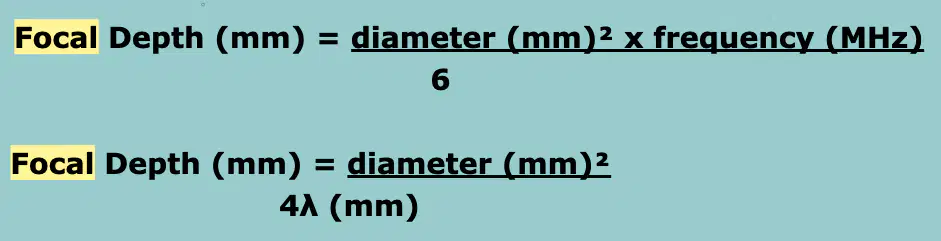
These equations relate to (a)
Gradual spread of the sound beam in the far field
(a)
What are the two main factors impacting beam divergence?
Transducer length
Transducer diameter
Frequency of sound
Length of focal zone
Smaller diameter crystal: (a) divergence
Larger diameter crystal: (a) divergence (Improved lateral resolution in the far field)
Which crystal will cause the MOST divergence in the far field?
10 mm
6mm
7mm
4mm
Which crystal will cause the LEAST divergence in the far field?
10mm
2mm
6mm
7mm
Larger diameter crystals that produce less divergence (a) lateral resolution in the far field
Crystal diameter and beam divergence are (a) related
Frequency and beam divergence are (a) related
Resolution is (a) imaging
It is the ability of the system to display two structures very close together along the beam’s main axis.
(a)
It is measured in mm (distance units)
(a)
Axial resolution is determined by (a)
Which abbreviation applies to axial resolution?
LARRD
LATA
LARRD stands for ___
Longitudinal
Axial
Range
Radial
Depth
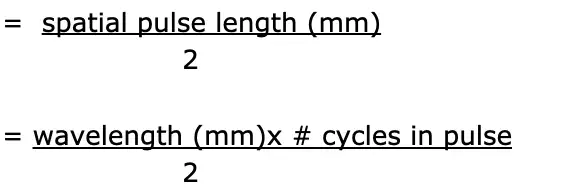
These equations apply to (a)
Is an Axial resolution of 2mm or 4mm better?
2mm
4mm
Axial resolution is determined by (a)
Do shorter pulses provide better or worse resolution?
Better
Worse
Shorter pulse = (a) (few cycles in pulse; damping the crystal)
Shorter pulse = (a) frequency (cycles with short wavelength)
Does higher or lower frequencies provide better axial resolution?
Higher
Lower
Lateral resolution (a) in the far field
What is the lateral resolution of a beam dependent on?
Focal depth, the wavelength, and probe diameter
Focal depth, frequency, and imaging depth
Frequency, period, wavelength
Sound, period, focal depth
•Shorter SPL
•Shorter pulse duration
•higher frequencies
•Fewer cycles
•Lower values
Better axial resolution
Worse axial resolution
It is the ability of the system to display two structures which are very close together side-by-side or perpendicular to the main axis
(a)
Measured in units of distance (mm)
(a)
Lateral resolution is determined by the (a) of the sound beam
Which abbreviation applies to lateral resolution?
LATA
LARRD
Lateral, Angular, Transverse, or Azimuthal resolution
(a)
Lateral resolution(mm) = (a) diameter (mm)
Lateral resolution is (a) at the focal zone
Lateral resolution is (a) at the focus.
Which type of resolution is better in clinical imaging?
Axial
Lateral
Ultrasound pulses are (a) than they are wide
(a) frequency transducers improve both axial and lateral resolution
Axial resolution: (a) pulses
Lateral resolution: (a) in the far field
Less divergence associate with (a) frequency transducer
Narrowing of the sound beam
(a)
Focusing (a) lateral resolution
External, internal, and phased array are the three different types of (a)
(a) focusing (lens; single element)
(a) focusing (curvature of PZT; single element)
__ ___ focusing (electronically adjustment; multi-element)
(a)
Focusing (a) the beam diameter in the near field and focal zone
The near zone length is shortened when the focus is (a) to the transducer
If the beam diameter widens in the far field, lateral resolution (a)
IF the focal zone size is reduced, the lateral resolution (a)
What is the diameter of the beam at TWO focal lengths?
Same diameter as the crystal or transducer
Twice the diameter of the element
Three times the diameter of the element
Half the diameter of the element
Thinner crystals are associated with (a) (higher or lower) frequency
The ability of a system to display two structures very close together along the beams main axis is called:
LARRD resolution
LATA resolution
Elevational resolution
Azmuthal resolution
What is the axial resolution of a pulse with 2 cycles and a 2mm wavelength?
2mm
4mm
8mm
10mm
Lateral or azimuthal resolution is determined by:
SPL
Thickness of the sound beam
Width of the sound beam
Frame rate
What is the ability to accurately distinguish two structures lying close together called?
(a)
If there are more cycles in a pulse, the numerical range resolution is (greater/lesser/same)
Greater
Lesser
Same
If a new pulsed transducer has many more cycles in its pulse, the image accuracy ___ (improves/degrades/stays same)
Improves
Degrades
Stays the same
(High/Low) frequency transducers have the best range resolution
High
Low
Which of the following has the worse axial resolution?
1.7 MHz, 4 cycles/pulse
2.6MHz, 3 cycles/pulse
1.7 MHz, 5 cycles/pulse
2.6 MHZ, 2 cycles/pulse
In soft tissue, a 3 cycle, 1 MHz pulse has a pulse length equal to 4.5mm. What is the axial resolution
3mm
1mm
2.25mm
1.5mm
Also called mechanical or conventional focusing, includes both external and internal techniques
(a)
External lens is placed (a) (in front/behind) the PZT

