
 Worksheets
IPAC 1- Infection Basics
Total questions: 90
Worksheet time: 45mins
Why is freedom from infection or infectious materials important in all environments?
It helps reduce the risk of serious illness in patients or staff.
It increases the cost of healthcare.
It is only important in laboratories.
It prevents the need for any medical treatment.
According to the Public Health Agency of Canada, what was the annual cost of treating microbial infections in 2015?
$500 million
$1 billion
$2 billion
$100 million
Explain why Infection Prevention and Control (IP&C) is a major focus in health care institutions. Use evidence from the provided information to support your answer.
Because it helps reduce serious illness and high treatment costs.
Because it is only required by law.
Because it is not important in non-healthcare settings.
Because it increases the number of infections.
If a hospital ignores infection prevention and control measures, what could be a likely consequence based on the information provided?
Increased risk of serious illness among patients and staff.
Decreased healthcare costs.
Improved patient satisfaction.
Reduced need for medical staff.
Which of the following best describes an infection?
A disease process that results from the entry and spread of a microorganism.
A condition caused by physical injury.
A genetic disorder passed from parents to offspring.
A reaction to environmental allergens.
What is a microorganism?
An organism so small it can only be seen under microscopic examination.
A large organism visible to the naked eye.
A chemical substance used to treat diseases.
A type of virus that infects only plants.
Which statement best explains what it means for a disease to be contagious?
It can be transmitted from person to person.
It can only be found in animals.
It is always fatal.
It cannot be prevented by vaccines.
Given the definitions provided, how would you distinguish between a contagious and a non-contagious disease?
A contagious disease can be transmitted from person to person, while a non-contagious disease cannot.
A contagious disease is always caused by bacteria, while a non-contagious disease is caused by viruses.
A contagious disease is visible to the naked eye, while a non-contagious disease is not.
A contagious disease only affects children, while a non-contagious disease affects adults.
Which of the following best describes a communicable disease?
A disease that is always non-contagious and cannot be transmitted
A disease that is transmitted from one person to another
A disease that only affects animals
A disease that is always genetic
Which of the following is an example of a communicable disease?
Diabetes
Asthma
Tuberculosis
Osteoporosis
Analyze why not all infectious diseases are considered communicable.
Because all infectious diseases are always genetic
Because some infectious diseases cannot be transmitted from person to person
Because communicable diseases are only caused by bacteria
Because infectious diseases are always non-contagious
Which of the following methods can help prevent some infectious and communicable diseases?
Immunization
Surgery
Physical therapy
Radiation therapy
If an infectious disease is caused by bacteria, fungi, or parasites, which of the following is the most effective treatment?
Antimicrobial drugs
Painkillers
Chemotherapy
Herbal supplements
A patient is diagnosed with a disease caused by a parasite. Based on your understanding of infectious and communicable diseases, which treatment approach is most likely to be effective?
Antimicrobial drugs
Physical exercise
Vitamin supplements
Homeopathy

Explain why immunization is considered an effective strategy in the prevention of some infectious and communicable diseases.
It helps the body develop immunity before exposure to the disease.
It cures the disease after infection.
It only treats symptoms, not the cause.
It is only effective for non-communicable diseases.
Which of the following best describes an epidemic?
The occurrence of more cases of disease than expected in a given area or among a specific group of people over a particular period of time.
A global outbreak of a specific disease that affects large populations.
A disease that is always present in a population.
The complete eradication of a disease worldwide.
How does a pandemic differ from an epidemic?
A pandemic is limited to a specific group of people in a small area.
A pandemic is a global outbreak of a specific disease with the potential to affect large populations, while an epidemic is more localized.
An epidemic affects the entire world, while a pandemic is only regional.
A pandemic refers to a disease that is always present in a population.
Given the definitions, which scenario would most likely be classified as a pandemic?
A sudden increase in flu cases in one city.
A new disease spreading rapidly across multiple continents and affecting millions.
A rare disease found only in a remote village.
A seasonal allergy affecting a small town.
Which of the following best describes a local infection?
Limited to a specific area and usually external
Affects the entire body
Always internal and affects multiple organs
Only causes fever and fatigue
What is a common treatment for a local infection?
Applying anti-microbial creams to the skin or affected area
Taking oral antibiotics for the whole body
Increasing physical activity
Drinking more water
Which symptoms are most likely associated with a systemic infection rather than a local infection?
Fever, fatigue, and changes in respirations/heart rate
Redness, swelling, and increased warmth in one area
Itching and mild discomfort
Bruising and muscle cramps
A patient presents with redness, swelling, and increased warmth in a small area on their arm. Based on these symptoms, which type of infection is most likely?
Local infection
Systemic infection
Viral infection
Chronic infection
Explain how you would distinguish between a local and a systemic infection based on symptoms and affected areas.
Local infections are limited to a specific area and show external symptoms like redness and swelling, while systemic infections affect the entire body and cause symptoms like fever and fatigue.
Local infections always cause fever, while systemic infections do not.
Systemic infections are always external, while local infections are always internal.
Local infections affect the heart, while systemic infections affect the skin.
Which of the following best describes an acute infection?
The course of the illness is usually short and the patient recovers with or without treatment.
Microorganisms are present for a long period of time.
A period in which a chronic infection shows no symptoms.
A flare up or a period in which a chronic infection shows symptoms.
What is the main characteristic of a chronic infection?
The illness resolves quickly.
Microorganisms are present for a long period of time.
The infection never shows symptoms.
The patient always recovers without treatment.
During which phase does a chronic infection show no symptoms?
Exacerbation
Acute Infection
Remission / Latency
Recovery
A patient with a chronic infection suddenly experiences a flare up of symptoms. What is this period called?
Remission
Exacerbation
Acute Infection
Latency
Compare and contrast the terms "exacerbation" and "remission/latency" in the context of chronic infections.
Exacerbation is a period with no symptoms, while remission is a flare up.
Exacerbation is a flare up of symptoms, while remission/latency is a period with no symptoms.
Both terms refer to the initial stage of infection.
Both terms mean the infection is cured.
Which of the following best describes a latent infection?
An infection in which signs and symptoms are present.
An infection in which the symptoms disappear and recur, but the disease causing agent remains in the body.
A repetition of an infection after recovery.
Re-emergence of an initial infection after it appears to have subsided but has not been cured.
What distinguishes a recurrent infection from a relapse?
Recurrent infection is the re-emergence of an initial infection after it appears to have subsided.
Recurrent infection is a repetition of an infection after recovery, often with a short illness course.
Relapse is a repetition of an infection after recovery.
Relapse is when symptoms disappear and recur, but the agent remains in the body.
A patient recovers from an infection, but after some time, the same infection occurs again and the illness is usually short. What type of infection pattern does this describe?
Active infection
Latent infection
Relapse
Recurrent infection
If an infection re-emerges after it seemed to have been cured but was not, what is this pattern of infection called?
Active infection
Latent infection
Relapse
Recurrent infection
Which of the following is NOT a characteristic of a recurrent infection?
The course of the illness is usually short.
The infection repeats after recovery.
The patient never recovers, even with treatment.
The patient may recover with or without treatment.
Which of the following best describes a community acquired infection?
Occurring in response to poor immunity after exposure to pathogen in susceptible host
An infection that only occurs in hospitals
An infection that is always caused by viruses
Occurring only in individuals with strong immune systems
What is an opportunistic infection?
An infection that only affects healthy individuals
An infection that does not ordinarily cause disease but does so under certain circumstances, especially in compromised immune systems
An infection that is always fatal
An infection that spreads only through water
A patient with a compromised immune system develops an infection that would not normally cause disease in a healthy person. What type of infection is this most likely to be?
Community acquired
Opportunistic
Chronic
Nosocomial
Which of the following best describes a nosocomial infection?
An infection acquired outside of a healthcare facility
An infection present before hospital admission
A hospital-related infection not present or incubating when a patient is admitted
An infection caused by a genetic disorder
Which scenario is an example of an iatrogenic infection?
A patient develops a cold after visiting a friend
A patient contracts pneumonia after a diagnostic bronchoscopy
A patient is born with a congenital infection
A patient gets food poisoning from a restaurant
How do iatrogenic infections typically occur?
Through exposure to contaminated food
As a result of genetic inheritance
As a result of diagnostic tests or therapeutic procedures
By direct contact with animals
A patient is admitted to a hospital and develops an infection that was not present or incubating at the time of admission. What type of infection is this?
Community-acquired infection
Nosocomial infection
Iatrogenic infection
Congenital infection
Which of the following best describes a micro-organism?
An organism so small it can only be seen under microscopic examination.
An organism that can be seen with the naked eye.
A plant that grows in water.
A large animal visible to the human eye.
What is the correct definition of a pathogen?
A microorganism that causes disease.
A microorganism that helps digestion.
A microorganism that produces oxygen.
A microorganism that lives in soil.
Virulence is best described as:
The power of a microbe to produce disease in a particular host.
The ability of a microbe to survive in water.
The speed at which a microbe reproduces.
The color change in a microbe under light.
If a microbe has high virulence, what can be inferred about its ability to cause disease in a host?
It is very likely to produce disease in the host.
It cannot produce disease in the host.
It only lives outside the host.
It helps the host fight other diseases.
Which of the following best describes how bacteria multiply?
By cell division
By using a host cell
By forming spores
By budding off from other organisms
Why are viruses difficult to treat with antibiotics?
They do not respond to antibiotics
They multiply too quickly
They are single-celled organisms
They can live without a host
Compare bacteria and viruses in terms of their ability to survive independently. Which statement is correct?
Bacteria can survive independently, while viruses require a host to live.
Both bacteria and viruses require a host to survive.
Viruses can survive independently, while bacteria require a host.
Neither bacteria nor viruses can survive independently.
A patient is diagnosed with an infection that does not respond to antibiotics. What is the most likely cause of the infection?
Virus
Bacteria
Fungus
Protozoa
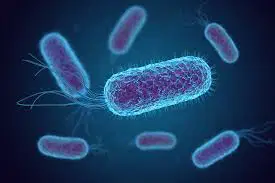
What does the diagram most likely represent based on the context of micro-organisms?
Bacteria
Virus
Fungus
Algae
Which of the following conditions do all bacteria require to thrive?
Moisture, warmth, darkness, and nutrients
Sunlight, dryness, and cold temperatures
High pressure and acidic environments
Saltwater and high altitude
Bacteria are categorized based on which of the following characteristics?
Their color and size
Their demand for oxygen and their shape
Their ability to photosynthesize
Their reproductive rate and habitat
Which type of bacteria requires oxygen to grow?
Aerobic bacteria
Anaerobic bacteria
Fungi
Viruses
Which statement best describes anaerobic bacteria?
They require oxygen to grow.
They do not require oxygen to grow.
They require sunlight to grow.
They require high temperatures to grow.
Explain how the reproduction of bacteria is related to the chain of infection.
Bacteria reproduce only in the presence of oxygen, breaking the chain of infection.
Bacteria stop reproducing when oxygen is absent, ending the chain of infection.
Regardless of oxygen presence, bacteria continue to reproduce, contributing to the chain of infection.
Bacteria reproduce only in the absence of oxygen, preventing the chain of infection.

Which of the following best describes fungi as mentioned in the learning material?
Multi-celled organisms that use sunlight to reproduce
Single-celled organisms that use spores to reproduce
Single-celled organisms that live in contaminated water
Multi-celled organisms that live in sewage
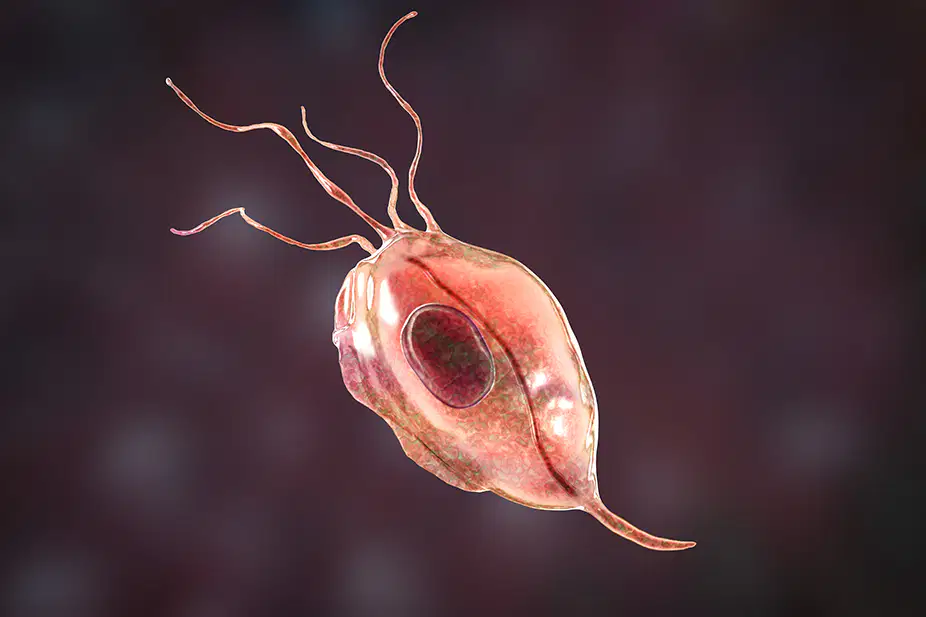
Protozoa are best characterized by which of the following?
Multi-celled organisms that use spores to reproduce
Single-celled organisms that live in contaminated water/sewage
Single-celled organisms that use sunlight to reproduce
Multi-celled organisms that live in clean water
Which of the following factors does NOT influence the severity of an infection?
The nature of the infectious organism
The color of the organism
The virulence of the infectious organism
The number of organisms present
A patient is infected with a micro-organism. Explain how the strain and potency of the organism could affect the severity of the infection.
The strain and potency determine how easily the organism can be detected by the immune system.
The strain and potency influence how severe the symptoms and damage caused by the infection will be.
The strain and potency only affect the speed at which the organism reproduces, not the severity.
The strain and potency are unrelated to the infection’s severity.
If two patients are exposed to the same infectious organism, but one is exposed to a higher number of organisms, what is likely to happen?
Both patients will have infections of equal severity.
The patient exposed to more organisms is likely to have a more severe infection.
The patient exposed to fewer organisms will have a more severe infection.
The number of organisms does not affect infection severity.
Which combination of factors would most likely result in a mild infection?
Highly virulent organism, high potency, large number present
Low virulence, low potency, small number present
Highly virulent organism, low potency, large number present
Low virulence, high potency, large number present
Which of the following is a function of normal flora micro-organisms in the gastrointestinal tract?
Aid in the breakdown of food
Cause disease
Produce toxins harmful to the body
Prevent absorption of nutrients
Why are normal flora micro-organisms considered nonpathogenic?
They do not cause disease
They always cause infections
They are only found outside the body
They destroy all bacteria in the body
A patient is taking antibiotics that disrupt their normal flora. Which of the following consequences is most likely to occur as a result?
Decreased synthesis of vitamins B and K
Increased breakdown of muscle tissue
Improved absorption of toxins
Enhanced production of stomach acid
How do normal flora micro-organisms help the body fight infection?
By competing with harmful pathogens for resources
By directly causing disease
By preventing the synthesis of vitamins
By breaking down muscle tissue
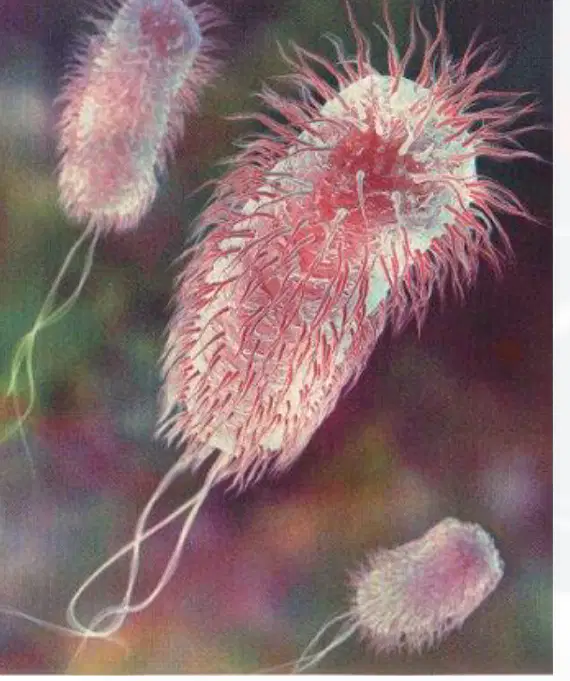
Explain why Escherichia coli is considered both beneficial and potentially harmful, depending on its location in the body.
It is always harmful regardless of location.
It is beneficial in the gastrointestinal tract but can cause infection if it enters the urinary system.
It is only beneficial in the urinary system.
It is never beneficial in any part of the body.
Which of the following is NOT one of the steps in the chain of infection?
A causative organism
A host reservoir
A mode of prevention
A portal of exit
Why is the susceptibility of the host an important factor in the chain of infection?
It determines how easily the host can transmit the pathogen to others.
It affects how quickly the pathogen can multiply in the environment.
It depends largely on the person’s immune system and defenses, influencing whether infection occurs.
It ensures the pathogen can survive outside the host.
A pathogen leaves the host reservoir and must find a route into a new host. Which step in the chain of infection does this describe?
Portal of exit and portal of entry
Causative organism and susceptible host
Mode of transmission and host reservoir
Portal of exit and mode of transmission
A host can be a person, animal, or environmental habitat. What is the most important requirement for a host in the chain of infection?
The host must be capable of providing an environment for the pathogen to survive and multiply.
The host must be able to move from place to place.
The host must be resistant to all pathogens.
The host must be visible to the naked eye.
A recipient host does not always become infected when exposed to a pathogen. What is the main reason for this?
The pathogen may not be strong enough.
The recipient host’s immune system and defenses may prevent infection.
The mode of transmission may be ineffective.
The portal of exit may be blocked.
Which of the following is NOT a portal of exit for pathogens from the human body?
Eyes (tears)
Nose (secretions)
Placenta
Skin (flakes)
Which portal of entry is unique to females and is not present in males?
Ear
Vagina
Urethra
Nose
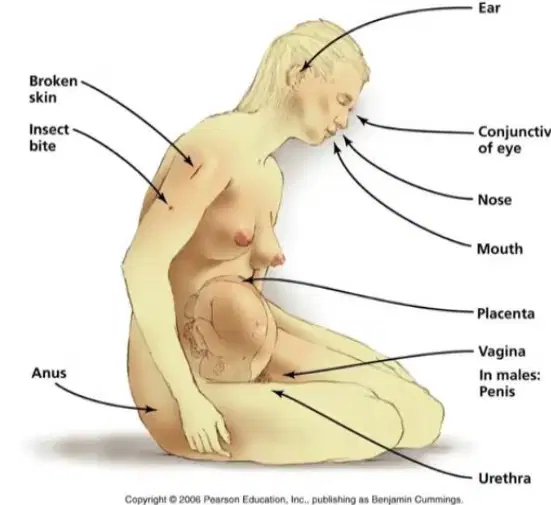
Compare the portals of exit and entry and determine which of the following is a portal for both entry and exit of pathogens.
Placenta
Seminal vesicles
Mouth
Mammary glands
A patient has a skin infection that is spreading. Based on the diagrams, which portal is most likely involved in both the exit and entry of the infectious agent?
Ear
Broken skin
Urethra
Mammary glands
Which of the following best describes indirect contact transmission?
Person to person through kissing
Person to an object to person
Person to animal to person
Person to air to person
Why does an organism need a mode of transmission after leaving the host reservoir?
To return to the original host
To find food
To reach a new host or recipient host
To become inactive
A disease is spread when a person touches a contaminated doorknob and then touches their face. Which mode of transmission does this scenario illustrate?
Direct contact
Airborne transmission
Indirect contact
Vector-borne transmission
Compare and contrast direct and indirect contact transmission by providing an example of each.
Direct: person to object to person; Indirect: person to person (kissing)
Direct: person to person (kissing); Indirect: person to an object to person
Direct: person to air to person; Indirect: person to animal to person
Direct: person to animal to person; Indirect: person to person (kissing)
A person infected with a respiratory virus coughs in a crowded room. Using your understanding of droplet transmission, explain why people up to 20 feet away might still be at risk of infection.
Water vapor released from the mouth or nose can travel through the air up to 20 feet, potentially carrying infectious agents to others.
The virus can only travel a few inches and quickly falls to the ground.
The virus is only transmitted by direct contact, not through the air.
The virus is destroyed immediately after leaving the body.
Which of the following best describes airborne transmission?
Transmission through direct contact with contaminated surfaces
Transmission through ingestion of contaminated food or water
Transmission where dust, evaporated droplets, or skin/hair particles remain suspended in air and can be inhaled by others at a distance
Transmission through insect bites
Why can microorganisms carried by airborne transmission be inhaled by people at some distance from the source?
Because they are heavier than air and settle quickly
Because they are dispersed widely by air currents, ventilation systems, and fans
Because they are only transmitted through direct contact
Because they are only present in water
A hospital is experiencing an outbreak of a disease that is spreading even to people who have not had direct contact with infected individuals. Which mode of transmission should be suspected, based on the information provided?
Waterborne transmission
Airborne transmission
Vector-borne transmission
Foodborne transmission
A patient contracts a disease after being bitten by a mosquito. Based on the modes of transmission discussed, which route is most likely responsible?
Vehicle route
Vector transmission
Direct contact
Airborne transmission
Explain how the vehicle route and vector transmission differ in terms of how diseases are spread. Provide an example for each.
Vehicle route involves transmission through air, while vector transmission involves water; examples: Influenza and Cholera.
Vehicle route involves transmission through food, water, blood, or body fluids, while vector transmission involves transmission via birds, animals, or insects; examples: HIV (vehicle) and Malaria (vector).
Both involve only direct human contact; examples: HIV and Malaria.
Vehicle route and vector transmission are the same; examples: West Nile Virus and HIV.
A public health official is investigating an outbreak of West Nile Virus. Which mode of transmission should they focus on controlling, based on the information provided?
Vehicle route
Vector transmission
Airborne transmission
Fomite transmission

Which of the following is NOT a component of the Chain of Infection?
Agent
Reservoir
Vaccine
Host

In the Chain of Infection, what is the role of the "portal of entry"?
It is the method by which the infectious agent leaves the reservoir.
It is the way the infectious agent enters a new host.
It is the place where the infectious agent lives and multiplies.
It is the process of the infectious agent being destroyed.

A hospital is trying to prevent the spread of infection by focusing on breaking the "transmission" link in the Chain of Infection. Which of the following actions best targets this link?
Sterilizing medical equipment between uses
Giving vaccines to patients
Identifying the infectious agent
Increasing the number of hospital beds

If a new infectious disease emerges, which link in the Chain of Infection would public health officials most likely target first to prevent an outbreak, and why?
Host, because removing all potential hosts will stop the disease.
Reservoir, because controlling or eliminating the source can prevent spread.
Portal of exit, because it is the only way to stop transmission.
Agent, because identifying the agent is unnecessary.

Which of the following is a method used to break the chain of infection by eliminating bacteria that require air to survive?
Remove air from bacteria which thrive on air
Increase humidity in the environment
Provide nutrients to bacteria
Expose bacteria to sunlight

