
 Worksheets
Biology Final '25
Total questions: 99
Worksheet time: 50mins
Name
Class
Date
1.
The first step in sequencing the human genome is
a)
locating overlapping sequences
b)
identifying genes by finding promoters
c)
cutting the DNA into manageable pieces
d)
sorting introns from exons
2.
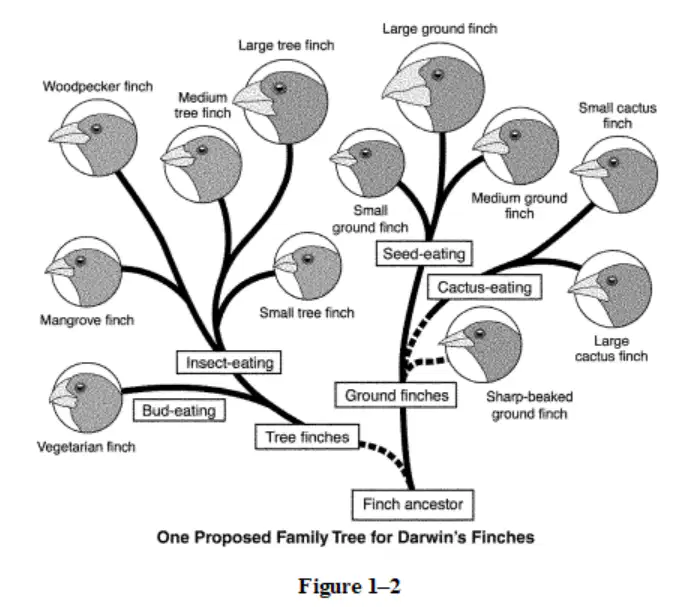
Figure 1-2 shows that tree finches and ground finches are descended from a common ancestor. This example represents which big idea in biology?
a)
interdependence in nature
b)
growth, development, and reproduction
c)
homeostasis
d)
evolution
3.
A scientist working in which area of biology is MOST likely to study DNA?
a)
information and heredity
b)
cellular basis of life
c)
matter and energy
d)
interdependence in nature
4.
What are the smallest units of life?
a)
cells
b)
body organs
c)
molecules
d)
organisms
5.
The three particles that make up atoms are
a)
protons, neutrons, and isotopes
b)
protons, isotopes, and electrons
c)
protons, neutrons, and electrons
d)
positives, negatives, and neutrals
6.
What subatomic particle is found in the space surrounding the nucleus of an atom?
a)
protons
b)
electrons
c)
neutrons
d)
ions
7.
Isotopes are atoms of the same element with the same number of protons and a different number of
a)
electrons
b)
molecules
c)
neutrons
d)
ions
8.
Which of the following makes up a molecule of water?
a)
one atom of hydrogen and one atom of oxygen
b)
one atom of sodium and one atom of chlorine
c)
one atom of hydrogen and two atoms of oxygen
d)
two atoms of hydrogen and one atom of oxygen
9.
A covalent bond is formed as the result of
a)
transferring electrons
b)
sharing electrons
c)
transferring protons
d)
sharing protons
10.
When salt is dissolved in water, water is the
a)
reactant
b)
solution
c)
solute
d)
solvent
11.
Amino acid is to protein as
a)
fat is to lipid
b)
DNA is to RNA
c)
sugar is to fat
d)
simple sugar is to starch (carbohydrate)
12.
Which of the following is NOT a monomer?
a)
a glucose molecule
b)
an amino acid
c)
a nucleotide
d)
a protein
13.
Enzymes affect the reactions in living cells by changing the
a)
products of the reaction
b)
speed of the reaction
c)
temperature of the reaction
d)
pH of the reaction
14.
A word that means the same thing as consumer is
a)
producer
b)
autotroph
c)
heterotroph
d)
carbohydrate
15.
Which of the following is NOT a principle of the cell theory?
a)
cells are the basic units of life
b)
all living things are made of cells
c)
very few cells are able to reproduce
d)
all cells are produced from existing cells
16.
Looking at a cell under a microscope, you note that it is a prokaryote. How do you know?
a)
the cell lacks cytoplasm
b)
the cell lacks a cell membrane
c)
the cell lacks a nucleus
d)
the cell lacks genetic material
17.
Which of the following is a function of the nucleus?
a)
stores DNA
b)
stores sugars
c)
builds proteins
d)
packages proteins
18.
Diffusion occurs because
a)
molecules are attracted to one another
b)
molecules constantly move and collide with each other
c)
cellular energy forces molecules to collide with each other
d)
cellular energy pumps molecules across the cell membrane
19.
Diffusion of water across a selectively permeable membrane is called
a)
osmotic pressure
b)
osmosis
c)
pinocytosis
d)
active transport
20.
Which means of particle transport requires input of energy from the cell?
a)
active transport
b)
passive transport
c)
osmosis
d)
facilitated diffusion
21.
An animal cell that is surrounded by fresh water will burst because the osmotic pressure causes
a)
water to move into the cell
b)
water to move out of the cell
c)
solutes to move into the cell
d)
solutes to move out of the cell
22.
Energy is released from ATP when
a)
a phosphate group is added
b)
adenine bonds to ribose
c)
ATP is exposed to sunlight
d)
a phosphate group is removed
23.
Organisms that cannot make their own food and must obtain energy from external sources are called
a)
autotrophs
b)
heterotrophs
c)
thylakoids
d)
pigments
24.
Organisms, such as plants, that make their own food are called
a)
autotrophs
b)
heterotrophs
c)
thylakoids
d)
pigments
25.
What happens during photosynthesis?
a)
heterotrophs consume ATP
b)
heterotrophs produce ATP
c)
autotrophs consume carbohydrates
d)
autotrophs produce carbohydrates
26.
Plants gather energy with light-absorbing molecules called
a)
pigments
b)
thylakoids
c)
chloroplasts
d)
glucose
27.
Most plants appear green because chlorophyll
a)
absorbs green light
b)
absorbs violet light
c)
does not absorb green light
d)
does not absorb violet light
28.
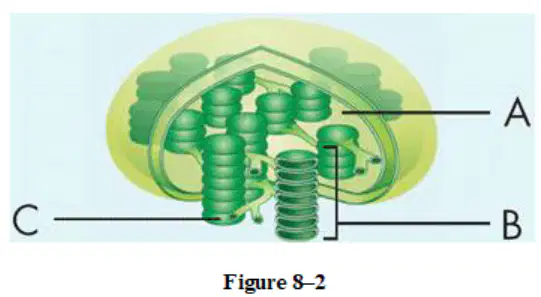
Which structure in Figure 8-2 represents a SINGLE thylakoid?
a)
structure A
b)
structure B
c)
structure C
d)
structure D
29.
What is the role of NADP+ in photosynthesis?
a)
electron carrier
b)
high-energy sugar
c)
photosystem
d)
pigment
30.
Photosynthesis uses sunlight to convert water and carbon dioxide into
a)
oxygen and carbon
b)
high-energy sugars and proteins
c)
ATP and oxygen
d)
oxygen and high-energy sugars
31.
Which of the following is NOT found in the overall reaction for photosynthesis?
a)
carbon dioxide
b)
water
c)
light
d)
nitrogen
32.
How do organisms get the energy they need?
a)
by burning food molecules and releasing their energy as heat
b)
by breathing oxygen into the lungs and combining it with carbon dioxide
c)
by breaking down food molecules gradually and capturing their chemical energy
d)
by using the sun's energy to break down food molecules and form chemicals
33.
Which of the following is NOT as stage of cellular respiration?
a)
fermentation
b)
electron transport
c)
glycoloysis
d)
Krebs cycle
34.
Which of the following is the correct sequence of events in cellular respiration?
a)
glycolysis → fermentation → Krebs cycle
b)
Krebs cycle → electron transport → glycolysis
c)
glycolysis → Krebs cycle → electron transport
d)
Krebs cycles → glycolysis → electron transport
35.
What is the correct equation for cellular respiration?
a)
6O₂ + C₆H₁₂O₆ → 6CO₂ + 6H₂O + energy
b)
6O₂ + C₆H₁₂O₆ + energy→ 6CO₂ + 6H₂O
c)
6CO₂ + 6H₂O → 6O₂ + C₆H₁₂O₆ + energy
d)
6CO₂ + 6H₂O + energy → 6O₂ + C₆H₁₂O₆
36.
Cellular respiration is called an aerobic process because it requires
a)
light
b)
exercise
c)
oxygen
d)
glucose
37.
Photosynthesis is to chloroplasts as cellular respiration is to
a)
chloroplasts
b)
cytoplasm
c)
mitochondria
d)
nucleus
38.
The products of photosynthesis are the
a)
products of cellular respiration
b)
reactants of cellular respiration
c)
products of glycolysis
d)
reactants of fermentation
39.
Which of these processes takes place in the matrix of the mitochondria?
a)
glycolysis
b)
electron transport
c)
Krebs cycle
d)
photosynthesis
40.
Glycolysis provides a cell with a net gain of
a)
2 ATP molecules
b)
4 ATP molecules
c)
18 ATP molecules
d)
36 ATP molecules
41.
Lactic acid fermentation occurs in
a)
bread dough
b)
any environment containing oxygen
c)
muscle cells
d)
mitochondria
42.
The two main types of fermentation are called
a)
alcoholic fermentation
b)
aerobic and anaerobic
c)
alcoholic and lactic acid
d)
lactic acid and anaerobic
43.
Breathing heavily after running a race is your body's way of
a)
making more citric acid
b)
repaying an oxygen debt
c)
restarting glycolysis
d)
stopping the electron transport chain
44.
Compared to small cells, large cells have more trouble
a)
dividing
b)
producing daughter cells
c)
storing needed materials and waste products
d)
moving needed materials in and waste products out
45.
The process by which a cell divides into two daughter cells is called
a)
cell division
b)
metaphse
c)
interphase
d)
mitosis
46.
Which pair includes a phase of the cell cycle and a cellular process that occurs during that phase?
a)
G₁ phase, DNA replication
b)
G₂ phase, preparation for mitosis
c)
S phase, cell division
d)
M phase, cell growth
47.
During the cell cycle, when is a cell's DNA replicated?
a)
G₁ phase
b)
G₂ phase
c)
S phase
d)
M phase
48.
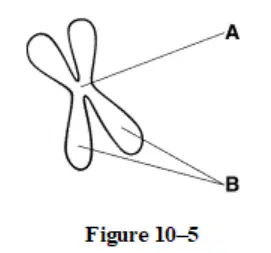
The structures labeled B in Figure 10-5 are called?
a)
centromeres
b)
centrioles
c)
sister chromatids
d)
spindles
49.
During which phase of mitosis do the chromosomes line up along the middle of the dividing cell?
a)
prophase
b)
telophase
c)
metaphase
d)
anaphase
50.
Which of the following represents the phase of mitosis in their proper sequence?
a)
prophase, metaphase, anaphase, telophase
b)
interphase, metaphase, prophase, anaphase, telophase
c)
interphase, prophase, metaphase, telophase
d)
prophase, anaphase, metaphase, telophase
51.
Cancer is a disorder in which some cells have lost the ability to control their
a)
growth rate
b)
size
c)
spindle fibers
d)
surface area
52.
Cancer cells form masses of cells called
a)
cyclins
b)
growth factors
c)
tumors
d)
p53
53.
Strands of DNA and protein inside the cell nucleus are called
a)
chromosomes
b)
haploid
c)
diploid
d)
meiosis
54.
The female gamete is called an ___________ in animals.
a)
sperm
b)
egg
c)
genetics
d)
pollen
55.
When Gregor Mendel crossed a tall plant with a short plant, the offspring plants inherited
a)
one allele from each parent
b)
two alleles from each parent
c)
three alleles from each parent
d)
four alleles from each parent
56.
A heterozygous tall pea plant is crossed with a short plant. The probability the offspring will be tall is
a)
25%
b)
50%
c)
75%
d)
100%
57.
Organisms that have two identical alleles for a particular trait are said to be
a)
hybrid
b)
homozygous
c)
heterozygous
d)
dominant
58.
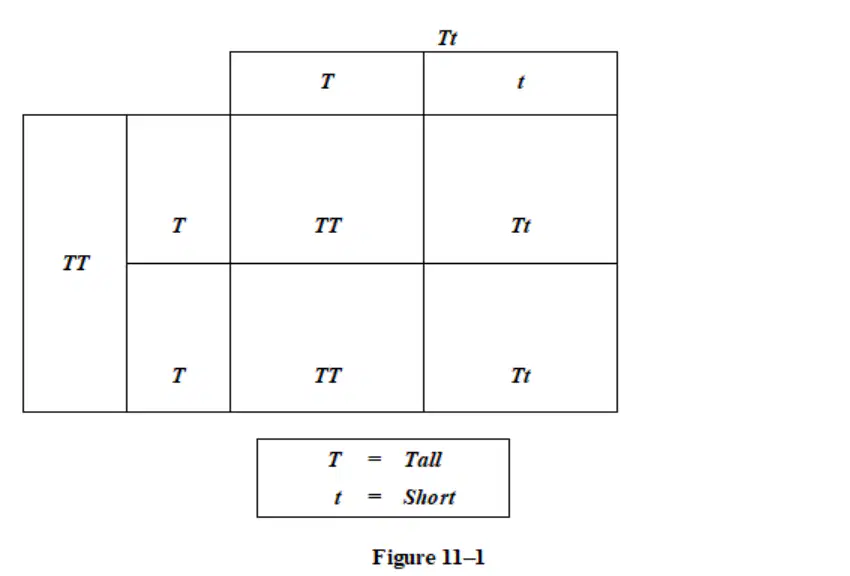
In the Punnett square shown in Figure 11-1, which of the following is true about the offspring resulting from the cross?
a)
about half are expected to be short
b)
all are expected to be short
c)
about three fourths are expected to be tall
d)
all are expected to be tall
59.
Roan cattle show codominance for the color of their hair. There are alleles for red hair and white hair. What would you expect a heterozygous roan bull to look like if the train showed incomplete dominance instead?
a)
it would be red
b)
it would be white
c)
it would be spotted
d)
it would be pink
60.
A breed of chicken shows codominance for feather color. One allele codes for black feathers, another codes for white feathers. The feathers of heterozygous chickens of this breed will be
a)
black
b)
white
c)
gray
d)
speckled
61.
Gametes are produced by the process of
a)
mitosis
b)
meiosis
c)
crossing-over
d)
replication
62.
What happens when a piece of DNA is missing?
a)
genetic information is stored
b)
genetic information is copied
c)
genetic information is lost
d)
genetic information is transmitted
63.
What stores genetic information in a cell?
a)
proteins
b)
carbohydrates
c)
lipids
d)
DNA
64.
Which of the following is a nucleotide found in DNA
a)
adenine + phosphate group + uracil
b)
cytosine + phosphate group + guanine
c)
deoxyribose + phosphate group + polymerase
d)
deoxyribose + phosphate group + cytosine
65.
Because of base pairing in DNA, the percentage of
a)
adenine molecules in DNA is about equal to the percentage of guanine molecules
b)
thymine molecules in DNA is about equal to the percentage of adenine molecules
c)
adenine molecules in DNA is much greater than the percentage of thymine molecules
d)
cytosine molecules in DNA is much greater than the percentage of guanine molecules
66.
Which scientist(s) figured out that the shape of a DNA molecule is a double helix?
a)
Hershey and Chase
b)
Griffith
c)
Watson and Crick
d)
Franklin
67.
Which scientist made x-ray diffraction photos of DNA?
a)
Franklin
b)
Chargaff
c)
Watson
d)
Avery
68.
During DNA replication, a DNA strand that has the bases CTAGGT produces a strand with the bases
a)
TCGAAC
b)
GATCCA
c)
AGCTTG
d)
GAUCCA
69.
Unlike DNA, RNA contains
a)
adenine
b)
uracil
c)
phosphate groups
d)
thymine
70.
Which of the following is true?
a)
RNA is usually single-stranded
b)
DNA is usually single-stranded
c)
DNA contains uracil
d)
RNA contains thymine
71.
Which molecules are involved with protein synthesis?
a)
transfer RNA, introns, and mutagens
b)
messenger RNA, introns, and ribosomal RNA
c)
ribosomal RNA, transfer RNA, and mutagens
d)
messenger RNA, ribosomal RNA, and transfer RNA
72.
What is produced during transcription?
a)
proteins
b)
RNA molecules
c)
DNA molecules
d)
RNA polymerase
73.
How many nucleotides are needed to specify THREE amino acids?
a)
3
b)
6
c)
9
d)
12
74.
A protein is being assembled when
a)
DNA is being translated
b)
RNA is being transcribed
c)
RNA is being translated
d)
DNA is being transcribed
75.
Which is the correct sequence of the transfer of information in most organisms?
a)
protein to DNA to RNA
b)
RNA to DNA to protein
c)
DNA to RNA to protein
d)
RNA to protein to DNA
76.
Changes in the sequence of DNA are called
a)
mutations
b)
gene shuffling
c)
allele frequencies
d)
genetic equilibrium
77.
How many chromosomes are shown in a normal human karyotype?
a)
2
b)
23
c)
44
d)
46
78.
Karyotyping is best to
a)
display an individual's collection/appearance of chromosomes
b)
the size, shape, and number of chromosomes
c)
two sex chromosomes
d)
all of the above
79.
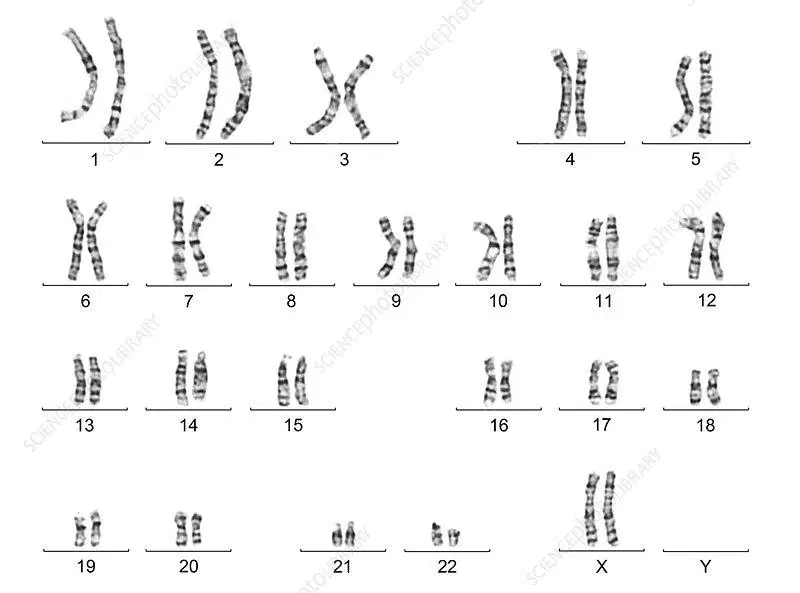
What type of karyotype is represented in the image below?
a)
male
b)
female
c)
not enough information
80.
What is the complementary mRNA sequence for the following DNA sequence: GCC AGA TTG
a)
CGG AUC UCU
b)
UAU UGG UAG
c)
CGG UCU AAC
d)
CTC CUG UGG
81.
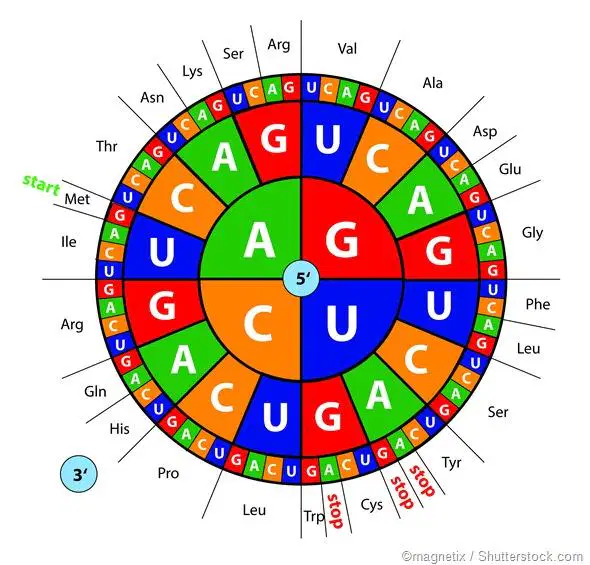
What is the polypeptide chain for the following mRNA sequence: CGG CUC UCU UGG AAC (Hint: there should be 5 amino acids, unless you have a STOP codon)
a)
Arg Leu Ser Trp Asn
b)
Gln Leu Ser Leu Lys
c)
Asn Trp Leu Ser His
d)
Pro Arg Leu Stop
82.
What is the complementary mRNA sequence for the following DNA sequence: AGT CAG ATC TAA
a)
ACG UCA GUC UAG
b)
UCA GUC UAG AUU
c)
ACG UCA GUC AUC
d)
UCA ACG UAG GGA
83.
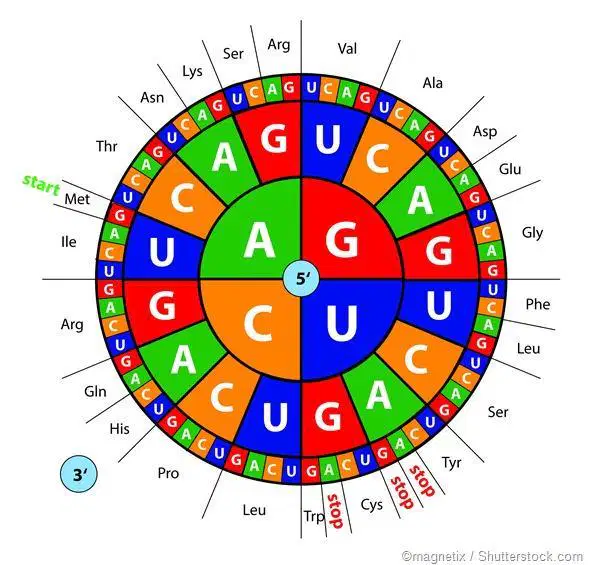
What is the polypeptide chain for the following mRNA sequence: ACG UCA GUC UAG AUU (Hint: there should be 5 amino acids, unless you have a STOP codon)
a)
Thr Val Ser Pro Lys
b)
Val IIe STOP Ser
c)
Ser Ile Val Thr Pro
d)
Thr Ser Val STOP
84.
Darwin first began to formulate his concept of evolution by natural selection after
a)
experimenting with animals
b)
observing patterns among the geographical location of certain species
c)
reading the writings of Wallace
d)
agreeing with Lamarck about the driving force behind evolution
85.
Jean-Baptiste Lamarck proposed that organisms
a)
have an innate tendency toward complexity and perfection
b)
have an innate tendency to become simpler as time passes
c)
inherit all of the adaptations they display
d)
belong to the species that never change
86.
In an experiment, supposed that the wings of fruit flies were clipped short for fifty generations. The fifty-first generation emerged with normal-length wings. This observation would tend to disprove the idea that
a)
inheritance of natural variations
b)
inheritance of acquired characteristics
c)
natural selection
d)
survival of the fittest
87.
The idea that events like war, starvation, and disease could prevent the endless growth of human populations (struggle for existence) was presented by
a)
Charles Darwin
b)
Jean-Baptiste Lamarck
c)
Thomas Malthus
d)
Charles Lyell
88.
When a dairy farmer chooses to breed the cows that give the most milk in the herd, the farmers are following the principle of
a)
acquired characteristics
b)
descent with modification
c)
artificial selection
d)
natural selection
89.
Charles Darwin called the ability of an organism to survive and reproduce in its specific environment
a)
diversity
b)
fitness
c)
adaptation
d)
evolution
90.
According to Darwin's theory of natural selection, the individuals that tend to survive are those that
a)
characteristics their parents acquired by use and disuse
b)
characteristics that plant and animal breeders value
c)
the greatest number of offspring
d)
variations best suited to environmental conditions
91.
Which of the following phrases best describes the results of natural selection?
a)
the natural variation found in all populations
b)
unrelated species living in different locations
c)
changes in the inherited characteristics of a population over time
d)
the struggle for existence undergone by all living things
92.
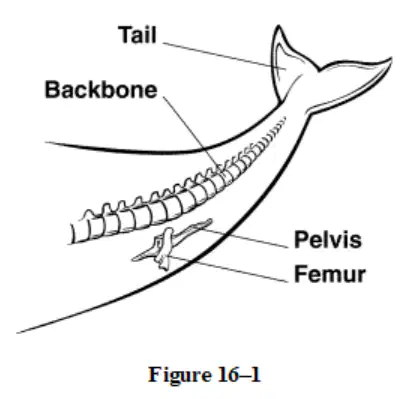
In humans, the pelvis and femur, or thigh bone, are involved in walking. In whales, the pelvis and femur are shown in Figure 16-1 are
a)
examples of fossils
b)
vestigial structures
c)
acquired traits
d)
examples of natural selection
93.
Crossing dissimilar individuals to bring together their best characteristics is called
a)
domestication
b)
inbreeding
c)
hybridization
d)
polyploidy
94.
Crossing individuals with similar characteristics so that those characteristics will appear in their offspring is called
a)
inbreeding
b)
hybridization
c)
recombination
d)
polyploidy
95.
Taking advantage of naturally occurring variations in organisms to pass wanted traits on to future generations is called
a)
selective breeding
b)
inbreeding
c)
hybridization
d)
mutation
96.
A member of a population of genetically identical cells produced from a single cell is a
a)
clone
b)
plasmid
c)
mutant
d)
sequence
97.
Colorblindness is more common in males than in females because the allele for colorblindness is
a)
dominant and located on the X chromosome
b)
dominant and located on the Y chromosome
c)
recessive and located on the X chromosome
d)
recessive and located on the Y chromosome
98.
Which of the following diseases and conditions does not appear until later in a person's life?
a)
cystic fibrosis
b)
sickle cell disease
c)
colorblindness
d)
Huntington's Disease
99.
Which of the following disorders does NOT result from nondisjunction in meiosis?
a)
Down Syndrome
b)
Turner's Syndrome
c)
Klinefelter's syndrome
d)
sickle cell disease
100 %

