
 Worksheets
Microbiology Ch. 6/7
Total questions: 86
Worksheet time: 43mins
The addition of which of the following to a culture medium will neutralize acids?
Buffers
Sugars
Carbon
Heat
pH
Which enzyme catalyzes the reaction: H2O2 + 2H+ --> 2H2O?
Superoxide dismutase
Oxidase
Catalase
Peroxidase
Most bacteria grow best at pH
9.
5.
1.
7.
14.
Which of the following pairs is mismatched?
Mesophile - growth at 25°C
Psychrotroph - growth at 0°C
Hyperthermophiles - growth at 100°C
Thermophile - growth at 37°C
Psychrophile - growth at 15°C
Salts and sugars work to preserve foods by creating a
Hypotonic environment.
Lower osmotic pressure.
Depletion of nutrients.
Lower pH.
Hypertonic environment.
Three cells with generation times of 30 minutes are inoculated into a culture medium. How many cells are there after 5 hours?
48
1024
243
3 x 2^10
16
Patients with indwelling catheters are susceptible to infections because
Biofilms develop on catheters.
Injected solutions are contaminated.
Their immune systems are weakened.
Bacteria cause infections.
Infections can be transmitted from other people.
Which of the following is an example of a metabolic activity that could be used to measure microbial growth?
Glucose consumption
Direct microscopic count
MPN
Turbidity
Standard plate count
Which of the following is NOT a direct method to measure microbial growth?
Metabolic activity
Standard plate count
MPN
Direct microscopic count
Filtration
A culture medium consisting of agar, human blood, and beef heart is a
Reducing medium.
Selective medium.
Complex medium.
Differential medium.
Chemically defined medium.
A culture medium on which only gram-positive organisms grow and a yellow halo surrounds Staphylococcus aureus colonies is called a(n)
Selective medium.
Enrichment culture.
Differential medium and Enrichment culture
Differential medium.
Selective medium and Differential medium
Which of the following is an organic growth factor?
Glucose
NH4H2PO4
Peptone
NAD+
H2O
Which of the following is NOT used to determine metabolic activity?
NO2- produced from the electron transport chain
CO2 produced from the Krebs cycle
Acid production from fermentation
Turbidity
Decreased dissolved oxygen
Which concentration of ethanol is the most effective bactericide?
70%
40%
50%
30%
100%
Which of the following affects the elimination of bacteria from an object?
Temperature
Presence of organic matter
All of these
pH
Number of bacteria present
Which of the following substances is used for surgical hand scrubs?
Soap
Chlorhexidine
Glutaraldehyde
Chlorine bleach
Phenol
Which of the following will NOT inactivate endospores?
Chlorine dioxide
High pressure
Supercritical CO2
Plasma
Autoclave
Which of the following pairs is mismatched?
Alcohols - open wounds
H2O2 - open wounds
Ag - burns
Organic acids - food preservation
CuSO4 - algicide
Which of the following is NOT a factor contributing to hospital-acquired infections?
Some bacteria metabolize disinfectants.
Bacteria may be present in commercial products such as mouthwash.
All of these may contribute to hospital-acquired infection.
Gram-negative bacteria are often resistant to disinfectants.
Invasive procedures can provide a portal of entry for bacteria.
Which of the following treatments is the most effective for controlling microbial growth?
72°C for 15 sec.
They are equivalent treatments.
63°C for 30 min.
None is effective.
140°C for 4 sec.
Which of the following substances is NOT an oxidizing agent?
Chlorine
Glutaraldehyde
Hydrogen peroxide
Ozone
Iodine
Bone and tendons for transplant are decontaminated by
Supercritical fluids.
Peroxygens.
Ethylene oxide.
Glutaraldehyde.
Plasma sterilization.
Which of the following substances is NOT used to preserve foods?
Sodium nitrite
Nisin
Sodium propionate
Potassium sorbate
Biguanides
Which one of the following is most resistant to chemical biocides?
Protozoan cysts
Gram-negative bacteria
Viruses with lipid envelopes
Mycobacteria
Gram-positive bacteria
Which of the following does NOT achieve sterilization?
Ethylene oxide
Autoclave
Dry heat
Formaldehyde
Pasteurization
Which of the following best describes the pattern of microbial death?
The cells in a population die at a constant rate.
All the cells in a culture die at once.
Not all of the cells in a culture are killed.
The pattern varies depending on the species.
The pattern varies depending on the antimicrobial agent.
Glutaraldehyde is considered one of the most effective disinfectants for hospital use. Which of the following statements about glutaraldehyde is false?
Stains and corrodes
Is safe to transport
Attacks all microorganisms
Is not hampered by organic material
Acts rapidly
Which of the following is NOT used to disinfect water?
Chlorine
Gamma radiation
Heat
Ozone
Copper sulfate
Which of the following is a limitation of the autoclave?
Cannot be used with glassware
Cannot be used with heat-labile materials
Cannot kill endospores
Requires a long time to achieve sterilization
Cannot inactivate viruses
Which of the following is the best method to sterilize heat-labile solutions?
Freezing
Dry heat
Membrane filtration
Autoclave
Pasteurization
Which enzyme catalyzes the reaction: O2- + O2- + 2H+ --> H2O2 + O2?
Superoxide dismutase
Oxidase
Peroxidase
Catalase
During which growth phase will gram-positive bacteria be most susceptible to penicillin?
Log phase
Lag phase
Stationary phase
Death phase
The culture is equally susceptible during all phases.
Which of the following is the best definition of generation time?
The time needed for nuclear division
The length of time needed for a cell to divide
The duration of log phase
The length of time needed for lag phase
The minimum rate of doubling
Which group of microorganisms is most likely to spoil a freshwater trout preserved with salt?
Facultative halophiles
Psychrophiles
Hyperthermophiles
Thermophiles
Anaerobes
Which enzyme catalyzes the reaction: 2H2O2 --> 2H2O + O2?
Superoxide dismutase
Catalase
Peroxidase
Oxidase
The source of nutrients in nutrient agar is
Peptone and beef extract.
Peptone and NaCl.
All of these.
Nutrient.
Agar.
Which of the following is an advantage of the standard plate count?
Can readily count cells that form aggregates
Cannot be used to count bacteria in food
Chemical and physical requirements are determined by media and incubation.
Requires incubation time
Determines the number of viable cells
Which of the following does NOT directly result from application of heat?
Breaking of sulfhydryl bonds
Damage to nucleic acids
Breaking of hydrogen bonds
Denaturing of enzymes
Cell lysis
Which of the following could be used to sterilize plastic Petri plates in a plastic wrapper?
Sunlight
Ultraviolet radiation
Autoclave
Microwaves
Gamma radiation
Which of these disinfectants acts by denaturing proteins?
Bisphenols
Alcohols
Aldehydes
Phenolics
Halogens
Which of the following substances is NOT effective against nonenveloped viruses?
Alcohol
Chlorine
Ethylene oxide
All are equally effective.
Ozone
If you were preparing nutrient agar at home and didn't have an autoclave, what could you use to sterilize the nutrient agar?
Pressure cooker at 121°C for 15 minutes
Oven at 121°C for 1 hour
Bleach
Boiling for 1 hour
Hydrogen peroxide
Place the following surfactants in order from the most effective to the least effective antimicrobial activity: 1-Soap; 2-Acid-anionic detergent; 3-Quats.
3, 1, 2
3, 2, 1
1, 3, 2
1, 2, 3
2, 1, 3
Assume you inoculated 100 cells into 100 ml of nutrient broth. You then inoculated 100 cells of the same species into 200 ml of nutrient broth. After incubation for 24 hours, you should have
More cells in the 200 ml.
The same number of cells in both.
More cells in the 100 ml.
Thirty-six colonies grew in nutrient agar from 1.0 ml of undiluted sample in a standard plate count. How many cells were in the original sample?
72
9
18
36
4
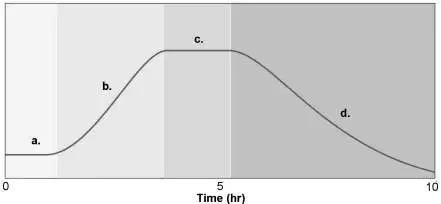
In Figure 6.2, which sections of the graph illustrate a logarithmic change in cell numbers?
c and d
b and d
b only
a and c
a and b
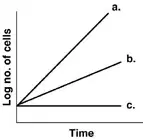
In Figure 6.1, which line best depicts a catalase-negative cell incubated aerobically?
b
c
a
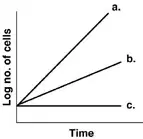
In Figure 6.1, which line best depicts a psychrophile incubated at room temperature?
b
a
c
In one hospital, Pseudomonas aeruginosa serotype 10 infected the biliary tract of 10% of 1300 patients who underwent gastrointestinal endoscopic procedures. After each use, endoscopes were washed with an automatic reprocessor that flushed detergent and glutaraldehyde through the endoscopes, followed by a tap water rinse. P. aeruginosa 10 was not isolated from the detergent, glutaraldehyde, or tap water. What was the source of the infections?
Fecal contamination of the bile ducts
Bacterial cell walls in the water
A biofilm in the reprocessor
Contaminated disinfectant
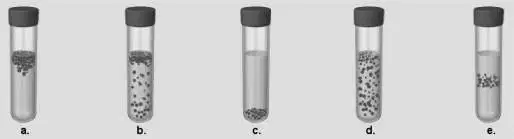
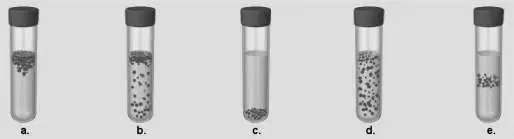
In Figure 6.4, in which tube are facultative anaerobes growing?
a
c
b
d
e
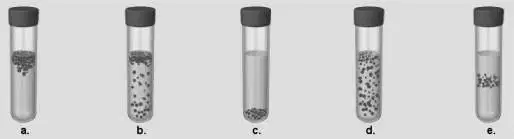
In Figure 6.4, in which tube are microaerophiles growing?
a
b
c
d
e
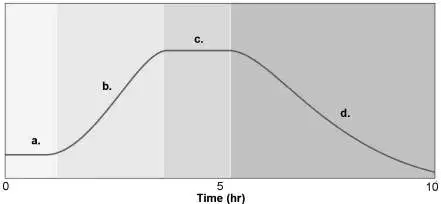
In Figure 6.2, which section shows a growth phase where the number of cells dying equals the number of cells dividing?
a
b
c
d
a and c
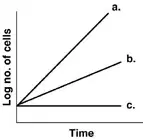
In Figure 6.1, which line best illustrates the growth of a facultative anaerobe incubated aerobically?
a
b
c
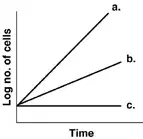
In Figure 6.1, which line shows the growth of an obligate aerobe incubated anaerobically?
a
b
c
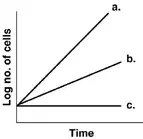
In Figure 6.1, which line best depicts a mesophile with an optimum temperature of 35°C incubated at 40°C?
a
b
c
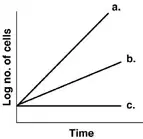
In Figure 6.1, which line best illustrates a mesophile at 5°C above its optimum temperature?
a
b
c

In Table, 6.1, in which medium would an autotroph grow?
B
A and C
A and B
A
C
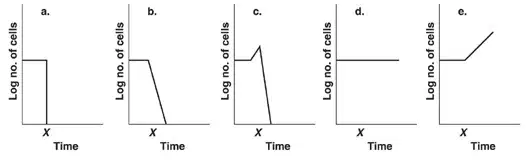
Assume 109 E. coli cells/ml are in a flask.
Which graph in Figure 7.3 best depicts the effect of placing the culture at 7°C at time x?
a
b
c
d
e

In Table 7.1, which compound was the most effective against Staphylococcus?
A
B
C
D
Can't tell

In Figure 7.2, the decimal reduction time (D value) for the culture is approximately
15 min.
60 min.
0 min.
45 min.
30 min.
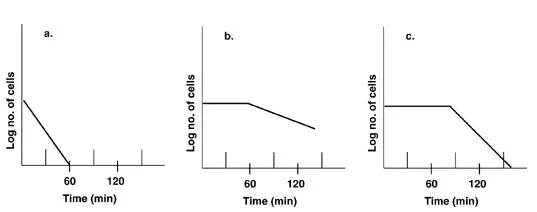
Assume that one culture is a freshly opened package of dried yeast with 0.1% moisture, another culture is the same yeast with 7.5% moisture, and the third culture is a package of yeast mixed with water. Each culture was exposed to 130°C in a hot-air oven. Which graph in Figure 7.1 most likely shows the yeast with 0.1% moisture?
a and b
c
b and c
a
b

In Table 7.1, which compound was the most effective against E. coli?
A
B
C
D
Can't tell
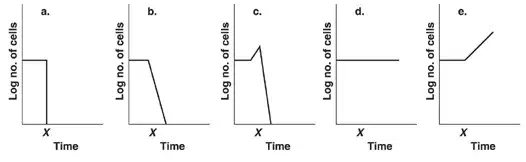
Which graph in Figure 7.3 best depicts the effect of placing the culture in an autoclave for 15 min. at time x?
a
b
c
d
e

In Table 7.3, which disinfectant is the most effective at stopping bacterial growth?
Mortum
K.O.
Doom
Sterl
Can't tell

In Figure 7.2, the thermal death point for this culture is
Can't tell from the data provided.
30 min.
50°C.
170°C.
15 min.
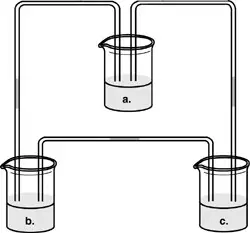
Figure 6.3 shows three containers of water connected by tubes. A selectively permeable membrane divides each tube. Solutes are added to each container to give final concentrations of 5% NaCl in (a); 10% NaCl in (b); and 5% sucrose in (c). When the experiment is first set up, the initial movement of water will be
b to a; b to c; c to a.
a to b; b to c; c to a.
a to b; c to b; c to a.
a to c; b to c; c to a.
a to c; c to b; c to a.
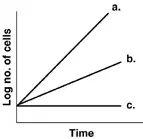
In Figure 6.1, which line best depicts a facultative anaerobe in the absence of O2?
a
b
c
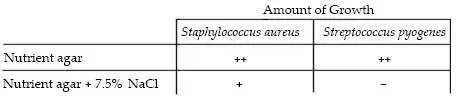
The data in Table 6.2 indicate that S. aureus is a(n)
Halophile.
Facultative anaerobe.
Aerobe.
Facultative halophile.
Mesophile.

In Table 7.3, which disinfectant was most effective against Salmonella?
K.O.
Doom
Can't tell
Sterl
Mortum

In Table 7.1, which compound was bactericidal?
A
B
C
D
Can't tell

In Figure 7.2, the thermal death time for this culture is
40 min.
60 min.
10 min.
0 min.
20 min.

In Table 7.2, which preservative is most effective?
No preservative
Benzoate
Sorbate + benzoate
Sorbate

In Table 7.3, which disinfectant was bactericidal?
Mortum
Sterl
Can't tell
K.O.
Doom
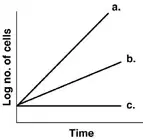
Micrococci are facultative halophiles. In Figure 6.1, which line best depicts the growth of Micrococcus luteus in a nutrient medium containing 7.5% NaCl?
a
b
c
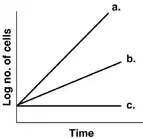
In Figure 6.1, which line best depicts a psychrotroph incubated at 0°C?
a
b
c
Which one of the following does NOT belong with the others?
Glutaraldehyde
Propylene oxide
Hydrogen peroxide
Ethylene oxide
Beta-propiolactone
Which one of the following does NOT belong with the others?
Acid-anionic detergents
Benzoic acid
Pasteurization
Supercritical CO2
Peracetic acid
Which of the following will NOT preserve foods?
Ionizing radiation
High pressure
Microwaves
Osmotic pressure
Desiccation
The antimicrobial activity of chlorine is due to which of the following?
The formation of hypochlorous acid
The formation of ozone
Disruption of the plasma membrane
The formation of free O
The formation of hydrochloric acid
Which one of the following pairs is mismatched?
Supercritical fluids - CO2
Plasma sterilization - free radicals
Ozone - takes electrons from substances
Ionizing radiation - hydroxyl radicals
Ultraviolet radiation - desiccation

In Table 6.1, which medium (media) is (are) chemically defined?
A
B
C
A and C
A and B
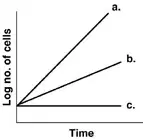
In Figure 6.1, which line best depicts Neisseria gonorrhoeae when growing inside the human body?
a
b
c
Which of the following is an advantage of the direct microscopic count?
Requires a large number of cells
Sample volume is unknown.
Requires no incubation time
Can readily count organisms that are motile
Enumerates dead cells
Iodophors differ from iodine (I2) in that iodophors
Are less irritating.
Don't stain.
Are combined with a nonionic detergent.
Are longer lasting.
All of these.
Which of the following substances can sterilize?
Phenolics
Ethylene oxide
Chlorine
Alcohol
Soap
Which of the following will NOT destroy prions?
Proteases
Incineration
NaOH + autoclaving at 134°C
All of these destroy prions.
Boiling

