
 Worksheets
Motion
Total questions: 83
Worksheet time: 2hrs 10mins
Name
Class
Date
1.
"How far" means that you are looking for....
a)
time
b)
distance
c)
velocity
d)
acceleration
2.
Which of the following causes a ball to stop rolling
a)
mass
b)
friction
c)
inertia
d)
gravity
3.
Objects stay in motion due to
a)
inertia
b)
momentum
c)
energy
d)
acceleration
4.
If a girl leaves her house and travels 5 miles to the store and then 5 miles back to her house, what was her distance traveled?
a)
0 miles
b)
5 miles
c)
10 miles
d)
25 miles
5.
What are the units for distance?
a)
m/s
b)
m
c)
s
d)
m/s2
6.
What are the units for velocity?
a)
m/s
b)
m
c)
s
d)
m/s2
7.
When a skydiver jumps from an airplane, a parachute allows her to land safely because it decreases the force that stops her motion. the force is reduced because the parachute decreases the -
a)
velocity of the airplane
b)
mass of the skydiver
c)
acceleration of the skydiver
8.
Acceleration occurs when an object changes its speed or ______.
a)
direction
b)
force
c)
inertia
d)
mass
9.
"A ball will roll until it is stopped by a force." This is an example of ....
a)
Newton's 1st Law
b)
Newton's 2nd Law
c)
Newton's 3rd Law
d)
Universal law of gravity
10.
What is velocity?
a)
the speed of something in a given direction
b)
the direction
c)
the speed
d)
difference in direction
11.
what is friction?
a)
a force that causes uncontrollable slipping.
b)
a force that opposes the sliding motion between two touching surfaces.
c)
friction is a force for good
12.
An object at rest will _______ if no outside forces are applied.
a)
Stay at rest
b)
Increase Velocity
c)
Decrease Mass
13.
A greater applied force is required to move an object with a greater mass than one with a smaller mass.
a)
True
b)
False
14.
The SI units for force are...
a)
Kilograms
b)
Newtons
c)
Meters per second
d)
Pounds
15.
According to Newton’s first law of motion, a moving object that is not acted on by an unbalanced force will
a)
remain in motion.
b)
eventually come to a stop.
c)
change its momentum.
d)
accelerate.
16.
Which of the following explains the difference between speed and velocity?
a)
One has motion, and the other does not.
b)
One has direction, and the other does not.
c)
One involves time, and the other does not.
d)
One involves acceleration, and the other does not.
17.
Dividing the total distance traveled by the total time is how to calculate
a)
average speed.
b)
average velocity.
c)
average acceleration.
18.
How does Newton’s third law explain how a rocket takes off?
a)
The rocket’s acceleration is positive, while the gasses acceleration is negative but the direction is the same.
b)
The rocket is at rest until ignition.
c)
The hot gasses move in one direction, while the rocket moves in the opposite direction but with equal force.
19.
Acceleration is caused by a force acting on a mass.
a)
Newton’s first law of motion
b)
Newton’s second law of motion
c)
Newton’s third law of motion
20.
For a force on an object there is an equal and opposite force.
a)
Newton’s first law of motion
b)
Newton’s second law of motion
c)
Newton’s third law of motion
21.
Without any force to change it, an object at rest stays at rest and an object in motion stays in motion
a)
Newton’s first law of motion
b)
Newton’s second law of motion
c)
Newton’s third law of motion
22.
A greater applied force is required to move an object with a greater mass than one with a smaller mass.
a)
True
b)
False
23.
A(n) __________ is a push or pull.
a)
newton
b)
acceleration
c)
force
d)
momentum
24.
A ____ force is the total force felt by an object.
a)
sum
b)
net
c)
strong
d)
balanced
25.
In order to be ____ forces, their effects must cancel each other out and not cause a change in an object's motion.
a)
balanced
b)
strong
c)
weak
d)
normal
26.
If the forces acting on an object are unbalanced, the net force is NOT ____.
a)
normal
b)
strong
c)
weak
d)
zero
27.
____ is the rubbing force that acts against motion between two touching surfaces.
a)
Acceleration
b)
Normal force
c)
Momentum
d)
Friction
28.
If you are driving forward and suddenly break, what would happen to your body and which law does that demonstrate?
a)
go back, 1st Law
b)
move forward, 1st Law
29.
Forces always act in equal and opposite pairs.
a)
Newton's 1st Law
b)
Newton's 3rd Law
30.

What force slows objects down and keeps them from moving?
a)
Friction
b)
Acceleration
31.
An object in motion will stay in motion and an object at rest will stay at rest unless acted upon by an outside force. Which law does this describe?
a)
Newton's 1st Law
b)
Newton's 2nd Law
32.

If there is a big mass, it would need a stronger force to accelerate it. Which law does this describe?
a)
Newton's 1st Law
b)
Newton's 2nd Law
c)
Newton's 3rd Law
33.
In a football game, two players tackle each other so hard that they both fly in opposite directions after they hit each other. What law of motion is this an example of?
a)
Newton's 2nd Law
b)
Newton's 3rd Law
34.
One object has twice as much mass as another object. The first object also has twice as much...
a)
velocity
b)
inertia
35.
Which has more Inertia? (and more force to move)
a)
Truck
b)
Ant
36.
Which law explains when a magician pulls a tablecloth out from under dishes and glasses on a table without disturbing them.
a)
Law 1
b)
Law 3
37.
(F = m X a) goes with which law of motion?
a)
First
b)
Second
c)
Third
d)
Fourth
38.
If you kicked a ball in space it would keep going because there is no gravity, friction, or air friction going against it. It will only stop moving in that direction if something comes into contact with it. This is an example of...
a)
Newton's First Law
b)
Newton's Second Law
c)
Newton's Third Law
39.
If you slide a hockey puck on ice, eventually it will stop because of the friction of the ice. This is an example of which Law of Motion.
a)
Newton's First Law
b)
Newton's Second Law
c)
Newton's Third Law
40.
A force of 20 N acts upon a 5 kg block. What is it's acceleration
a)
4 m/s2
b)
100 m/s2
c)
10 m/s2
d)
5 m/s2
41.
What is speed?
a)
how far you go
b)
how much distance is covered over a period of time
c)
how fast you accelerate
d)
the change in the location of a object
42.
What is velocity?
a)
the quickness of an object
b)
the location of an object
c)
acceleration
d)
speed in a specific direction
43.
If a cheetah runs 180 miles in 3 hours, what is its average speed?
a)
60 hours
b)
60 miles
c)
60 miles/hour
d)
60 miles/second/second
44.
The formula for average speed is ______
hint: Miles/hour
hint: Miles/hour
a)
Speed = Distance / time
b)
Speed = Distance X time
c)
Speed = ???
d)
something fast
45.
Newton's 1st law is often called the _______.
a)
Newton's 2nd law
b)
action-reaction law
c)
law of equality
d)
law of inertia
46.

What is the speed this motion?
a)
constant speed
b)
not moving
c)
speed increasing
d)
speed increasing at a constant rate
47.

What happened during A to B point?
a)
not moving
b)
increasing speed at a constant rate
c)
moving at a constant speed
d)
moving at 10 m/s2 acceleration
48.

What happened during C to D point?
a)
not moving
b)
increasing speed at a constant rate
c)
moving at a constant speed
d)
moving at 0 m/s2 acceleration
49.

What happened during E to F point?
a)
not moving
b)
increasing speed at a constant rate
c)
moving at a 5 m/s
d)
moving at 5 m/s2 acceleration
50.

which line represents the constant acceleration?
a)
A
b)
B and D
c)
C
d)
A, B, and D
51.

which line shows a negative acceleration ?
a)
A
b)
B and C
c)
D
d)
A, B, and
A, B, and D
A, B, and D
52.
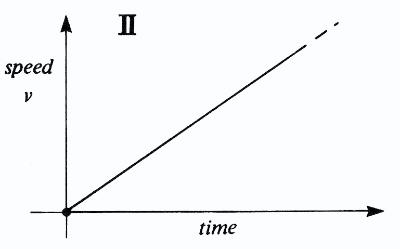
what is the motion described in the graph
a)
all of above
b)
constant speed
c)
constant acceleration
d)
constant position
53.

What does this graph represent?
a)
Constant speed
b)
Acceleration
c)
Not moving
54.

Which runner won the race?
a)
A
b)
B
c)
C
55.

Which runner had a head start?
a)
A
b)
B
c)
C
56.
65 miles per hour North is an example of an objects what?
a)
Speed
b)
Velocity
c)
Average Speed
d)
Constant Speed
57.
10 miles per hour is an example of an objects what?
a)
Velocity
b)
Speed
c)
Acceleration
d)
Inertia
58.
Velocity is
a)
speed
b)
direction
c)
speed with a direction
59.
On a distance vs. time graph, the steeper the slope _____
a)
the slower the speed
b)
the faster the speed
c)
less acceleration
d)
greater acceleration
60.

A proper quantity showing velocity would be
a)
25 m/s.
b)
30 m south.
c)
15 m/s north.
d)
10 m.
61.
Speed is equal to
a)
Distance/Time
b)
Time/Distance
c)
Time x Distance
d)
Acceleration
62.
Which of Newton's laws is illustrated when a magician pulls a tablecloth out from under the dishes without disturbing them?
a)
first
b)
second
c)
third
d)
fourth
63.
With unbalanced forces, the object will move in the direction that the _______ force is being applied.
a)
larger
b)
smaller
c)
equal
64.
You push on a tree with 20 N of force. If the tree doesn't move, the tree is pushing back on you with _____of force.
a)
20N
b)
40N
c)
10N
d)
70N
65.
Which has more Inertia? (so need more force to move)
a)
Truck
b)
Ant
c)
A cat
d)
A skateboard
66.
A 20 kg bike accelerates at 10 m/s2. what was the force
a)
25
b)
200 N
c)
20 N
d)
10 N
67.
Unit of mass
a)
m/s 2
b)
m/s
c)
newtons
d)
kg
68.
A person is pushed forward into their seatbelt when a car stops
a)
1st
b)
2nd
c)
2 and 3
d)
3rd
69.
What is Newton's First Law known as? The Law of
a)
Friction
b)
Mass
c)
Inertia
d)
Gravity
70.
Which law explains why when you put a book on a table the table pushes on the book
a)
3rd law
b)
4th law
c)
1st law
d)
2nd law
71.
formula for acceleration is
a)
Mass X speed
b)
distance divided by time
c)
change in velocity divided by time
d)
mass x acceleration
72.
45 m/s2 is the...
a)
Mass
b)
Force
c)
Acceleration
d)
weight
73.
Gravity attracts all objects towards one another.
a)
False
b)
True
c)
It depends
d)
I don't care
74.
Any object with mass is surrounded by a gravitational field.
a)
True
b)
Sometimes
c)
False
d)
Never
75.
The force of gravity is also known as
a)
Mass
b)
Weight
c)
Distance
d)
Acceleration
76.
As distance between two objects increase the pull of gravity
a)
Increases
b)
Decreases
c)
Stays the same
77.
The force of gravity acting on an object is the object's ______.
a)
mass
b)
matter
c)
weight
d)
terminal velocity
78.
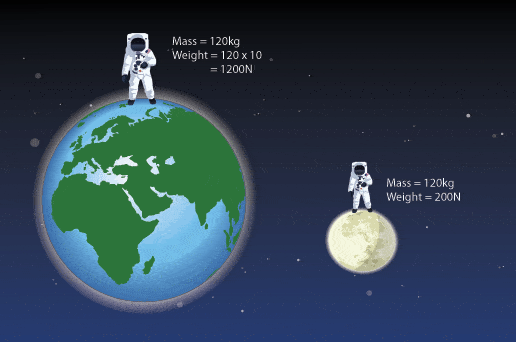
Which of the following will not change in different gravitational fields?
a)
weight
b)
force
c)
mass
d)
pounds
79.
An object is falling but is not accelerating. What do you know?
a)
Gravity is stronger than air resistance
b)
Air resistance is stronger than gravity
c)
Air resistance is equal to gravity
d)
Forces are unbalanced
80.
Where would you have to travel to reduce your weight but not lose any mass?
a)
The moon
b)
The Sun
c)
Jupiter
d)
Saturn
81.
Both of these are measured in Netwons
a)
Force and acceleration
b)
Force and weight
c)
Mass and weight
d)
Mass and acceleration
82.
A person would weigh more on Jupiter than on the Earth because . . .
a)
Jupiter has more mass, and therefore more gravity
b)
Jupiter has less mass, and therefore more gravity
c)
Jupiter has more mass, and therefore less gravity
d)
Jupiter has less mass and therefore less gravity
83.
A person weighs _____ on the Earth than they do on the Moon.
a)
less
b)
more
c)
the same
100 %

