
 Worksheets
Leadership - Theme 1: Section 1.4 Managing People
Total questions: 98
Worksheet time: 49mins
Which of the following is a characteristic of a leader?
Enact the plan
Inspire people
Use their authority
Manage risks
Which of the following is a characteristic of a manager?
Build relationships
Take risks
Have followers
Manage risks
Leaders ______ people, while managers ______ the plan.
Leaders inspire people, while managers enact the plan.
Leaders manage people, while managers inspire the plan.
Leaders ignore people, while managers avoid the plan.
Leaders confuse people, while managers disrupt the plan.
In reality, both leaders and managers are closely linked.
True
False
Match the following leadership styles with their names:
Authoritarian
Authoritarian
Paternalistic
Paternalistic
Democratic
Democratic
Laissez-faire
Laissez-faire
Which view of leadership focuses on command & control and decision-making?
Traditional View
Modern View
Which view of leadership includes inspiring employees and building effective teams?
Traditional View
Modern View
Name two activities associated with the modern view of leadership.
Inspiring employees, creating a vision, shaping core values & culture, building effective teams (any two).
Micromanaging daily tasks, enforcing strict hierarchies.
Focusing solely on short-term profits, ignoring employee input.
Maintaining status quo, avoiding change.
The distinction between management and leadership is:
Management focuses on organizing and controlling, while leadership inspires and motivates.
Management and leadership are exactly the same.
Leadership is only about giving orders, while management is about following them.
Management is less important than leadership in organizations.
Which of the following is NOT a type of leadership style?
Autocratic
Paternalistic
Democratic
Bureaucratic
Laissez-faire
Fill in the blank: A ________ leadership style involves making decisions without consulting others.
Autocratic
Democratic
Laissez-faire
Transformational
Which leadership style is characterized by leaders who involve team members in decision-making?
Autocratic
Paternalistic
Democratic
Laissez-faire
From Entrepreneur to Leader: One key change an entrepreneur must make to become an effective leader is:
Delegating responsibilities to others
Focusing solely on personal goals
Avoiding feedback from the team
Maintaining complete control over all decisions
Fill in the blank: According to Mullins, a general interpretation of leadership is 'A relationship through which one person influences the ________ or actions of other people.'
behaviour
appearance
wealth
location
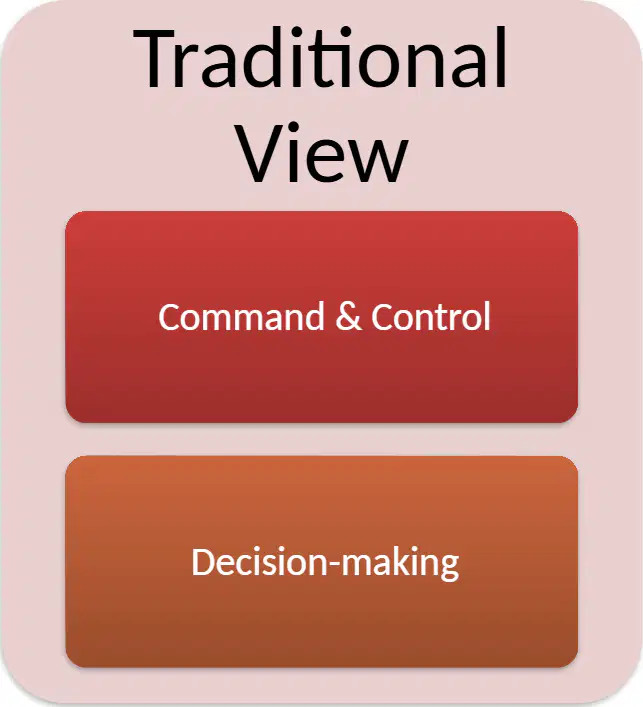
Which of the following is a characteristic of the Traditional View of leadership?
A. Inspiring employees
B. Command & Control
C. Building effective teams
D. Shaping core values & culture
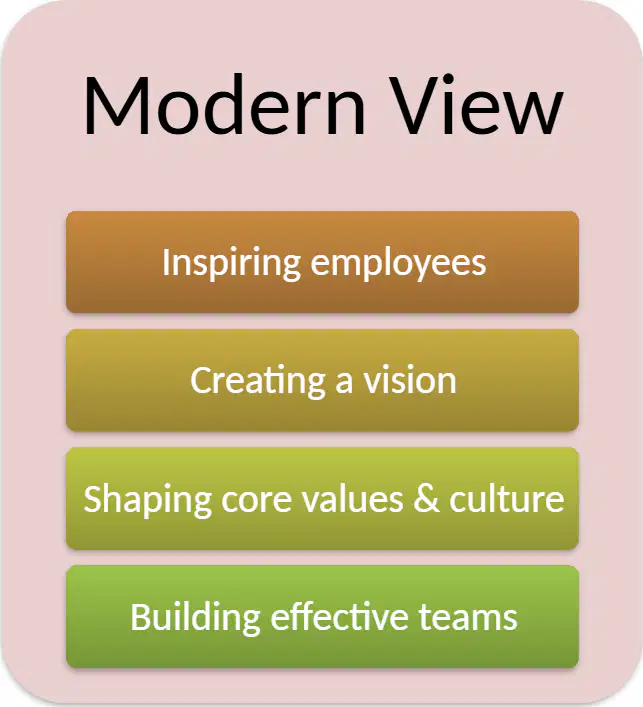
Which of the following is NOT a characteristic of the Modern View of leadership?
Creating a vision
Decision-making
Shaping core values & culture
Building effective teams
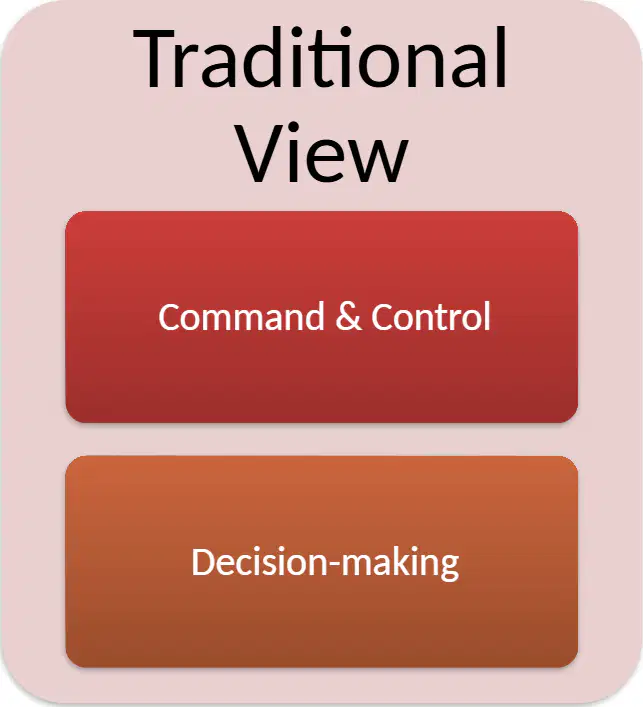
Fill in the blank: The Traditional View of leadership focuses on ________ and decision-making.
Command & Control
Empathy & Support
Innovation & Creativity
Collaboration & Teamwork
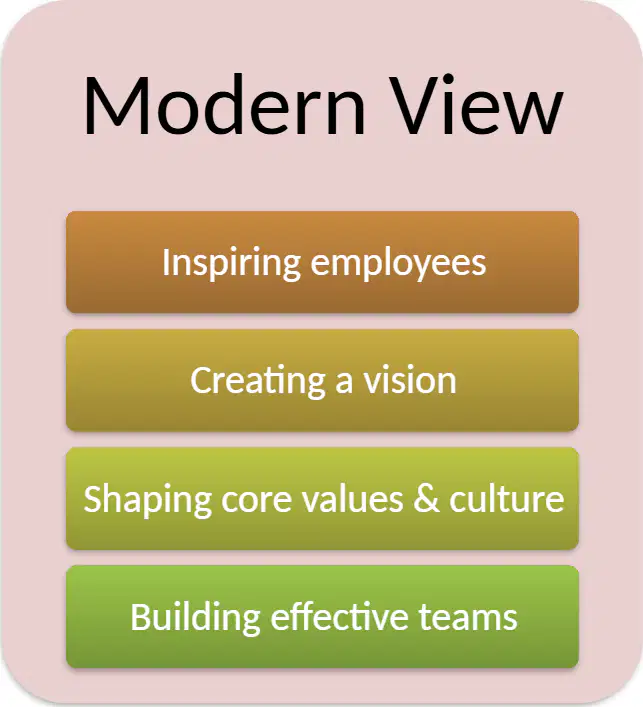
Fill in the blank: The Modern View of leadership includes inspiring employees and ________.
Creating a vision
Filing paperwork
Following orders
Avoiding responsibility
Ignoring feedback
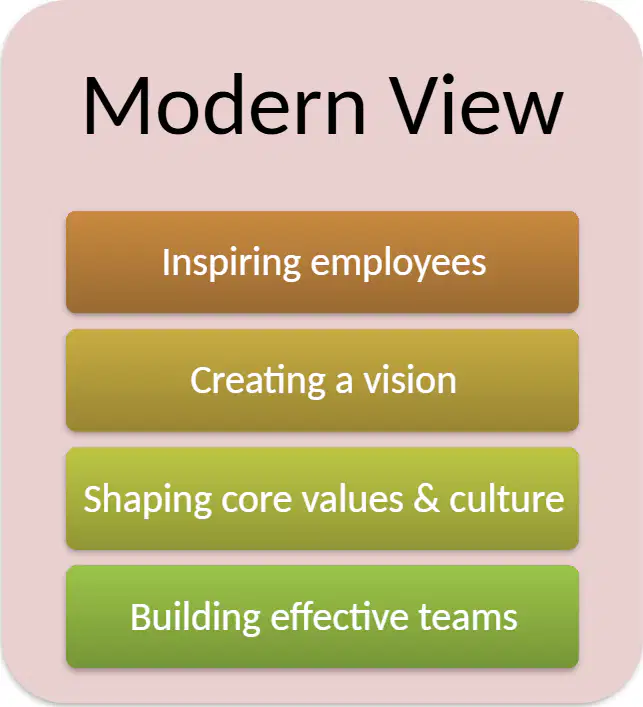
Building effective teams is a characteristic of the Traditional View of leadership.
True
False
Why is leadership increasingly important in business according to the slide?
Changing organisational structures
Rapid Change
Decreasing competition
Lower employee turnover
Fill in the blank: One reason leadership is increasingly important in business is due to ______ organisational structures, which involve flatter hierarchies and greater delegation.
changing
rigid
traditional
centralized
Which of the following is NOT mentioned as a feature of changing organisational structures?
Flatter + greater delegation
Teamwork + focus on quality assurance
Coaching, support & empowerment
Increased bureaucracy
Fill in the blank: Teamwork and a focus on ______ are highlighted as important in changing organisational structures.
quality assurance
profit maximization
individual achievement
market expansion
Coaching, support, and empowerment are listed as important aspects of changing organisational structures.
True
False
Fill in the blank: Change is becoming a constant feature of ______ life, making leadership increasingly important.
business
personal
academic
political
According to the slide, what soft skills are becoming increasingly important in business leadership and management?
Soft skills of leadership and management
Technical skills of programming
Physical skills of athletics
Mathematical skills of calculus
Fill in the blank: Strategic leaders are the people who ______ or control the corporate strategy of a business.
influence
ignore
oppose
avoid
Strategic leaders are often personally identified with the strategy.
True
False
Fill in the blank: The role of strategic leadership occurs both in small firms (e.g. the founder) and ______ corporates.
large
tiny
remote
temporary
Where leaders take direct control. Leadership as (a) .
vision
command
symbolic
decision-making
Leadership as (a) .
vision
command
symbolic
decision-making
How Strategic Leadership is Demonstrated:
Where the leader is the embodiment of the strategy, but not involved day-to-day. Leadership as (a) .
vision
command
symbolic
decision-making
Leadership as (a) .
vision
command
symbolic
decision-making
Which of the following is a characteristic of Leaders?
A) Enact the plan
B) Inspire people
C) Use their authority
D) Manage risks
Which of the following is a characteristic of Managers?
Build relationships
Take risks
Have followers
Have subordinates
Leaders ______ people.
Inspire
Ignore
Confuse
Distract
Managers ______ the plan.
Enact
Refuse
Ignore
Delay
Leaders build ______.
relationships
walls
machines
obstacles
Managers use their ______.
authority
money
furniture
uniform
Leaders take ______.
risks
orders
breaks
notes
Managers manage ______.
risks
profits
employees
projects
In reality, both leadership and management are closely linked.
True
False
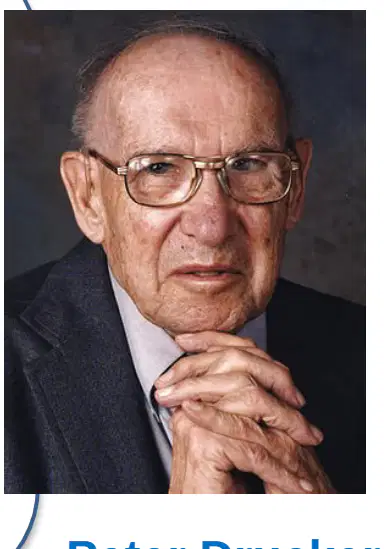
According to the classic quote by Peter Drucker, what is the main difference between management and leadership?
Management is doing things right; leadership is doing the right things
Management is doing the right things; leadership is doing things right
Management and leadership are the same
Leadership is not important
Fill in the blank: According to Peter Drucker, management is doing things right; leadership is _________?
doing the right things
making things happen
following the rules
setting strict guidelines
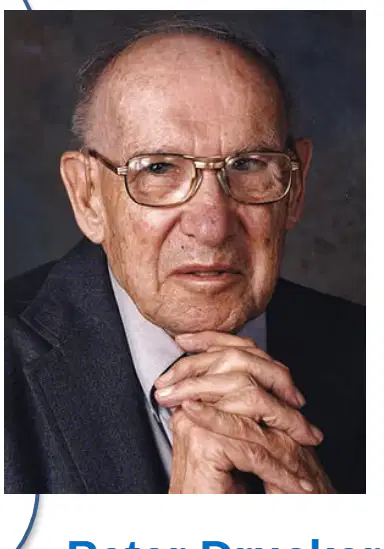
Who is credited with the classic quote on the difference between leadership and management?
Peter Drucker
Warren Bennis
Elon Musk
Steve Jobs
Which of the following is responsible for setting corporate objectives and strategic direction in a business?
Junior Management
Middle Management
Senior Management
Who is accountable to senior management and runs business functions and departments?
Senior Management
Middle Management
Junior Management
Which level of management has a supervisory role and is accountable to middle management?
Senior Management
Middle Management
Junior Management
Fill in the blank: The Board of Directors is an example of _________.
Senior Management
Middle Management
Operational Staff
External Consultants
Match the following levels of management with their primary responsibility:
Set corporate objectives & strategic direction
Senior Management
Run business functions and departments
Middle Management
Monitor & control day-to-day tasks, and manage teams of workers
Junior Management
Fill in the blank: A leadership style is the way that the ________ of leadership are carried out.
functions
colors
locations
numbers
Which of the following best describes a leadership style?
The way that a leader dresses
The way that a leader behaves
The way that a leader travels
The way that a leader speaks
Fill in the blank: One of the traditional classifications of leadership style is (a) .
Authoritarian
Paternalistic
Democratic
Laissez-faire
Fill in the blank: One of the traditional classifications of leadership style is (a) .
Authoritarian
Paternalistic
Democratic
Laissez-faire
Fill in the blank: One of the traditional classifications of leadership style is (a) .
Authoritarian
Paternalistic
Democratic
Laissez-faire
Fill in the blank: One of the traditional classifications of leadership style is (a) .
Authoritarian
Paternalistic
Democratic
Laissez-faire
Fill in the blank: In an Authoritarian management style, the focus of power is with the _______.
manager
employees
customers
team
Fill in the blank: In an Authoritarian management style, communication is _______ and one-way.
top-down
bottom-up
collaborative
circular
Fill in the blank: Authoritarian management uses formal systems of _______ & control.
command
negotiation
collaboration
delegation
Fill in the blank: Authoritarian management uses _______ & penalties.
rewards
suggestions
negotiations
democracy
Fill in the blank: In an Authoritarian management style, there is very little _______.
delegation
communication
motivation
planning
Fill in the blank: The Authoritarian management style is associated with McGregor Theory _______ approach.
X
Y
Z
W
Which leadership style is described as one where the leader decides what is best for employees?
Democratic
Laissez-faire
Paternalistic
Authoritarian
Paternalistic leadership links with which theorist by addressing employee needs?
Maslow
Mayo
Herzberg
Taylor
Paternalistic leadership is akin to a ______/child relationship.
parent
teacher
friend
boss
Paternalistic leadership involves a lot of delegation.
True
False
Paternalistic leadership is a softer form of ______ leadership.
authoritarian
democratic
laissez-faire
transformational
Fill in the blank: In a democratic leadership style, the focus of power is more with the ______ as a whole.
group
leader
manager
individual
Fill in the blank: In a democratic leadership style, leadership functions are shared within the ______.
group
leader
organization
community
Fill in the blank: In a democratic leadership style, employees have greater involvement in ______-making.
decision
profit
risk
product
Fill in the blank: In a democratic leadership style, there is an emphasis on ______ and consultation.
delegation
punishment
isolation
competition
In a democratic leadership style, there is a trade-off between speed of decision-making and better motivation and morale.
True
False
Fill in the blank: In a Laissez-faire leadership style, the leader has little input into ________ decision-making.
day-to-day
strategic
financial
long-term
Which of the following best describes a Laissez-faire leadership style?
Leader makes all decisions
Conscious decision to delegate power
No delegation of power
Staff have no freedom
Fill in the blank: In a Laissez-faire leadership style, managers or employees have freedom to do what they ________ is best.
think
ignore
forget
avoid
The Laissez-faire leadership style is effective when staff are ready and willing to take on responsibility.
True
False
True or False: Laissez-faire leadership is the same as abdication.
True
False
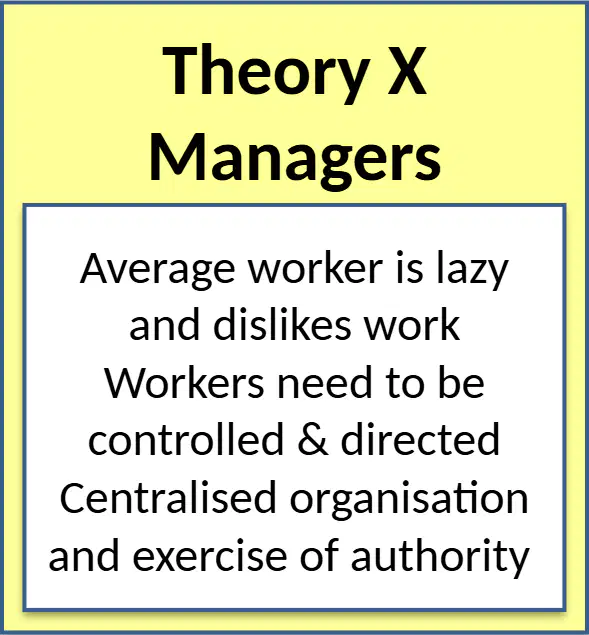
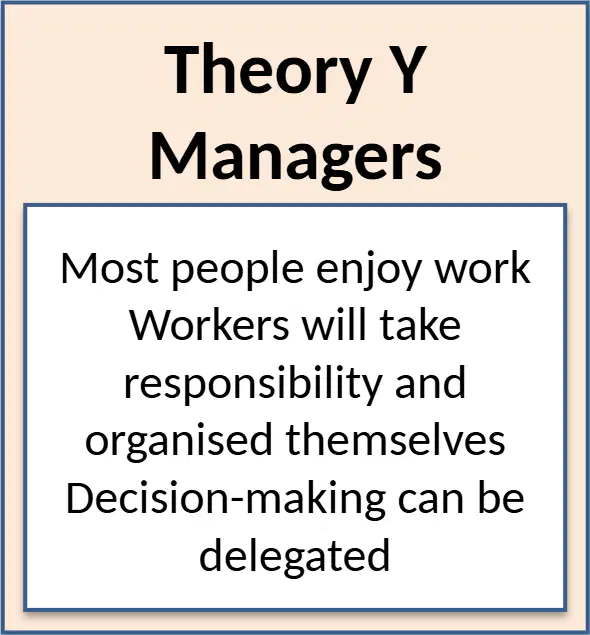
According to McGregor's Theory X & Y, which type of manager believes that the average worker is lazy and dislikes work?
Theory X Managers
Theory Y Managers
Both
Neither
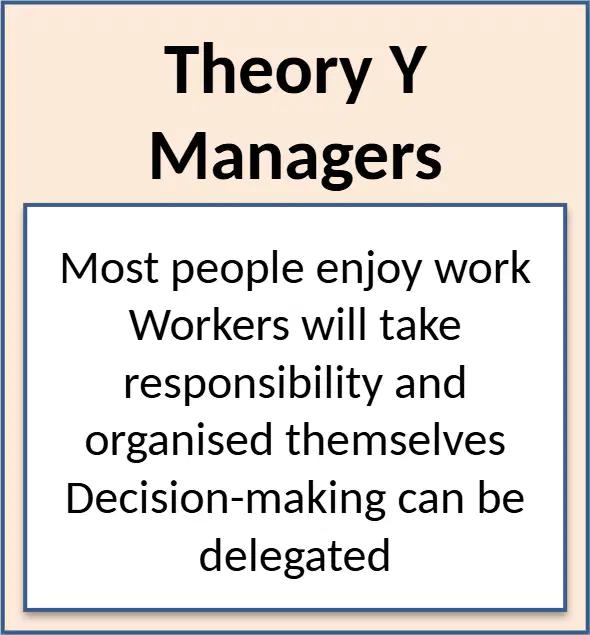
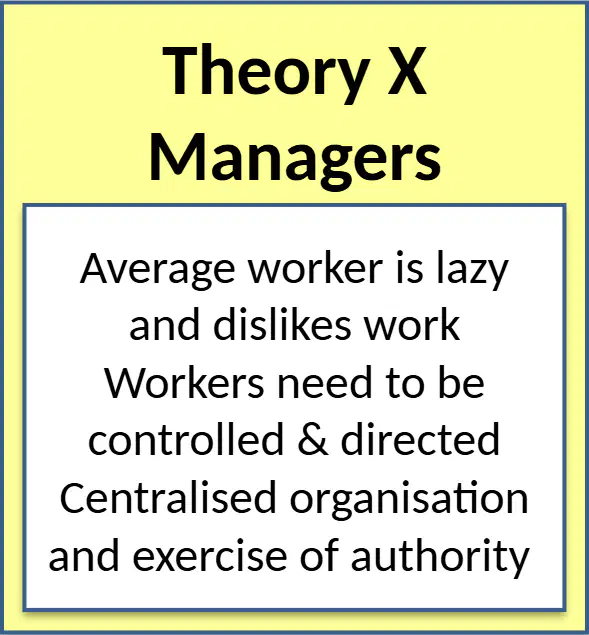
According to McGregor's Theory X & Y, which type of manager believes that most people enjoy work?
Theory X Managers
Theory Y Managers
Both
Neither
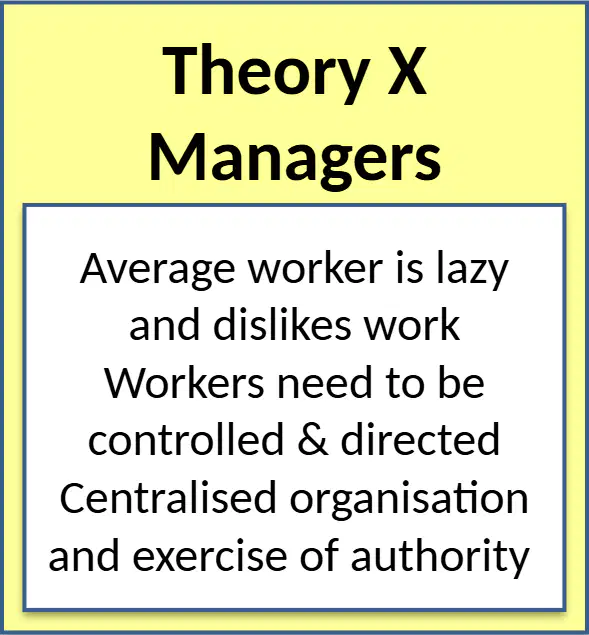
Fill in the blank: According to Theory X Managers, workers need to be _______ and directed.
controlled
rewarded
ignored
praised
Fill in the blank: According to Theory Y Managers, decision-making can be _______.
delegated
avoided
centralized
ignored
Which type of manager, according to McGregor's Theory X & Y, believes in centralised organisation and exercise of authority?
Theory X Managers
Theory Y Managers
Both
Neither
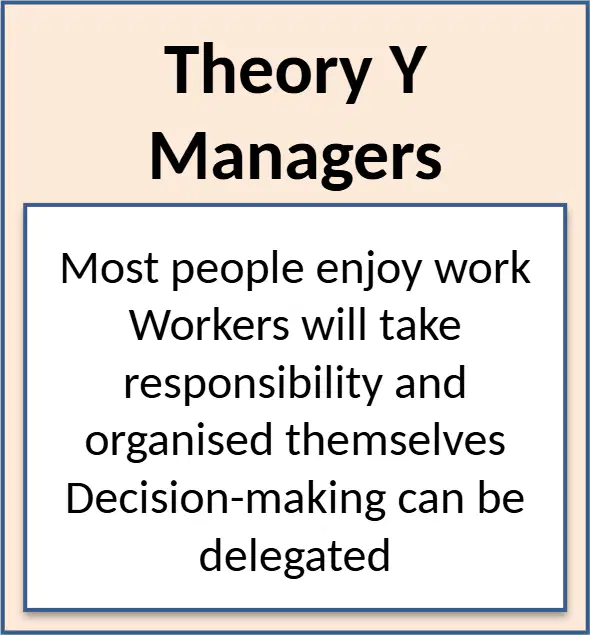
Which type of manager, according to McGregor's Theory X & Y, believes that workers will take responsibility and organise themselves?
Theory X Managers
Theory Y Managers
Both
Neither
Fill in the blank: One reason why modern business leadership is moving away from autocratic styles is changes in ________ values.
society's
technological
economic
political
Fill in the blank: A better ________ workforce is a reason for the shift away from autocratic leadership styles.
educated
divided
isolated
temporary
Fill in the blank: There is a focus on the need for soft ________ skills as a reason for moving away from autocratic leadership.
HR
Technical
Mechanical
Physical
Fill in the blank: Changing ________ organisation is one reason for the move away from autocratic leadership styles.
workplace
climate
technology
policy
Fill in the blank: Greater workplace ________ is a factor in the shift away from autocratic leadership.
legislation
competition
automation
migration
Fill in the blank: Pressure for greater employee ________ is a reason for modern business leadership moving away from autocratic styles.
involvement
punishment
isolation
competition
Is 'Personal value systems' a factor affecting leadership style?
True
False
Is 'Manager’s experience' a factor affecting leadership style?
True
False
Is 'Confidence in subordinates' a factor affecting leadership style?
True
False
Is 'Feelings of security' a factor affecting leadership style?
True
False
Is 'Nature of the business problems' a factor affecting leadership style?
True
False
Is 'Type of organisation (size, structure)' a factor affecting leadership style?
True
False
Is 'Effectiveness of teams and groups' a factor affecting leadership style?
True
False
Is 'Skills and experience of subordinates' a factor affecting leadership style?
True
False
Is 'Pressure (time, costs)' a factor affecting leadership style?
True
False

