
 Worksheets
Objectives - Construction Site Safety
Total questions: 27
Worksheet time: 14mins
State the legislation used for reporting accidents on construction sites.
Reporting of Injuries, Diseases and Dangerous Occurrences Regulations (RIDDOR)
Health and Safety at Work Act
Control of Substances Hazardous to Health (COSHH) Regulations
Construction (Design and Management) Regulations
Major types of emergencies that can occur on construction sites include:
Fire, structural collapse, chemical spills, and electrical accidents
Only fire emergencies
Only medical emergencies
Only equipment failure
Reportable injuries and diseases as per RIDDOR include which of the following?
Fractures, amputations, occupational diseases, and loss of consciousness
Common cold and mild headaches
Minor cuts and bruises
Seasonal allergies and muscle cramps
The authorised personnel involved in dealing with accident and emergency situations on construction sites are:
Site safety officer
Construction workers
Project clients
Suppliers
Actions taken when discovering an accident on a construction site include:
Report the accident, provide first aid if safe, and secure the area.
Ignore the accident and continue working.
Wait for someone else to notice and act.
Remove all evidence before reporting.
Good housekeeping on site is important because it helps to maintain safety and efficiency, and risk assessments and method statements are necessary to identify hazards and plan safe working methods.
They help maintain safety and efficiency, and identify hazards and plan safe working methods.
They are only required for legal compliance and paperwork.
They are mainly for aesthetic purposes and do not affect safety.
They are used to increase the speed of work without considering safety.
Types of hazards and correct storage of chemicals on site include:
Identifying chemical hazards and storing chemicals in designated, labeled areas away from incompatible substances.
Storing all chemicals together regardless of type.
Ignoring hazard labels and storing chemicals in open containers.
Placing chemicals near heat sources for easy access.
What is an accident? Fill in the blank: An accident is an ________, unplanned and uncontrolled event.
unforeseen
intentional
scheduled
controlled
Which of the following is NOT mentioned as a type of emergency on site?
Fire
Bomb alerts
Chemical spillage
Floods
Security alerts
Fill in the blank: All accidents, including near misses, must be reported to the ______ and Safety Executive (HSE) by employers.
Health
Work
Public
Environmental
Employees must report all accidents and near misses to their supervisor so that the cause can be analysed and action taken to prevent incidents happening again.
True
False
According to the City & Guilds Construction guidelines, an accident that causes death, major injury, or absence from work for more than how many days must be reported to the HSE using an Accident Record Form?
1 day
2 days
3 days
More than 3 days
Who normally completes accident reports according to the City & Guilds Construction guidelines?
The injured person
A manager or supervisor
A co-worker
The HSE inspector
Why is it important to report accidents according to the Reporting of Injuries, Diseases and Dangerous Occurrences Regulations (RIDDOR) 1995?
Reporting accidents allows you to look closely at what causes accidents. This means that you can take action to prevent them in future.
Reporting accidents is only necessary for insurance purposes.
Reporting accidents is optional and does not affect workplace safety.
Reporting accidents is only required if someone is seriously injured.
What must be entered into the employer’s Accident Book at work?
All accidents, even minor ones.
Only accidents that result in time off work.
Only accidents witnessed by a supervisor.
Only accidents that require hospital treatment.
A brief description of the accident, cause and what the injury is must be recorded in the Accident Book.
True
False
Who is responsible for reporting whether the accident is reportable to the HSE?
The employer
The employee
A witness
The local police
Who will be informed by the site manager and will assess the area of the accident to check it is now safe, investigate the cause of the accident, and produce a report if required?
Safety officer
Project engineer
Site supervisor
Logistics manager
Who will be informed as soon as possible so they can inform the HSE and their head office?
Site Manager
Project Engineer
Safety Officer
Foreman
Who should all accidents be reported to, as identified by a sign on site?
First aider
Site visitor
Security guard
Catering staff
Who must be contacted immediately if an accident results in death or major injury and followed up with a full report within 10 days?
HSE
Local Police
Fire Department
Insurance Company
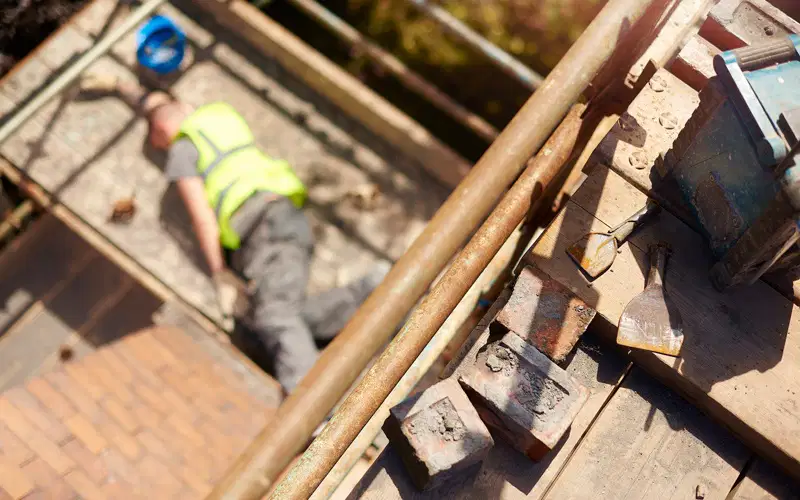
What was the most common cause of major injuries to construction employees in 2011/12?
Handling
Slips, trips and falls
Falls
Being struck by moving objects / falling objects
Most accidents are caused by:
Human error
Weather conditions
Mechanical failure
Road design
The importance of good housekeeping: Which of the following is NOT a recommended housekeeping practice on a construction site?
A) Keep your site clean and tidy
B) Allow public access to dangerous areas
C) Fence the site off and use warning signs
D) Keep clear space for people to work in
The importance of good housekeeping: To keep people, including the public, away from danger on a construction site, you should:
Erect barriers and warning signs around hazardous areas.
Allow unrestricted access to all areas.
Ignore potential hazards as they arise.
Rely on workers to warn the public verbally.

What is a risk assessment?
A risk assessment is a careful study of some work that is to be done so as to identify the risks to health and safety of the people working.
A risk assessment is a document that lists the names of all employees in a company.
A risk assessment is a financial report prepared at the end of the year.
A risk assessment is a checklist for daily attendance.
Which of the following is a common hazard on construction sites?
Electricity
Water fountains
Fire extinguishers
Safety vests

