
 Worksheets
HBHD Ch 20
Total questions: 90
Worksheet time: 45mins
The kidneys are located in the abdominal cavity and have a bean-shaped structure. They act as vital organs in maintaining homeostasis by filtering blood and regulating fluid balance. Which of the following best describes the location, structure, and function of the kidneys?
The kidneys are located in the abdominal cavity, are bean-shaped, and maintain homeostasis by filtering blood and regulating fluid balance.
The kidneys are located in the chest cavity, are round-shaped, and produce digestive enzymes.
The kidneys are located in the pelvic cavity, are triangular-shaped, and store bile.
The kidneys are located in the cranial cavity, are oval-shaped, and regulate body temperature.
The nephron consists of several parts, each playing a role in balancing blood and forming urine. Which of the following correctly matches a nephron part with its function?
Glomerulus - filtration of blood
Loop of Henle - secretion of hormones
Bowman's capsule - reabsorption of glucose
Collecting duct - production of red blood cells
The importance of filtration, tubular reabsorption, and tubular secretion in renal physiology is to:
maintain homeostasis by regulating the composition of blood and urine
produce hormones for digestion
control muscle contraction directly
regulate body temperature
The mechanisms that control urine volume include:
Antidiuretic hormone, aldosterone, and renal blood flow
Insulin, glucagon, and thyroid hormone
Adrenaline, melatonin, and serotonin
Growth hormone, prolactin, and oxytocin
The structure and function of the ureters, urinary bladder, and urethra are best described as:
Ureters transport urine from the kidneys to the bladder; the urinary bladder stores urine; the urethra expels urine from the body.
Ureters produce urine; the urinary bladder filters blood; the urethra stores urine.
Ureters store urine; the urinary bladder transports urine to the kidneys; the urethra filters urine.
Ureters expel urine from the body; the urinary bladder produces urine; the urethra stores urine.
The process of micturition involves the expulsion of urine from the bladder, and control problems with this process frequently include which of the following?
Urinary incontinence and retention
Increased blood pressure and heart rate
Digestive enzyme deficiency
Respiratory tract infection
The purpose and importance of urinalysis is to:
Detect and monitor diseases of the urinary tract and other systemic conditions.
Measure blood pressure levels.
Assess lung function and respiratory health.
Determine visual acuity and eye health.
Which of the following lists major renal and urinary disorders along with their mechanisms?
Glomerulonephritis (inflammation of glomeruli), Nephrotic syndrome (increased glomerular permeability), Urinary tract infection (bacterial infection of urinary tract), Renal calculi (formation of kidney stones)
Hypertension (increased blood pressure), Diabetes (high blood sugar), Asthma (airway inflammation), Arthritis (joint inflammation)
Pneumonia (lung infection), Hepatitis (liver inflammation), Migraine (headache disorder), Anemia (low red blood cells)
Osteoporosis (bone loss), Cataract (cloudy lens), Psoriasis (skin disorder), Epilepsy (seizure disorder)
Where do the kidneys lie in the human body?
Under back muscles, behind parietal peritoneum, just above waistline
In the chest cavity
In the pelvic region
In the neck
Which kidney is usually a little lower than the other?
Left kidney
Right kidney
Both are at the same level
None of the above
What is the outer layer of the kidney called?
Renal cortex
Renal medulla
Renal pelvis
Renal capsule
What is the inner portion of the kidney called?
Renal cortex
Renal medulla
Renal pelvis
Renal capsule
The kidney resembles the shape of a _________
lima bean
apple
carrot
potato

Refer to the diagram of the urinary system. Which organ is responsible for filtering blood to form urine?
Liver
Kidney
Ureter
Urinary bladder
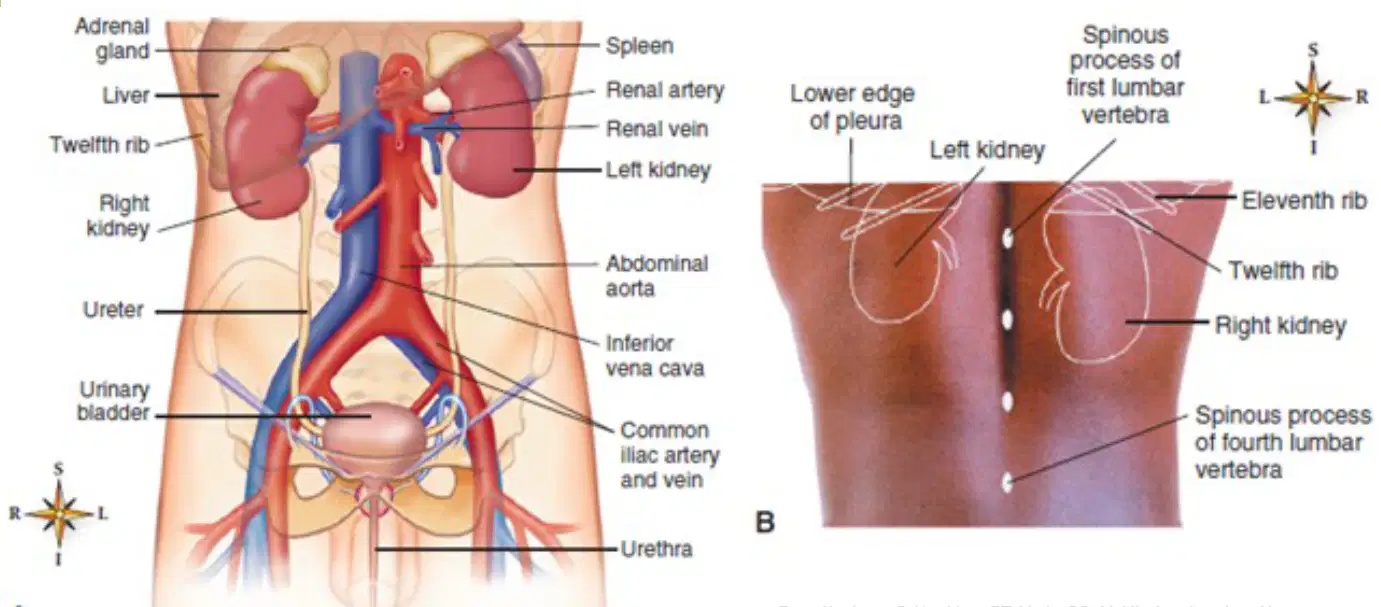
Refer to the diagram of the urinary system. The tube that carries urine from the kidney to the bladder is called the ________.
Ureter
Urethra
Renal vein
Renal artery
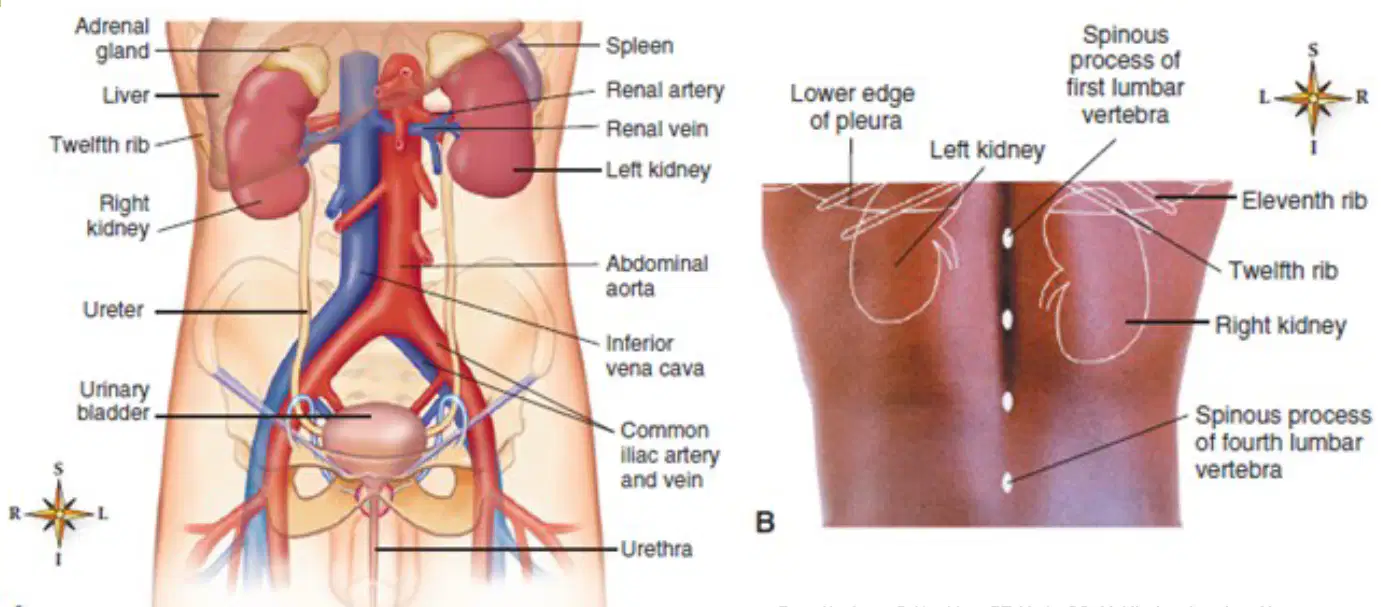
Refer to the diagram of the urinary system. Match the following anatomical terms to their correct locations:
Top of the kidney
Adrenal gland
Tube leading out of the bladder
Urethra
Large vein running down the center
Inferior vena cava
Organ that stores urine
Urinary bladder

What is the name of the outermost layer labeled in the diagram?
Capsule (fibrous)
Medulla
Renal pelvis
Cortex

Refer to the diagram of the internal structure of the kidney. What is the region labeled as the functional tissue of the kidney, located just beneath the capsule?
Cortex
Medulla
Pelvis
Ureter

What is the name of the innermost region, containing the renal pyramids?
Medulla
Cortex
Pelvis
Capsule

What is the name of the funnel-shaped structure that collects urine from the major calyces?
Renal pelvis
Ureter
Renal cortex
Renal medulla

What is the name of the tube that carries urine from the kidney to the bladder?
Ureter
Urethra
Vas deferens
Fallopian tube

What is the name of the area where blood vessels, nerves, and the ureter enter and exit the kidney?
Hilum
Cortex
Medulla
Renal capsule

What is the name of the small projections at the tip of each renal pyramid?
Renal papilla of pyramid
Renal cortex
Renal medulla
Renal capsule

What is the name of the structure that separates the renal pyramids?
Renal column
Renal pelvis
Renal capsule
Renal papilla

What is the name of the cavity within the kidney that houses the calyces, renal pelvis, and vessels?
Renal sinus
Renal cortex
Renal medulla
Renal capsule

What is the name of the arteries that supply blood to the kidney, shown branching within the cortex?
Interlobular arteries
Renal veins
Afferent arterioles
Segmental arteries
Fill in the blank: The triangular divisions of the medulla in the kidney are called _________.
renal pyramids
Bowman's capsules
glomeruli
renal columns
Fill in the blank: The cortical tissue that dips down between renal pyramids is called _________.
renal columns
renal cortex
renal medulla
renal papilla
Fill in the blank: The narrow, innermost end of a renal pyramid is called the _________.
renal papilla
renal cortex
renal capsule
renal column
Fill in the blank: The expansion of the upper end of the ureter that lies inside the kidney is called the _________.
renal pelvis
renal cortex
renal medulla
renal capsule
Fill in the blank: The divisions of the renal pelvis are called _________.
renal calyces
renal pyramids
Bowman's capsules
glomeruli
Fill in the blank: The interior of the kidney is composed of more than _______ microscopic nephron units.
1 million
10 thousand
100 thousand
10 million
Which of the following best describes the shape of the nephron?
Round and flat
Unique shape well suited to function
Square and rigid
Irregular and random
Fill in the blank: The principal components of a nephron are the _______ and the _______.
renal corpuscle; renal tubule
glomerulus; loop of Henle
Bowman's capsule; collecting duct
proximal tubule; distal tubule
What is the Bowman capsule?
Cup-shaped top of nephron
Part of the alveoli in lungs
Section of the small intestine
Chamber in the heart
What is the glomerulus?
Network of blood capillaries surrounded by Bowman capsule
A tube that carries urine to the bladder
A hormone produced by the kidney
A muscle that controls urination
What percentage of nephrons are cortical nephrons and where are they mostly located?
85% of total; located mostly in renal cortex
15% of total; located mostly in renal medulla
50% of total; located mostly in renal pelvis
30% of total; located mostly in renal capsule
What is the role of juxtamedullary nephrons and where are they located?
Have important role in concentrating urine; located near junction between cortex and medullary layers
Regulate blood pressure; located only in the renal cortex
Filter glucose exclusively; found in the outer medulla
Produce erythropoietin; located in the renal pelvis
What is the first segment of the renal tubule?
Proximal convoluted tubule (PCT)
Distal convoluted tubule (DCT)
Loop of Henle
Collecting duct
Which part of the renal tubule is an extension of the proximal tubule and consists of descending limb, loop, and ascending limb?
Henle loop
Bowman's capsule
Distal convoluted tubule
Collecting duct
Which segment of the renal tubule is the extension of the ascending limb of Henle loop?
Distal convoluted tubule (DCT)
Proximal convoluted tubule (PCT)
Collecting duct
Bowman's capsule
What is the straight extension of the distal tubule called?
Collecting duct (CD)
Loop of Henle
Proximal convoluted tubule
Bowman's capsule
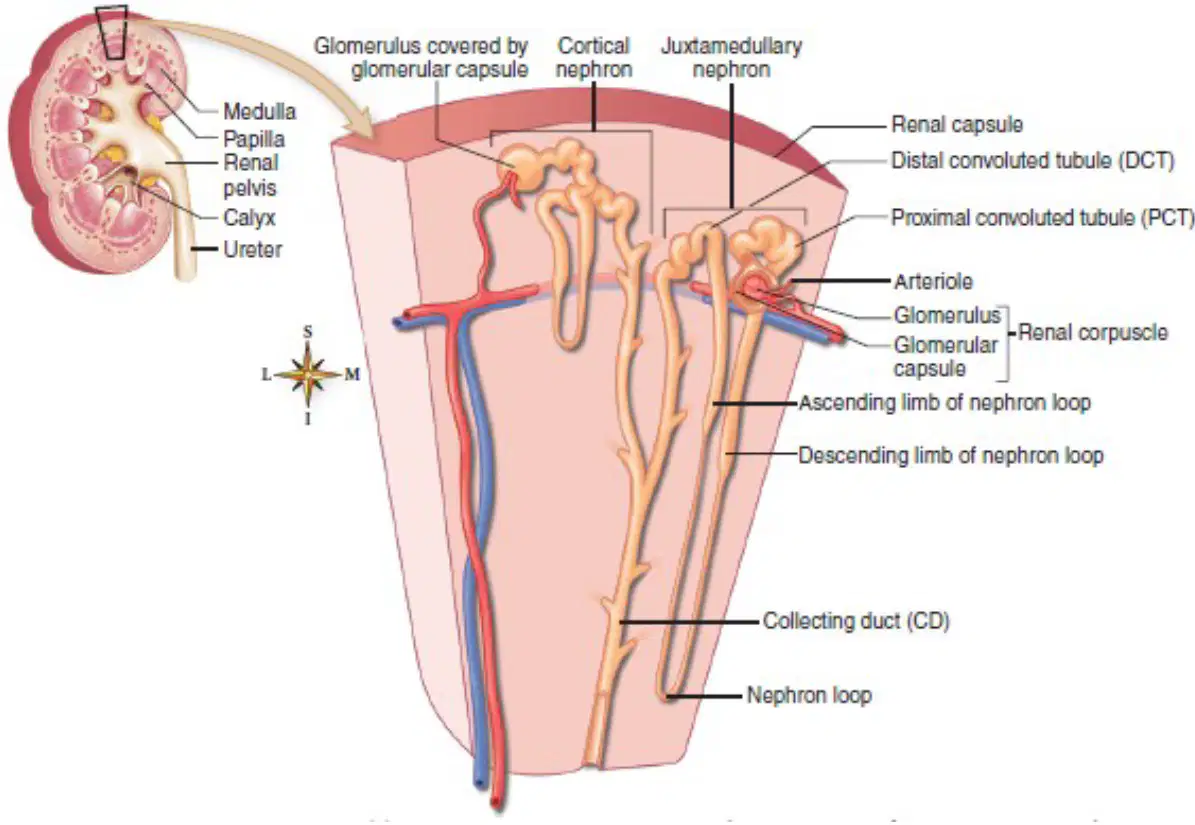
Refer to the diagram titled 'Location of Nephrons'. What is the function of the glomerulus?
Filtration of blood
Reabsorption of water
Secretion of hormones
Storage of urine
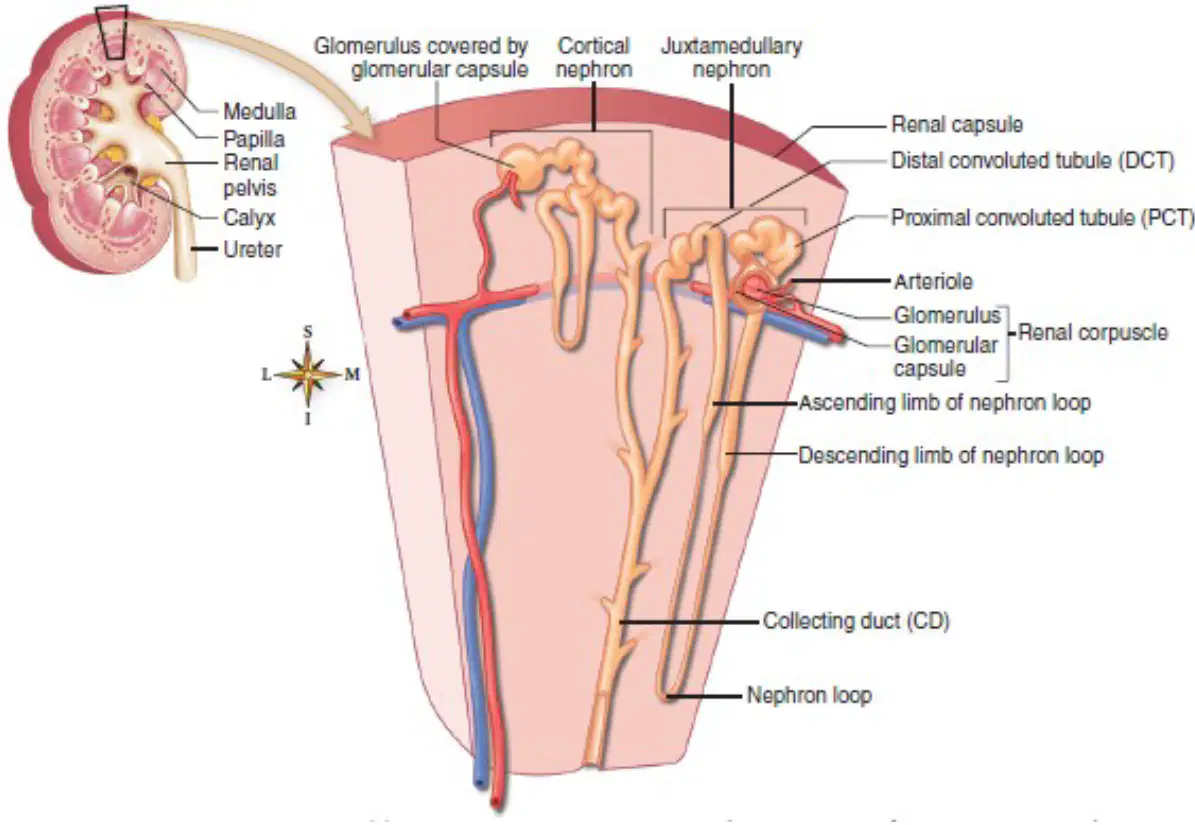
Refer to the diagram titled 'Location of Nephrons'. The structure labeled as 'Collecting duct (CD)' is responsible for:
Filtration
Collecting urine from nephrons
Blood supply
Hormone secretion

Refer to the diagram titled 'Location of Nephrons'. The ________ is the outermost region of the kidney where cortical nephrons are located.
cortex
medulla
pelvis
ureter

Refer to the diagram titled 'Location of Nephrons'. Which part of the nephron is responsible for reabsorbing most of the filtered water and solutes?
Proximal convoluted tubule (PCT)
Distal convoluted tubule (DCT)
Collecting duct (CD)
Renal capsule

Refer to the diagram titled 'Location of Nephrons'. The structure labeled as 'Ureter' carries urine from the kidney to the ________.
bladder
liver
pancreas
stomach

Refer to the diagram titled 'Location of Nephrons'. The ascending limb of the nephron loop is primarily involved in:
Reabsorption of sodium and chloride
Filtration of blood
Secretion of hormones
Storage of urine
The renal capsule surrounds which structure?
Glomerulus
Collecting duct
Ureter
Papilla

Refer to the diagram titled 'Location of Nephrons'. The papilla is located at the tip of the ________.
medulla
cortex
glomerulus
renal capsule

Refer to the diagram titled 'Location of Nephrons'. The calyx is a structure that collects urine from the ________.
papilla
glomerulus
loop of Henle
Bowman's capsule
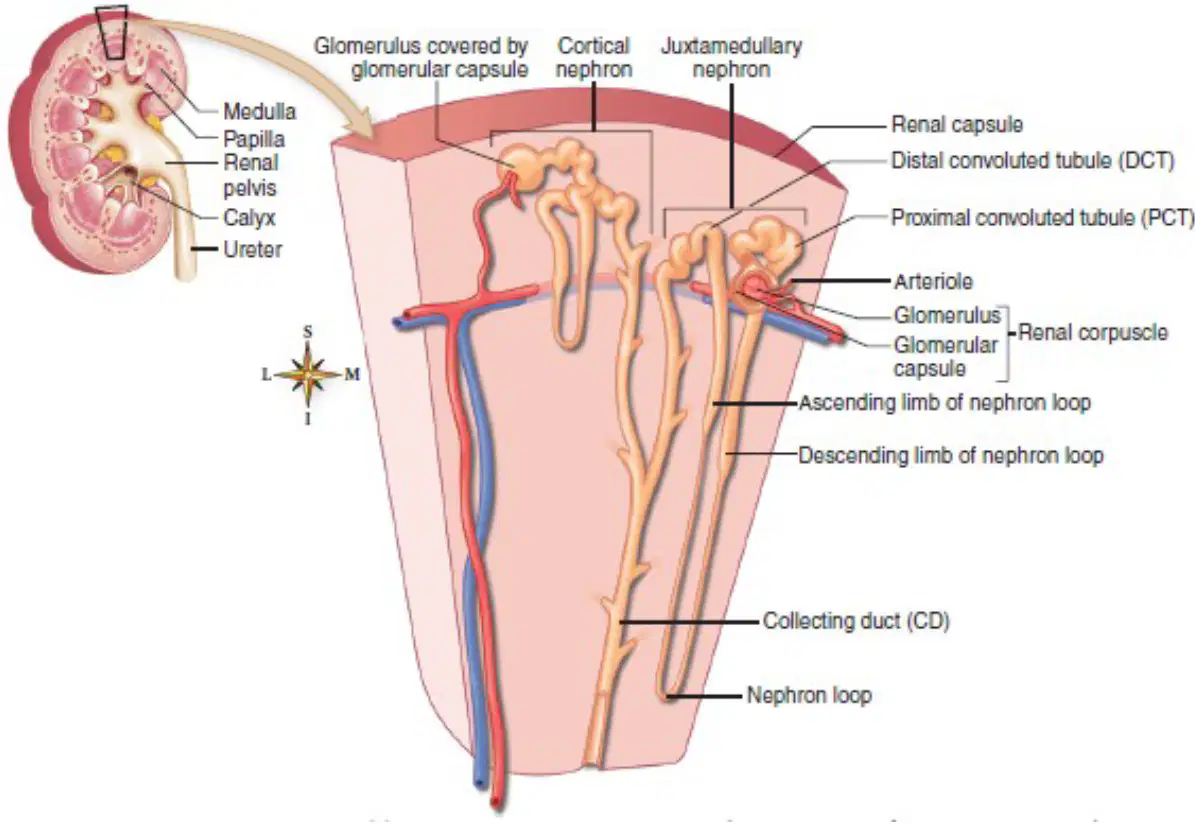
Refer to the diagram titled 'Location of Nephrons'. The distal convoluted tubule (DCT) is located after the ________ in the nephron.
nephron loop (loop of Henle)
proximal convoluted tubule (PCT)
renal corpuscle
collecting duct
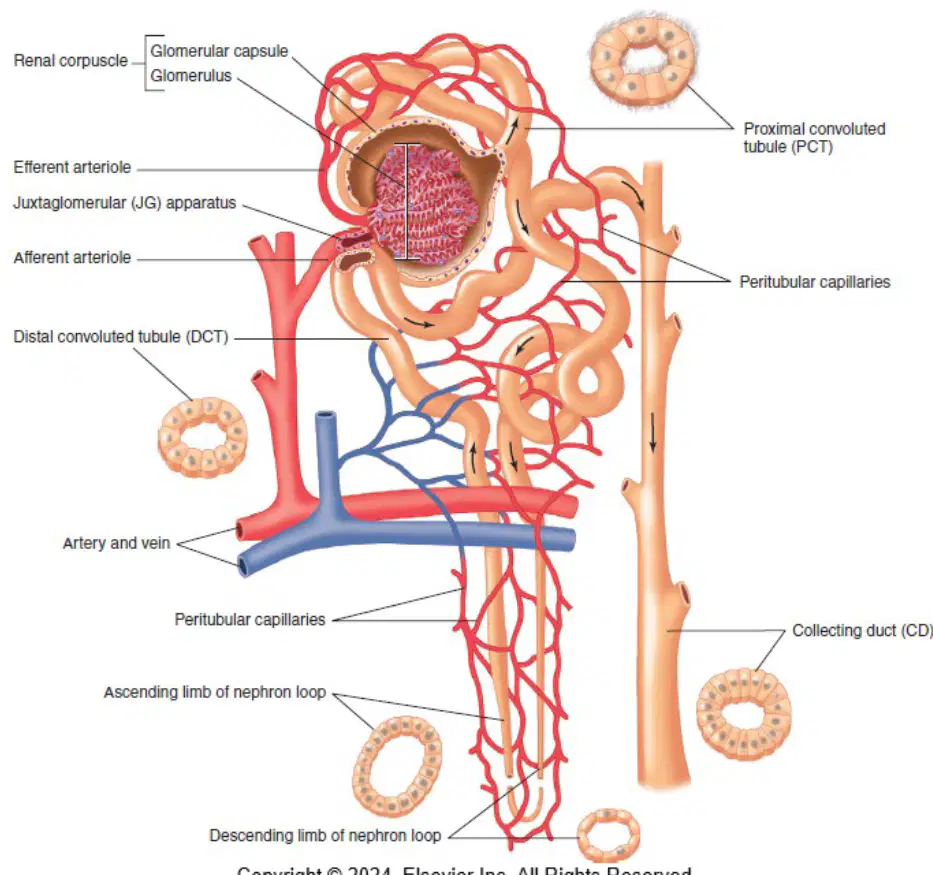
The function of the 'Collecting duct (CD)' in the nephron unit is:
to concentrate urine by reabsorbing water
to filter blood plasma
to secrete hormones
to produce red blood cells
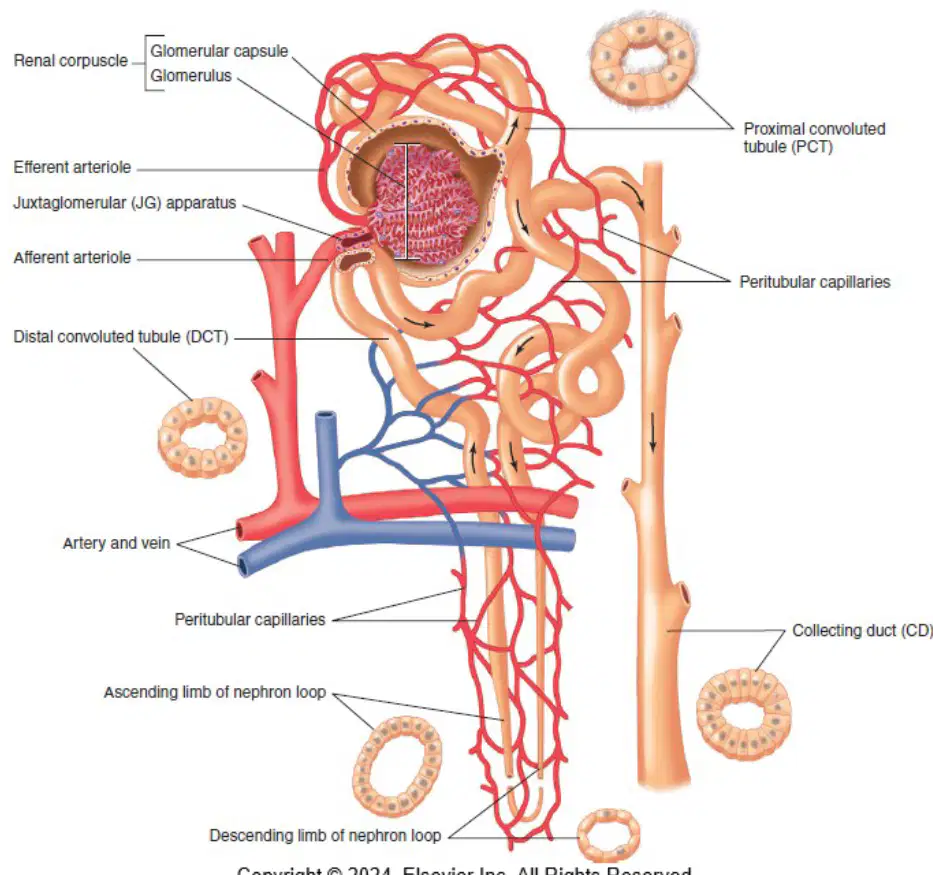
Which structure in the nephron unit is responsible for filtering blood to form urine?
Glomerulus
Loop of Henle
Collecting duct
Proximal convoluted tubule

Match the following nephron parts with their correct labels:
Glomerular capsule
Glomerular capsule
Distal convoluted tubule (DCT)
Distal convoluted tubule (DCT)
Ascending limb of nephron loop
Ascending limb of nephron loop
Juxtaglomerular (JG) apparatus
Juxtaglomerular (JG) apparatus
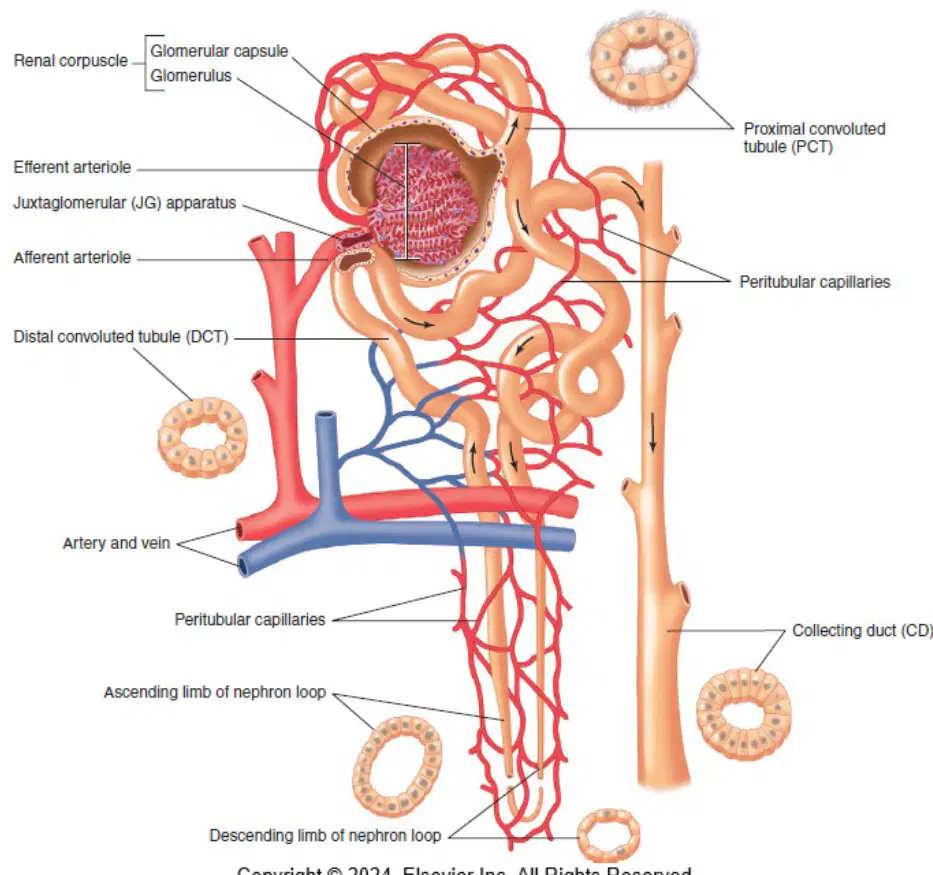
The 'Afferent arteriole' brings blood to which structure in the nephron unit?
Glomerulus
Loop of Henle
Collecting duct
Distal convoluted tubule

The 'Descending limb of nephron loop' is involved in the reabsorption of water.
True
False

Which part of the nephron is surrounded by peritubular capillaries?
Proximal convoluted tubule (PCT) and Distal convoluted tubule (DCT)
Loop of Henle (descending limb only)
Glomerulus
Collecting duct

The main function of the 'Juxtaglomerular (JG) apparatus' in the nephron unit is:
Regulation of blood pressure
Filtration of blood
Reabsorption of glucose
Secretion of erythropoietin

Which vessel carries blood away from the glomerulus?
Efferent arteriole
Afferent arteriole
Renal vein
Peritubular capillary
Fill in the blank: One of the functions of the kidney is to excrete ______ and nitrogenous wastes.
toxins
hormones
vitamins
enzymes
Fill in the blank: The kidney helps regulate levels of many ______ in blood.
chemicals
bones
muscles
organs
Fill in the blank: The kidney helps maintain ______ balance.
water
sugar
oxygen
protein
Fill in the blank: The kidney helps regulate blood ______ and volume.
pressure
sugar
temperature
oxygen
Fill in the blank: The kidney regulates red blood cell production by secreting ______.
erythropoietin
insulin
adrenaline
thyroxine
What process goes on continuously in renal corpuscles?
Filtration
Secretion
Absorption
Excretion
Glomerular blood pressure causes water and dissolved substances to filter out of glomeruli into which structure?
Bowman capsule
Loop of Henle
Collecting duct
Distal convoluted tubule
What is the normal glomerular filtration rate?
125 mL per minute
250 mL per minute
75 mL per minute
10 mL per minute
Which of the following is the normal glomerular filtration rate?
50 mL per minute
100 mL per minute
125 mL per minute
200 mL per minute
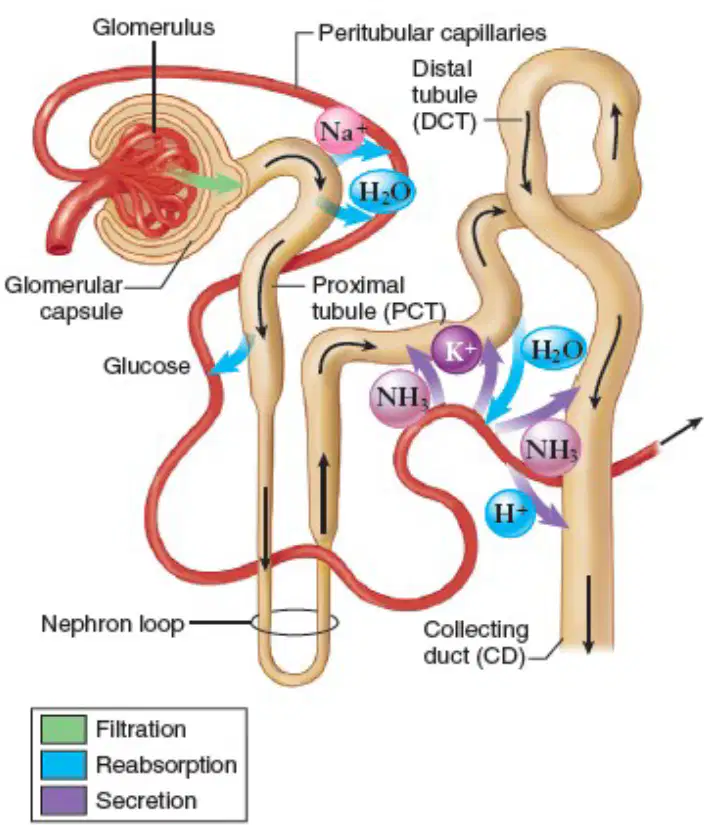
Refer to the diagram of the nephron in the 'Formation of Urine'. Which part is responsible for filtration?
Glomerulus
Proximal tubule (PCT)
Distal tubule (DCT)
Collecting duct (CD)
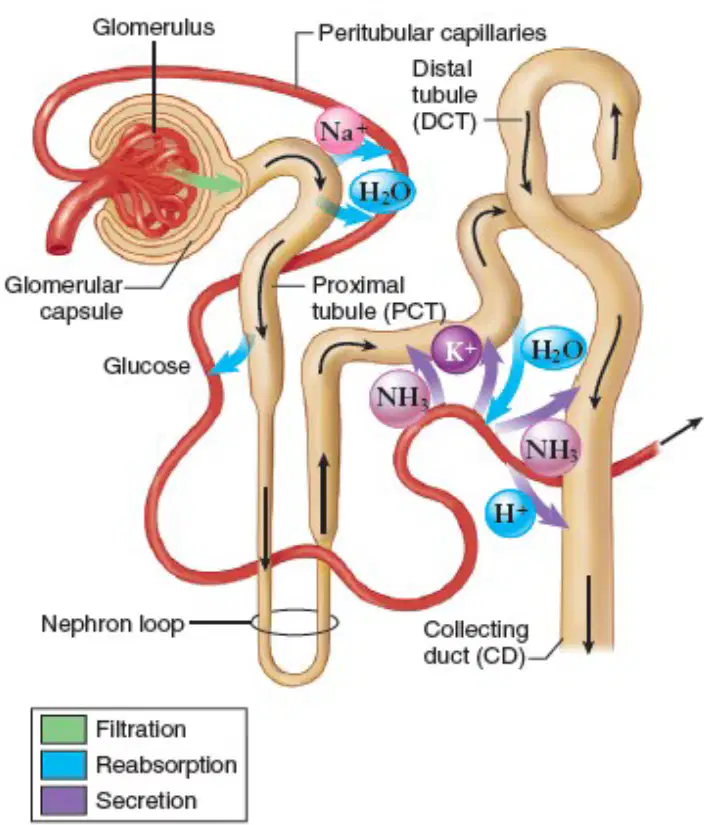
In the 'Formation of Urine' diagram, which process is represented by the blue arrows?
Filtration
Reabsorption
Secretion
Excretion
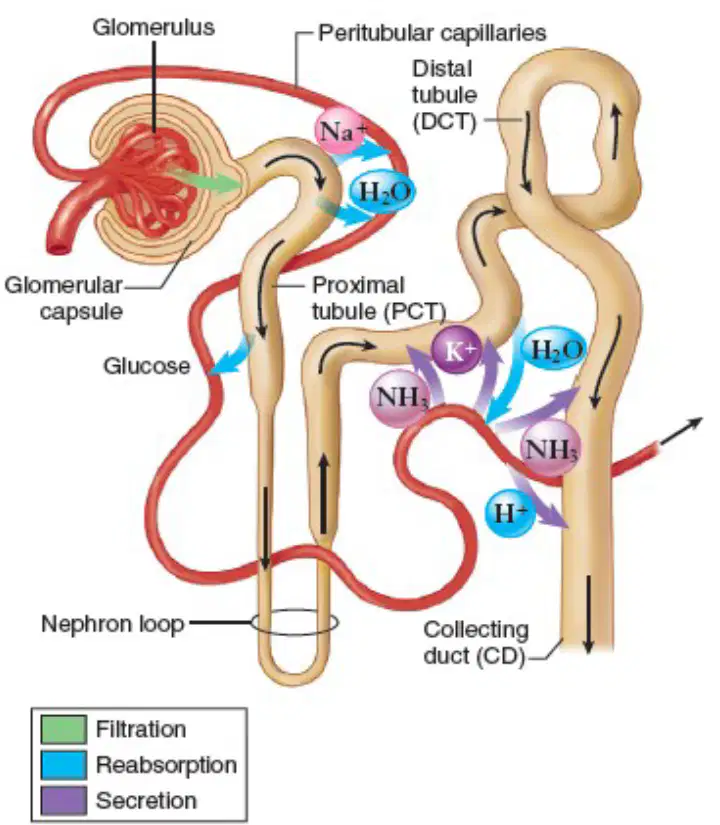
In the nephron diagram, what substance is reabsorbed in the proximal tubule (PCT)?
Glucose
Urea
Creatinine
Bilirubin
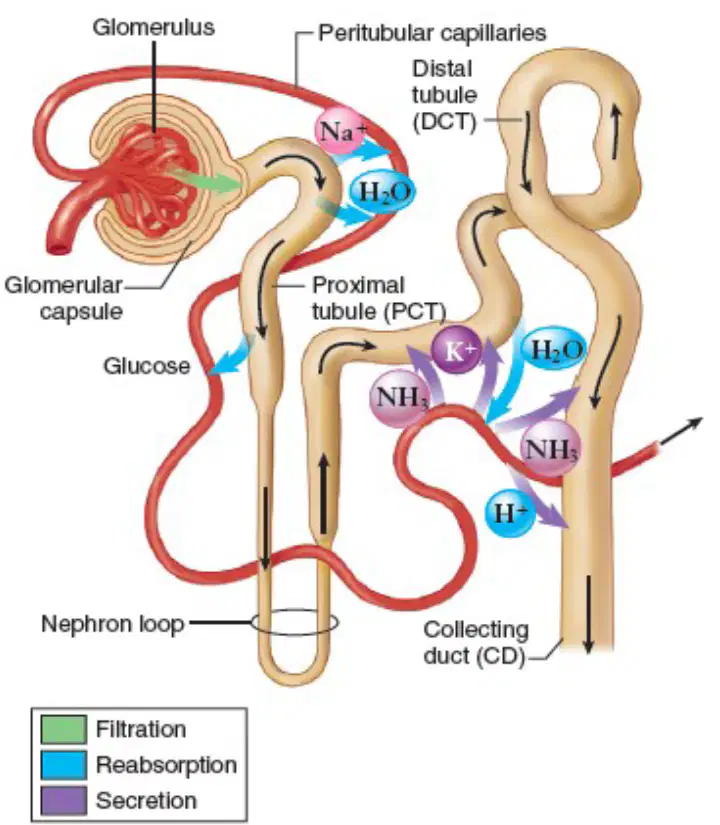
Match the following processes with their color codes as shown in the 'Formation of Urine' diagram:
Green
A
Blue
B
Purple
C
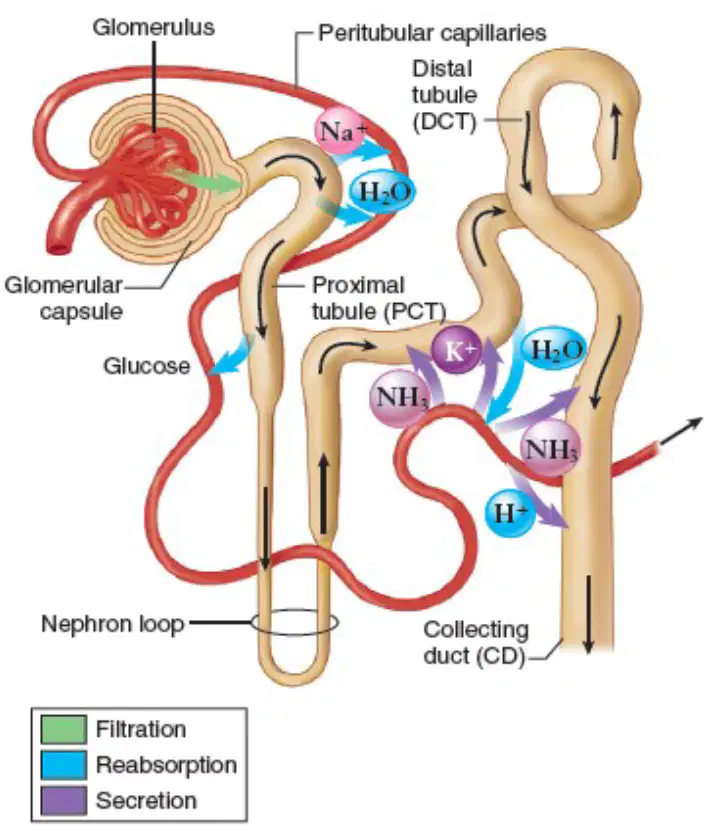
According to the diagram, which ion is secreted into the distal tubule (DCT)?
Na+
K+
Glucose
H2O
Fill in the blank: The movement of substances out of renal tubules into blood in ________ capillaries is called reabsorption.
peritubular
glomerular
pulmonary
hepatic
Which substances are reabsorbed during the process of reabsorption?
Water, nutrients, and ions
Proteins and fats
Only water
Only ions
Fill in the blank: Water is reabsorbed by ________ from proximal tubules.
osmosis
diffusion
active transport
filtration
Where does sodium reabsorption occur using countercurrent flow?
Proximal tubules
Henle loop
Distal tubules
Collecting duct
Countercurrent mechanisms keep the medulla hypertonic so that the kidney can reabsorb extra _____
water
glucose
urea
sodium

What is the name of the part of the kidney indicated by the red arrow in the diagram provided?
renal medulla
renal cortex
renal pelvis
ureter

part G is the
ureter
urethra
renal artery
renal vein

What is the tissue region labelled C called?
medulla
cortex
pelvis
capsule

What is the name of the part of the nephron indicated by the red arrow in the diagram provided?
descending loop of henle
ascending loop of henle
proximal convoluted tubule
distal convoluted tubule

the triangular divisions of the medulla of the kidney are called
renal cortex
renal pyramid
renal papilla
renal pelvis
What is the main function of the Loop of Henle?
Filtration of blood
Reabsorption of water and ions
Secretion of waste
Production of urine
Which structure in the kidney collects urine before it moves to the ureter?
Renal Cortex
Renal Medulla
Renal Pelvis
Renal Capsule
What are the structures in the kidneys that filter blood and produce urine?
Renal Cortex
Nephron
Ureter
Renal Pelvis
The innermost portion of the kidney.
renal capsule
renal cortex
renal medulla
renal pyramids
Which part of the nephron is responsible for the filtration of blood?
Loop of Henle
Distal Convoluted Tubule
Glomerulus
Collecting Duct

