
Font size
 Worksheets
2 Responses Muscular System
Total questions: 17
Worksheet time: 14mins
Which type of muscle fibre is primarily recruited during a long-distance run, such as a 5-mile race?
Type IIx
Type I
Type IIa
Type III
During a single session of high-intensity sprinting, which muscle fibre type is most heavily recruited?
Type I
Type IIx
Type IIa
Type IV
What is the main reason for increased blood flow to working muscles during exercise?
To remove lactic acid
To supply more oxygen and nutrients
To cool the muscles
To increase muscle size
Which of the following best describes a micro-tear in muscle tissue?
A complete rupture of the muscle
Small-scale damage to muscle fibres caused by exercise
A bruise on the muscle
A dislocation of the muscle
What typically happens to muscle temperature during a single session of vigorous exercise?
It decreases
It remains the same
It increases
It fluctuates randomly
Which muscle fibre type is most resistant to fatigue?
Type IIx
Type IIa
Type I
Type III
After a session of resistance training, what is the likely cause of muscle soreness experienced 24-48 hours later?
Accumulation of lactic acid
Micro-tears in muscle fibres
Dehydration
Loss of electrolytes
Which of the following is a direct effect of increased blood flow to muscles during exercise?
Decreased delivery of oxygen
Increased removal of carbon dioxide
Reduced muscle temperature
Decreased nutrient supply
During a 100-metre sprint, which muscle fibre types are predominantly recruited?
Type I only
Type IIa and Type IIx
Type IIa only
Type I and Type IIa
What is the typical temperature range (in Celsius) that muscle tissue can reach during intense exercise?
20–25°C
30–35°C
38–39°C
45–50°C
Which process helps repair micro-tears in muscle fibres after exercise?
Glycolysis
Protein synthesis
Photosynthesis
Respiration
What is the main benefit of increased muscle temperature during exercise?
It slows down enzyme activity
It increases the risk of injury
It enhances enzyme activity and muscle elasticity
It causes muscle fatigue
Which of the following best describes the recruitment of muscle fibres during a single exercise session?
All muscle fibres are recruited at once
Muscle fibres are recruited based on the intensity and duration of the activity
Only Type I fibres are ever recruited
Only Type IIx fibres are ever recruited
What is the primary function of Type IIa muscle fibres?
High endurance, low force production
High force, quick fatigue
Moderate force, moderate endurance
No force production
Which of the following is NOT a response of the muscular system to a single session of exercise?
Increased muscle temperature
Increased blood flow to muscles
Permanent increase in muscle size
Micro-tears in muscle fibres
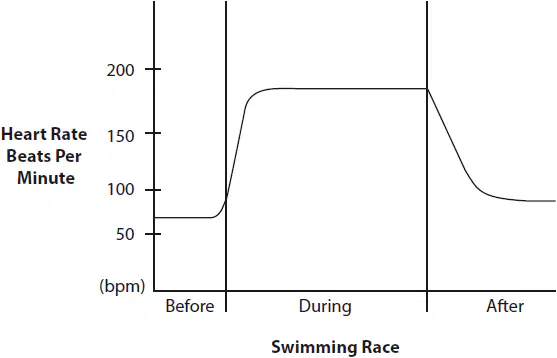
Blood flow around Penny's body will vary during exercise and rest.
Describe how blood flow is redistributed when Penny starts to swim.
(2 marks)

Michelle is a marathon runner. A marathon is a long-distance event.
During marathon running Michelle mainly uses one type of muscle fibre.
Type IIx muscle fibres only have a few mitochondria.
Explain one reason why having few mitochondria makes type IIx muscle fibres unsuitable for marathon running.
(4 marks)

