
 Worksheets
joaqui
Total questions: 197
Worksheet time: 2hrs 27mins


Which topic would an astronomer study?
pollution
galaxies
mountains
rain

Studying the speed and motion of an object would be under which branch of science?
Physics
Chemistry
Biology
Astronomy

The science of the origin, history, and structure of the Earth, and the physical, chemical, and biological changes that it has experienced or is experiencing.
Paleontology
Geology
Environmental Science
Meteorology

The study of the universe beyond the Earth's atmosphere.
Meteorology
Astrology
Oceanography
Astronomy
It is the study of plants.
Botany
Biomimetic
Zoology
Bioengineering
It is the application of principles of engineering on living organisms.
Biomimetic
Bioengineering
Biostatistics
Biology
It is the study of animals.
Zoology
Botany
Paleontology
Physics
It is the study of the function and behavior of genes.
Meteorology
Oceanography
Genetics
Mimetics

The science of the forms of life that existed in prehistoric or geologic periods.
Evolution
Paleontology
Entomology
Anthropology
Which branch of Science deals with the physical composition of the earth and its atmosphere?
Life Sciences
Earth Sciences
Physical Science
None of the above
Which area of Earth Science is the study the ocean?
Geology
Meteorology
Oceanology
Chemistry
Biology is the study of ______________________.
rock
stars
life
matter
A universally used system for locating points and indicating locations on Earth's surface
Coordinate System
Geographic coordinate system
Latitudinal System
Polar System
Using the geographic coordinate system, the distance of places can be measured in what Units?
kilometers
kilograms
degrees
liters
The equator is located in what latitude?
60o
20o
0o
45o
The following are bodies of water that surrounds the Philippines except:
Philippine Sea
West Philippine Sea
Celebes Sea
Carribean Sea
This is an Archipelago, a sovereign state in Southeast Asia in the Western Pacific Ocean.
The Philippines is rich in the following resources:
Water and Energy Resources only
Mineral, Agricultural and Energy Resources
Water and Energy resources, forest and agricultural and minerals
Water and Energy resources, biogas, landforms and aquatic animals
The following are examples of aquatic resources except:
Corals
Shellfish
Pearls
Coal
The metals that are rich in the Philippines are:
Nickel, mercury and gold
Cobalt, silver and gold
Iron, Vibranium and Zinc
Copper, Coal and Methane gas
Statement 1: Oil supply from the Philippines is pumped out of our own oil wells.
Statement 2: The gas field in the Philippines in the Camago-Malampaya in Palawan is estimated 3.7trillion ft3 of natural gas reserve.
Only Statement 1 is correct
Only statement 2 is correct
Both statements 1 and 2 are correct
Both statements 1 and 2 are wrong.

What is the distance of A from the equator?
2o
15o
20o
30o

What is the direction of A with reference to the equator?
East
North
South
West

What is the distance of A from the prime meridian?
3o
15o
30o
45o

What is the direction of A with reference to the prime meridian
East
North
South
West

What is the exact location of A
10 northo, 15 westo
20 northo, 30 westo
30 northo, 30 westo
40 northo, 50 westo
These are harmful materials found in the atmosphere, in the bodies of water and on land?
Pollution
Pollutants
Dirt
Junk
The following are natural sources of air pollutants except:
Volcanoes
Forest fires
Sea waves
Vehicular emissions
When oxides of sulfur and nitrogen are dissolved in rainwater in the atmosphere, this type of precipitation occurs:
Acid Crystallization
Crystal Rain
Acid Sublimation
Acid Precipitation
A type of pollution caused when waste heat is discharged into the environment and altering its temperature
Water Pollution
Air Pollution
Eutrophication
Thermal Pollution
The process in which water becomes richer in dissolved nutrients resulting in oxygen deficiency.
Air pollution
Water pollution
Eutrophication
Thermal pollution
The following are ways to solve ecological problems except:
Proper maintenance of vehicle engines.
Smoke belching should be allowed.
Industrial firms must utilize pollution control devices.
Paper and bottles may be recycled.

What is this science tool?
jar
beaker
thermometer
ruler


What does this science tool do?
used for heating a liquid
used for measuring volume of a liquid
used for measuring mass
used for measuring volume of a sound

Name this tool.
Thermometer
Triple Beam Balance
Pan Balance
Safety Goggles
Which of the following is a test tube?


erlenmeyer flask
test tube
graduated cylinder
beaker
Which of the following pieces of chemistry lab equipment produces a flame from gas that is used for heating substances?
Bunsen burner
induction cooker
crucible
stove
What is a mortar and pestle used for?
Crushing and grinding solids into a powder
Heating substances
Scooping up solids such as powder

What is this?
beaker
telescope
microscope
spring scale

What is this?
Triple Beam Balance
Graduated Cylinder
Overflow Can
Massometer

What is this?
barometer
compass
test tube
thermometer


What is this?
A Beaker
An Erlenmeyer Flask
A Test Tube
A Vial

What is this?
A Graduated Cylainder
A Spot plate
A Triple Beam Balance
A Test Tube Rack
The basic unit of length in the metric system is the
foot.
kilometer.
meter.
mile.
The SI unit of time is the
minute.
hour.
second.
day.
The SI unit of temperature is the
kelvin.
degree Celsius.
metric degree.
degree Fahrenheit.
What is an organized way to collect and record scientific observations?
data table
graph
using a scanner
The common tool used to measure length is the
graduated cylinder.
thermometer.
stopwatch.
meter stick.
Temperature is measured using a(n)
graduated cylinder.
ammeter.
thermometer.
barometer.
The basic SI unit for measuring mass in the metric system is
meter.
ounces.
liter.
gram.
What lab equipment would use to measure the mass of an object?
a beaker
a meter stick
a balance
a graduated cylinder
What would you use to measure the volume of a liquid?
thermometer
triple beam beam
graduated cylinder
test tube
One useful tool that may help a scientist interpret data by revealing unexpected patterns is a
graph.
variable.
theory.
law.
An organized way to collect and record scientific observations is with a(n
inference.
data table.
model.
operational definition.
What is a device used to observe small objects that cannot be seen with an unaided eye?
thermometer
balance
beaker
microscope
The number of digits in a measurement that are known with a certain degree of reliability are called
precision figures.
significant figures.
accuracy figures.
notation digits.
A description of how close a measurement is to the accepted or true value is (are)
precision.
significant figures.
accuracy.
International System of Units.
A description of how similar or close measurements are to each other is (are)
International System of Units.
accuracy.
significant figures.
precision.
An accepted international system of measurement, also known as SI units, is the
International System of Units
System of International Measurements
System of Intellectual Units
Units of International Measurement
The basic unit of volume in the metric system is
gram.
liter.
second.
meter.
How many liters are in 8000 milliliters?
8
.8
8,000,000
answer not given
How many significant figures are in 9020?
4
3
2
1
How many kilometers are in 62.001 centimeters?
62,001
.062001
6.2001
.00062001
How many significant figures are in 0.68010?
6
5
4
answer not given
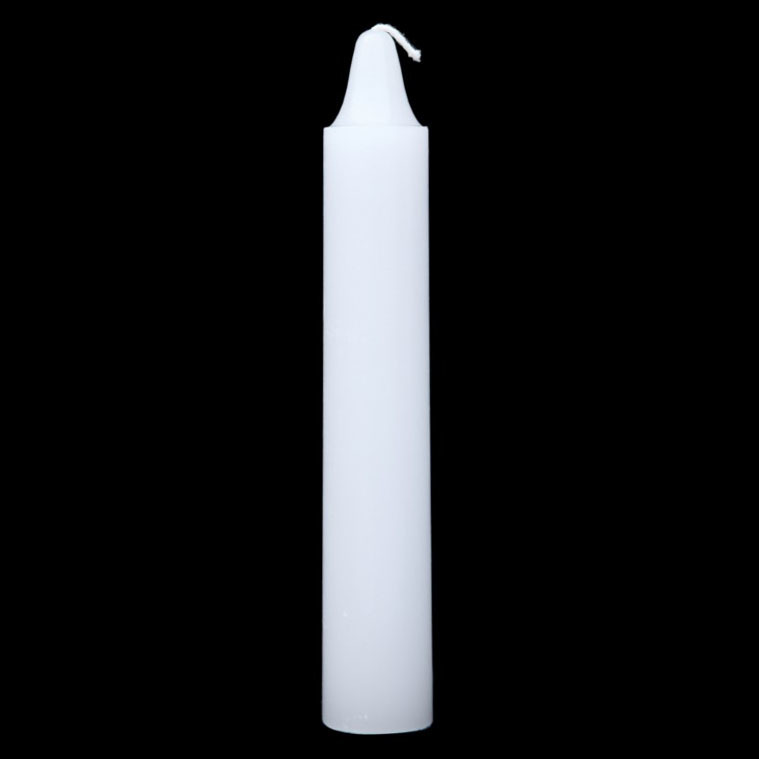
The white candle has a cylindrical shape. it has a diameter of about 3 cm. the length of the candle is 20 cm. It is hard, smooth and can be scratched. There is a white wick that extends from top to bottom.
Which is a qualitative observation from the sentence?
diameter of about 3 cm
length is 20 cm
hard, smooth and can be scratched

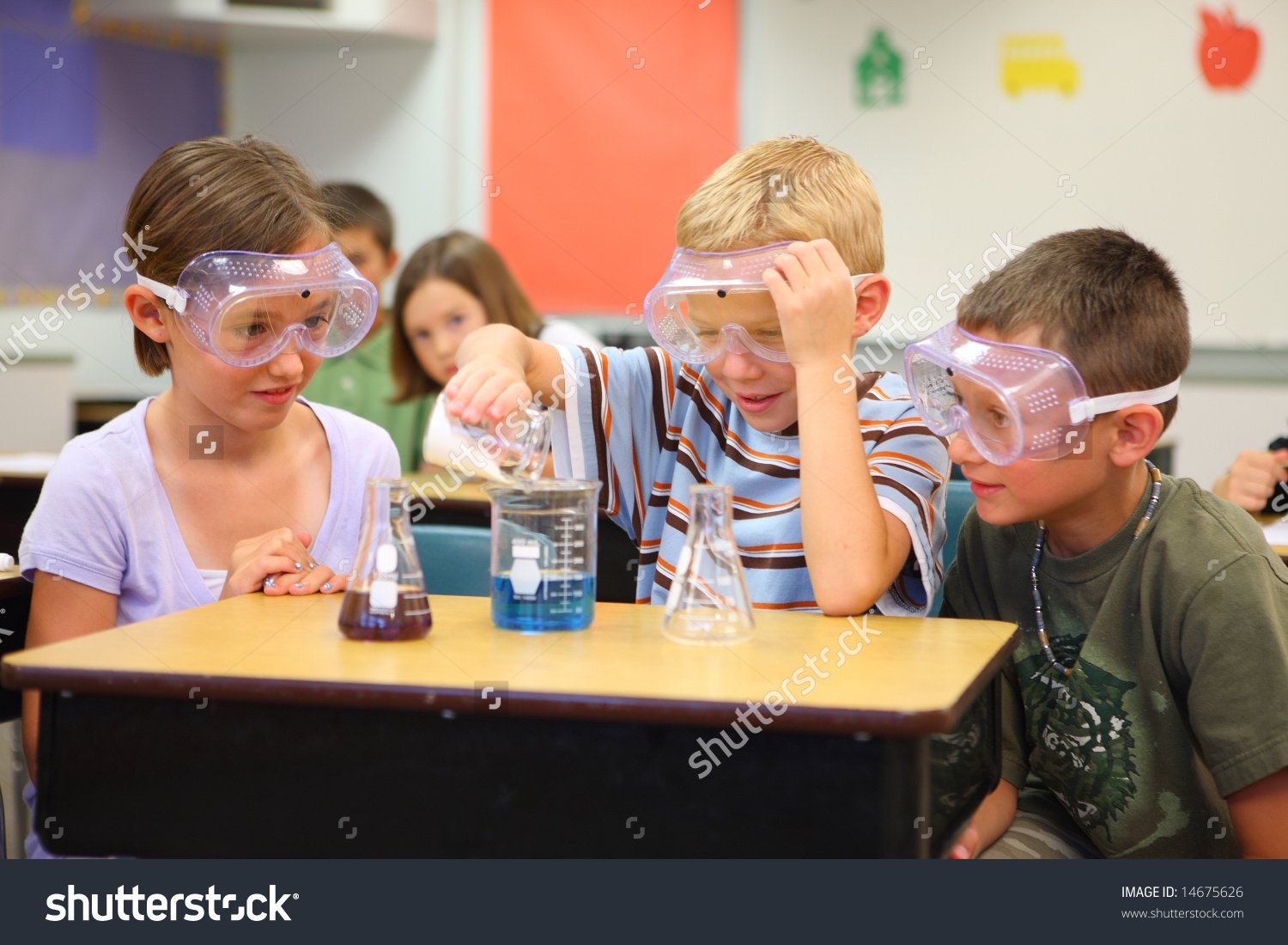

It is the series of steps in science that help you solve problems and answer question.
Inferring
Observing
Scientific Method
Hypothesizing
Which of the following scientific processes provides a tentative answer to an identified problem?
experimentation
hypothesizing
observation
prediction


_______________________.


______________________.
What is the amount of matter in an object?
Weight
Mass
Volume
Circumference
Which of the following describe weight?
the quantity of matter in an object.
the measure of an object's inertia.
the force exerted by gravity on an object's mass.
equal to the mass of an object.
A force of 90N is applied to each cart below, which one will have the highest acceleration?
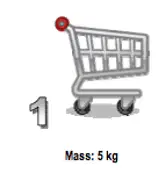
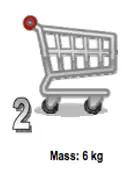

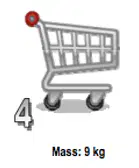

A basketball with a mass of 0.60 kg is accelerated with a force of 10.8 N. Ignore the air resistance.
What is the acceleration of the basketball to the nearest m/s2?
An object has a weight of 230N on the moon where the acceleration of gravity is 1.6 m/s2.
What is the mass of the object on earth?
140 kg
143.75 kg
368 kg
370 kg
An object of 25kg has a weight of 830N on an unknown planet.
What is the gravitational field strength of this planet?
33 m/s2
33.2 m/s2
21000 m/s2
20750 m/s2
You push on a tree with 20 N of force. If the tree doesn't move, the tree is pushing back on you with _____of force.
20N
40N
10N
70N
What Unit do we Measure Force in?
Newtons
Joules
Force
I don't know

In a tug of war the left team pulls with a force of 200N. The right team pulls with a force of 150N.
What is the resultant force on the robe?
350N to the left
350N to the right
50N to the left
50N to the right
When an object is traveling at constant speed, the resultant force on the object is (a)
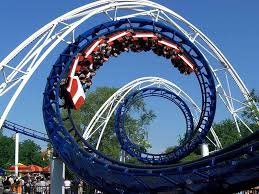
A roller coasters accelerates from an initial velocity of of 6.0 m/s to a final velocity of 70.0 m/s over 4.0 seconds.
Which is the correct calculation for acceleration?
4.06.0 − 70.0
4.070.0 − 6.0
70.0 − 6.04.0
6.0 − 70.04.0
You exert a force of 8.0 N on a object of mass 2.0 kg. The object experience a constant speed.
Which of the following is correct about the friction?
When the object is at constant speed, the resultant force, FR, is 0 N. Thus the Friction is 8.0 N.
When the object is at constant speed, the resultant force, FR, greater than 0 N. As FR=8.0 N − Friction , thus the Friction smaller than 8.0N.
When the object is at constant speed, the resultant force, FR, is 0 N. As FR=8.0 N − Friction , thus the Friction is 8.0N.
When the object is at constant speed, the resultant force, FR, smaller than 0 N. As FR=8.0 N − Friction , thus the Friction greater than 8.0N.

The mass of the box is 1.5 kg and subjected to the forces applied as shown in the diagram.
Which of the following explain the motion of the object?
Resultant force is greater than 0 N as FR=(50N+30N)−20N & FR=1.5kg×a . Thus, the box is experience an acceleration of 40 m/s2.
Resultant force is greater than 0 N to the right as FR=−20N +(50N+30N) & FR×1.5kg=a . Thus, the box is experience an acceleration of 90 m/s2 to the right.
Resultant force is greater than 0 N to the right as FR=(50N+30N)−20N & FR=1.5kg×a . Thus, the box is experience an acceleration of 40 m/s2 to the right.
Resultant force is equal 0 N as FR=(50N+30N)−20N & a=FR×1.5kg . Thus, the box is experience an acceleration of 90 m/s2.

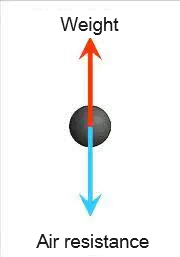
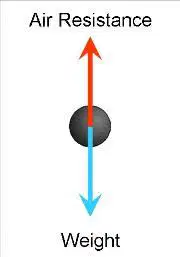
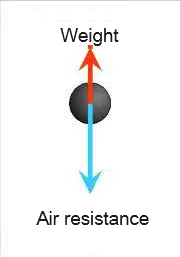
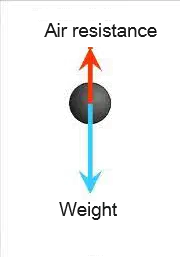
A coconut falling in the air with an acceleration. The length of the arrow represent the magnitude of the force.
Which diagram shows the correct free body diagram?
Which of the following can use energy to make food and doesn't rely on other organisms?
Consumer
Producer
Herbivore
Carnivore
Which of the following animals are carnivores?


Which of the following is a diagram that shows the path of energy transfer from producers to consumers (simple, doesn't show multiple things that an organism eats).
Decomposer
Food web
Ecosystem
Food chain

Which of the following is an organism that gets energy and nutrients by breaking down the remains of other organisms?
Omnivore
Herbivore
Decomposer
Producer

The animals above are consumers that only eat plants. That means that these organisms are ____________________.
Producers
Food webs
Herbivores
Carnivores

The diagram above is the feeding relationship among organisms in an ecosystem. It is more complicated and shows several different things that organisms eat.
Food web
Dichotomous key
Consumer
Food chain
A consumer is an organism that eats other organisms. Which of the following are examples of consumers? (There will be more than one right answer.)
Producer
Herbivore
Carnivore
Omnivore
There are creatures that eat both plants an animals. (Humans are examples of this, as are chickens, bears, and pigs.) What is the vocab word that describes them?
Decomposer
Omnivore
Food chain
Herbivore

Based on its teeth (sharp and made for ripping flesh), what kind of a consumer would you guess this animal is?
Hebivore
Carnivore
Omnivore
She's vegan
Which of the following organisms are consumers?


What does it mean to classify living things?
To group them based on similar characteristics
To give them names
To rank them from most to least important
To describe them
*sweating to cool the body and maintain a constant internal temperature.
*drink water to keep hydrated and to maintain water balance in the body
*excrete toxic wastes to maintain a clean bloodstream
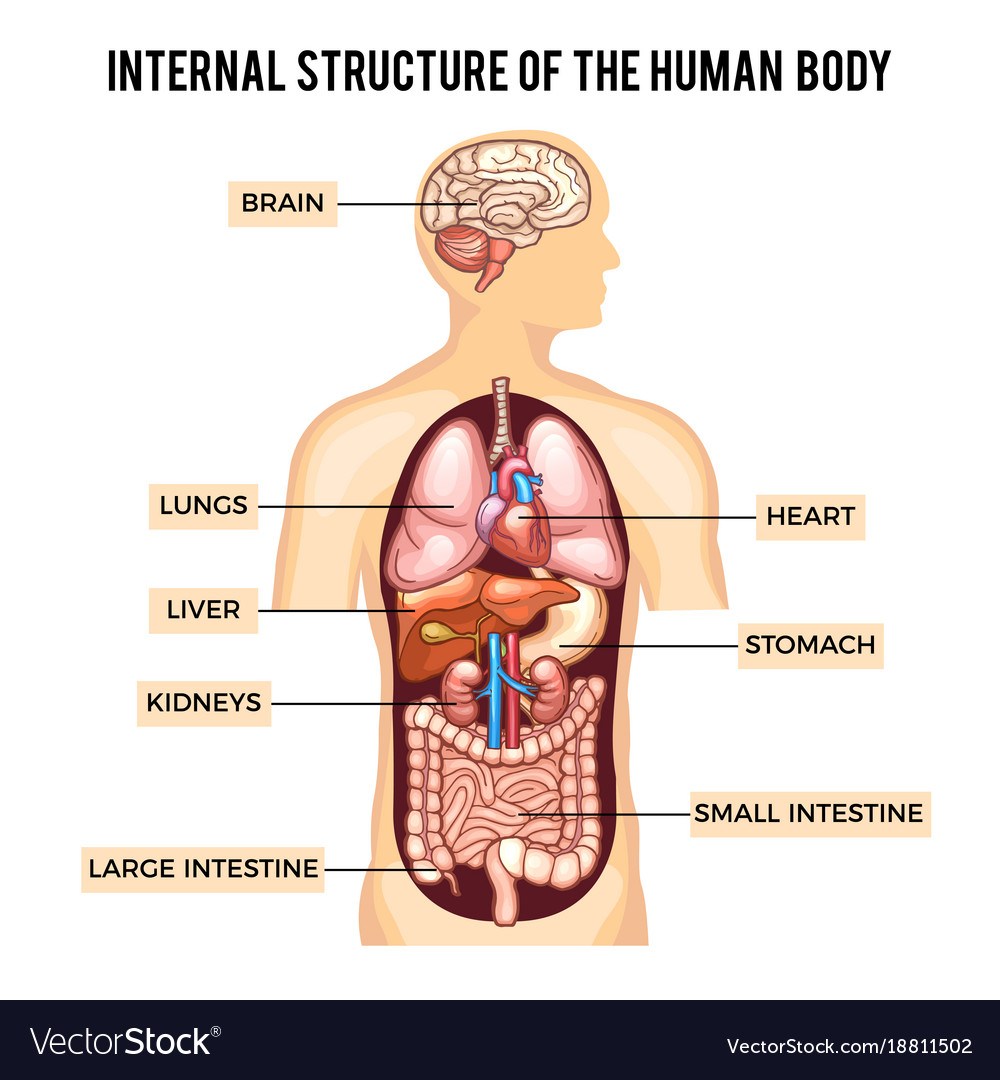
What is an organ?
A group of tissues that work together to perform closely related functions.
the network of nerve cells and fibers that transmits nerve impulses between parts of the body.
all of the bones and muscles in your body and responsible for body structure and movements.
responsible for providing your body with nutrients from food.
The nervous system is made up of which of the following organs?
brain, nerves and spinal cord
cells, lungs and heart
heart, blood vessels and blood
skin, tissues and muscles
The point on earth's surface, directly above the focus (or hypocenter) is called the __________________.
epicenter
fault
seismic wave
earthquake place

What is the Earth's outer most layer made of solid rocks?
crust
mantle
outer core
inner core

What is the Earth's layer that is made up of the upper most part of the mantle and the crust?
hydrosphere
lithosphere
continental crust
tectonic faults

What is the Earth's layer that is made of hot, soft rocks ?
crust
mantle
outer core
inner core

What is the Earth's layer that is made of hot, liquid metal (iron and nickel)?
crust
mantle
outer core
inner core

What is the Earth's layer that is made of hot, solid metal (iron and nickel)?
crust
mantle
outer core
inner core

What are the parts of the Earth's crust that move because of convection currents in the mantle?
continents
oceans
tectonic plates
faults

What is an opening in the Earth's crust where molten lava, ash, and gases comes out of?
mountain
hill
volcano
mantle

What is a sudden movement of the Earth's crust?
volcano
crustquake
tectonic fault
earthquake

What are the breaks in Earth's crust where rocks can move past each other?
tectonic plates
earthquakes
faults/plate boundaries
lithosphere

Which fault is it when tectonic plates move away form each other?
divergent
convergent
transverse

Which fault is it when tectonic plates move past each other?
divergent
convergent
transverse

Which fault is it when tectonic plates move toward each other?
divergent
convergent
transverse

What is the layer of earth labeled A?
(a)
What is the layer of earth labeled B?
(a)
What is the layer of earth labeled C?
(a)
What is the layer of earth labeled D?
(a)

What is the supercontinent that is was on earth 300 million years ago?
Pangea
supercontinents
continents
landmasses

Based on the diagram, which evidence best supports the idea that the landmasses on Earth were once in these position?
Fossil evidence of animals and plants are found in different continents.
Animals and plants are found all over the world.
Every country in the world has plants.
Continents have matching mountains.
Chopping firewood
Chemical
Physical
Cooking an egg
Chemical
Physical
Melting Chocolate
Chemical
Physical
Evaporating Water
Chemical
Physical
No new substance created
Chemical
Physical
New substance created
Chemical
Physical
Breaking a glass
Chemical
Physical
Burning wood
Chemical
Physical
Bike rusting
Chemical
Physical
Crumpling tin foil
Chemical
Physical
Baking a cake
Chemical
Physical
Crushing a can
Chemical
Physical
Boiling water
Chemical
Physical
Milk going sour
Chemical
Physical
Digesting food
Chemical
Physical
Shredding paper
Chemical
Physical
Apple rotting
Chemical
Physical
Fireworks
Chemical
Physical
Melting Wax
Chemical
Physical
Chopping firewood
Chemical
Physical
How can you tell the difference between a physical and a chemical change?
Your response should be in 2-3 complete sentences.
What are the 3 states of matter?
Solids
Liquids
Particles
Gases
What is matter?
Anything with mass
Nothing
A Scientific Law
Anything that takes up space
What is volume?
The mass per unit volume of a substance
The amount of space a sample of matter occupies
The amount of matter in an object
The ability of one material to dissolve in another
What is solubility?
The mass per unit volume of a substance
The amount of space a sample of matter occupies
The amount of matter in an object
The ability of one material to dissolve in another
What is density?
The mass per unit volume of a substance
The amount of space a sample of matter occupies
The amount of matter in an object
The ability of one material to dissolve in another
What is mass?
The mass per unit volume of a substance
The amount of space a sample of matter occupies
The amount of matter in an object
The ability of one material to dissolve in another
_________ is a state of matter with a definite shape and volume.
A solid
A liquid
A gas
___________ is a state of matter with a definite volume but not a definite shape.
A solid
A liquid
A gas
__________ is a state of matter without a definite shape or volume.
A solid
A liquid
A gas

What state are the particles are shown in the image?
Solid
Liquid
Gas

What state are the particles are shown in the image?
Solid
Liquid
Gas

What state are the particles are shown in the image?
Solid
Liquid
Gas
What is a physical property?
Characteristics of matter that can be observed without changing the identity of the substances that make it up
The ability or inability of a substance to combine with or change into one or more new substances
What are examples of physical properties?
Mass and Weight
Volume
Density
Solubility
What are examples of chemical properties?
Flammability
Ability to rust
Copper turning green
Fruit rotting when exposed to oxygen

