
NEW
Font size
 Worksheets
Checking Shim Clearance on an Engine
Total questions: 39
Worksheet time: 20mins
Why is shim clearance important in an engine?
It ensures proper valve lash for correct valve operation, engine performance, and longevity.
It increases fuel consumption.
It reduces engine oil usage.
It makes the engine quieter.
What is the effect of thermal expansion on engine components?
Components shrink when hot
Components expand when hot, requiring a necessary gap to prevent valves from being held open
Components remain the same size
Components melt
Fill in the blank: The small gap allows engine oil to _______ the contact surfaces between the cam lobe and the tappet.
lubricate
corrode
block
cool
Over time, what can alter the shim clearance in an engine?
Valve train components wear
Oil changes
Spark plug replacement
Air filter cleaning
Which tool is absolutely crucial for checking shim clearance and provides specific valve clearance specifications for your engine?
Feeler Gauges
Factory Service Manual
Torque Wrench
Magnetic Pickup Tool
What is the purpose of feeler gauges when checking shim clearance?
To tighten bolts
To measure the gap between the cam lobe and the valve tappet/bucket
To clean engine parts
To record measurements
Name two basic hand tools you might need to remove engine covers and access the valve train when checking shim clearance.
Sockets, wrenches, screwdrivers
Pliers, hammers, chisels
Files, sandpaper, glue
Measuring tape, calipers, protractor
Why is it important to ensure the engine is completely cold before measuring valve clearances?
Valve clearances are always measured when the engine is at ambient temperature, as the measurements will be inaccurate if the engine is warm due to thermal expansion.
A cold engine prevents oil from leaking during measurement.
A warm engine can cause the spark plugs to misfire during measurement.
Measuring on a cold engine ensures the battery does not drain quickly.
Which of the following is NOT a step in accessing the valve train?
Remove any components blocking access to the valve cover
Carefully remove the valve cover
Start the engine and let it idle
Follow the service manual's instructions for bolt removal patterns
What should you draw to help keep track of your valve measurements?
A diagram of your cylinder head, noting the intake and exhaust valves for each cylinder.
A list of random numbers for each valve.
A chart of engine oil types.
A sketch of the car's exterior.
To position the engine for measurement, you need to rotate the crankshaft to position the cam lobe correctly for each valve. What is this position called?
Top Dead Center (TDC)
Bottom Dead Center (BDC)
Valve Overlap Position
Ignition Advance Position
Which tool is used to measure the clearance between the cam lobe and the valve tappet/bucket?
Feeler gauge
Vernier caliper
Torque wrench
Dial gauge
What is the ideal feel when using the 'Slight Drag' method with a feeler gauge?
Loose fit
Excessive force required
Slight drag as you slide the gauge in and out
No resistance at all
In the 'Go/No-Go' method, what should happen with the 'go' side of the gauge?
It should not slide in
It should slide in
It should require excessive force to insert
It should be loose
When recording measurements, you should note whether the clearance is within the specified range, too tight, or too loose.
True
False
What is the first step in adjusting valve clearance using the Shim-Under-Bucket/Shim-Over-Bucket System?
Remove Tappet Buckets and Shims
Remove Camshafts
Measure Existing Shims
Obtain New Shims
What tool should you use to accurately measure the thickness of the shims you just removed?
Micrometer
Ruler
Caliper
Protractor
What is the formula for calculating the new shim size?
(Specified Clearance - Measured Clearance) + Old Shim Size
(Measured Clearance - Specified Clearance) + Old Shim Size
(Old Shim Size - Measured Clearance) + Specified Clearance
(Measured Clearance + Specified Clearance) - Old Shim Size
If your specified clearance is 0.20mm, your measured clearance was 0.15mm (too tight), and your old shim was 2.80mm, what is the new shim size?
2.75mm
2.85mm
2.80mm
2.70mm
If your specified clearance is 0.20mm, your measured clearance was 0.25mm (too loose), and your old shim was 2.80mm, what is the new shim size?
2.85mm
2.75mm
2.80mm
2.90mm
Shims are available in very small increments such as 0.025mm or 0.05mm.
True
False
Why is it important to re-check the valve clearances after installing new shims, tappet buckets, and camshafts?
To verify they are now within specification and to ensure accuracy and prevent issues.
To increase the engine's horsepower immediately.
To avoid having to change the oil again.
To make the engine run at a lower temperature.
Which of the following is NOT listed as an important consideration when adjusting valve clearance?
Cleanliness
Lubrication
Speed
Patience
What should you always follow for cam caps, valve cover bolts, and any other fasteners you loosen during the process?
Torque specifications in your service manual
The tightest setting possible
Whatever feels right by hand
The order you remember from last time
What does 'Cmeasured' represent in the context of calculating new shim thickness for engine valve adjustments?
Your measured valve clearance (the value you got with the feeler gauge).
The thickness of the new shim to be installed.
The recommended valve clearance from the manufacturer.
The thickness of the old shim currently installed.
What does 'Cspec' represent in the context of calculating new shim thickness for engine valve adjustments?
The specified or desired valve clearance (from your engine's service manual).
The current thickness of the installed shim.
The measured clearance between the cam and the shim.
The recommended oil viscosity for the engine.
What does 'Sold' represent in the context of calculating new shim thickness for engine valve adjustments?
The thickness of the old shim that you removed from the valve.
The thickness of the new shim to be installed.
The clearance between the cam and the valve bucket.
The diameter of the valve stem.
What does 'Snew' represent in the context of calculating new shim thickness for engine valve adjustments?
The thickness of the new shim you need to install.
The current valve clearance measurement.
The thickness of the old shim removed.
The recommended valve gap from the manufacturer.
Fill in the blank: The formula for a thinner shim is __.
Snew = Sold - (Cspec - Cmeasured)
Snew = Sold + (Cspec + Cmeasured)
Snew = Sold + (Cmeasured - Cspec)
Snew = Sold - (Cmeasured + Cspec)
Given the following values: Specified Intake Clearance (Cspec): 0.15 mm, Measured Intake Clearance (Cmeasured): 0.10 mm (too tight), Old Shim Thickness (Sold): 2.70 mm. Calculate the new shim thickness (Snew).
2.65 mm
2.75 mm
2.60 mm
2.80 mm
If the specified exhaust clearance (Cspec) is 0.25 mm, the measured exhaust clearance (Cmeasured) is 0.30 mm (too loose), and the old shim thickness (Sold) is 2.80 mm, what is the new shim thickness (Snew)?
2.85
2.75
2.80
2.90
If Cmeasured = 0.20 mm and Cspec = 0.25 mm, what is the new shim thickness (Snew)?
2.65
2.55
2.75
2.35
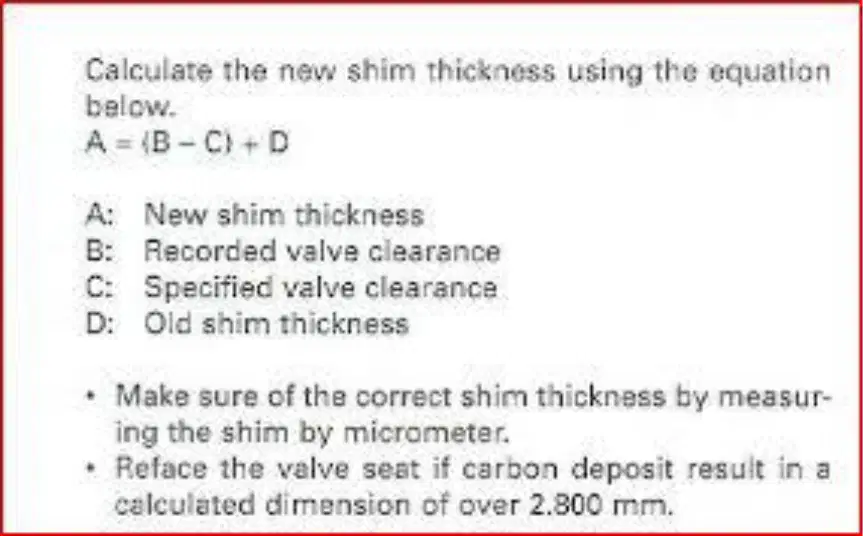
What is the formula to calculate the new shim thickness (A) as given in the worksheet?
A = (B - C) + D
A = (B + C) - D
A = (C - B) + D
A = (B - D) + C
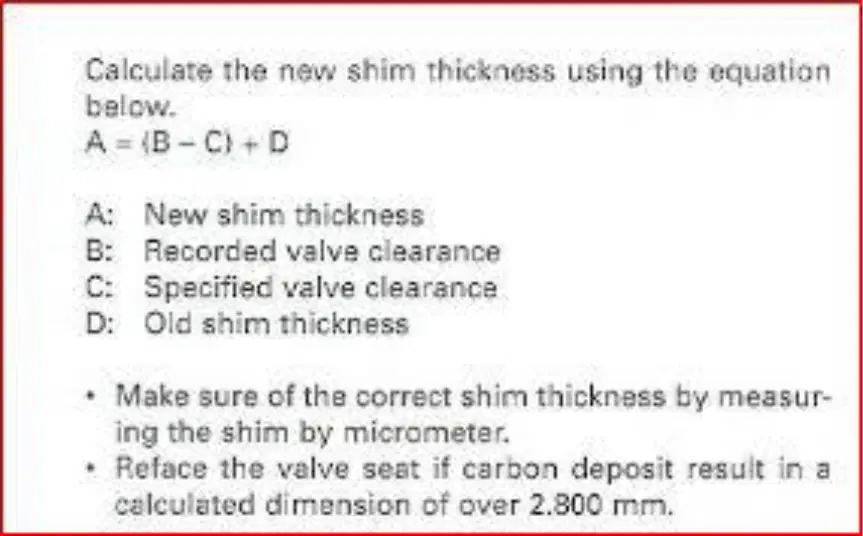
What does 'A' represent in the formula A = (B - C) + D?
New shim thickness
Old shim thickness
Thickness of part C
Value of D
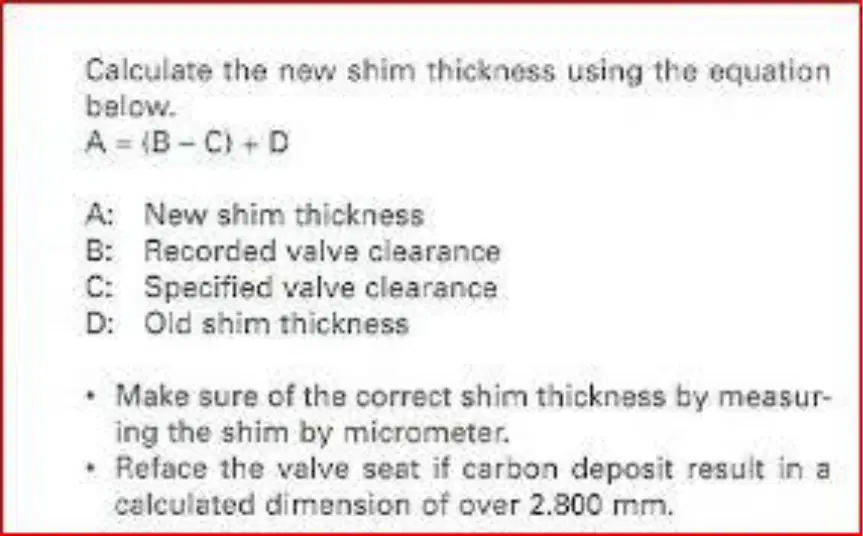
What does 'B' represent in the formula A = (B - C) + D?
Recorded valve clearance
Measured camshaft lift
Engine oil pressure
Cylinder bore diameter
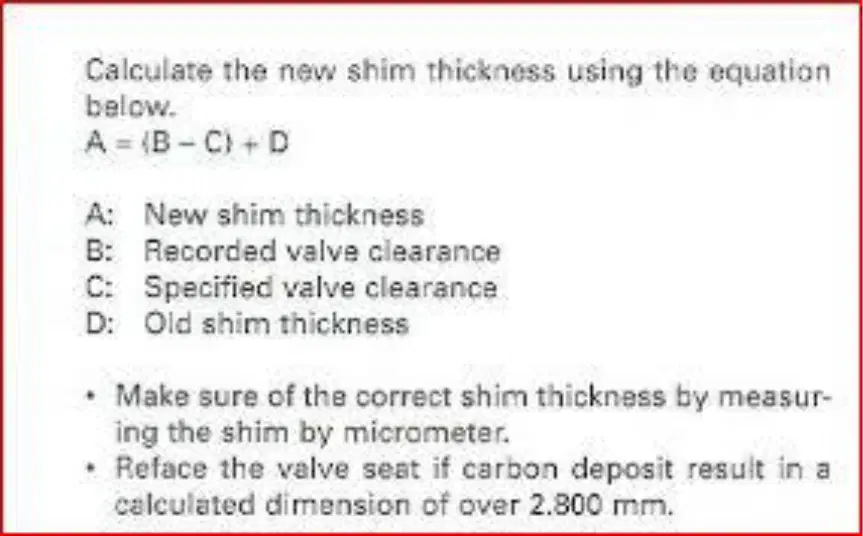
What does 'C' represent in the formula A = (B - C) + D?
Specified valve clearance
Cylinder bore
Crankshaft length
Combustion pressure
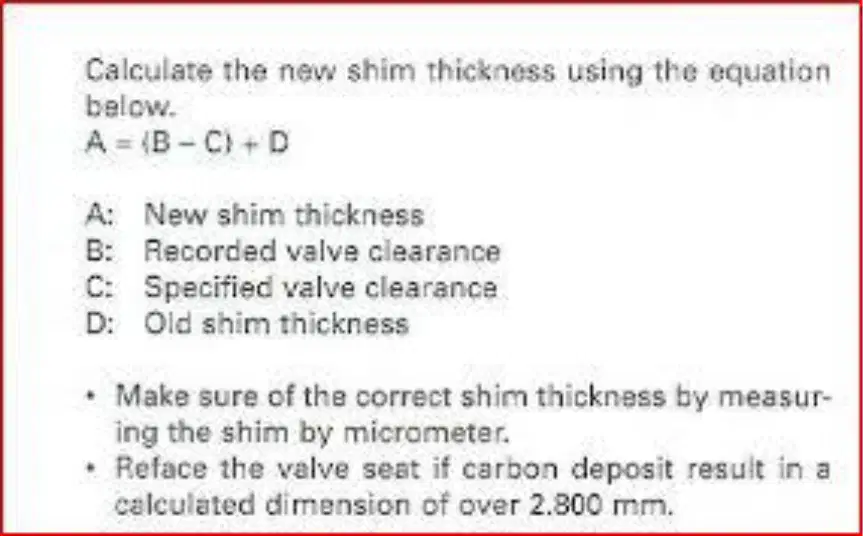
What does 'D' represent in the formula A = (B - C) + D?
Old shim thickness
New shim thickness
Thickness of gasket
Diameter of piston
If the valve was too tight, what kind of shim do you need?
A thinner shim.
A thicker shim.
The same size shim.
No shim at all.
If the valve was too loose, what kind of shim do you need?
A thicker shim.
A thinner shim.
The same size shim.
No shim at all.

