
 Worksheets
Classifying Matter / Elements of the Periodic Table
Total questions: 52
Worksheet time: 26mins
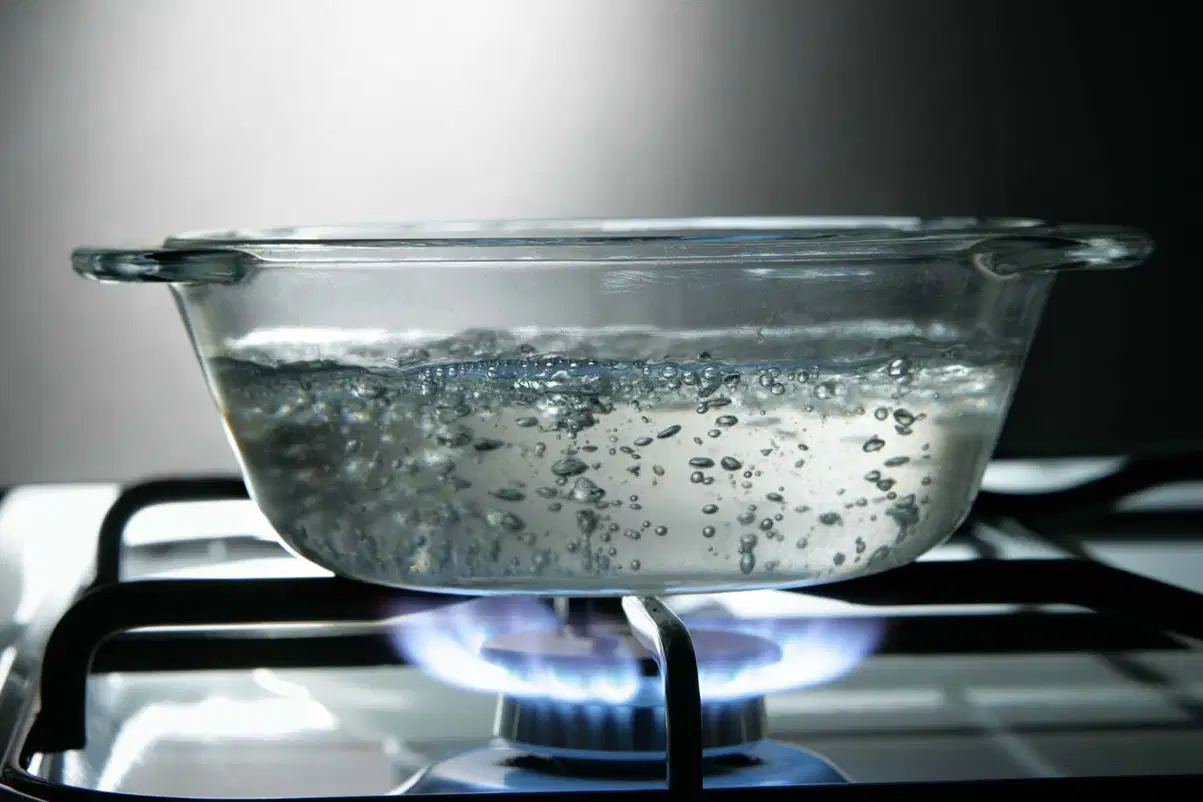
What is the temperature at which a substance changes states from a liquid to a gas?
Boiling Point
Classify
Conductor
Insulator
What is tending to break rather than to flex or bend?
Brittle
Conductivity
Density
Luster
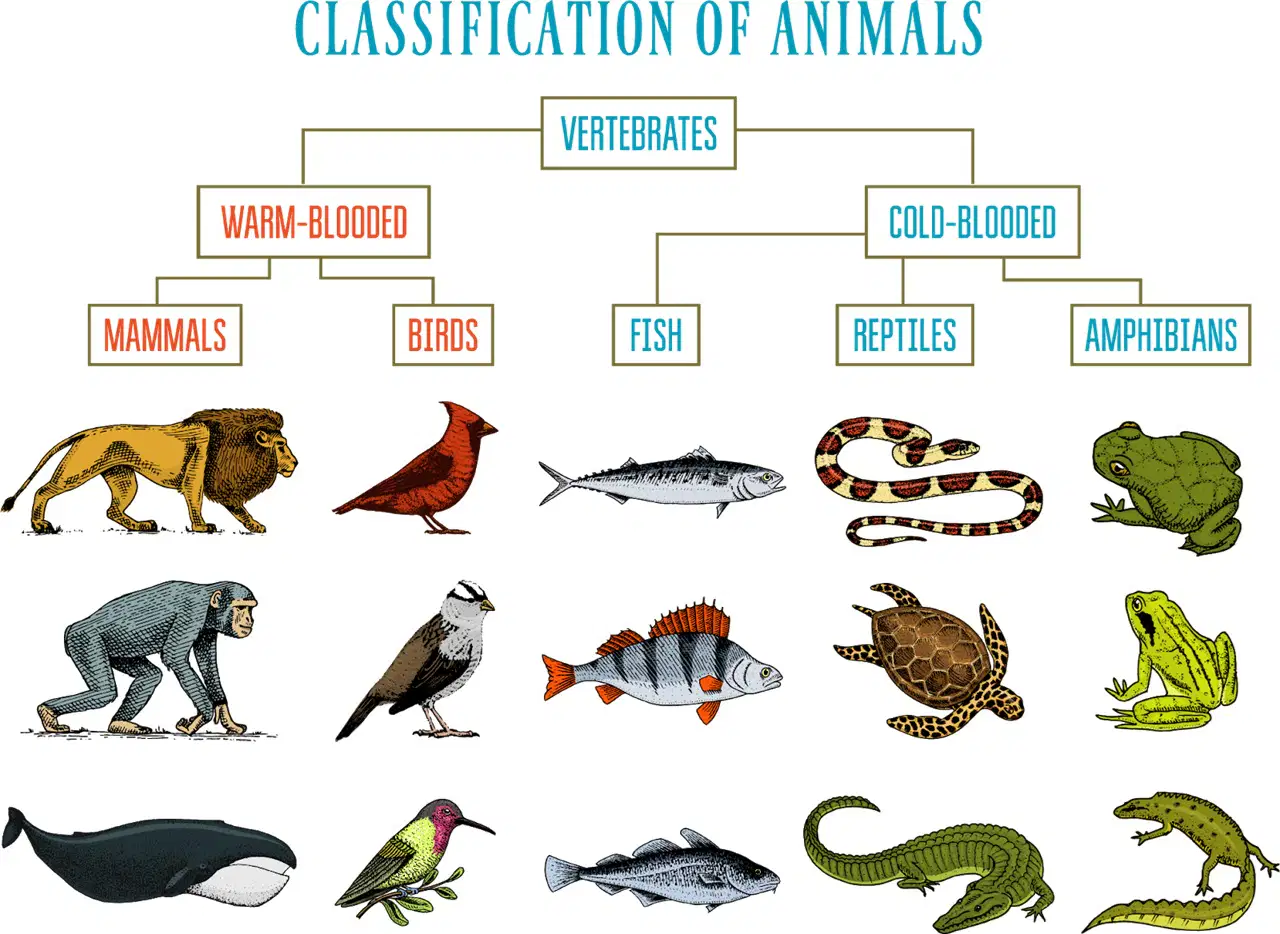
What is to sort or put into groups based on similar and dissimilar physical, chemical, or biological characteristics
Classify
Conductor
Insulator
Magnetism
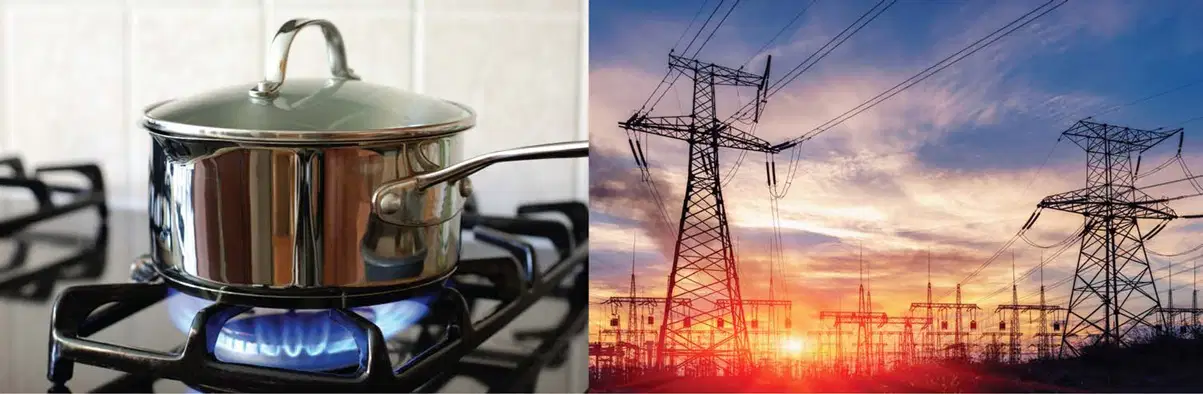
What is a physical property that describes the ability of a substance to transfer heat or electrical energy?
Conductivity
Density
Luster
Malleability

What is a substance that allows the flow of electrical charge or transfers thermal energy through matter?
Conductor
Insulator
Magnetism
Matter

What is the amount of matter in a given space or volume?
Density
Luster
Malleability
Melting Point
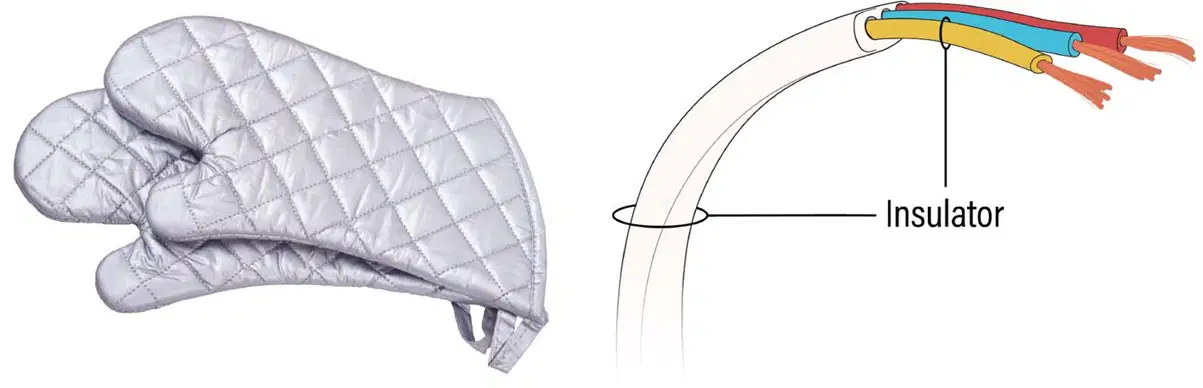
What is a material that does not conduct heat or electric current?
Insulator
Magnetism
Matter
Metalloids

What is a physical property that describes the way the surface of a substance shines or reflects light, ranging between metallic (shiny) and nonmetallic (dull)?
Luster
Malleability
Melting Point
Metals

What is a force that attracts or repels objects toward or away from each other; caused by electrons in a substance?
Magnetism
Matter
Metalloids
Nonmetal
What is a physical property that describes the ability of a material to be permanently reshaped without breaking or cracking?
Malleability
Melting Point
Metals
Physical Property

What is anything that has volume and mass?
Matter
Metalloids
Nonmetal
Semiconductor
What is the temperature at which a substance changes states from a solid to a liquid?
Melting Point
Metals
Physical Property
Solubility

What are elements that have properties of both metals and nonmetals; sometimes referred to as semiconductors?
Metalloids
Nonmetal
Semiconductor
Element

What are elements that are typically solid, shiny, malleable, and good conductors of heat and electricity; includes most elements
Metals
Physical Property
Solubility
Periodic Table of Elements

What are elements that are typically not shiny, not malleable, and poor conductors of heat and electricity; usually gases or brittle solids?
Nonmetal
Semiconductor
Element
Properties
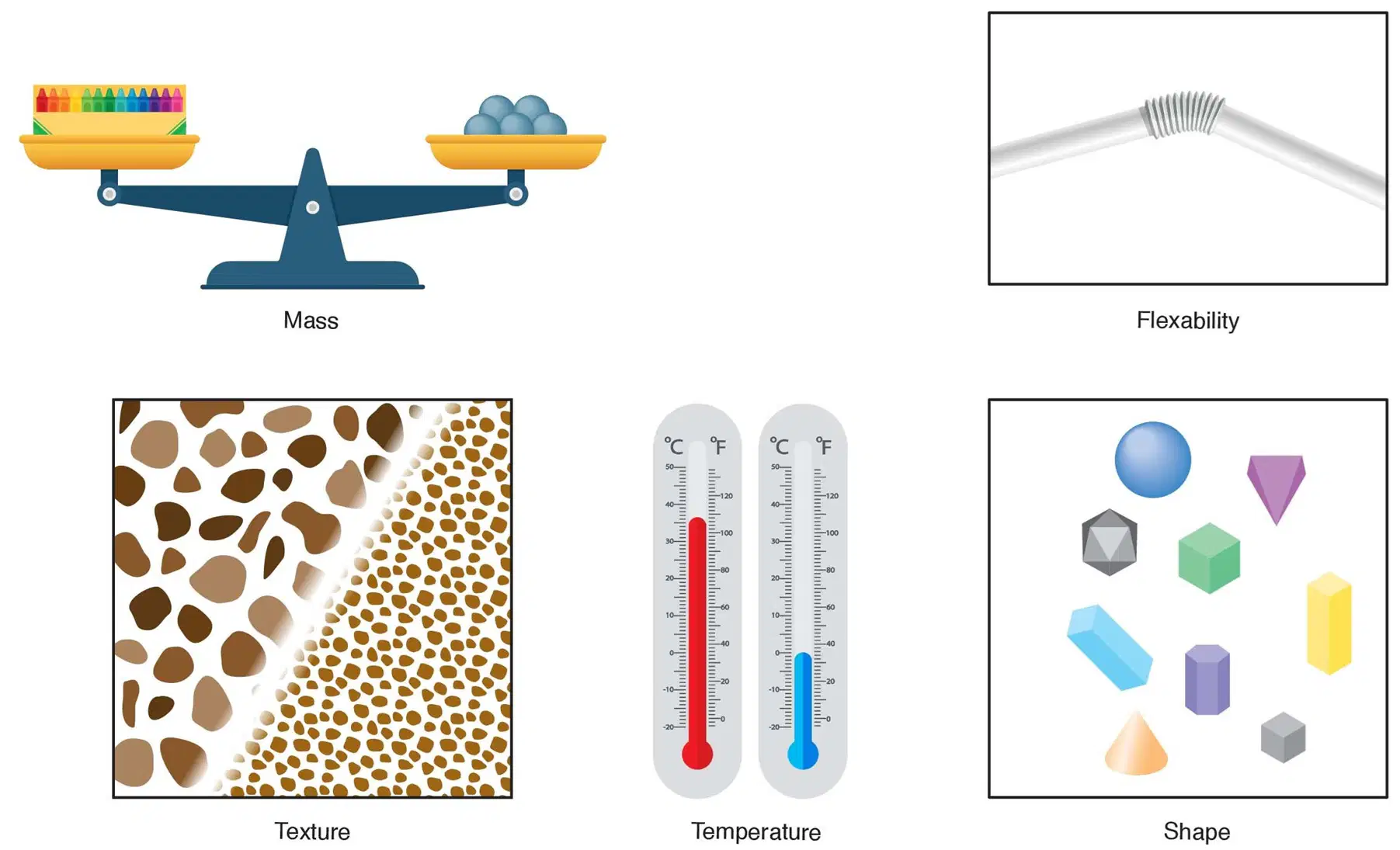
What is a characteristic that can be observed or measured without changing the substance?
Physical Property
Solubility
Periodic Table of Elements
Boiling Point

What is a substance whose electric conductivity falls between that of a conductor and an insulator; the foundation of modern electronics?
Semiconductor
Element
Properties
Brittle
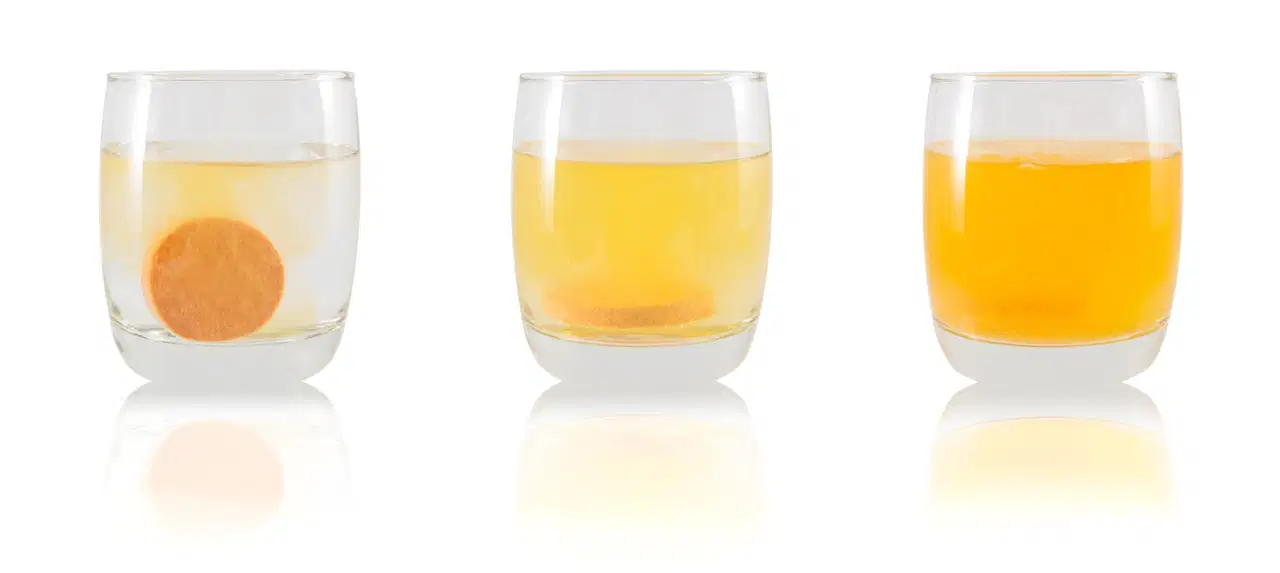
What is a measurement of the ability of a substance to dissolve in another substance?
Solubility
Periodic Table of Elements
Boiling Point
Classify
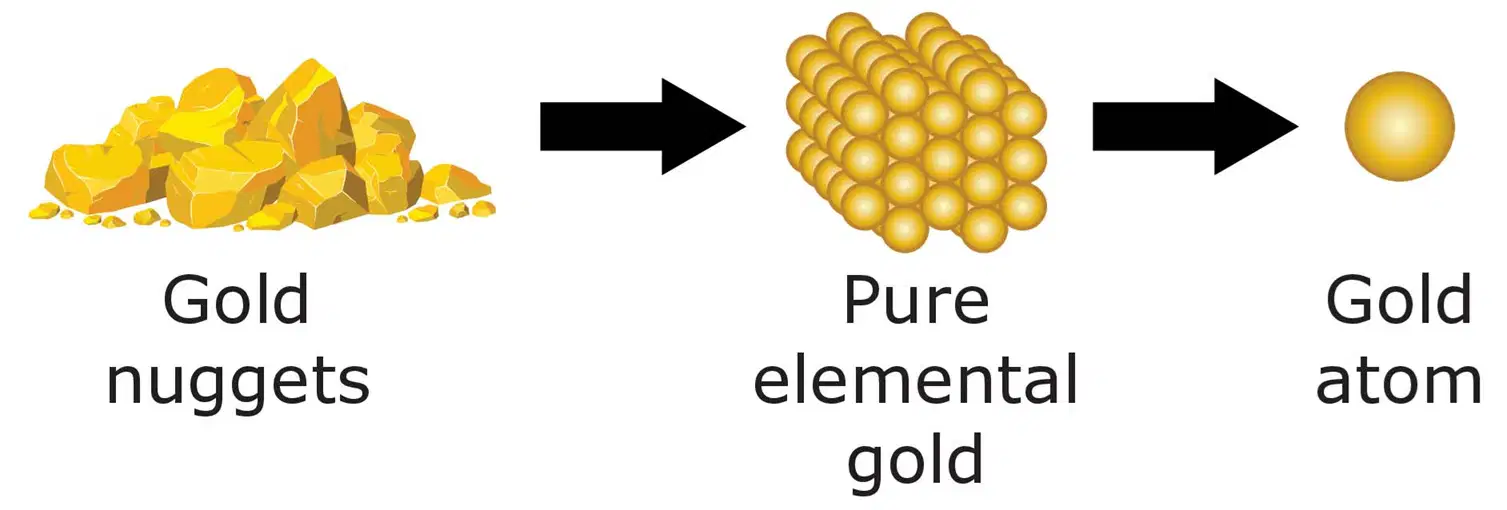
What is a pure substance composed of the same type of atom throughout?
Element
Properties
Brittle
Conductivity
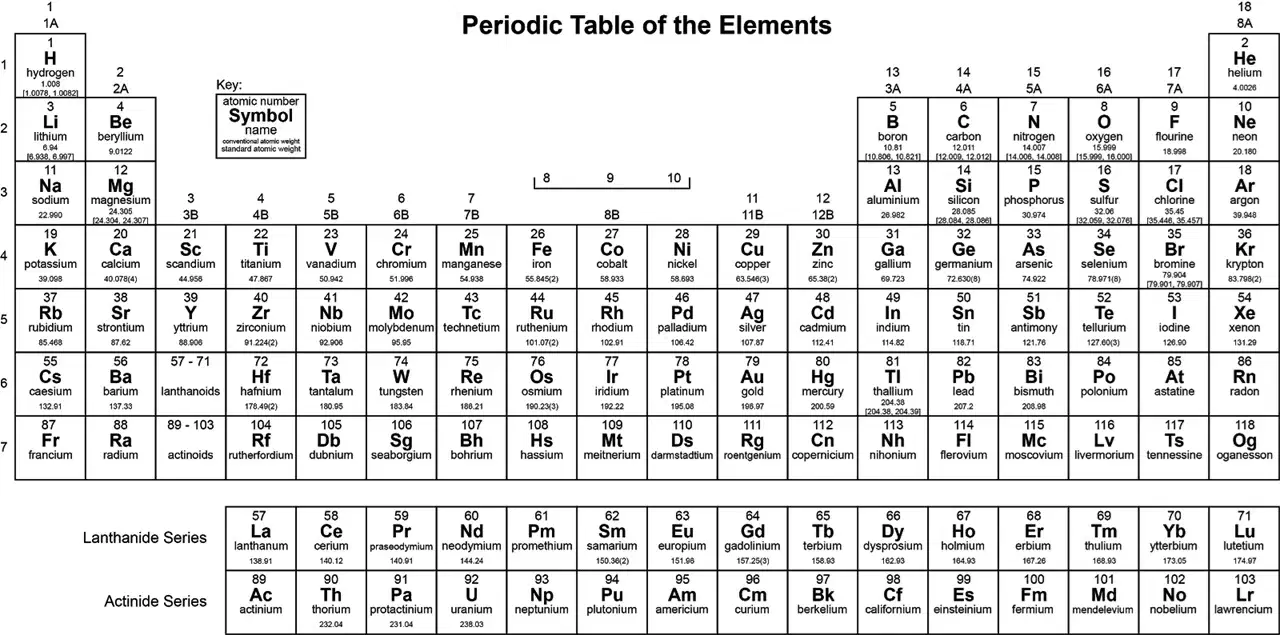
What is a table in which all the known elements are arranged by properties and are represented by chemical symbols?
Periodic Table of Elements
Boiling Point
Classify
Conductor
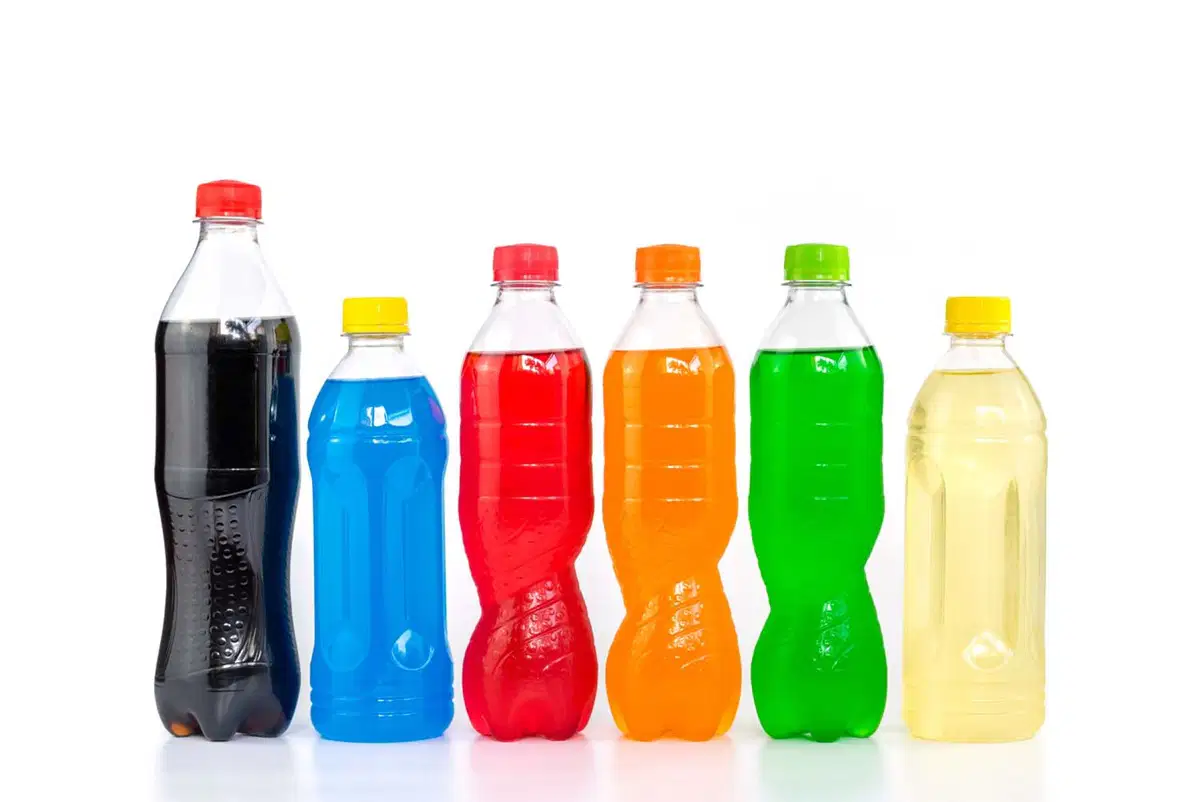
What are physical and chemical characteristics of matter used to describe or identify a substance?
Properties
Brittle
Conductivity
Density
What is a physical property of matter?
The ability to burn in air
The color or texture of a substance
How a substance reacts with acid
Whether a substance can rust
How are physical properties used to classify matter?
By describing chemical reactions
By measuring how matter changes
By grouping substances based on traits like color, shape, or density
By observing how matter burns or rusts
Do the physical properties of matter change when the matter size changes?
No, physical properties never change under any condition
Yes, the properties always change when size changes
Some physical properties stay the same, like density and color
Only chemical properties change, not physical ones
What properties distinguish solids, liquids, gases, and plasma from each other?
Color and temperature
Shape, volume, and particle movement
Size and chemical makeup
Mass and ability to rust
How does the particle structure of a solid affect its shape, volume, and compressibility?
The loose particles make solids easy to compress
The fixed particles give solids a definite shape and volume
The fast-moving particles let solids flow easily
The charged particles make solids behave like gases
What are the differences between physical and chemical changes?
Physical changes create new substances; chemical changes do not
Chemical changes are always reversible; physical changes are not
Chemical changes form new substances; physical changes do not
Physical changes only happen with heat; chemical changes do not need energy
How are the physical and chemical properties of atoms represented on the periodic table of elements?
By grouping elements randomly to mix different traits
By using pictures to show each element’s behavior
By arranging elements in patterns based on atomic structure and reactivity
By listing elements in alphabetical order only
How are elements arranged in the periodic table of elements?
By the date they were discovered
By atomic number, showing patterns in properties
By the number of neutrons in each atom
By whether they are solids, liquids, or gases
How can the periodic table of elements be used to compare the atomic mass of different elements?
Atomic mass is listed, allowing easy comparison between elements
The color of each element shows its atomic mass
Atomic mass is hidden and must be calculated from atomic number
Only metals have their atomic mass shown
What do the columns on the periodic table of elements represent?
Elements with similar masses
Elements found in the same state of matter
Elements with similar properties and number of valence electrons
Elements that were discovered in the same year
What do the rows on the periodic table of elements represent?
Elements with the same number of neutrons
Elements that react the same way
Elements with the same number of electron shells or energy levels
Elements grouped by color and texture
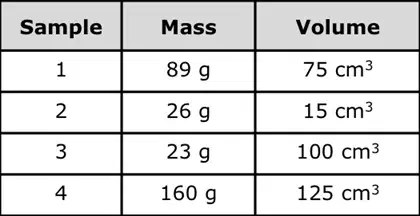
A table shows data for four sample materials. One of them is cork, which is a kind of wood that floats on water (water’s density = 1.00 g/cm³). Based on this information, which sample is most likely cork?
Sample 1
Sample 2
Sample 3
Sample 4
A 1,000-mL sample of ethanol boils at 78.4°C. If a 100-mL sample of the same substance is tested, what would be the most reasonable prediction for its boiling point?
0.078.4 °C
0.784°C
7.84°C
78.4°C
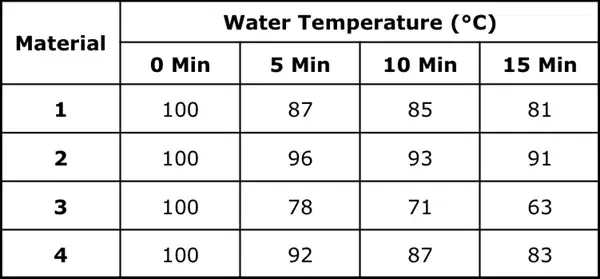
Boiling water was poured into containers made from four different materials. Using the data in the table, which material did the best job at keeping heat from escaping?
Material 1
Material 2
Material 3
Material 4
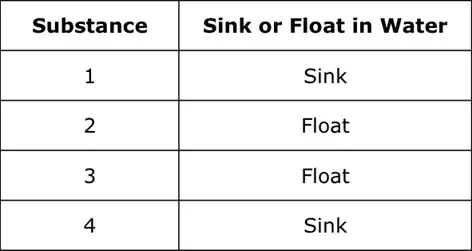
Four different objects were placed in a tank of water, and their behavior was recorded in a table. Based on what happened, what conclusion can be made about the densities of the balls?
Substance 1 has the highest density of all four substances.
Substance 4 has the lowest density of all four substances.
Substances 1 and 4 have higher densities than substances 2 and 3.
Substance 2 has a lower density than substance 3.
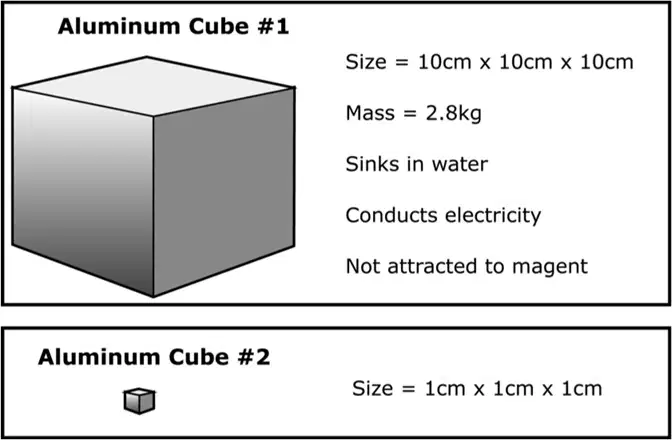
Diego and Mariah tested a large aluminum block (10 cm × 10 cm × 10 cm) and recorded their results. Later, they found a much smaller aluminum block (1 cm × 1 cm × 1 cm). Which property should remain the same in the smaller block?
Has a mass of 2.8 kg
Floats in water
Conducts electricity
Attracted to a magnet
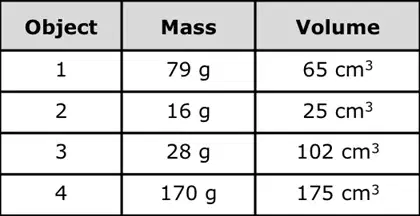
Lillian is investigating density and has measured the mass and volume of four objects. Using her data, which object is the most dense?
Object 1
Object 2
Object 3
Object 4
Water boils at 100°C and acetone boils at 50.5°C. At which temperature could you heat a mixture of both to begin separating the two liquids based on their boiling points?
49.5°C
60°C
100°C
150.5°C
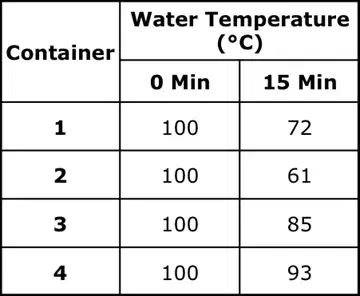
Wyatt is testing which container keeps boiled water warm the longest. He measures the temperature in each container after 15 minutes. According to his data, which container did the best job at preventing heat loss?
Container 1
Container 2
Container 3
Container 4
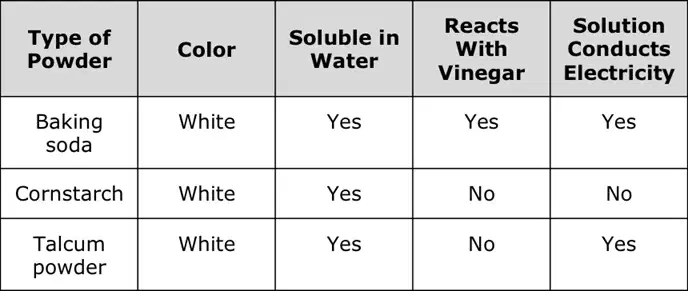
A student is trying to figure out if an unknown powder is baking soda. They have data on three similar powders. Which test would best help confirm whether the unknown powder is baking soda?
Adding a small amount of vinegar to the powder
Dissolving the powder in a beaker of water
Testing the electrical conductivity of it in solution
Comparing the color of the powder to other powders
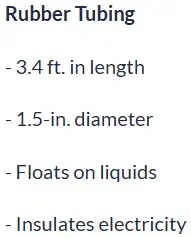
Physical properties describe matter without changing what it's made of. A piece of rubber tubing has certain physical properties listed. What can reasonably be expected about a rubber sphere made from the same material?
It will have the same diameter.
It can insulate electricity.
It will have the same length.
It will sink in liquids.
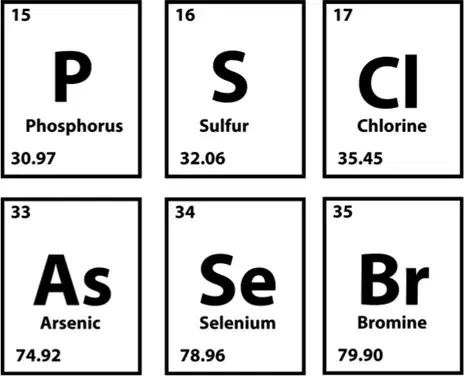
Looking at the section of the periodic table provided, which element is most likely to react in a similar way to bromine?
Chlorine
Sulfur
Selenium
Phosphorus
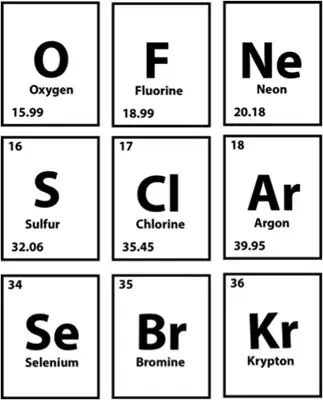
During a class discussion, students examine part of the Periodic Table. Based on the portion shown, which student correctly identifies two elements that are most alike in their properties?
Amanda believes the two element that will be most similar are oxygen and fluorine.
Jason believes the two element that will be most similar are neon and argon.
Maria believes the two element that will be most similar are sulfur and argon.
Micah believes the two element that will be most similar are oxygen and krypton.
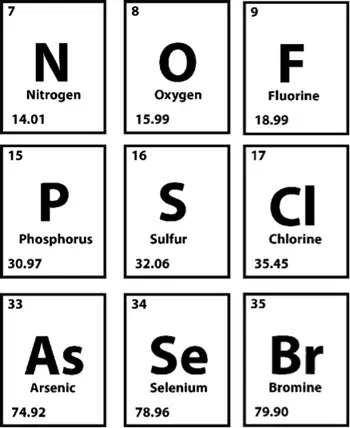
Based on the section of the Periodic Table provided, which element is most likely to share similar properties with sulfur?
Nitrogen
Oxygen
Fluorine
Chlorine
When using the Periodic Table, how can you usually find another element with similar chemical behavior to a given element?
in the same phase.
in the same group.
with a similar symbol.
of the same mass.
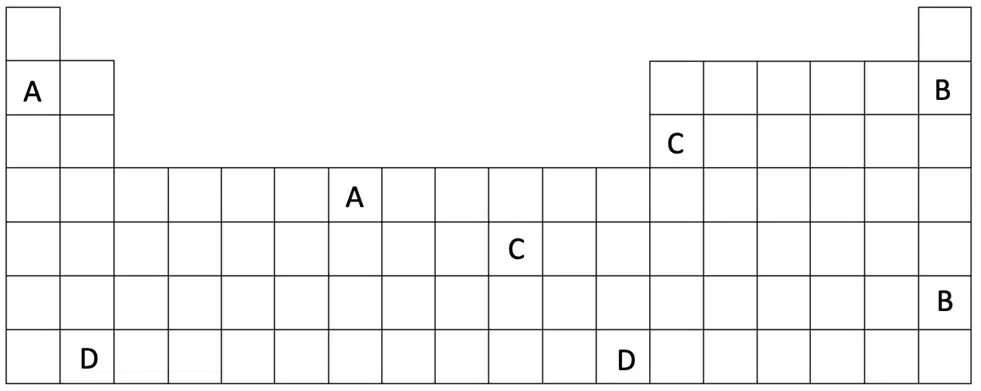
Using the simplified Periodic Table shown, which labeled pair of elements is most likely to have similar chemical properties?
A
B
C
D
If you're trying to find elements that behave similarly, which feature of the elements should you focus on the most?
Elements with the same mass
Elements in the same column
Elements with the same symbol
Elements in the same state of matter
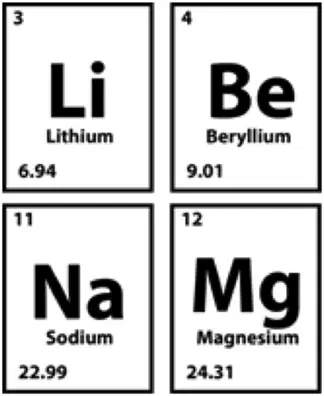
Looking at their positions on the Periodic Table, which two elements are most likely to share similar chemical properties?
Lithium and Beryllium
Magnesium and Sodium
Lithium and Sodium
Magnesium and Lithium
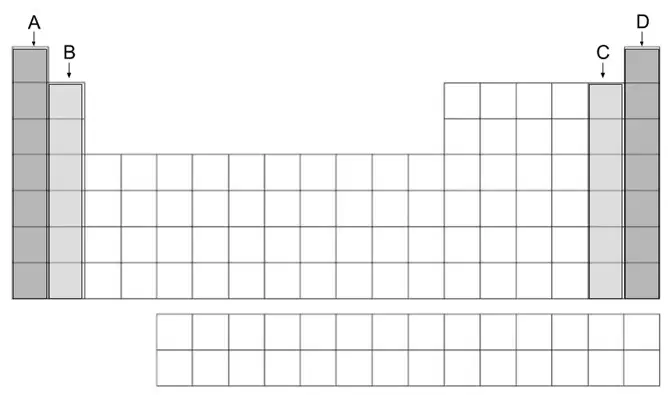
Mr. Gomez asks his class to pick two elements from the four shaded areas of the Periodic Table shown in the diagram. Each student makes a choice. Which student selected a pair of elements that are most alike in their properties?
Jamal selected an element from Group A and one from Group B.
Lee selected one element from Group B and one from Group C.
Ainsley selected two elements, both of them from Group C.
Qing selected one element from Group C and one from Group D.
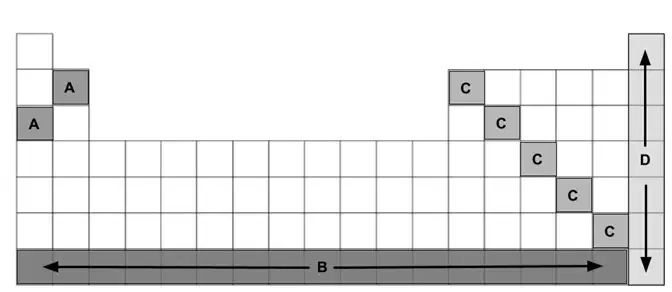
A basic version of the Periodic Table is shown. In which labeled section are you most likely to find two elements with similar chemical behavior?
A
B
C
D
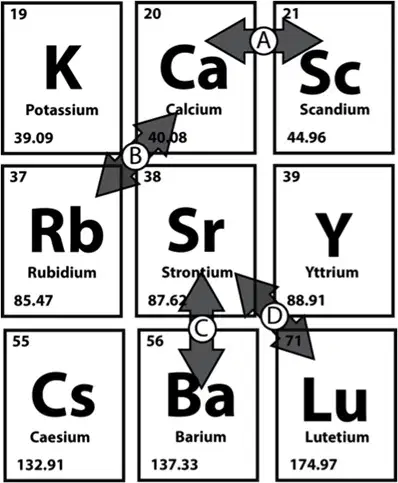
Refer to the section of the Periodic Table shown. Which labeled arrow is pointing to two elements that are most alike in their chemical properties?
A
B
C
D

