
 Worksheets
Edelman 15, 16, 17 (Harmonics, Contrast agents, displays)
Total questions: 115
Worksheet time: 2hrs 40mins
Which electronic component is required for gray scale imaging?
VCR
Non-interlaced display
Computer memory
Scan converter
Which of the following scan converters will provide the best spatial resolution?
256 x 256 pixels
512 x 512 pixels
128 x 128 pixels1
1000 x 1000 pixels
Which of these statements regarding a bit of computer memory is false?
It is the smallest element of an image
It is bistable
Eight bits combine to make one byte
It is a component of a digital scan converter
How many shades of gray can be represented by a group of 4 bits?
12
16
4
8
How many shades of gray can be represented by a group of 2 bits?
2
16
8
4
How many shades of gray can be represented by 8 bits?
128
512
256
1064
Which of the following statements regarding a pixel is false?
It is the smallest part of a digital image
A collection of bits, assigned to each pixel, stores the shade of gray
It displays up to 3 shades of gray simultaneously
Image quality is improved when the number of pixels is high
(a) is a method of describing the extent to which a signal can vary and still maintain accuracy
Number of available choices
(a)
Weak signals are (a) the signals threshold
Measure of the signal magnitude identified and managed by the system
(a)
Dynamic Range (a) - varies per component of the system.
Reported in decibels. It is a comparison, a relative measurement, or ratio between the smallest and largest signals
(a)
Strong signals (a) the system
The dynamic range of the information (a) the more it is processed
100-150dB
(a)
100-120dB
(a)
40-50dB
(a)
20-30dB
(a)
10-30dB
(a)
Largest and smallest remain the same –
Range is narrowed
(a)
(a) is a technique that reduces the dynamic range of a signal without introducing errors
The largest signal remains the largest
(a)
The smallest signal remains the smallest
(a)
The range of signals is reduced
(a)
An uncompressed signal within the receiver of an ultrasound system has a dynamic range of 110dB. The signal undergoes 40dB of compression. What is the dynamic range of the compressed signal
40dB
100dB
70dB
80dB
After compression, a signal within the ultrasound system has a dynamic range of 70dB. The original was compressed by 40dB. What is the dynamic range of the original, uncompressed signal?
110dB
40dB
70dB
30dB
10:1
(a)
100:1
(a)
The best examples for these limitations and reductions of the dynamic range through the different components is the BRIGHTNESS LEVELS available on the (a)
1000:1
(a)
Fewer shades of gray
Narrowest DR is the bistable.
High contrast
(a)
More shades of gray
Many choices
Low contrast
(a)
The original frequency of the transducer.
(a)
Multiples of the fundamental frequency.
(a)
Twice the original frequency.
Non-linear
(a)
If the fundamental frequency is 2MHz, what would the harmonic frequency be?
2MHz
8Mhz
4MHz
6MHz
The creation of an image from sound reflections at twice the frequency of the transmitted sound
(a)
(a) are more effective, less distortion, and non-linear
The image created by processing reflections that have the same frequency as the transmitted sound
(a)
The image created by processing reflections that are twice the fundamental frequency
(a)
Harmonic imaging is most useful in improving poor quality imaging because harmonic frequency waves undergo (a) distortion
Which of the following are the TWO forms of harmonics that are important in diagnostic sonography?
Tissue harmonics
Contrast harmonics
Linear harmonics
Non-linear harmonics
proportional
symmetrical
(a)

(a) systems respond in an even manner
disproportionate, irregular, uneven
(a)
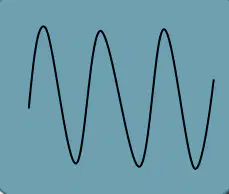
A system is (a) when it behaves unevenly
Non linear behavior is (a)
Harmonics frequency is produced by (a) behavior.
As a subbed wave travels in the body, a minuscule amount of energy is converted from fundamental frequency to the harmonic frequency
(a)
What non-linear behavior creates tissue harmonics?
A sound wave series called up fractions and condensations
A sound wave series called rarefactions and compressions
A sound wave series called nodes and up fractions
A sound wave series called condensations and rarefactions
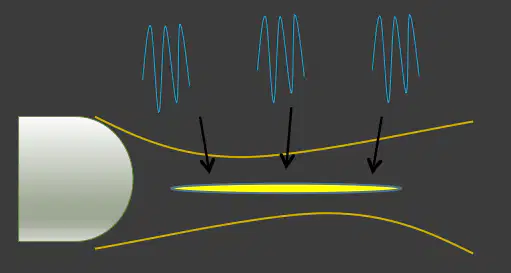
The arrows in this image is pointing to:
Contrast harmonics
Tissue harmonics
Harmonics are present in the (a) aspect of the sound beam offset of the transducer surface.
What is the significance of gradual development of a harmonic signal?
The beam is very weak and many different anatomic layers distort the sound beam
The beam is very strong and no very many different anatomic layers distort the sound beam
The beam is very strong and many different anatomic layers distort the sound beam
Sound wave must propagate a short distance in the medium (a) transfer of energy occurs from fundamental frequency to the harmonic frequency
Little pulse distortion occurs (a) the transducer (region free of harmonics).
Tissue harmonic signals DO NOT EXIST at (a) depths
As the fundamental frequency travels in the medium, energy is transferred to harmonic frequencies in multiples of the fundamental frequency (i.e. 2MHz, 4MHz, 6MHz..)
True
False
Harmonics (a) the signal-to-noise ratio
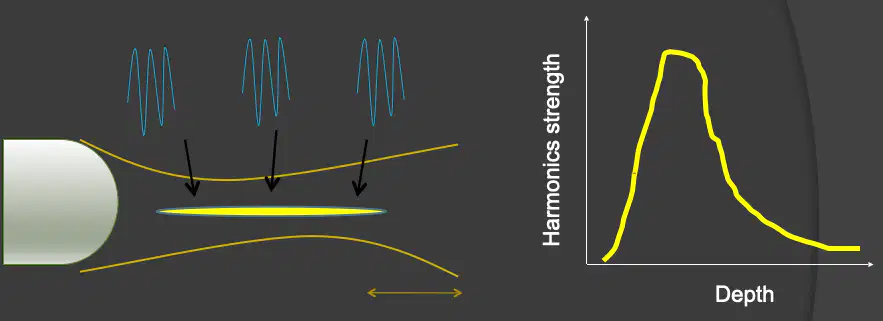
As the sound wave propagates in the medium, harmonics (a) , and the fundamental frequency becomes more attenuated and distorted (becomes more linear and stops transferring energy to the harmonics).
Weak sound beams (a) create tissue harmonics
Beams that are most likely to create harmonics are (a) likely to create artifacts
Are tissue harmonics present when the sound leaves the transducer?
Yes
No
When are tissue harmonics created?
After transmission
During transmission
Right as sound leaves the transducer
Before it leaves the transducer
Which type of behavior creates tissue harmonics?
Non-linear behavior
Linear behavior
Absolute behavior
Frequency behavior
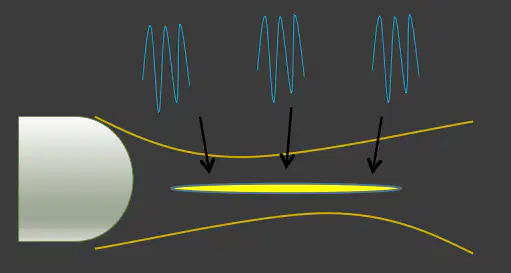
Where are tissue harmonics primarily created?
Along the face of the transducer
Along the beams lateral axis
Along the beams focus
Along the beams main axis
4. Then, harmonics start to be (a) in the medium.
Targets within the second harmonics will be insonated by both –the fundamental and the harmonic frequencies-, then, a filter must be placed to eliminate the echoes from the fundamental frequency in order to process only the tissue harmonic component
True
False
Filters has been replaced by ___ ___ Harmonics.
(a)
(a) is an imaging technique specifically designed to utilize harmonic reflections, which are distortion free, while eliminating distorted fundamental reflections
(a) separate the harmonics from the fundamental frequencies more successfully
With pulse inversion harmonics, (a) consecutive ultrasound pulses are transmitted down each scan line
Harmonic portions of the reflection are (a) and interfere constructively, while fundamental signals to the opposite
One advantage of (a) is that it creates an image with less distortion
One disadvantage of (a) is that two pulses are transmitted down each scan line and twice the number of pulses are required to create each image. This reduces temporal resolution
(a) an imaging technique specifically designed to augment harmonic reflections, which contain less distortion, while eliminating distorted fundamental reflections
Since clutter, grating lobes, and side lobe artifacts are produced by the (a) . HARMONICS eliminate these artifacts
Reverberation artifacts are reduced
(a)
Low echo amplitudes do not generate harmonics
(a)
Distortion and scattering depend on the fundamental frequency; then, they are avoided when using harmonics
(a)
Reduction of acoustic noise
(a)
Detection of low-contrast solid lesions is improved
(a)
Acoustic enhancements and shadowing are more easily demonstrated
(a)
Liquid cavities show less filling echoes
(a)
High acoustic pressure occur near the main beam axis and within the focal zone.
This is the source of harmonics production.
(a)
Then, width of harmonic sound beam is narrower than the width of the fundamental frequency sound beam improves lateral resolution
(a)
Less overall penetration because of higher attenuation for harmonics
(a)
Contrast agents, also called (a) , are gas bubbles encapsulated into a shell
Ingested or Injected (IV)
(a)
Contrast agents create (a) reflectors
Contrast agents (a) chambers, cavities, vessels, etc
Safe
Inert
Long lasting
Small than capillaries.
(a)
(a) is produced by the non-linear behavior of micro bubbles when they are stroked by the sound beam
When are contrast harmonics created?
During transmission
During after transmission
During reflection
During the sound
Bubble fluctuates size (a) the sound beam. Resonance
bubble shrinks and pressure within increases
(a)
bubble expands and pressure within decreases
(a)
It is the amount of contrast harmonics produced
(a)
(a) depends on the frequency of the transmitted sound and the rarefaction pressure of the sound wave
Fundamental frequency and the pressure of the sound wave
(a)
MI (a) with lower frequencies and high pressure variations
MI (a) with higher frequencies and low pressure variations
Low mechanical index sound beams (a) create harmonics because the micro bubbles expand and contract evenly in a linear fashion
No harmonics, backscatter, linear behavior, higher frequency sound, low beam strength
Low MI <0.1
Higher MI 0.1-1.0
Highest MI >1.0
Strong harmonics, resonance, non-linear behavior, lower frequency sound, higher beam strength
Low MI <0.1
Higher MI 0.1-1.0
Highest MI >1.0
Strongest harmonics, bubble disruption, extreme non-linear, lowest frequency sound, highest beam strength
Low MI <0.1
Higher MI 0.1-1.0
Highest MI >1.0
- outer shell
- gas within bubble
(a)
Which of the following determines the stability of micro bubble?
Inner shell
Outer shell
Gas without the bubble
Gas within bubble
Sound with a frequency of 4MHz is created by the transducer, what is the fundamental frequency?
4MHz
8Mhz
2MHz
cannot be determined
Sound with a frequency of 4MHz is created by a transducer. What is the harmonic frequency?
4Mhz
8Mhz
2Mhz
cannot be determined
Which of the following creates harmonics?
Reflection
Transmission
Linear behavior
Non Linear behavior
Where are harmonics created?
In the pulser
In the transducer
In the tissues
In the receiver
What nonlinear behavior creates tissue harmonics?
Microbubbles expand to a greater extent than they compress
Sound reflects off boundaries with different impedances
Sound travels faster in compressions and slower in rarefactions
Microbubble compress to a greater extent than they can expand
What nonlinear behavior creates contrast harmonics?
Microbubbles expand to a greater extent than they compress
Sound reflects off boundaries with different impedances
Sound travels faster in compressions and slower in rarefactions
Microbubbles compress to a greater extent than they can expand
Which of the following is associated with the highest mechanical index?
Low frequency, extreme peak rarefaction pressure
High frequency, extreme peak rarefaction pressure
Low frequency, extreme peak compression pressure
High frequency, extreme peak compression pressure

