
Font size
 Worksheets
Nature's dart gun
Total questions: 85
Worksheet time: 45mins
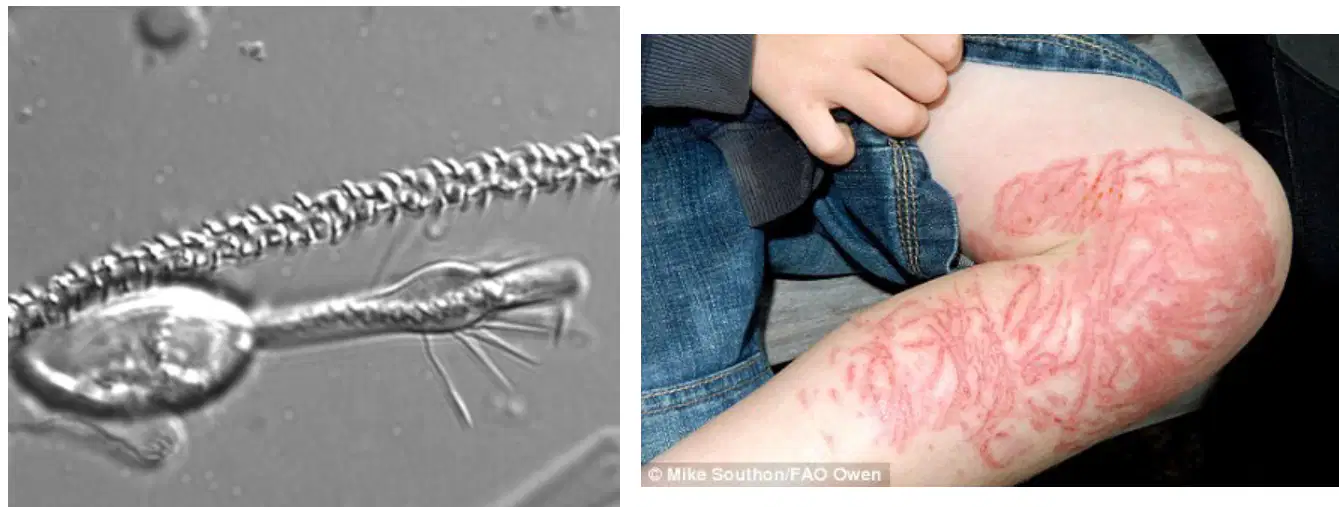
Cnidarians have nematocysts – specialized organelles that require slight stimulation to fire a chemical projectile containing toxin. What is the function of nematocysts in cnidarians?
A) Digestion
B) Movement
C) Defense and capturing prey
D) Respiration
Nematocysts are found in which group of animals?
Cnidarians
Annelids
Echinoderms
Molluscs

Cnidarians have nematocysts – specialized organelles that require slight stimulation to fire a chemical projectile containing toxin. Nematocysts can cause visible skin reactions in humans.
True
False
From the Greek knide (nettle) and the Latin aria (suffix for plural). What does the Latin suffix 'aria' indicate in the name 'Cnidaria'?
Singular
Plural
Adjective
Verb
Why does the phylum Cnidaria use the Latin suffix for plural?
They are solitary animals
They are colonial
They are extinct
They are vertebrates
What is the function of cnidocytes?
Responsible for stinging
Used for locomotion
Aid in digestion
Help in respiration
Phylum Cnidaria has the longest fossil history of any animal. How many million years does this history span?
700 million years
200 million years
1,200 million years
350 million years
All ________, mostly marine. (Fill in the blank with the correct word from the passage.)
aquatic
terrestrial
aerial
arboreal
These organisms prefer which type of water?
Deep, cold water
Shallow, warm water
Freshwater lakes
Fast-moving rivers
Most are sessile, a few are slow moving or can _______ slightly.
swim
jump
fly
crawl
Many exist in symbiotic relationships. Which of the following is NOT a type of symbiotic relationship mentioned? Choose the correct option.
Mutualistic
Commensalistic
Parasitic
Predatory

Refer to the image of the marine organism and the ship. Which organism is likely being described by the characteristics listed above?
What is Mutualism?
A) Both individuals benefit
B) One individual benefits, one experiences no effect
C) One individual benefits, the other experiences a loss
What is Commensalism?
Both individuals benefit
One individual benefits, one experiences no effect
One individual benefits, the other experiences a loss
What is Parasitism?
Both individuals benefit
One individual benefits, one experiences no effect
One individual benefits, the other experiences a loss
Which group of cnidarians is of significant economic consequence?
All cnidarians
Only jellyfish
Only corals
None of the above
What do reefs provide?
Food and tourism
Oil and gas
Freshwater
Timber
Fill in the blank: Coral reefs are the most ______ aquatic ecosystem, supporting more than 50% of all marine species.
diverse
polluted
arid
fragile
What percentage of the ocean area do coral reefs cover?
Less than 1%
About 10%
Around 25%
Nearly 50%
Fill in the blank: The presence of ________ is a characteristic, usually nematocysts.
Cnidocytes
Choanocytes
Amoebocytes
Osteocytes
Fill in the blank: These organisms are ________ (live in water).
Aquatic
Terrestrial
Aerial
Desert
Fill in the blank: These organisms are ________ or biradially symmetrical.
Radially
Bilaterally
Asymmetrically
Laterally
Fill in the blank: These organisms have ________ and medusae.
polyps
tentacles
spores
leaves
These organisms are diploblastic with ________.
mesoglea
coelom
notochord
pseudocoelom
Fill in the blank: These organisms have ________ digestion.
extracellular
intracellular
mechanical
chemical
Fill in the blank: These organisms have a simple ________ net.
nerve
blood
muscle
digestive
Fill in the blank: These organisms have no ________ or respiratory system.
excretory
digestive
nervous
circulatory
Fill in the blank: These organisms have no ________ cavity.
coelomic
digestive
thoracic
oral
Cnidarians have two distinct life stages. Which of the following is sessile and includes most corals?
Medusa
Polyp
Both
Neither
Cnidarians have two distinct life stages. Which of the following is mobile and includes jellyfish?
Medusa
Polyp
Both
Neither
Both polyps and medusae have a saclike body plan.
True
False
Fill in the blank: Medusa is just an _______ polyp.
unattached
attached
floating
sessile
Which of the following is NOT a method by which polyps reproduce asexually?
A) Budding
B) Fission
C) Pedal laceration
D) Sexual reproduction
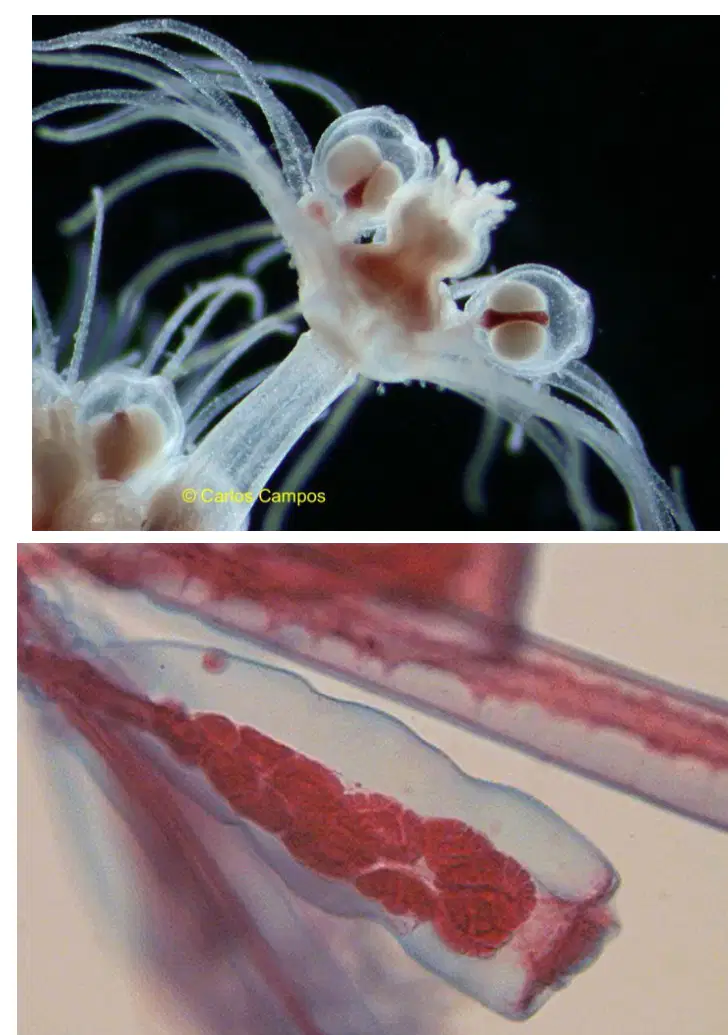
Fill in the blank: Polyps exhibit strong phenotypic ________ or polymorphism, meaning a single genotype can have multiple phenotypes.
plasticity
rigidity
fixity
singularity

A single genotype in polyps can have multiple phenotypes, such as Hydrozoa hydrants vs. gonangia.
True
False

Which of the following best describes the body shape of Medusae?
Flat and elongated
Bell or umbrella shaped
Cylindrical
Star shaped
Medusae exhibit tetramerous symmetry, which means their body parts are arranged in groups of how many?
Two
Three
Four
Five
Fill in the blank: Medusae use ______ for orientation and ______ for light reception.
statocysts, ocelli
tentacles, rhopalia
nematocysts, statoliths
rhopalia, statocysts
According to the Cnidarian life cycles, what roles do polyps and medusae play?
Both are asexual
Both are sexual
Polyps are asexual, medusae are sexual
Polyps are sexual, medusae are asexual
Fill in the blank: In Cnidarian life cycles, polyps are usually _______.
sessile
motile
parasitic
photosynthetic
Which of the following is true about the variation between taxonomic groups in Cnidarians?
All polyps are always sessile
There is lots of variation between taxonomic groups
Only medusae are present in all groups
Polyps and medusae are always found together

Based on the diagram, what is the correct sequence in the Cnidarian life cycle?
Medusa → Gonads → Fertilized egg → Planula larva → Polyp with developing medusa
Gonads → Medusa → Planula larva → Fertilized egg → Polyp with developing medusa
Polyp with developing medusa → Medusa → Gonads → Fertilized egg → Planula larva
Planula larva → Fertilized egg → Gonads → Medusa → Polyp with developing medusa
What is a phylogenetic constraint in the context of medusa evolution?
Anthozoans branch off before medusa evolves.
Medusae are the only cnidarians with tentacles.
All cnidarians must have a medusa stage.
Medusa evolved before polyps in all lineages.
What is meant by 'true loss of character state' in hydrozoans?
Hydrozoans probably lost the medusa.
Hydrozoans developed new tentacles.
Hydrozoans gained additional body segments.
Hydrozoans increased their reproductive rate.
How can medusa reduction appear as a loss in some species?
Some may have medusa reduction so drastic it appears as loss.
Medusa reduction always leads to increased reproduction.
Medusa reduction causes species to become extinct immediately.
Medusa reduction results in larger medusae.
All based on niche. Do you need to reproduce both ways? What do you gain or lose based on your needs?
The need to reproduce both ways depends on the organism's niche and what is gained or lost based on reproductive needs.
All organisms must reproduce both ways regardless of their niche.
Reproducing both ways always results in a loss of genetic diversity.
Organisms only gain advantages by reproducing asexually.
What are the layers of the body wall described in the slide?
Outer epidermis, inner mesodermis, mesoglea between
Outer endodermis, inner gastrodermis, mesoglea between
Outer ectodermis, inner endodermis, mesoglea between
Outer mesodermis, inner epidermis, mesoglea between
The body wall described in the slide contains true muscle cells.
True
False
Fill in the blank: The mesoglea is thickest in the ______ and thinnest in the _______.
thickest in the stalk and thinnest in the tentacles
thickest in the tentacles and thinnest in the stalk
thickest in the bell and thinnest in the stalk
thickest in the base and thinnest in the bell
Which of the following is NOT a function of the mesoglea as described in the slide?
Gives support through hydrostatic pressure
Acts like an elastic skeleton
Functions as the 'jelly' in a jellyfish
Produces digestive enzymes

The image shows a hand holding a clear, jelly-like substance. What does this substance represent in a jellyfish?
The mesoglea, or the 'jelly' in a jellyfish
The tentacles used for stinging prey
The digestive cavity of the jellyfish
The outer epidermis layer
Cnidocytes are a unique cell type to which phylum?
Cnidarians (phylum Cnidaria)
Arthropods (phylum Arthropoda)
Mollusks (phylum Mollusca)
Annelids (phylum Annelida)
What are the several types of cnidocytes?
Adhesive, recoiling, nematocysts
Flagella, cilia, pseudopodia
Chloroplasts, mitochondria, ribosomes
Axons, dendrites, synapses
What is a cnidocyte called during development?
Cnidoblast
Nematocyst
Amoebocyte
Choanocyte
What happens when cnidae (organelle) are discharged?
The cell is resorbed.
The cell divides rapidly.
The cell undergoes photosynthesis.
The cell migrates to another tissue.
Nematocyst is a specialized type of cnidae.
True
False
What is the trigger of a cnidocyte called?
Cnidocil
Nematocyst
Flagellum
Cilium

What is the function of the nematocyst in the cnidocyte of a sea anemone?
Digestion
Locomotion
Capturing prey and defense
Photosynthesis
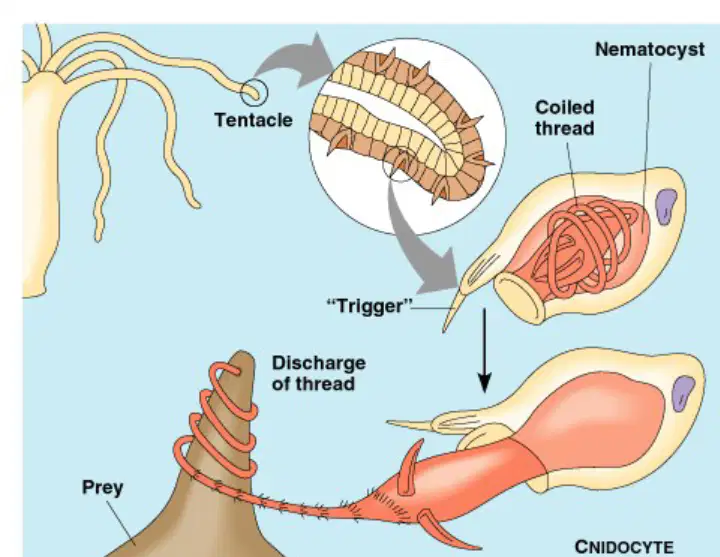
Refer to the diagram in the top left panel. The structure that is discharged to capture prey from the cnidocyte is called the _________.
nematocyst
spicule
choanocyte
spongocoel

The interaction between the sea anemone and the fish in this image is an example of:
Mutualism
Parasitism
Predation
Competition

What type of relationship is shown between the clownfish and the sea anemone?
Parasitism
Mutualism
Competition
Predation
What type of feeders are polyps?
Herbivorous
Carnivorous
Omnivorous
Detritivorous
How do polyps capture their prey?
With their mouth
With their tentacles
With their fins
With their teeth
Digestion in polyps is ______, but extracellular.
internal
external
partial
mechanical
Medusa are usually ______ feeders, but not always.
filter
herbivorous
parasitic
detritus
The end of the 'mouth' or mouth tube is called a ______.
manubrium
tentacle
pedal disc
oral arm
Corals usually supplement their diet with ______ algae.
symbiotic
parasitic
saprophytic
autotrophic
What happens to algae when water gets too warm around coral polyps?
Algae are evicted from coral polyps.
Algae multiply rapidly and cover the coral.
Algae turn into fish food.
Algae become more colorful.
If the water cools after coral bleaching, what can happen?
The algae can return.
The coral turns blue.
Fish stop visiting the reef.
The coral dissolves completely.
If the water does not cool after coral bleaching, what happens to the coral?
The coral dies from starvation.
The coral grows faster.
The coral changes color to green.
The coral becomes immune to bleaching.
Coral bleaching is expected to result in the destruction of most coral reefs by which year?
2025
2050
2100
2000
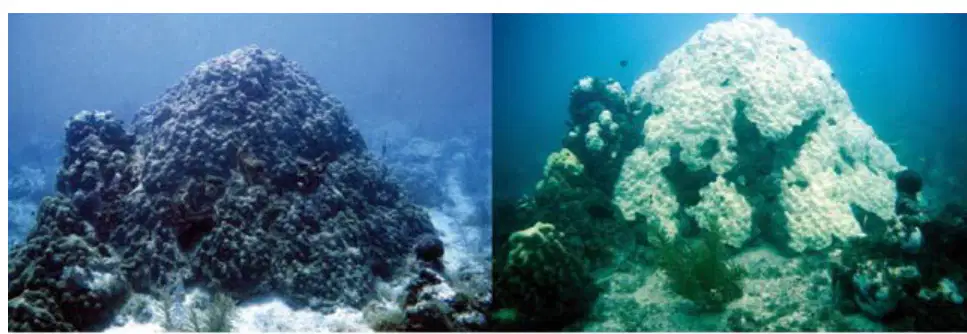
Look at the images below. Which image shows healthy coral and which shows bleached coral?
A) Left: Healthy, Right: Bleached
B) Left: Bleached, Right: Healthy

Observe the images of the coral reef from 2005 and 2010. What major change can you see in the coral between these two years?
The coral became more colorful in 2010
The coral appears bleached and less healthy in 2010
There are more fish in 2010
The coral grew larger in 2010

The image on the right (2010) shows coral that is mostly ________ compared to the image on the left (2005).
bleached
growing
colorful
healthy

Based on the images, it can be inferred what might have happened to the coral reef between 2005 and 2010.
The coral reef experienced significant bleaching and loss of life.
The coral reef grew larger and healthier.
The coral reef remained unchanged.
The coral reef was replaced by a different ecosystem.
Where are nerve nets found in the body?
Base of epidermis and base of gastrodermis
Brain and spinal cord
Heart and lungs
Muscles and bones
Nerve nets have two-way transmission.
True
False

In cnidarians, vesicles are found on ________.
both sides
one side only
the tentacles only
the outer surface only
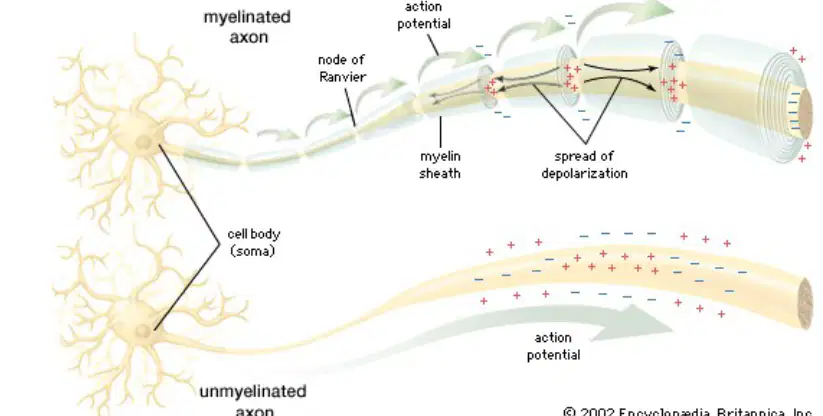
Do nerve nets have myelin?
Yes
No
Which of the following is NOT a characteristic of a nerve net?
A) Two nets that interconnect
B) Two-way transmission
C) Presence of myelin
D) Found at the base of epidermis and gastrodermis
What is the neuromuscular system a combination of?
Sensory and nerve cells
Blood and plasma
Bones and ligaments
Skin and hair
Which of the following is an example of the neuromuscular system still represented in animals?
Digestive system in annelids
Nerve plexuses in mammals
Both A and B
None of the above
The nerve net shows centralization in all animals.
True
False
What is rhopalia?
Cluster of sensory cells, precursor to centralization
A type of jellyfish tentacle
A reproductive organ in sponges
A pigment cell in corals

What structure is labeled in the diagram?
Nerve net
Spinal cord
Brain stem
Axon

