
 Worksheets
DIG 1 anatomy 3rd semester
Total questions: 75
Worksheet time: 38mins
How many pairs of salivary glands are there in the mouth?
2
3
4
5
Which of the following is not one of the salivary glands?
Tonsil
Parotid
Sublingual
Submandibular
Radiographic examination of the salivary glands using contrast medium is called:
Parotitis
Angiography
Sialography
Sialostenosis
The hard palate is formed by the:
Ethmoid and vomer
Ethmoid and palatine bone
Maxillae and vomer
Maxillae and palatine bone
The salivary glands produce how much saliva each day?
0.25 liter
0.50 liter
1 liter
1.5 liter
Which salivary glands are the largest?
Parotid
Submandibular
Sublingual
B & C are both equal in size
Which salivary gland is located on the floor of the mouth?
Parotid
Submandibular
Sublingual
Both Submandibular & Sublingual

Parotid
Submandibular
Sublingual
Thymus
The organ of the voice is thr
Uvula
Epiglottis
Pharynx
Larynx
The laryngeal prominence known as the “Adam’s Apple” is the
Epiglottis
Cricoid cartilage
Thyroid cartilage
Hyoid bone
Which is the most common imaging modality for examination of the soft palate, pharynx, and larynx?
Computed radiography
Computed tomography
Magnetic resonance imaging
Nuclear medicine
Which of the following serves as a passage for both food and air?
Pharynx
Larynx
Trachea
Bronchus
The roof of the posterior wall of the nasopharynx contains a mass of lymphoid tissue known as the
Thymus gland
Thyroid gland
Pharyngeal tonsil
Epiglottis
Which of the following lies anterior to the neck?
1.) thyroid gland
2.) parathyroid glands
3.) thymus gland
1 & 2
1 & 3
2 & 3
ALL

Oropharynx
Nasopharynx
Soft palate
Epiglottis

Oropharynx
Esophagus
Larynx
Trachea
The serous membrane that lines the abdominopelvic walls is called the
Peritoneum
Mesentery
Omentum
Peritoneal cavity
The liver lies in the
Upper left quadrant
Upper right quadrant
Lower left quadrant
Lower right quadrant
Which of the following convey blood to the liver?
1.) hepatic veins
2.) hepatic artery
3.) portal vein
1 & 2
1 & 3
2 & 3
ALL
What is the radiologically important primary function of the liver?
Formation of bile
Storage of bile
Formation of insuline
Storage of insulin
The 2 main hepatic ducts join to form the:
Cystic duct
Pancreatic duct
Common bile duct
Common hepatic duct
The common hepatic ducts join and the cystic duct join together to form the
Cystic duct
Pancreatic duct
Common bile duct
Common hepatic duct
The common bile duct and the pancreatic duct join and together as the enter the chamber known as
Gallbladder
Duodenum
Bile duct sphincter
Hepatopancreatic ampulla

Duodenum
Pylorus
Common hepatic duct
Left hepatic duct
The combining form cholecyst(o)- means
Sac
Bile ducts
Gallbladder
Common bile duct

Spleen
Pancreas
Duodenum
Stomach
Functions of the gallbladder include
1.) store bile
2.) concentrate bile
3.) store cholecystokinin
1 & 2
1 & 3
2 & 3
A
The pancreas produces which of the following?
1.) insulin
2.) glucagon
3.) pancreatic juice
1 & 2
1 & 3
2 & 3
ALL
Which of the following describes the function of the spleen?
1.) produces glucagon
2.) produces lymphocytes
3.) stores and removes dead red blood cells
1 & 2
1 & 3
2 & 3
ALL

Lung
Liver
Spleen
Stomach
Which of the following organs lie in the abdominal cavity?
1.) stomach
2.) gallbladder
3.) kidneys
1 & 2
1 & 3
2 & 3
All
Which of the following organs lie in the pelvic cavity?
1.) kidneys
2.) rectum
3.) urinary bladder
1 & 2
1 & 3
2 & 3
All
The outer portion of the sac that lines the abdominopelvic cavity is termed the
Parietal peritoneum
Visceral peritoneum
Parietal pleura
Visceral pleura
The inner portion of the sac that lines the abdominopelvic cavity is termed the :
Parietal peritoneum
Visceral peritoneum
Parietal pleura
Visceral peritoneum
The folds of the peritoneum that surround and support the abdominal organs are called the:
1.) omenta
2.) mesentery
3.) pleura
1 & 2
1 & 3
2 & 3
All
The narrow space between two layers of peritoneum is called the
Pleural cavity
Peritoneal cavity
Diaphragm
Abdominopelvic cavity
The largest gland(s) in the body is the
Pancreas
Spleen
Liver
Kidney
The distal end of the common bile duct contains a sphincter that controls the bile entering the duodenum. This sphincter is termed the
Cystic duct
Hepatic duct
Choledochal sphincter
Sphincter of the hepatopancreatic ampulla
The hepatopancreatic ampulla is controlled by a circular muscle known as the
Cystic duct
Hepatic duct
Choledochal sphincter
Sphincter of the hepatopancreatic ampulla
The combining form cholangi(o)- means
Sac
Bile ducts
Gallbladder
Common bile duct
How long is the entire alimentary canal?
5 feet
10 feet
20 feet
30 feet
The stomach wall is composed of how many layers?
1
2
4
5
The expanded portion of the terminal esophagus is called the
Cardiac notch
Abdominal esophagus
Cardiac antrum
Esphagogastric junction

The Area identified above is
Fundus
Angular notch
Cardiac antrum
Lesser curvature

Identify
Greater curvature
Pyloric antrum
Pyloric canal
Pyloric sphincter
Which of the following are components of the alimentary canal?
1.) mouth and pharynx
2.) stomach and intestines
3.) liver and pancreas
1 & 2
1 & 3
2 & 3
A
Which of the following are included as components of the alimentary canal?
1.) Anus
2.) colon
3.) esophagus
1 & 2
2 & 3
1 & 3
ALL
The muscular opening between the stomach and the duodenum is termed the
Pylorus
Pyloric sphincter
Pyloric antrum
Ileocecal valve
For which type of body habitus is the stomach almost horizontal?
Sthenic
Asthenic
Hyposthenic
Hypersthenic
For which type of body habitus in the stomach nearly vertical?
Sthenic
Asthenic
Hyposthenic
Hypersthenic
Functions of the stomach include:
1.) storage of food
2.) absorption of food products
3.) food is chemically broken down
1 & 2
1 & 3
2 & 3
ALL
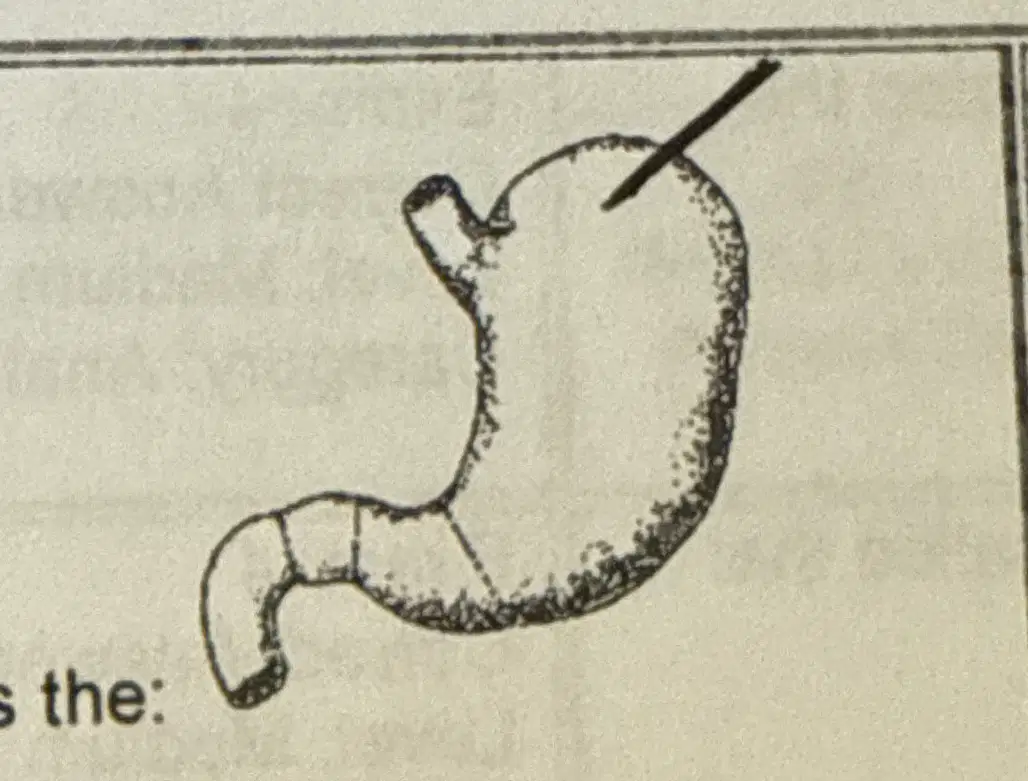
Identify
Fundus
Body
Cardiac antrum
Greater curvature

Fundus
Duodenum
Pyloric portion
Angular notch
The contraction waves by which the digestive tube moves its contents toward the rectum are called
Respiration
Peristalsis
Mastication
Deglutition
The wall of the esophagus is composed of how many layers of tissue
1
2
3
4
The folds of the thick lining of the stomach are termed the
Rugae
Serous
Mucous layer
Submucous layer
The esophagus joins the stomach through an opening called the
Pyloric orifice
Cardiac orifice
Cardiac sphincter
Pyloric sphincter
The opening between the stomach and the small intestine is termed the
Pyloric sphincter
Pyloric antrum
Pyloric orifice
Pyloric canal
What percentage of the population will have a combination of Sthenic and Hyposthenic body habitus
50%
60%
75%
85%
The common bile duct and the pancreatic duct usually unite to form the:
Pyloric portion
Duodenal bulb
Hepatopancreatic ampulla
Greater duodenal papilla
The opening inside the duodenum where pancreatic enzymes and bile enter is cause the
Pyloric portion
Duodenal bulb
Hepatopancreatic ampulla
Greater duodenal papilla
What is the first division of the digestive system?
Mouth
Stomach
Small intestine
Salivary glands
Which structure forms the mesentary and omenta folds?
Liver
Pancreas
Gallbladder
Peritoneum
Which duct is formed by the merging of the right and left hepatic ducts?
Cystic
Pancreatic
Common bile
Common hepatic
The distal esophagus empties its contents into which of the following?
Duodenum
Pyloric canal
Duodenal bulb
Cardiac antrum
Which opening is located between the stomach and small intestine?
Cardiac orifice
Pyloric orifice
Ileocecal orifice
Ampulla of vater
Which body function does the pancreas perform?
Filtration of blood
Production of bile
Production of lymphocytes
Prouduction of digestive juices
Where do the pancreatic and common bile ducts terminate?
Ileum
Duodenum
Gallbladder
Large intestine
Deglutition is the act of:
Chewing
Speaking
Swallowing
Tasting
Mastication is the act of
Chewing
Swallowing
Speaking
Tasting
The esophagus lies anterior/posterior to the trachea & heart.
Anterior
Posterior
Greater/Lesser omentum is the fold of peritoneum that lies between the stomach and liver.
Greater
Lesser
Greater/Lesser omentum is the fold of peritoneum that extends from the lower margin of the stomach to the transverse colon.
Greater
Lesser
The head/tail of the pancreas lies within the c-loop of duodenum
Head
Tail
The pancreas lies anterior/posterior to the stomach
Anterior
Posterior

