
 Worksheets
CHAPTER 3 NEW
Total questions: 78
Worksheet time: 39mins
What does the biosphere consist of?
Only land
Only water
All life on Earth and all parts of the Earth in which life exists, including land, water, and all the atmosphere
Only the atmosphere
The biosphere extends roughly about ___ kilometers above Earth's surface and ___ kilometers below the surface of the ocean.
(a)
Which of the following are included in the biosphere?
Whales
All of the answers could be possible
Bacteria
Trees
Humans
True or False: The biosphere includes only animals and plants.
True
False
Name three components of the biosphere as shown in the diagram.
Atmosphere (Air), Lithosphere (Land), Hydrosphere (Water)
Stratosphere, Thermosphere, Exosphere
Biosphere, Cryosphere, Magnetosphere
Troposphere, Mesosphere, Ionosphere
Fill in the blank: All forms of life interact with each other and with their _________
environments
colors
shapes
numbers
What is ecology the scientific study of?
The structure of atoms
Interactions among organisms, populations, and communities; organism’s effects on their environment; their responses to changes in their environment
The movement of planets
The history of Earth
Which of the following is NOT a focus of ecology?
A) Interactions among organisms
B) Organism’s effects on their environment
C) The structure of DNA
D) Responses to changes in the environment
Fill in the blank: Interactions within the biosphere produce a web of interdependence between organisms and the environment that they live in _________.
levels of organization
climate zones
food chains
energy pyramids
Fill in the blank: _______ is a group of similar organisms that can breed or produce offspring.
Species
Genus
Family
Kingdom
Fill in the blank: _______ is a group of individuals that belong to the same species, live in the same area, and interbreed.
Population
Community
Ecosystem
Habitat
Fill in the blank: _______ refers to different populations that live together in a defined area.
Community
Organism
Habitat
Ecosystem
Fill in the blank: _______ includes all the organisms that live in a place together with their physical environment.
Ecosystem
Population
Community
Habitat
Fill in the blank: _______ is a group of ecosystems that share similar climates and typical organisms.
Biome
Habitat
Population
Community
Environmental conditions are described as which of the following?
Only abiotic factors
Only biotic factors
Abiotic factors or biotic factors
Neither abiotic nor biotic factors
A biotic factor is any ________ part of the environment in which an organism might interact. Fill in the blank.
LIVING
NONLIVING
CHEMICAL
PHYSICAL
Which of the following is NOT an example of a biotic factor?
A) Animals
B) Plants
C) Sunlight
D) Bacteria
A(n) ________ factor is any NONLIVING part of the environment. Fill in the blank.
abiotic
biotic
organic
cellular
Which of the following is an example of an abiotic factor?
Mushrooms
Heat
Bacteria
Animals
Fill in the blank: Modern ecologists use three methods in their work: Observation, Experimentation, and ______.
Modeling
Guesswork
Repetition
Imagination
Which method involves asking questions or forming hypotheses?
Experimentation
Modeling
Observation
Which method involves testing hypotheses?
Observation
Experimentation
Modeling
Which method involves physical simulations or mathematical formulas based on data collected?
Observation
Experimentation
Modeling
Fill in the blank: The ________ includes all the gasses that surround the earth.
Atmosphere
Lithosphere
Hydrosphere
Biosphere
Fill in the blank: The ________ includes all Earth's fresh water and salt water, including water vapor and rain in the atmosphere, water underground, and ice.
Hydrosphere
Lithosphere
Atmosphere
Biosphere
Fill in the blank: The ________ includes all the rocks, continents, and ocean floors.
Geosphere
Atmosphere
Hydrosphere
Biosphere
Which of the following spheres includes all living organisms and the environments they live in?
Atmosphere
Hydrosphere
Biosphere
Geosphere
Ecology is the study of:
plants only
animals only
interactions between organisms and their environment
the atmosphere
List the levels of organization in order.
Cell, tissue, organ, organ system, organism
Organism, organ system, organ, tissue, cell
Tissue, cell, organ, organism, organ system
Organ, tissue, cell, organism, organ system
Which of the following best explains the difference between abiotic and biotic factors and provides 3 examples of each?
Abiotic factors are living things like plants, animals, and bacteria, while biotic factors are non-living things like water, sunlight, and soil.
Abiotic factors are non-living things like water, sunlight, and soil, while biotic factors are living things like plants, animals, and bacteria.
Abiotic factors and biotic factors are both living things, but abiotic factors include only plants, animals, and fungi.
Abiotic factors are only found in water, while biotic factors are only found on land.
Fill in the blank: Weather consists of short-term changes in temperature, precipitation, clouds, and wind from ____ to ____, or minute to minute.
day to day
year to year
season to season
month to month
Fill in the blank: Climate is defined by patterns and averages over many years of temperature, precipitation, clouds, wind, and extreme weather events such as ____
heat waves, droughts, and floods
rainbows and sunshine
gentle breezes and mild days
morning dew and evening fog
What produces climate and water?
A) A global system of wind and ocean currents
B) Only the sun
C) Only the moon
D) Only rain
Fill in the blank: Earth's global climate system is powered and shaped by the total amount of ____ retained in the biosphere as heat, and by the unequal distribution of that heat between the equator and the poles.
solar energy
carbon dioxide
oxygen
water vapor
Some of the solar energy that hits Earth's surface is reflected back into space and some is ________ or converted into heat.
absorbed
refracted
dissolved
evaporated
The balance between heat that stays in the atmosphere and the heat lost in space determines what?
Earth's average temperature
The speed of Earth's rotation
The amount of rainfall on Earth
The shape of Earth's continents
Which of the following is NOT a greenhouse gas?
Carbon dioxide
Methane
Water Vapor
Oxygen
The balance of heat in Earth's atmosphere is largely controlled by concentrations of which type of gases?
Greenhouse gases
Noble gases
Inert gases
Radioactive gases
Select all that are greenhouse gases:
Carbon dioxide
Methane
Water Vapor
Nitrogen
If greenhouse gas concentrations rise, they trap more heat, so the Earth ______.
warms
cools
shrinks
freezes
If the greenhouse gas concentration falls, more heat escapes, the Earth (a) .
Without the greenhouse effect, the Earth would be roughly (a) degrees cooler than it is today.
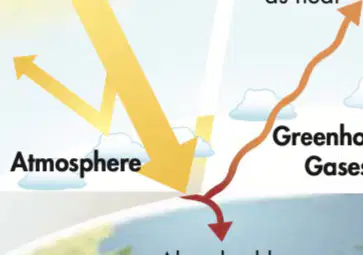
Which of the following best describes the function of greenhouse gases according to the diagram?
They allow visible light to enter and trap heat
They block all sunlight
They cool the Earth's surface
They reflect all heat back to space
What effect does tilting of the earth have on the distribution of solar energy on Earth?
It causes solar energy to be distributed evenly across the Earth.
It results in more solar energy at the equator and less at the poles.
It makes the poles receive more solar energy than the equator.
It prevents solar energy from reaching the Earth's surface.
Near the equator, solar energy is intense because the sun is almost directly overhead at noon all year.
True
False
The difference in heat distribution creates three different climate zones. Select the correct three climate zones from the options below:
Tropical
Temperate
Polar
Desert
Fill in the blank: North and south of the equator, the sun drops ______ in the sky during winter as the tilted Earth revolves in orbit and days become short.
lower
higher
brighter
faster

Match the following climate zones to their approximate latitude ranges as shown in the diagram:
0° to 23.5° (N and S)
tropical
23.5° to 66.5° (N and S)
temperate
66.5° to 90° (N and S)
polar
Which zone includes the equator?
Tropical Zone
Temperate Zone
Polar Zone
Summers may be quite hot and winters can be very cold in which zone?
Tropical Zone
Temperate Zone
Polar Zone
Winters are bitterly cold, and summers barely get warm in which zone?
Tropical Zone
Temperate Zone
Polar Zone
The unequal distribution of heat across the globe creates ______ and ocean currents.
wind
rainfall
mountains
volcanoes
Air that is heated in a warm area, such as near the equator, expands and becomes less dense, causing it to
RISE
SINK
As air cools, it becomes more dense and ______.
sinks
rises
evaporates
expands
The pattern of rising and sinking air creates ______.
winds
clouds
rainbows
mountains
Earth’s rotation causes winds to blow generally from west to east over the temperate zone and east to west over the tropical and polar zones.
True
False
What are ocean currents driven and shaped by?
Only by the location of continents
Warming and cooling, by winds, and the location of continents
Only by winds
Only by warming and cooling
Interactions between _______ and _______ shape weather and climate on land.
atmosphere, hydrosphere
lithosphere, biosphere
mantle, core
crust, mantle
What do surface currents influence that affects marine organisms and communities?
Water temperature and salinity
Only water temperature
Only salinity
Wind speed
Cold ocean water near the poles sinks and flows along the _______.
ocean floor
surface currents
beach
riverbed
What is the phenomenon called when bottom water rises to the surface?
Downwelling
Upwelling
Surface current
Deep flow
Upwelling usually occurs when winds push surface water away from a continent and _______ water rises to take its place.
cold, bottom
warm, surface
salty, deep
fresh, shallow
Regional climates are shaped by which of the following?
A) Latitude
B) Transport of heat and moisture by winds and ocean currents
C) Geographic features such as mountain ranges, large bodies of water, and ocean currents
D) All of the above
Which of the following is NOT a factor that shapes regional climates?
A) Latitude
B) Transport of heat and moisture
C) Type of soil
D) Geographic features
How are climate and weather different?
Climate refers to long-term patterns of weather in a region, while weather refers to short-term atmospheric conditions.
Climate and weather are the same thing.
Weather refers to long-term patterns, while climate refers to short-term changes.
Climate only affects temperature, while weather only affects precipitation.
What determines Earth’s average temperature?
The amount of sunlight absorbed and the amount of heat radiated back into space
The number of continents on Earth
The speed of Earth's rotation
The amount of rainfall each year
What are the three gases found in the atmosphere that help balance earth’s temperature?
Oxygen, Nitrogen, and Argon
Carbon dioxide, Methane, and Water vapor
Ozone, Nitrogen, and Helium
Hydrogen, Neon, and Krypton
What are the three climate zones and why are there different climates for each?
The three climate zones are tropical, temperate, and polar; they exist because of differences in latitude and sunlight.
The three climate zones are desert, rainforest, and tundra; they exist because of animal populations.
The three climate zones are urban, rural, and coastal; they exist because of human activities.
The three climate zones are mountain, valley, and plain; they exist because of elevation.
What causes wind and ocean currents?
The rotation of the Earth and differences in temperature and pressure
The phases of the moon
The growth of plants
The movement of tectonic plates
How many natural classes of biological communities called biomes do ecologists recognize?
10
5
20
15
Biomes are described in terms of which two types of factors?
Abiotic factors and biotic factors
Physical factors and chemical factors
Geographical factors and climatic factors
Organic factors and inorganic factors
What biome is home to more species than all other biomes combined?
Tropical Rain Forest
Desert
Tundra
Savanna
How much rain does a tropical rain forest receive in a year?
About 2 meters a year
About 20 centimeters a year
About 10 meters a year
About 50 centimeters a year
What is the dense, leafy covering formed by tall trees in a tropical rain forest called?
Canopy
Understory
Shrub layer
Forest floor
What is the layer formed by shorter trees and vines below the canopy called?
Understory
Emergent layer
Forest floor
Canopy
True or False: The organic matter on the forest floor of a tropical rain forest is recycled/reused so quickly that the soil is very rich in nutrients.
True
False
Which of the following is NOT an abiotic factor of the tropical rain forest?
Hot/wet year round
Tall trees
Thin, nutrient poor soils
Erosion
Which adaptation helps understory plants in the tropical rain forest compete for sunlight?
Small leaves
Large leaves
Thick bark
Deep roots

