
 Worksheets
3160 Exam 3 Review Part 1
Total questions: 25
Worksheet time: 13mins
When auscultating an apical pulse, you suspect that there is an abnormal heart sound. You then:
compare the apical pulse to the carotid pulse simultaneously
notify the provider that the patient has a dangerous murmur
determine when the sound occurs in the respiratory cycle
Educate the patient that all murmurs are innocent
You are auscultating a patient's carotid artery and hear a "whooshing" sound. This could indicate:
That the patient has cardiovascular disease
that the patient has adequate blood flow to the brain
that the patient has a pansystolic murmur
that the patient has an active clot in the carotid artery
A murmur that is very loud and can be heard with one corner of the stethoscope lifted off the chest is:
grade 6
grade 4
grade 5
grade 3
Where do you auscultate the apical pulse?
the pulmonic valve, located at the 2nd intercostal space, left of sternum
the mitral valve, located at 5th intercostal space, left midclavicular line
the aortic valve, located at the 2nd intercostal space, right of sternum
the mitral valve, located at the 3rd intercostal space, left sternal border
What questions should you prioritize asking to differentiate cardiac and non-cardiac chest pain? (SATA)
Is the pain recreated when palpating the chest?
Does the pain worsen when you change position?
does the chest pain get worse when you breathe in?
do you have a family history of GERD?
When S3 and S4 are "smooshed" together, also known as a quadruplet sound. It is a really loud, long sound heard after S2
Mitral prosthetic sound
S4
Summation
pericardial friction rub
Which of the following can be caused by thrusting inside of the ventricles, such as in ventricular hypertrophy?
thrill
murmur
bruit
a lift/heave
In order to avoid causing bradycardia, the nurse should
tell the patient to "bear down" when palpating for a thrill
ask the patient to hold their breath while auscultating for heart murmurs
only use light pressure when palpating the carotid pulse
avoid palpating when assessing for jugular vein distention
This is the sound heard when the tricuspid and mitral valves (the AV valves) are closing:
S3
S1
S4
S2
In what ways can the nurse assess jugular vein distention? (SATA)
elevated the HOB to 30 degrees and look for distention in the neck
palpate the carotid pulse in the neck unilaterally
place the patient in Trendelenburg and assess for distention in the neck
hold a ruler parallel with the angle of louis while looking for distention
All of the following are age-related cardiac changes in the elderly patient EXCEPT:
higher incidence of ventricular dysrhythmias
increased risk factors for CVD
stiffening of the arteries
Higher resting pulse
Which of the following assessments would MOST likely be associated with an anemic patient?
A systolic blood pressure of 126
a heart rate of 50
an SpO2 of 90%
Erythema in the lower extremities
What is the pack year calculation for a patient who smokes 4 packs per day for 10 years?
40
0.4
8
20
Your patient is exhibiting intercostal retractions. As the patient's nurse, you should conclude:
This is an expected finding in someone with asthma. Document findings.
The patient is in respiratory distress. I should notify the HCP
The patient is demonstrating normal, symmetrical chest expansion
The patient is exhibiting barrel chesting and needs a breathing treatment
Which of the following are expected respiratory changes with aging? (SATA)
increased vital capacity
decreased residual volume
lungs become more rigid and less elastic
decreased gas exchange
These lymph nodes drain the breast and upper arm:
cervical nodes
epitrochlear nodes
axillary nodes
inguinal nodes
Deep muscles can hide cancerous lumps hidden in the:
subscapular area
tail of spence/axillary area
substernal area
right upper quadrant of breast
While inspecting and palpating the breasts, the nurse should always:
determine if the right side is symmetrical with the left
report a supernumerary nipple to the provider
have the patient lie in sims position for palpation
report nipple inversion that can be pulled out
Which of the following might you associate with a serum HGB of 6.0?
prolonged capillary refill
a positive modified allen's test
a radial pulse rating 2+
skin that blanches upon palpation
Which of the following is an associated finding with lymphatic obstruction?
muscle atrophy
soft, pitting edema
bilateral swelling
hard, non-pitting edema
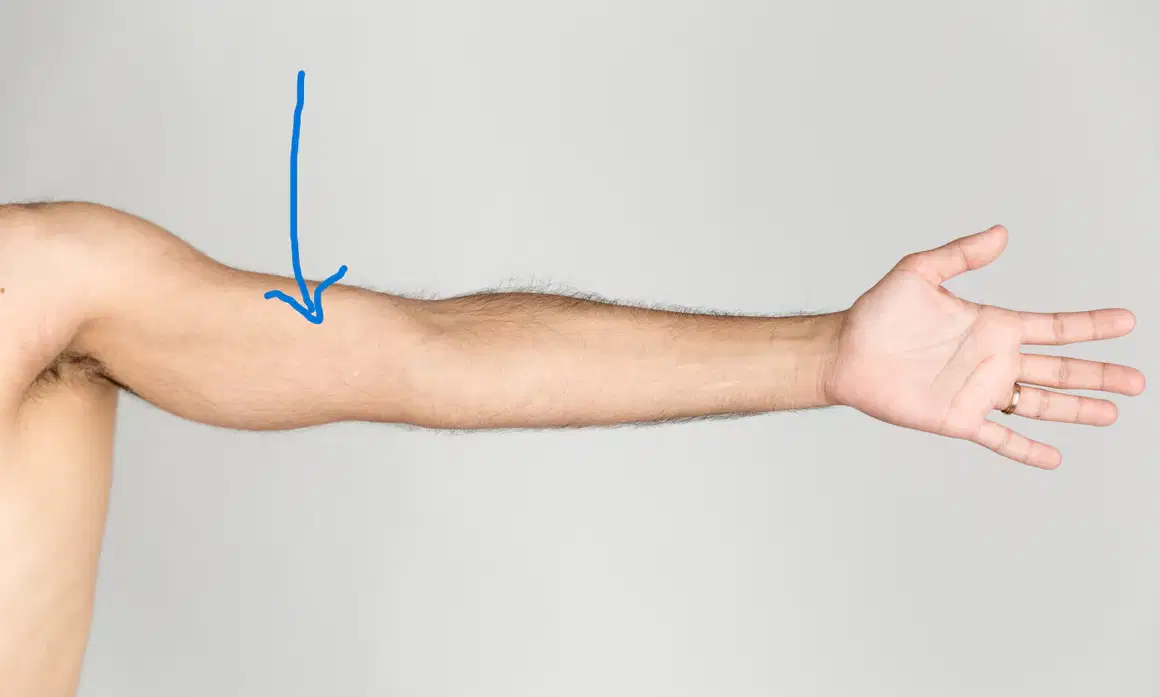
What lymph nodes, located between the bicep and tricep, is the arrow pointing to?
epitrochlear
central
inguinal
axillary
To palpate the central axillary, subscapular, and pectoral lymph nodes, the nurse must use their fingers to feel:
the groin
the armpit/axilla
2-3 cm above the antecubital fossa
the sides of the neck
A patient reports that they experience increased leg pain when walking up stairs. This most likely describes:
aortic stenosis
venous stasis
coronary artery disease
intermittent claudication
All of the following criteria are part of the Wells scoring system EXCEPT:
prescribed an anticoagulant= +1 point
alternative diagnosis with similar symptoms as DVT= +2 points
calf swelling larger than 3cm compared to opposite side= +1 point
recently bedridden for longer than 3 days= +1 point
What is the greatest risk for respiratory disease
A patient who works in a factory with dangerous chemicals and reports SOB
A patient who works as a farmer spraying pesticide and complains of no symptoms
A patient who recently received a pneumonia vaccine

