
NEW
Font size
S
M
L
XL
 Worksheets
Post-Lecture Online Assessment : Cell Cycle
Total questions: 25
Worksheet time: 13mins
Name
Class
Date
1.
1. What is the best definition of the cell cycle?
a)
A single-phase process where a cell only divides
b)
A series of events in which a cell grows, duplicates its DNA, and divides into two daughter cells
c)
The breakdown of the nuclear envelope during mitosis
d)
A metabolic pathway producing ATP
2.
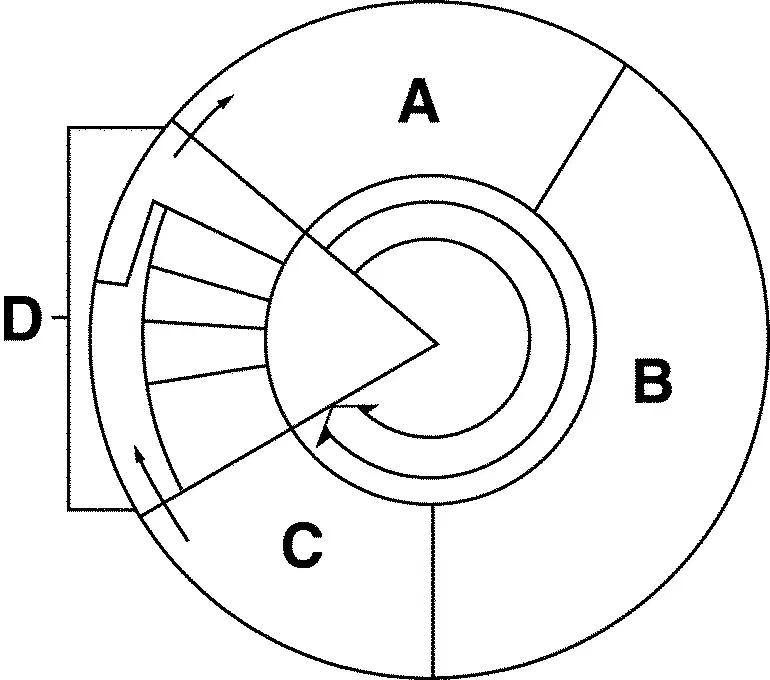
2. Choose the CORRECT stages of A, B, C and D shown in the cell cycle below.
a)
A: G2 phase , B: S phase , C: G1 phase and D : Mitosis phase
b)
A: G1 phase, B: S phase, C: G2 phase and D : Mitotic phase
c)
A: G1 phase, B: S phase, C : G2 phase and D : Mitotis phase
d)
A: S Phase, B : G1 phase, C: G2 phase and D : Meiosis phase
3.
3. What is the longest phase of the cell cycle in most cells?
a)
Interphase
b)
Anaphase
c)
Metaphase
d)
Telophase
4.
4. During the G₁ phase, what is the cell primarily doing?
a)
Replicating DNA.
b)
Condensing chromosomes.
c)
Growing in size and synthesizing mRNA and proteins
d)
Dividing into two daughter cells.
5.
5. Which activity is NOT characteristic of the G₁ phase?
a)
Cell increase in size.
b)
Increase in the number of organelles such as mitochondria & endoplasmic reticulum.
c)
Cell produces lipid, carbohydrates & protein.
d)
Centrosomes replicated.
6.
6. What is the primary event of the S phase?
a)
Cell division
b)
Chromosome condensation
c)
DNA replication
d)
Cytokinesis
7.
7. Which event occurs in parallel with DNA replication during the S phase?
a)
Synthesis of organelles.
b)
Chromosome condensation
c)
Synthesis of histone proteins and nucleosome assembly
d)
Spindle formation
8.
8. The region of a chromosome in which the two double strands of replicated DNA are held together is called __________.
a)
a centromere
b)
chromatin
c)
a centriole
d)
a chromatid
9.
9. What is the primary role of the G₂ phase?
a)
DNA replication
b)
Cytokinesis
c)
Chromosome segregation
d)
Synthesis of microtubules for development of spindle fibers.
10.
10. Which pair includes a phase of the cell cycle and a cellular process that occurs during that phase?
a)
G1 phase, DNA replication
b)
G2 phase, preparation for mitosis
c)
S phase, cell division
d)
M phase, cell growth
11.
11. Which of the following occurs during interphase?
a)
a reduction in the size of the nuclear membrane
b)
cell growth and duplication of the chromosomes
c)
separation of newly formed DNA to opposite ends of the cell
d)
chromosomes arrived at opposite poles
12.
12. During which phase in the cell cycle does mitosis happen?
a)
G1 phase
b)
G2 phase
c)
M phase
d)
S phase
13.
13. Which of the following statements is TRUE?
a)
The non-dividing state of the cell cycle is called mitosis.
b)
Chromosome replication occurs during S phase.
c)
Preparation for S phase occurs during G2.
d)
M phase occurs between G1 and S phase.
14.
14. The _______ state implies the exit of cells from the cell cycle
a)
S
b)
G1
c)
G2
d)
G0
15.
15. What is the phenomenon of nuclear division known as?
a)
Telekinesis
b)
Cytokinesis
c)
Karyokinesis
d)
Autokinesis
16.
16. What is the phenomenon of cytoplasmic division known as?
a)
Telekinesis
b)
Cytokinesis
c)
Karyokinesis
d)
Autokinesis
17.
17. Where do cells enter the G₀ phase?
a)
After S phase
b)
After M phase
c)
From G₁, before committing to S phase
d)
From G₂
18.
18. Which of the following statements is TRUE about cells in G₀?
I. The cell cycle is halted (stop)
II. Cells are metabolically active
III. G₀ cells never re-enter the cell cycle
IV. Some G₀ cells can re-enter the cell cycle upon stimulation
a)
I and II only
b)
I, II, and III
c)
I, II, and IV
d)
All four
19.
19. What happens when a cell does not receive the go‑ahead signal at the G₁ checkpoint?
a)
It proceeds directly into mitosis.
b)
It enters S phase and begins DNA replication.
c)
It exits the cell cycle and enters a quiescent state called G₀, or may undergo apoptosis
d)
It moves to G₂ phase for preparation.
20.
20. What happens when a cell receives the go‑ahead signal at the G₁ checkpoint?
a)
It enters the G₀ phase and stops dividing.
b)
It moves into mitosis directly.
c)
It complete G₁, S, G2 and M phase and divide.
d)
It pauses until the next signal.
21.
21. What does the G₁ checkpoint primarily check for?
a)
Proper spindle fiber attachment
b)
Complete DNA replication.
c)
DNA damage, sufficient nutrients, growth factors, and cell size.
d)
Chromosome alignment before mitosis.
22.
22. What does the G₂ checkpoint primarily check for?
a)
Attachment of spindle fibers to kinetochores.
b)
Cell size and nutrient availability.
c)
Completion of DNA replication and absence of DNA damage.
d)
Proper chromosome alignment before anaphase.
23.
23. What does the M checkpoint primarily check for?
a)
Completion of DNA replication
b)
Sufficient cell size and nutrients
c)
Proper attachment of all chromosomes to the spindle microtubules (proper kinetochore–spindle interaction)
d)
Presence of growth factors
24.
24. If a cell fails to receive a stop signal at a checkpoint and continues dividing, what is the most likely outcome?
a)
It undergoes apoptosis (cell death).
b)
It continues dividing, potentially accumulating mutations leading to cancer.
c)
It permanently enters G₀ phase.
d)
It repairs DNA and halts division.
25.
25. What happens when all chromosomes are properly attached to spindle fibers?
a)
The cell undergoes cytokinesis immediately.
b)
The cell enters the G₀ phase.
c)
The cell proceed into anaphase.
d)
The cell repeats metaphase.
Reset

