
Font size
 Worksheets
1311 Chapter 1 Reading Quiz
Total questions: 100
Worksheet time: 1hrs 15mins
What is the primary focus of communication studies as described in the introduction?
Only public speaking
The study of nonverbal communication only
The diversity of knowledge about how humans communicate in various contexts
The study of ancient Greek philosophers
According to the text, who were among the first to systematically study and write about speech?
Modern communication scholars
Ancient Greek philosophers like Plato and Aristotle
Scientists in the 20th century
Roman emperors
How is communication defined for the purposes of this material?
The process of public speaking only
The process of generating meaning by sending and receiving verbal and nonverbal symbols and signs influenced by multiple contexts
The act of writing books
The process of listening only
How many published definitions of communication have there been since the systematic study began in colleges and universities?
Less than 10
About 50
More than 126
Exactly 100
Which of the following is NOT mentioned as a context in which communication is studied?
Interpersonal communication
Group communication
Mathematical communication
Media communication
Who is considered a logical starting point when tracing the development of communication scholarship?
Aristotle
Cicero
Plato
James A. Winans
What does the term "rhetoric" primarily refer to according to ancient Greek philosophers?
Speaking well and persuasively
Misleading or false communication
Writing poetry
Legal proceedings
Which of the following is NOT one of the five canons of rhetoric expanded by Cicero?
Interpretation
Invention
Arrangement
Memory
What does "arrangement" refer to in the context of the five canons of rhetoric?
The organization of speech
The use of evidence and arguments
The use of language
The techniques to retain information
According to James A. Winans, what are the two motives for learning to speak?
Increasing one’s chance to succeed and increasing one’s power to serve
Winning debates and writing essays
Memorizing speeches and delivering them
Learning new languages and traveling
Which canon of rhetoric is considered the least studied?
Memory
Invention
Style
Delivery
What shift occurred in the study of communication as social psychology began to expand in academic institutions?
Definitions of communication expanded to include social and psychological contexts
Focus shifted solely to legal proceedings
Rhetoric was no longer taught
Communication became less important
Which of the following best describes intrapersonal communication?
Communication with oneself using internal vocalization or reflective thinking.
Communication between two or more people in a group.
Communication through mass media channels.
Communication between a speaker and a large audience.
What is a key characteristic that distinguishes intrapersonal communication from other forms of communication?
It involves multiple participants.
It takes place only inside our heads.
It uses external vocalization.
It always requires a physical audience.
Which of the following is an example of intrapersonal communication?
Debating with a friend about politics.
Reading a news article aloud to a group.
Deciding what to eat based on feeling hungry.
Giving a speech at a conference.
According to the text, what can trigger intrapersonal communication?
Only external stimuli.
Only internal stimuli.
Both internal and external stimuli.
Only communication with others.
Which of the following is NOT mentioned as a main form of communication in the text?
Intrapersonal communication
Interpersonal communication
Group communication
Written communication
What is the primary focus of communication scholars who study presidential speeches?
Comparing presidential speeches with other presidential rhetoric.
Analyzing family conflicts.
Studying the effects of mass media on public opinion.
Investigating the impact of technology on communication.
What might communication scholars study at a cultural level, according to the text?
The internal thoughts of individuals.
The election of an African American president and its impact on racial politics.
The structure of group discussions.
The effectiveness of advertising campaigns.
What is interpersonal communication?
Communication between people whose lives mutually influence one another.
Communication that only occurs within oneself.
Communication that only happens in large groups.
Communication that is only written and not spoken.
Which of the following is NOT a context in which interpersonal communication occurs?
Intercultural communication
Organizational communication
Health communication
Intrapersonal communication
Why is interpersonal communication considered more structured than intrapersonal communication?
It is influenced by social expectations and is interactive.
It only happens in formal settings.
It does not involve any goals.
It is always unplanned.
What is an example of an instrumental need fulfilled by interpersonal communication?
Greeting someone to fulfill a morning ritual
Writing in a diary
Reading a book alone
Watching television
What skills are important for a competent interpersonal communicator?
Conflict management and listening skills
Only public speaking skills
Only writing skills
Only memorization skills

What is group communication?
Communication among three or more people interacting to achieve a goal
Communication between two people only
Communication within oneself
Communication with animals
What is a key difference between group communication and interpersonal communication?
Group communication is more intentional and formal than interpersonal communication.
Group communication is less formal than interpersonal communication.
Interpersonal communication is always goal-oriented, unlike group communication.
Group communication never involves task-focused interactions.
Which of the following best describes public communication?
A sender-focused form of communication where one person conveys information to an audience.
A group-focused form of communication where everyone shares information equally.
A form of communication that is always informal and unplanned.
A type of communication that only occurs in private settings.
Why is group communication considered valuable in academic and professional settings?
It provides experience and preparation for teamwork in professional environments.
It is always easier than working alone.
It eliminates all interpersonal conflicts.
It is less important than public communication.
What is a common challenge in group communication?
Interpersonal conflict or misunderstandings among group members.
Lack of any task to complete.
No need for any formal structure.
Complete agreement among all members at all times.
Compared to interpersonal and group communication, public communication is:
The most consistently intentional, formal, and goal-oriented form.
The least formal and least intentional form.
Only used in casual conversations.
Focused only on small groups.
What is a key difference between public communication and interpersonal or group communication in Western societies?
It is more sender focused.
It is more listener focused.
It is less formal.
It is always written.
What is one way to manage anxiety toward public speaking, according to the text?
See connections between public speaking and other familiar forms of communication.
Ignore the audience completely.
Memorize the entire speech word for word.
Focus only on nonverbal communication.
Which of the following is an example of mass communication?
A television broadcast
A private phone call
A face-to-face conversation
A group discussion in a classroom
What distinguishes mass communication from other forms of communication?
It is intentionally transmitted through technology to many people.
It only involves face-to-face interaction.
It does not require any technology.
It is always informal.
Which of the following is NOT considered a mass communication channel?
A private diary
Television
Websites
Podcasts
What is required to send mass communication messages?
Technology and intentionality
Only verbal skills
No planning or technology
Face-to-face interaction only
According to the text, which of the following is a mass communication message?
The President’s State of the Union address
A president’s verbal gaffe during a news interview
A private conversation between friends
A handwritten letter to a family member
Which of the following is an example of print media used in mass communication?
Newspapers and magazines
Podcasts
Television shows
Websites
What is a similarity between public speaking and daily conversations, as mentioned in the text?
Both allow for verbal and nonverbal feedback.
Both are always formal.
Both require technology.
Both are mass communication.

What does the image in Figure 1.3 represent?
Instagram as a form of mass communication
A private phone call
A handwritten letter
A group discussion
What is the main purpose of models of communication as described in the text?
To provide a visual representation of the various aspects of a communication encounter.
To make communication more complicated.
To eliminate the need for communication.
To replace real-life communication experiences.
Which of the following is NOT mentioned as one of the three models of communication discussed in the text?
Transmission model
Interaction model
Transaction model
Reflection model
In communication models, who are the participants?
The senders and/or receivers of messages in a communication encounter.
Only the person who initiates the conversation.
Only the person who receives the message.
The people who observe the communication.
What is the process of turning thoughts into communication called?
Encoding
Decoding
Channeling
Transmitting
What is the process of turning communication into thoughts called?
Decoding
Encoding
Channeling
Transmitting
According to the text, what is a channel in the context of communication?
A sensory route on which a message travels to the receiver for decoding.
A type of message.
A participant in the communication process.
A model of communication.
Which sensory routes are most commonly used for communication, as mentioned in the text?
Visual (sight) and auditory (sound)
Taste and smell
Touch and taste
Smell and auditory (sound)
What does the transmission model of communication primarily describe?
Communication as a linear, one-way process from sender to receiver
Communication as a circular, two-way process between sender and receiver
Communication as a group discussion among multiple participants
Communication as a random exchange of messages
In the transmission model of communication, what is the main role of the receiver?
To act as a target or end point for the message
To continuously interact with the sender
To create new messages for the sender
To modify the message before sending it back
Which of the following best describes "noise" in the context of the transmission model of communication?
Anything that interferes with a message being sent between participants
Only loud sounds that disrupt communication
The process of encoding a message
The feedback given by the receiver
What is "environmental noise" according to the transmission model of communication?
Any physical noise present in a communication encounter
Misunderstanding of symbols or language
The process of encoding a message
The feedback from the receiver
What is "semantic noise" in the transmission model of communication?
Noise that occurs when participants do not understand a symbol
Physical noise in the environment
The process of sending a message
The clarity of the message
Which of the following is an example of semantic noise?
A French speaker not understanding Swedish
A loud construction site near a conversation
A clear and static-free radio signal
A message being sent through a faulty antenna
What is one limitation of the transmission model of communication as described in the text?
It cannot capture dynamic face-to-face interactions.
It is too complex for everyday use.
It only works for written communication.
It ignores the role of technology.
What is an example of semantic noise interfering with a text message?
An abbreviation the receiver doesn’t know or an autocorrect error changing the intended word.
A message sent in a foreign language.
A message sent too late at night.
A message that is too long to read.
Which model of communication is best suited for describing the act of text messaging?
Transmission model
Interaction model
Transactional model
Linear model
What does the interaction model of communication emphasize that the transmission model does not?
Feedback and two-way interaction
One-way message delivery
Use of technology
Written communication only
According to the interaction model of communication, what do participants do?
Alternate positions as sender and receiver and generate meaning by sending messages and receiving feedback.
Only send messages without receiving any.
Communicate only in written form.
Ignore physical and psychological contexts.
What is feedback in the context of the interaction model of communication?
Messages sent in response to other messages.
Background noise during a conversation.
A one-way message from sender to receiver.
A type of semantic noise.
What does the diagram labeled "Figure 1.5: The interaction model of communication" illustrate?
The process of communication as a two-way interaction with feedback.
A one-way transmission of messages.
The effect of noise on communication.
The use of technology in communication.
What is a key feature of the interaction model of communication compared to the transmission model?
The interaction model includes a feedback loop and alternates roles between sender and receiver.
The interaction model only focuses on the sender.
The interaction model ignores feedback.
The interaction model is only concerned with written messages.
Which of the following best describes "physical context" in a communication encounter?
The environmental factors such as size, layout, temperature, and lighting.
The mental and emotional state of the participants.
The language used in the conversation.
The number of messages sent.
What does "psychological context" in communication refer to?
The mental and emotional factors influencing communication.
The physical location of the conversation.
The number of people involved in the conversation.
The type of technology used for communication.
According to the interaction model, what is NOT a primary concern when judging the effectiveness of communication?
Whether a single message was successfully transmitted and received.
The process of communication itself.
The presence of feedback and context.
The possibility that some messages may not be received.
How can positive psychological states, such as love, affect communication according to the text?
They can cause individuals to overlook incompatible personality traits.
They always improve communication accuracy.
They eliminate the need for feedback.
They make communication less important.
What is a key difference between the transaction model of communication and earlier models?
The transaction model views communication as a simultaneous process where participants are both senders and receivers.
Earlier models focus only on written communication.
The transaction model ignores the role of context.
Earlier models do not involve any feedback.
In the transaction model of communication, what term is used to refer to the people involved in a communication encounter?
Communicators
Senders
Receivers
Observers
According to the transaction model, what do communicators create through their interactions?
Social realities
Physical objects
Mathematical formulas
Technological devices
Which of the following is NOT a context considered in the transaction model of communication?
Technological context
Social context
Cultural context
Relational context
What does the transaction model suggest about the roles of sender and receiver?
We are simultaneously senders and receivers.
We alternate strictly between sender and receiver.
Only one person communicates at a time.
There is no need for feedback.
What does the transaction model of communication consider in order to account for contextual influences outside of a single interaction?
Only the words spoken during the interaction
Social, relational, and cultural contexts
The physical environment only
The emotional state of the sender only
Which of the following is an example of a social norm that influences communication?
Speaking in a foreign language
Not interrupting people
Using technical jargon
Writing in cursive
How are social norms typically learned?
Through genetic inheritance
By reading textbooks only
Through observation, practice, and trial and error
By memorizing laws
What might happen if someone breaks a social norm at a company holiday party?
They will always be formally punished
They may feel social awkwardness or embarrassment
They will be promoted
They will be ignored by everyone
What is a characteristic of initial interactions with someone you have just met, according to the concept of relational context?
They are usually informal and unstructured
They are highly scripted and governed by established norms and rules
They involve breaking social norms
They are always emotional
Why might someone be more likely to interrupt a close friend than a professor during a lecture?
Because professors encourage interruptions
Because social norms are less powerful with friends
Because relational context allows for bending social norms with close friends
Because friends are always wrong
What is included in the concept of "relational context" in communication?
The type of relationship people have
The physical setting of communication
The language spoken
The time of day communication occurs
Which of the following is NOT typically included in the cultural context of communication?
Favorite food
Race
Gender
Nationality
According to the text, why might people with historically marginalized identities be more aware of their cultural identities in communication?
Because they are regularly aware of how their cultural identities influence communication
Because they communicate less frequently
Because they do not have cultural identities
Because they are always in the majority
What is encouraged as you learn the principles of communication?
To take note of aspects of communication you haven’t thought about before
To ignore communication principles
To focus only on written communication
To avoid applying communication principles to your life
What effect can putting communication at the front of your mind have?
It can be informative and have many positive effects
It will make communication less important
It will make you forget how to communicate
It will only help in professional settings
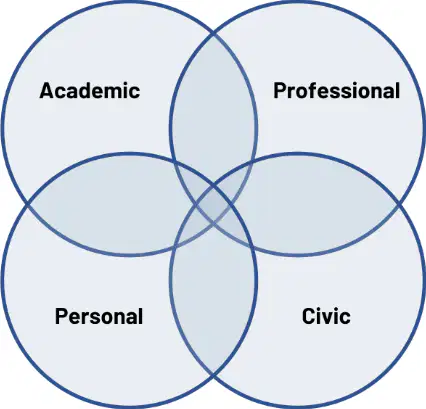
Which four spheres are used to describe how communication is integrated into all parts of our lives?
Academic, Professional, Personal, Civic
Academic, Social, Economic, Political
Professional, Economic, Social, Civic
Academic, Economic, Personal, Political
What is the philosophy called that encourages students to reflect on how the content they are learning connects to other classes, professional goals, and civic responsibilities?
Integrative learning
Experiential learning
Collaborative learning
Independent learning
According to the text, what does the term "real" emphasize in the context of communication studies?
That communication is only theoretical
That communication is only about passing tests
That communication is practical and applies to our actual lives
That communication is limited to the classroom
Why is it important for students in a communication class to make explicit connections between the course and other courses they have taken or are currently taking?
To earn a higher grade in the communication class
To build foundational communication skills and become a more competent communicator
To memorize more vocabulary
To avoid taking future communication classes
What is one reason why students may not fully understand the extent to which communication forms, maintains, and ends interpersonal relationships?
They lack specific vocabulary and foundational knowledge of communication concepts.
They do not watch enough television talk shows.
They only learn from textbooks, not experience.
They focus only on written communication.
What does having a vocabulary to name communication phenomena in our lives help us do?
Consciously alter our communication to achieve goals and avoid miscommunication.
Memorize more words for exams.
Communicate only in professional settings.
Avoid all mistakes in communication.
What does "civic engagement" refer to?
Working to make a difference in our communities by improving the quality of life and raising awareness about issues.
Attending only social events in the community.
Voting in every election.
Watching political debates on television.
How is the civic part of our lives developed?
Through engagement with decision making in society at various levels.
By focusing only on personal achievements.
By avoiding political discussions.
Through academic study alone.
Why is civic engagement important in a democratic society?
It enables us to work for the common good and become part of meaningful groups or causes.
It allows us to avoid all political discussions.
It helps us focus only on our personal lives.
It is required by law.
According to the text, what is a limitation of viewing communication only as the transmission of information?
It does not address the various needs we have as human beings.
It makes communication too complex.
It focuses only on written messages.
It ignores the importance of technology.
Besides helping us achieve physical and instrumental needs, what else does communication influence according to the text?
Our identities and relationships.
Only our academic performance.
The speed of information exchange.
The cost of communication devices.
What are physical needs as described in the context of communication?
Needs that keep our bodies and minds functioning
Needs that help us achieve short- and long-term goals
Needs that help us maintain social bonds
Needs that are only related to food and shelter
Which of the following is an example of meeting a physical need through communication?
Asking a friend if you can stay at their house after being evicted
Making a to-do list for the day
Joining a club to make new friends
Reading a book for entertainment
According to the text, what can good interpersonal communication skills help people do?
Adapt to stress and have less depression and anxiety
Win every argument
Avoid all physical health problems
Never need help from others
What are instrumental needs?
Needs that help us get things done in our day-to-day lives and achieve goals
Needs that keep our bodies and minds functioning
Needs that help us maintain social bonds
Needs that are only related to emotional support
Which of the following is NOT an example of an instrumental need?
Getting information you need
Influencing others
Getting support
Crying when you are hungry
What are relational needs?
Needs that help us maintain social bonds and interpersonal relationships
Needs that help us achieve short-term goals
Needs that keep our bodies functioning
Needs that are only related to financial success
Why is communicating for relational needs considered essential?
It helps us achieve the social relating that is an essential part of being human
It helps us win arguments
It helps us get more money
It helps us avoid all physical needs
What is one way communication helps meet our relational needs?
To develop, maintain, and end relationships
To solve mathematical problems
To create scientific theories
To design buildings

