
 Worksheets
X-Ray Error Identification Quiz (Weeks 2/3)
Total questions: 15
Worksheet time: 8mins
Which of the following best describes "improper centering" in an x-ray image?
The x-ray beam is not aligned with the area of interest.
The patient is not holding their breath.
The exposure time is too long.
The shielding is placed over the area of interest.
What is the primary purpose of shielding in radiographic imaging?
To improve image contrast
To protect patients from unnecessary radiation
To center the x-ray beam
To increase exposure
Which of the following is a sign of poor patient positioning in a chest x-ray?
The clavicles are not equidistant from the spine.
The image appears too dark.
The shielding is visible in the image.
The exposure time is too short.
Which of the following is an example of incorrect exposure settings?
The image is too light or too dark
The patient is not centered
The shielding is missing
The patient is rotated

A student is reviewing a chest x-ray and notices that the right lung appears larger than the left, and the trachea is shifted. Which error is most likely present?
Improper centering
Poor patient positioning
Incorrect exposure settings
Inadequate shielding
You observe an x-ray image where the gonadal shielding is placed over the area of interest, obscuring important anatomy. What is the best description of this error?
Improper centering
Inadequate shielding practices
Poor patient positioning
Incorrect exposure settings

A chest x-ray shows only 6 posterior ribs above the diaphragm. What does this indicate about the patient's inspiration?
Sufficient inspiration
Insufficient inspiration
Overexposure
Improper centering
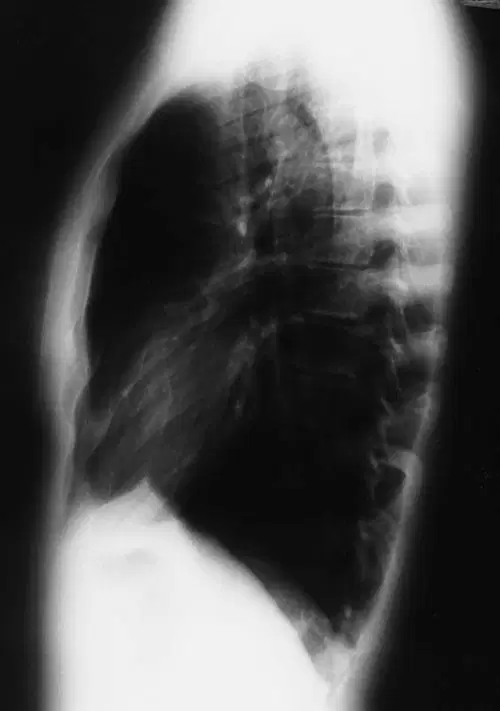
If an x-ray image is too dark, which adjustment should be made to the exposure settings for the next attempt?
Increase the mAs
Decrease the mAs
Increase the kVp
Decrease the SID
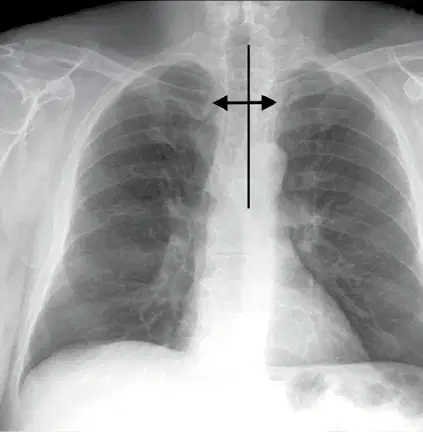
A radiograph shows the patient's spine is not centered between the medial ends of the clavicles. What is the most likely cause?
Improper centering technique
Inadequate shielding
Incorrect exposure
Insufficient inspiration
A student is asked to evaluate a chest x-ray for proper inspiration. What evidence should they use to determine if inspiration was sufficient?
The number of visible anterior ribs above the diaphragm
The number of visible posterior ribs above the diaphragm
The position of the scapulae
The presence of shielding
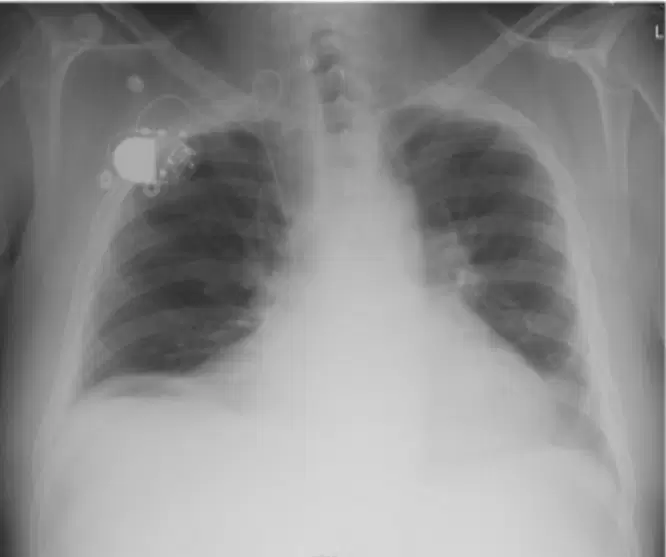
Given a chest x-ray where the heart appears unusually large and the lung fields are hazy, what combination of errors might be present, and how would you confirm your hypothesis?
Insufficient inspiration and incorrect exposure; check rib count and image density
Improper centering and inadequate shielding; check beam alignment and shielding placement
Poor patient positioning and misalignment; check clavicle symmetry and spine position
Overexposure and improper centering; check image darkness and area of interest alignment
A radiograph shows the left hemidiaphragm is higher than the right, and the patient’s scapulae are not outside the lung fields. What steps would you take to correct these errors in a repeat image?
Instruct the patient to take a deeper breath and reposition their arms
Increase the exposure time and move the shielding
Center the x-ray beam lower and decrease the kVp
Place the patient in a supine position and reduce mAs
You are presented with a chest x-ray where the vertebral column is not visible through the heart shadow, and the image appears underexposed. How would you adjust the exposure settings and why?
Increase the mAs to allow more x-ray photons to reach the detector, improving image density
Decrease the mAs to reduce image density
Increase the SID to magnify the image
Decrease the kVp to reduce penetration
With digital imaging, it is impossible to overexpose the patient to radiation because the computer makes adjustments to the image.
True
False
Whenever magnification is increased:
spatial resolution is decreased
spatial resolution is increased
spatial resolution stays the same
exposure to the image receptor increases

