wayground logo

Free Printable Worksheets

Font size

S
M
L
XL
Worksheets

PS Science Foundations Review

Total questions: 84

Worksheet time: 2hrs 34mins

Name
Class
Date
1.
Goofing-off or inappropriate use of lab equipment will result in...
a)
fun
b)
a happy teacher
c)
loss of lab privileges
d)
an A+
2.
What should you do if you break glass in the lab?
a)
Tell the teacher.
b)
Sweep up the glass.
c)
Pick up the glass with your hands.
d)
Ignore it; the teacher will clean it up when she sees it later.
3.

In a laboratory, the following should NOT be worn

a)

gloves

b)

open toed shoes

c)

apron

d)

goggles

4.

In the classroom you should stack your bags and books in the aisles.

a)

True

b)

False

5.

If you do not understand a direction or part of a lab procedure, you should

a)

figure it out on your own as you go

b)

ask your teacher

c)

guess

d)

write a pros and cons list

6.
Horseplay or practical jokes in the laboratory are
a)
ok as long as  you're done
b)
always accepted
c)
dangerous and could cause harm and invalidate the experiment
d)
fun
7.
You are heating a piece of glass and now want to pick it up. You should 
a)
pour cold water on it
b)
use tongs
c)
pick up the end that looks cooler
d)
use a rag or paper towels
8.
To put out a fire on a person's hair or clothes, use:
a)
the fire blanket.
b)
the wind from running.
c)
the fire extinguisher.
d)
any wet chemical you can find.
9.

Any student can go into the science storage room if they need something.

a)

True

b)

False

10.

When removing the plug from a socket,

a)

after washing your hands, unplug the cord.

b)

grab the cord and jerk it out of the wall

c)

grasp the plug

11.
Identify the primary function of the lab equipment seen in the image.
a)
Mixing liquids
b)
Measuring liquid volume
c)
Mixing solids
d)
Measuring mass
12.
Identify the piece of lab equipment seen in the image.
a)
Erlenmeyer Flask
b)
Graduated Cylinder
c)
Beaker
d)
Test Tube
13.

What is used to measure, heat, and mix large amounts of liquids?

a)

Beaker

b)

Flask

c)

Test Tube

d)

Graduated Cylinder

14.
What is used to hold test tubes?
a)
Test tube rack
b)
Magnifying glass
c)
Petri dish
d)
Funnel
15.

What is used to measure the volume of liquids?

a)

Flask

b)

Beaker

c)

Graduated Cylinder

d)

Pipette

16.

What is used to pick up items?

a)

Clamps

b)

Tongs

c)

Hand lens

d)

Pipette

17.

What is used to transfer small amounts of liquid?

a)

Graduated Cylinder

b)

Medicine Dropper/Pipette

c)

Beaker

d)

Flask

18.

Which piece of equipment would be used to measure our 30 mL of water?

a)

graduated cylinder

b)

triple beam balance

c)

test tube

d)

pipette

19.

Which of the following is the proper way to attempt to determine the identity of an unknown substance?

a)

Put the substance close to your nose and sniff it.

b)

Taste a very small amount of it.

c)

Put a small amount on your skin and see if it burns.

d)

Waft it toward your nose.

20.
If you wear contact lenses..
a)
keep the information to yourself
b)
you do not have to wear goggles
c)
ensure to take them out when using the eyewash station
d)
take them out before starting the lab
21.
after exposure, how many minutes do eyes and skin get rinsed with water for
a)
15
b)
30
c)
10
d)
5
22.

After completing an experiment, all chemical wastes should be:

a)

Left at your lab station for the next class

b)

Disposed of according to your instructor’s directions

c)

Dumped in the sink

d)

Taken home

23.

When gathering glassware and equipment for an experiment, you should:

a)

Read all directions carefully to know what equipment is necessary

b)

Examine all glassware to check for chips or cracks

c)

Clean any glassware that appears dirty

d)

All of the above

24.

How many hours are in a fortnight (2 weeks)?

1 week = 7 days; 1 day = 24 hours [Note: do not round answer]

a)

672 hours

b)

168 hours

c)

336 hours

d)

504 hours

25.

How many decades are equal to 1.7 x 1025 minutes?

(60 min = 1 hour; 24 hours = 1 day; 7 days = 1 week; 52 weeks = 1 year; 10 years = 1 decade)

a)

3.2 x 10¹⁸ decades

b)

3.2 x 10¹⁹ decades

c)

1.2 x 10²² decades

d)

2.3 x 10²⁰ decades

26.

On Dr. Davis' bookshelf, there are 23 science textbooks, each with an average of 31 chapters. If each chapter contains 5 pages, how many total pages are there?

a)

3.6 x 10⁴ pages

b)

36 pages

c)

3.6 x 10² pages

d)

3600 pages

27.

A newborn baby eats 8 times a day. At each feeding, he eats 2.5 ounces of formula. How many days will it take

for the baby to eat 1000 ounces? (do not round your answer)

a)

50 days

b)

400 days

c)

32 days

d)

312 days

28.

You have a summer job serving ice cream cones at the beach, serving an average of 25 cones per hour. You work 8 hours per day, 5 days a week, and get paid a salary of $940.34 every 2 weeks. Approximately how many ice cream cones will you have to serve to earn the $5,800 you are saving to buy a car?

a)

12,000 cones

b)

62,000 cones

c)

21,000 cones

d)

95,000 cones

29.
7.82 x 10⁻⁶ is an example of scientific notation. The exponent of -6 tells you your number will be very ________.
a)
Large
b)
Small
c)
Basic
30.
If the exponent on your power of 10 is positive, is your number larger or smaller than 10?
a)
Larger
b)
Smaller
31.
Change from standard form to scientific notation: 12,000,000
a)
12.0  x  107
b)
0.12  x  107
c)
1.2  x  106
d)
1.2  x  107
32.
Change from standard form to scientific notation:  450,000
a)
4.5  x  105
b)
45  x  105
c)
4.5  x  104
d)
4.5  x  106
33.
Change from standard form to scientific notation:  0.000398
a)
39.8  x  10-5
b)
3.98  x  10-5
c)
3.98  x  10-4
d)
39.8  x  10-6
34.
Change from standard form to scientific notation: 0.004078
a)
4.078  x  10-3
b)
4.078  x  103
c)
40.78  x  10-4
d)
.4078  x  10-2
35.
Try to change the number back to standard form:  6.79  x  104
a)
679,000
b)
6,790
c)
67,900
d)
6,790,000
36.
Try to change the number back to standard form: 3.97  x  10-2
a)
0.000397
b)
0.0397
c)
0.0000397
d)
0.397
37.
The factor multiplied by a power of 10 in scientific notation needs to be greater than or equal to one but less than ___________?
a)
1
b)
10
c)
100
d)
1,000
38.
240 cm = ___________ m
a)
2400
b)
24
c)
2.4
d)
0.24
39.
32.9 km = ___________ cm
a)
32,900
b)
329,000
c)
3,290,000
d)
32,900,000
40.
Accuracy is defined as
a)
close repeated measurements
b)
awesome measurements
c)
really good guessing
d)
measurement near the true value
41.
Which is more 4 kg or 3,000 g?
a)
4 kg
b)
3,000 g
42.
Romy's measurements: 6.02 m, 6. 04 m, 6.03 m
Actual Value: 6.02 m
How would you define her measurements?
a)
accurate and precise
b)
accurate 
c)
precise
d)
neither
43.
Why is a beaker not a good measuring tool?
a)
holds too much liquid
b)
too many lines
c)
not many lines
d)
has a weird shape
44.
This bullseye demonstrates...
a)
High Accuracy & High Precision
b)
High Accuracy & Low Precision
c)
Low Accuracy & High Precision
d)
Low Accuracy & Low Precision
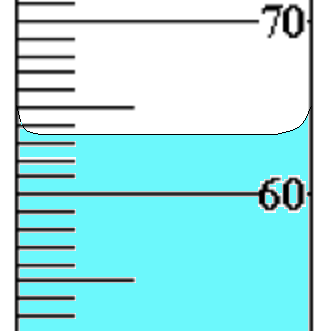
45.
Volume?
a)
63.5 mL
b)
63 mL
c)
63.55 mL
d)
6 mL
46.
An empty beaker has a mass of 60 grams.  When mercury is added to the graduated cylinder, it has a mass of 200 grams. What is the mass of the mercury?
a)
140 grams
b)
200 grams
c)
140 mL
d)
260 g
47.
How would you write 4.3756 x 10in standard form?
a)
437,560,000
b)
0.00043756
c)
43,756
d)
4,3756
48.
When measuring the mass of an elephant it is best to use:
a)
g
b)
nL
c)
ng
d)
kg
49.
How many milliliters are in 0.04L?
a)
0.004L
b)
0.004ml
c)
40ml
d)
4L
50.
What is an if....then statement that predicts the outcome of an experiment?
a)
Conclusion
b)
Materials
c)
Hypothesis
d)
Problem
51.
?
a)
High Accuracy & High Precision
b)
High Accuracy & Low Precision
c)
Low Accuracy & High Precision
d)
Low Accuracy & Low Precision
52.
The metal is 7.1 cm long
a)
7 is the estimated digit
b)
1 is the estimated digit
c)
7 is the uncertain digit
d)
Both 7 and 1 are estimated digits
53.
How many estimated digits should there be in an accepted measurement?
a)
0
b)
1
c)
2
d)
3
54.
"I saw a Cheetah!!!" ... is an example of a
a)
hypothesis
b)
conclusion
c)
theory
d)
observation
55.
A control is a group of subjects that
a)
does not receive the independent variable
b)
does not receive the dependent variable
c)
run the experiment
d)
increase the effect of the outside variables on the experiment
56.
How many manipulated variables does an experiment have?
a)
0
b)
1
c)
between 1 and 5
d)
as many as needed
57.
A student wants to test the effects of type of exercise on heart rate.  What is the dependent variable?
a)
heart rate
b)
type of exercise
c)
amount of exercise
d)
time of day exercise occurs
58.
An experiment is performed on plants to see how different liquids affect plant growth. Each plant in the experiment is given a different liquid; water, apple juice, or milk. Each plant has the same amount of soil, sunlight, and listens to the same music. In this investigation, the independent variable is ...
a)
The type of plant
b)
The amount of sunlight
c)
The type of music
d)
The type of liquid
59.
Batman decides to conduct an experiment where he tests how far Batarangs of different shapes and sizes can travel. Why would Alfred consider this a bad experiment?
a)
It has more than one independent variable
b)
Batarangs don't travel that far
c)
You never talk back to batman
d)
Batarangs are too old school
60.
This variable in an experiment is the one being deliberately changed by the scientist. 
a)
dependent variable
b)
independent variable
c)
data
d)
control group
61.
Which of these statements is qualitative?
a)
Max's high score is 132,550.
b)
My piano teacher's cat weights 8.5 lbs.
c)
The policeman will give you a ticket if you drive faster than 50 mph down this road.  
d)
Carly is wearing her red dress.
62.
Which of these statements is quantitative?
a)
The ice is so smooth that it is nearly frictionless.  
b)
It is very humid outside today.
c)
It took seven trials of the experiment for the researcher to gather enough data.
d)
Kepler showed that planets orbit faster near the Sun.  
63.
You are measuring the speed at chich a marble rolls down an inclined plane.  Which set of measurements is the most precise and most acccurate if the actual speed is 2 m/s?
a)
9.0, 11, 1.4, 0.0 m/s
b)
1.10, 1.15, .920, .900 m/s
c)
2.10, 2.15, 2.00, 1.90 m/s
d)
4.10, 4.15, 3.92, 3.90 m/s
64.
Sally makes a pendulum using a 6 cum long string attached to a 1 g ball.  She measures the time it takes for one back-and forth swinging motion and repeats the experiment with several different lengths of string.  Which of the following is the dependent variable in her experiment?
a)
length of the string
b)
time for one swinging motion
c)
mass of the pendulum ball
d)
distance the pendulum swings
65.
There are __?__ significant digits in the number 0.00076
a)
2
b)
4
c)
5
d)
6
66.
There are __?__ significant digits in the number 2,000,000
a)
1
b)
2
c)
6
d)
7
67.
There are __?__ significant digits in the number 90,000.00
a)
1
b)
2
c)
5
d)
7
68.
Order the following from least to greatest. 
a) 7.21 x 10⁵
b) 1.3 x 10⁶
c) 2.2 x 10⁶
d) 9.01 x 10⁵
a)
a, b, c, d
b)
a, d, b, c
c)
a, d, c, b
d)
d, a, b, c
69.
Never pour ______ into ______.
a)
water into an acid
b)
acid into water
c)
mentos into coke
d)
coke into mentos
70.
How many significant figures does the following number have?
0.00345
a)
6
b)
5
c)
3
d)
Ambiguous: 3,4,5, or 6
71.
How many significant figures does the following number have: 0.00204
a)
6
b)
4
c)
3
d)
2
72.
How many significant figures does the following number have: 100.00210
a)
7
b)
8
c)
10
d)
Ambiguous: 7 or 8
73.

How many significant figures: 450 m

a)

3

b)

2

c)

1

d)

0

74.
How many significant figures: 0.001 g
a)
4
b)
3
c)
2
d)
1
75.
How many significant figures: 100.000 cL
a)
1
b)
3
c)
5
d)
6
76.
How many significant figures: 1000 mL
a)
1
b)
2
c)
3
d)
4
77.

What does length measure?

a)

how much liquid something can hold

b)

how heavy something is

c)

how much time something takes to happen

d)

how long something is

78.

When you think of a millimeter, think of _______________________.

a)

the width of your pinky nail

b)

the edge of a dime

c)

the width of a door

d)

the length of 10 football fields

79.

When you think of how long a centimeter is, think of ______________________.

a)

the width of your pinky nail

b)

the edge of a dime

c)

the width of a door

d)

a paperclip

80.

When you think of how long a meter is, think of ______________________.

a)

your knuckle to knuckle

b)

a pineapple

c)

the length of 10 football fields

d)

the width of the door

81.

When you consider the length of a kilometer, think about __________________________.

a)

the length of 10 football fields

b)

the width of a door

c)

the height of a fridge

d)

the width of your pinky nail

82.

How many millimeters are in 1 meter?

a)

2

b)

10

c)

100

d)

1,000

83.

1 kilometer = _____ meters

a)

2

b)

10

c)

100

d)

1,000

84.

1 liter = ________ milliliters

a)

5

b)

10

c)

100

d)

1,000