
 Worksheets
Overview of topic 1: Plate Tectonics
Total questions: 85
Worksheet time: 43mins
The plate tectonic theory explains:
how Earth's lithospheric plates move and interact
the process of photosynthesis in plants
the formation of the solar system
the water cycle on Earth
Convection currents in the mantle cause tectonic plate movement by:
transferring heat and causing plates to move apart or collide
cooling the Earth's core and solidifying plates
creating earthquakes directly at the surface
melting the crust completely
Slab-pull force contributes to tectonic plate movement by:
pulling the plate into the mantle at subduction zones
pushing plates apart at mid-ocean ridges
lifting plates upward at mountain ranges
rotating plates around the Earth's core
Evidence of seafloor spreading includes which of the following?
The age of rocks increases as you move away from the mid-ocean ridge
The seafloor is completely flat and featureless
Ocean water temperature is the same everywhere
There are no magnetic patterns on the ocean floor
Evidence of seafloor spreading supports the plate tectonic theory because it shows that new oceanic crust is formed at mid-ocean ridges and moves outward.
It shows that new oceanic crust is formed at mid-ocean ridges and moves outward.
It proves that continents have always remained in the same position.
It demonstrates that mountains are only formed on land.
It indicates that the ocean floor is older than the continents.
Magnetic striping refers to:
the pattern of magnetic minerals in oceanic crust that shows alternating stripes of normal and reversed polarity
the process of forming mountains through tectonic activity
the layering of sedimentary rocks in horizontal bands
the movement of tectonic plates along fault lines
1.3 Magnetic Striping: Evidence of magnetic striping supports the plate tectonic theory because:
it shows symmetrical patterns of magnetic minerals on either side of mid-ocean ridges, indicating seafloor spreading.
it proves that continents have always been in their current positions.
it demonstrates that magnetic fields never change over time.
it shows that ocean floors are older than continents.
1.4 Processes at different plate boundaries: The different tectonic plate boundaries are:
Divergent, convergent, and transform boundaries
Continental, oceanic, and volcanic boundaries
Subduction, collision, and spreading boundaries
Mantle, crust, and core boundaries
At divergent plate boundaries, which of the following processes occurs?
Plates move apart and new crust forms
Plates collide and mountains form
One plate sinks beneath another
Plates slide past each other
At convergence plate boundaries, which of the following occurs?
Plates move towards each other and collide
Plates move away from each other
Plates slide past each other horizontally
Plates remain stationary
At transform plate boundaries, which of the following occurs?
Plates slide past each other horizontally.
Plates move away from each other, creating new crust.
Plates collide and one is forced beneath the other.
Plates remain stationary with no movement.
According to the plate tectonic theory, what helps us understand why and how plates move?
The plate tectonic theory helps us understand why and how plates move.
The water cycle helps us understand why and how plates move.
The greenhouse effect helps us understand why and how plates move.
The rock cycle helps us understand why and how plates move.
Which of the following is explained by the plate tectonic theory?
Earth has a three-layered structure.
The Earth's lithosphere is broken up into tectonic plates.
Tectonic plates are constantly moving.
All of the above.
The Earth's ________ is broken up into tectonic plates.
lithosphere
mantle
core
atmosphere
What does the movement of tectonic plates result in?
Formation of major landforms (e.g. volcanoes, fold mountain ranges, and oceanic trenches)
Occurrence of certain phenomena (e.g. earthquakes and tsunamis)
Both A and B
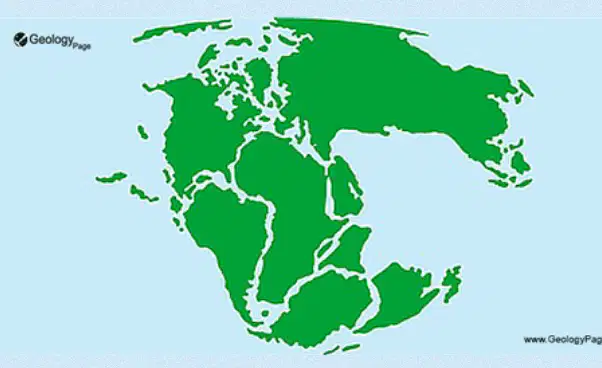
What does this diagram represent in the context of plate tectonic theory?
The diagram represents the supercontinent Pangaea, illustrating how Earth's landmasses were once joined together before plate movements separated them.
The diagram shows the current distribution of tectonic plates across the globe.
The diagram illustrates the process of sea-floor spreading at a mid-ocean ridge.
The diagram depicts the formation of volcanic island arcs due to subduction zones.
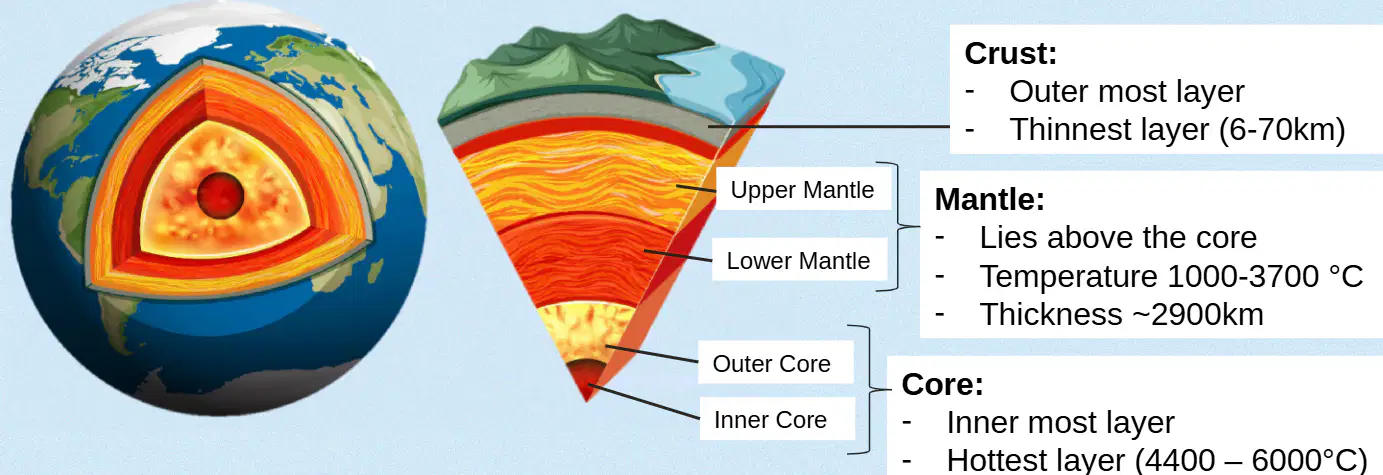
Which is the outermost layer of the Earth?
Mantle
Core
Crust
Inner Core
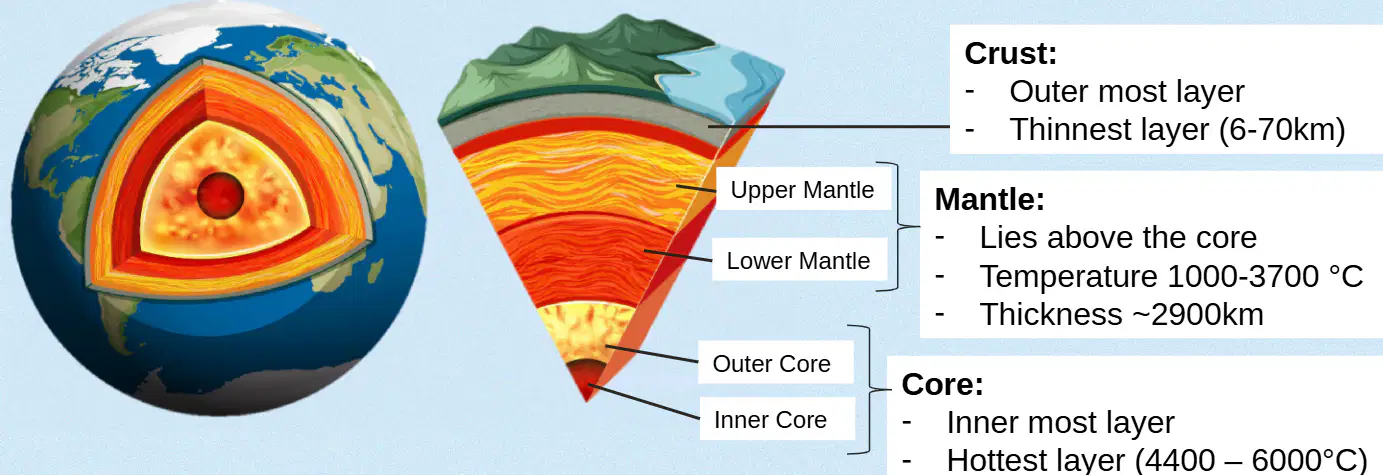
The mantle lies above the core.
True
False
Sometimes true
Only in the outer core
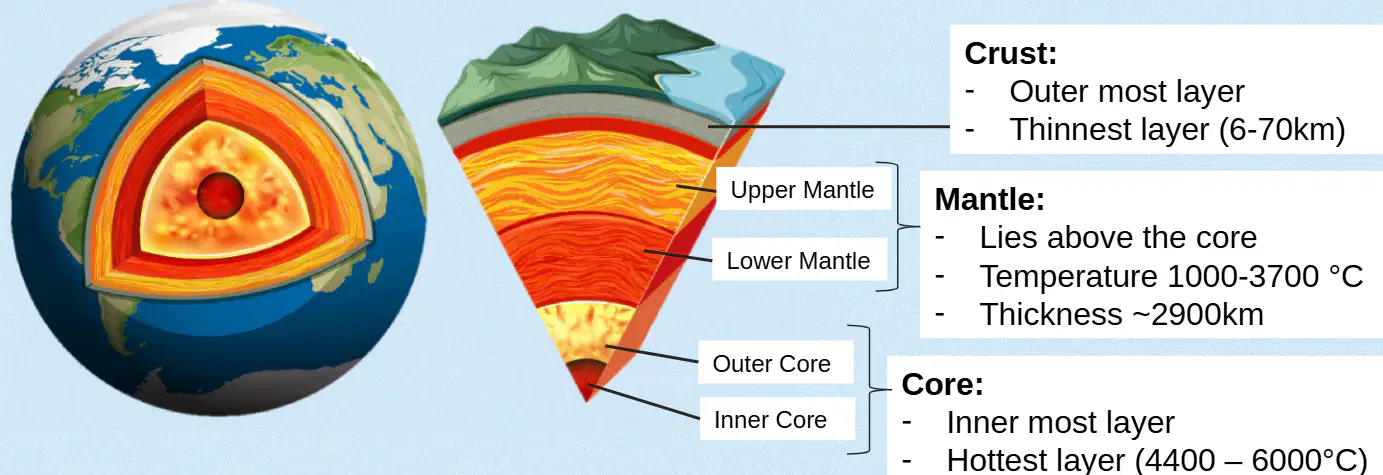
Fill in the blank: The core is the ________ layer of the Earth.
innermost
outermost
middle
thickest
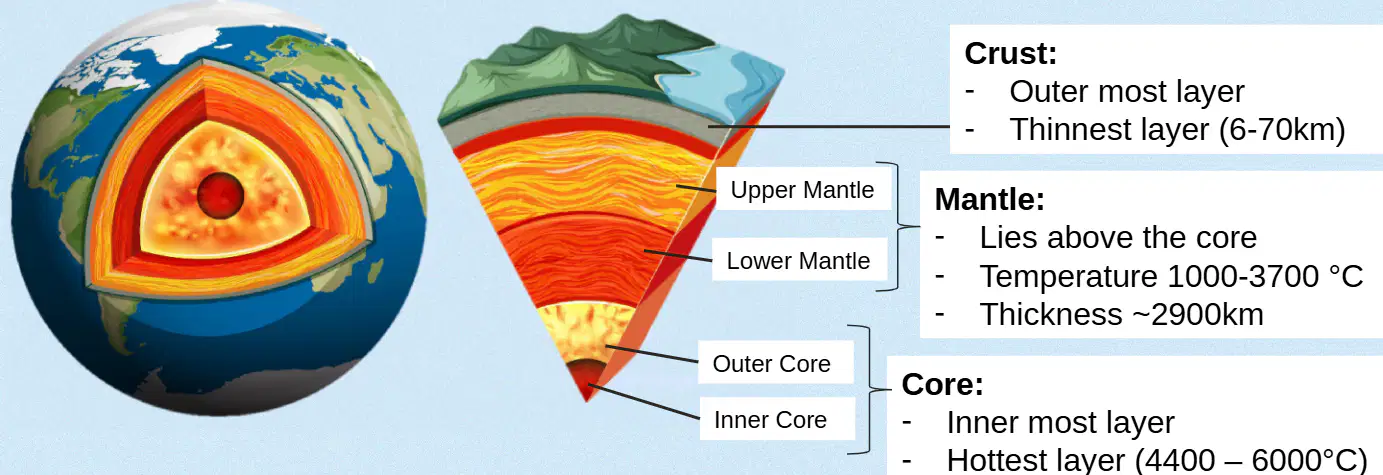
Which layer of the Earth has the highest temperature (4400 – 6000°C)?
Crust
Mantle
Outer Core
Core
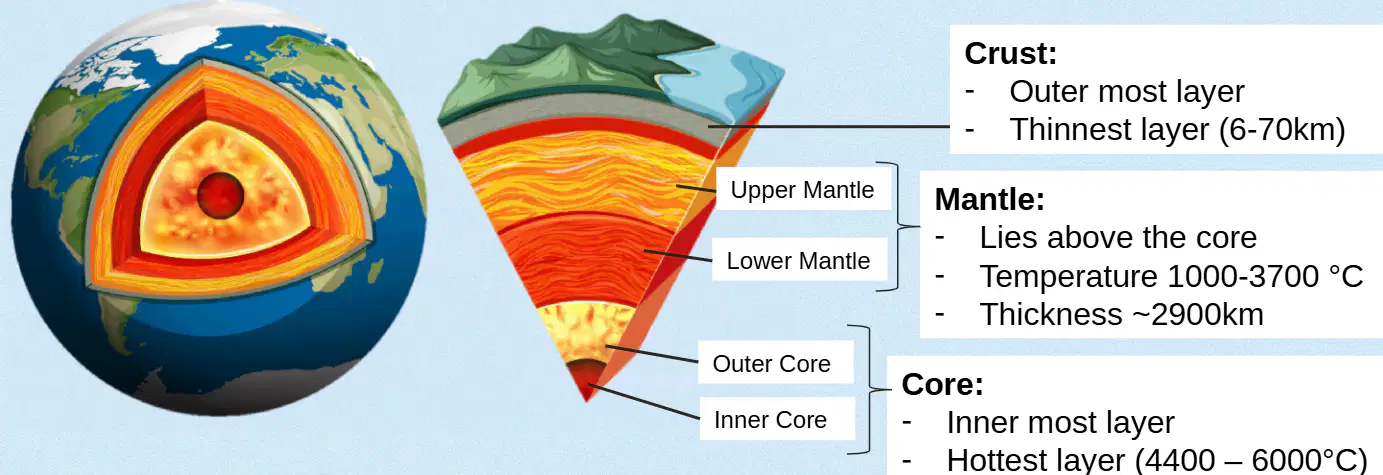
Match the following layers of the Earth with their characteristics:
Crust
Thinnest layer (6-70km)
Mantle
Lies above the core
Core
Hottest layer (4400 – 6000°C)
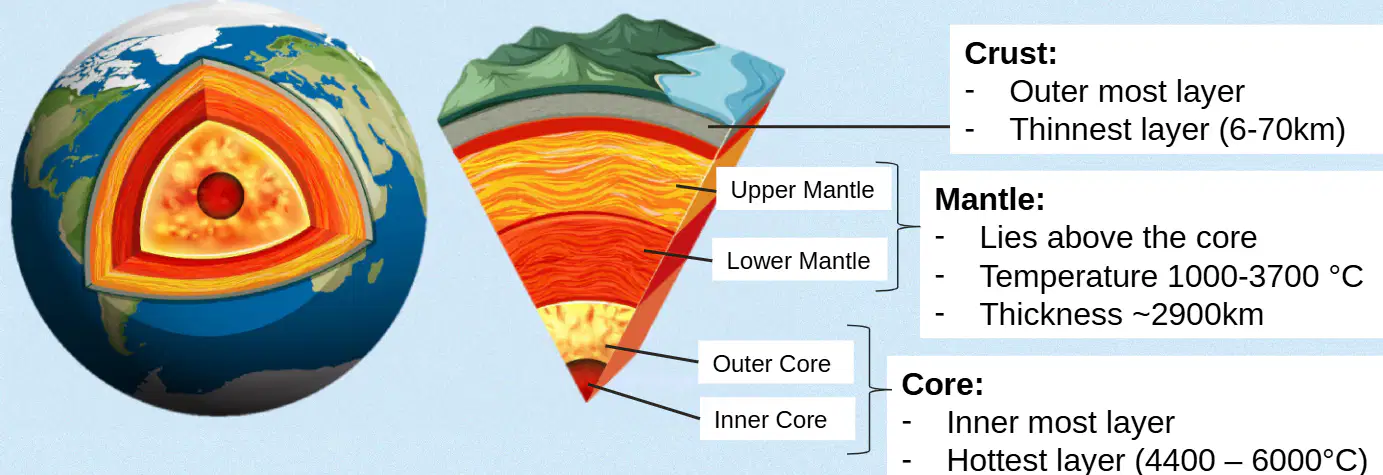
What is the approximate thickness of the mantle?
6-70 km
~2900 km
~3300 km
1000-3700 °C
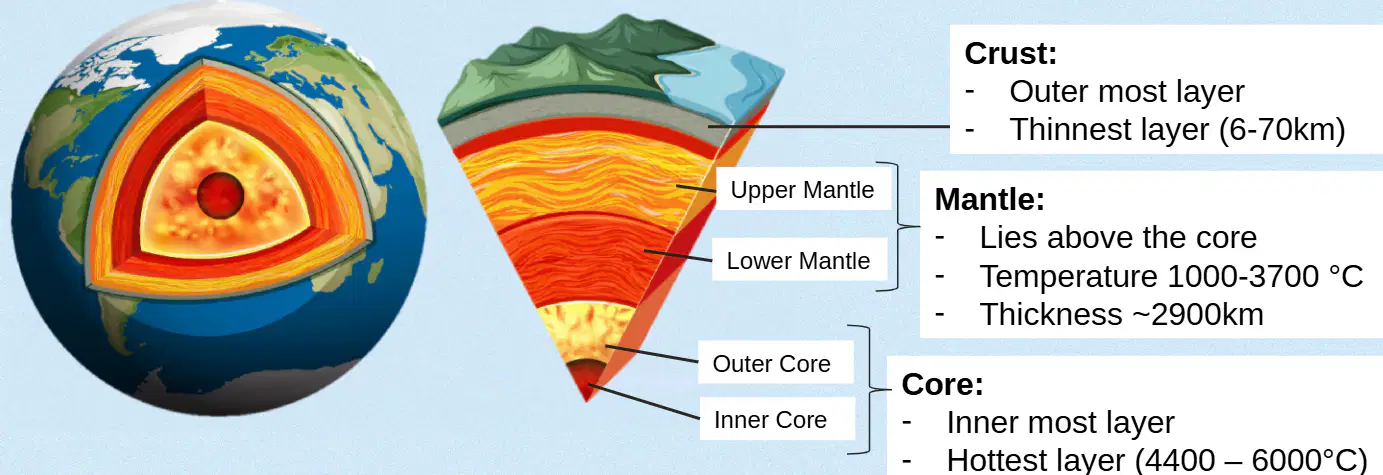
Fill in the blank: The crust is the ________ layer of the Earth and is the thinnest layer (6-70km).
outermost
innermost
middle
core
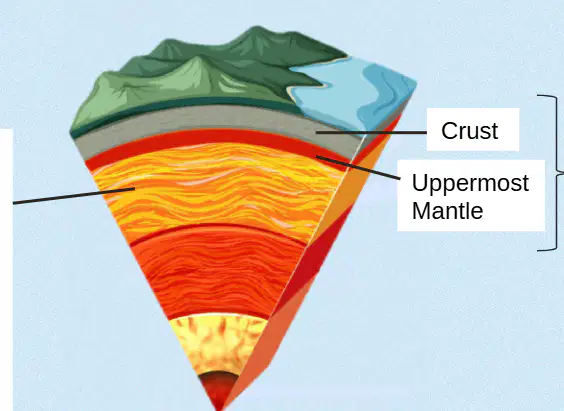
What is the lithosphere?
The semi-solid layer below the crust
The upper-most part of the mantle and the crust above it, which are the solid parts of the Earth
The liquid outer core
The inner core
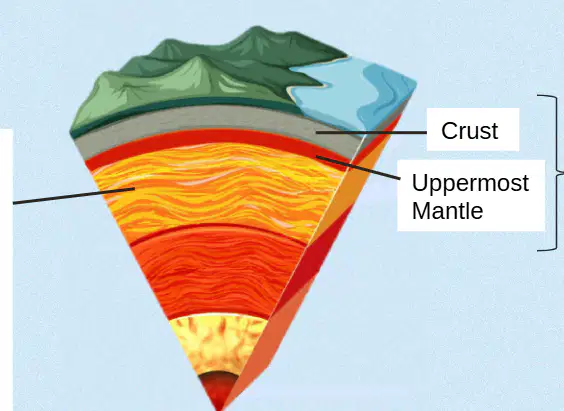
What is the asthenosphere?
The solid upper-most part of the mantle
The semi-solid layer below the lithosphere where heat from the core causes rocks to melt
The Earth's crust
The oceanic crust
Fill in the blank: The ________ lithosphere is found on land, making up the continents.
continental
oceanic
mantle
core
Fill in the blank: The ________ lithosphere makes up the seafloor.
oceanic
continental
mantle
crustal
Oceanic crust is denser than continental crust as they consist of different materials.
True
False
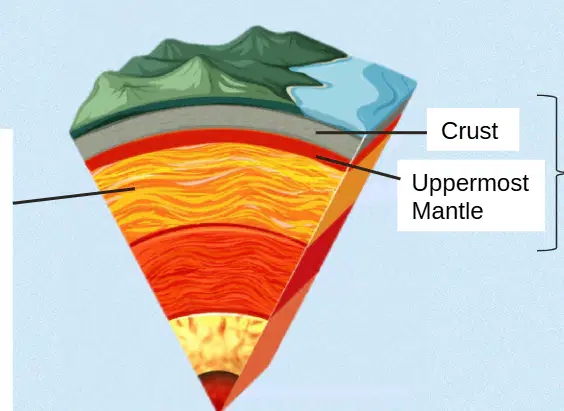
Which two layers make up the lithosphere according to the diagram?
A) Crust and Uppermost Mantle
B) Crust and Core
C) Uppermost Mantle and Inner Core
D) Asthenosphere and Crust
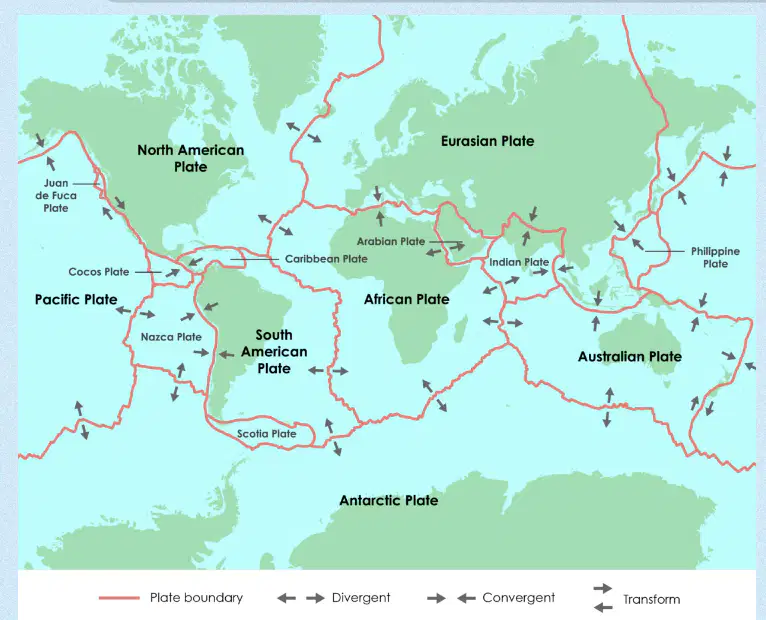
What is the lithosphere divided into?
Tectonic plates
Continental shelves
Ocean currents
Magma chambers
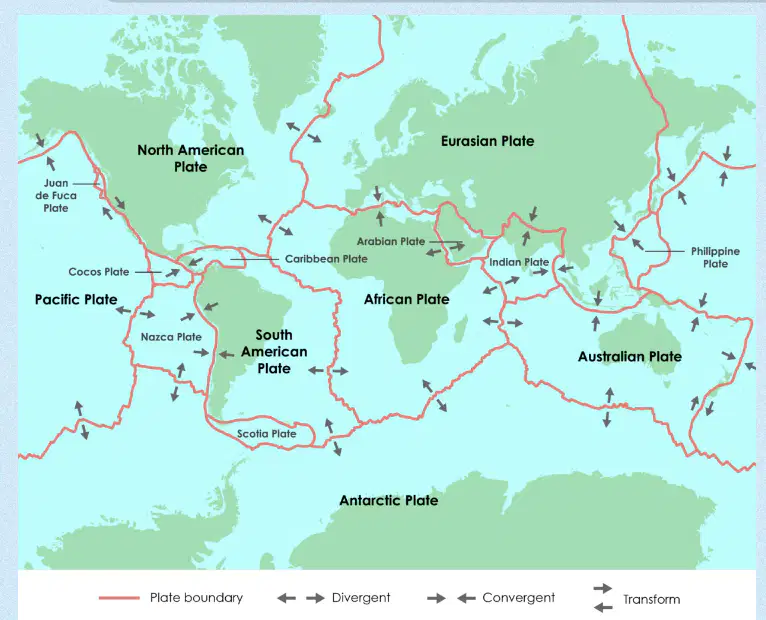
How many major tectonic plates are there?
Eight
Five
Ten
Six
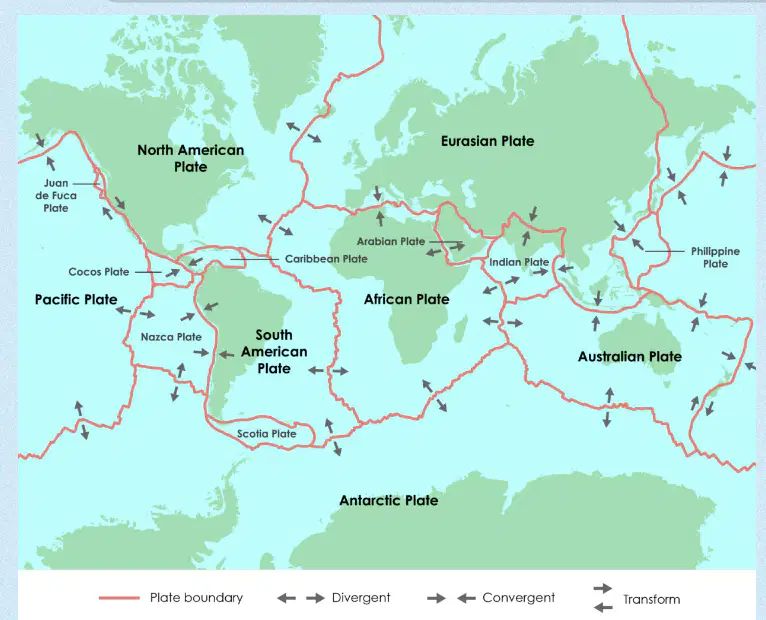
Which of the following is NOT a major tectonic plate?
North American Plate
South American Plate
Caribbean Plate
Eurasian Plate
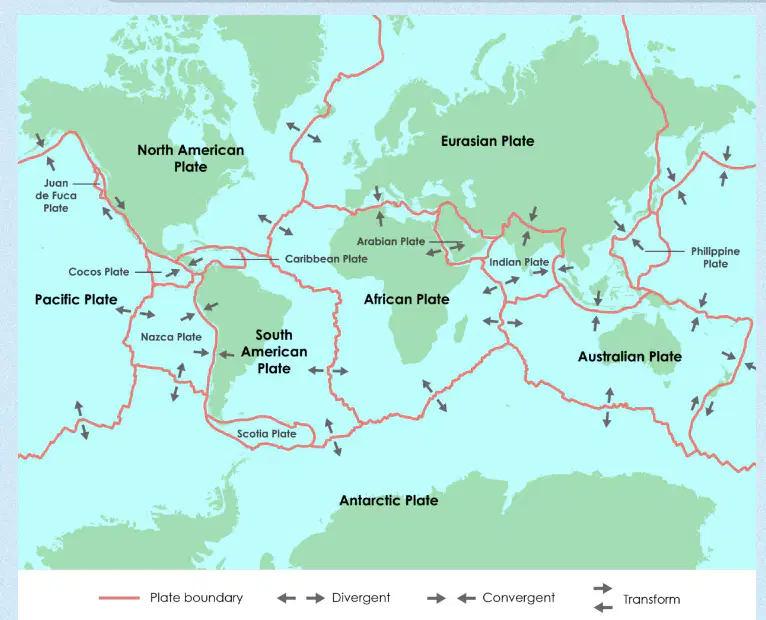
Match the following tectonic plates with their type:
Major plate
North American Plate
Smaller plate
Juan de Fuca Plate
Smaller plate
Nazca Plate
Major plate
African Plate
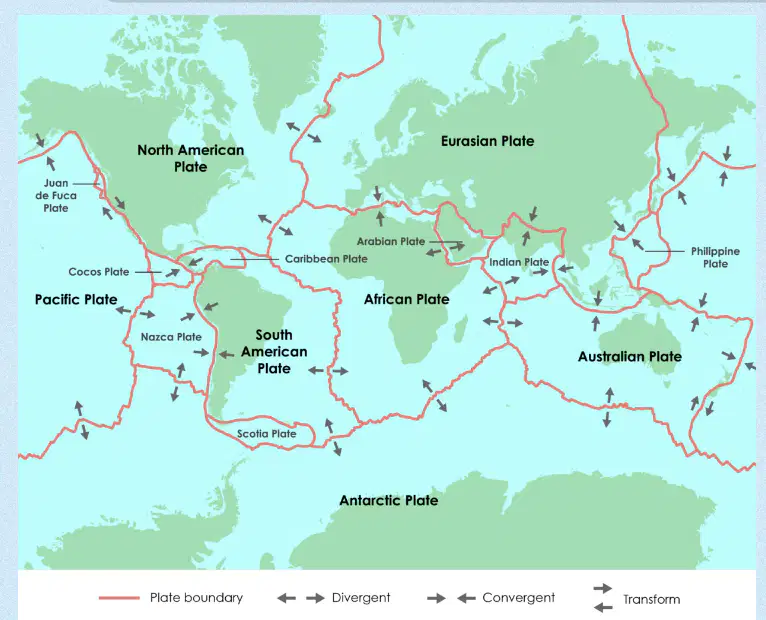
The Pacific Plate is one of the eight major tectonic plates.
True
False
What are the three main types of plate boundaries described in the movement of tectonic plates?
Divergent, Convergent, Transform
Static, Dynamic, Rotational
Oceanic, Continental, Subduction
Erosional, Depositional, Volcanic
Fill in the blank: Most tectonic activity takes place at the _______ of tectonic plates.
boundaries
centers
surfaces
edges
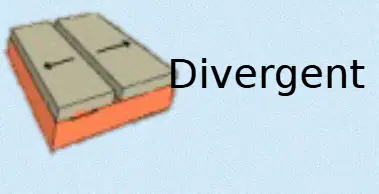
Which type of plate boundary is described as plates moving away from each other?
Divergent
Convergent
Transform
Subduction
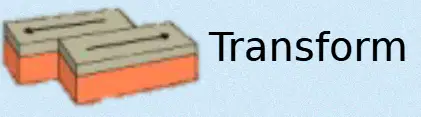
Which type of plate boundary is responsible for plates sliding past each other?
Divergent
Convergent
Transform
Subduction
Tectonic activity is responsible for forming volcanoes, mountain ranges, and deep ocean trenches, and causes phenomena such as earthquakes and tsunamis.
True
False
What are convection currents?
The rising and sinking of the mantle material form a current known as convection currents.
The movement of tectonic plates due to earthquakes is called convection currents.
The process of water evaporating from the ocean is called convection currents.
The rotation of the Earth on its axis is called convection currents.
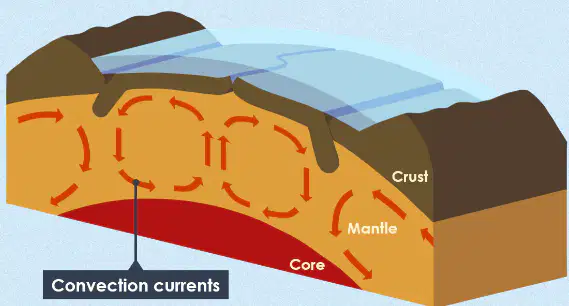
Identify the layers labeled in the diagram:
Crust, Mantle, Core
Crust, Core, Mantle
Mantle, Crust, Core
Core, Mantle, Crust
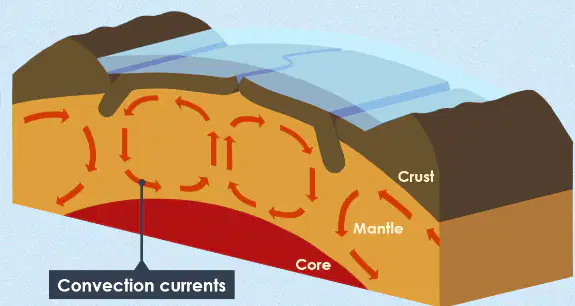
How do rising convection currents create plate boundaries? Fill in the blank: Rising convection currents spread beneath the plates, they drag the plates away from each other. This creates the _______ plate boundary. The convergent boundaries are found where the convection currents are sinking.
divergent
transform
subduction
convergent
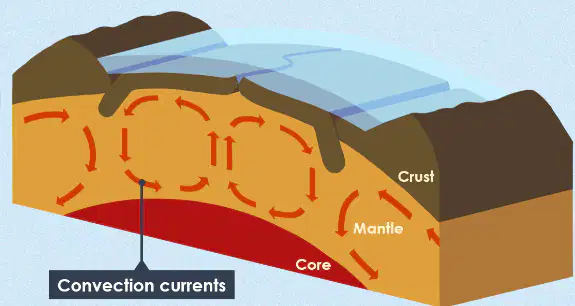
What are the main layers of the Earth shown in the diagram?
Crust, Mantle, Core
Crust, Ocean, Air
Mantle, Water, Soil
Core, Water, Air
Convection currents are a major driving force for tectonic plate movements.
True
False
According to the passage, what causes the mantle material to become less dense?
Pressure from the crust
Heat from the earth's core
Movement of tectonic plates
Cooling of the mantle
Fill in the blank: Mantle material ______ towards the surface as it becomes less dense due to heat from the earth's core.
rises
sinks
solidifies
contracts
What happens when rising convection currents drag the plates apart?
Convergent plate movement
Divergent plate movement
No movement
Subduction
Fill in the blank: The mantle material then loses heat and ______ towards the core.
sinks
rises
expands
evaporates
Where does convergent plate movement occur according to the passage?
Where the plates are dragged apart
Where the convection currents collide
At the surface
In the inner core
Fill in the blank: The rising and sinking of the mantle material forms ______ currents.
convection
electrical
tidal
magnetic
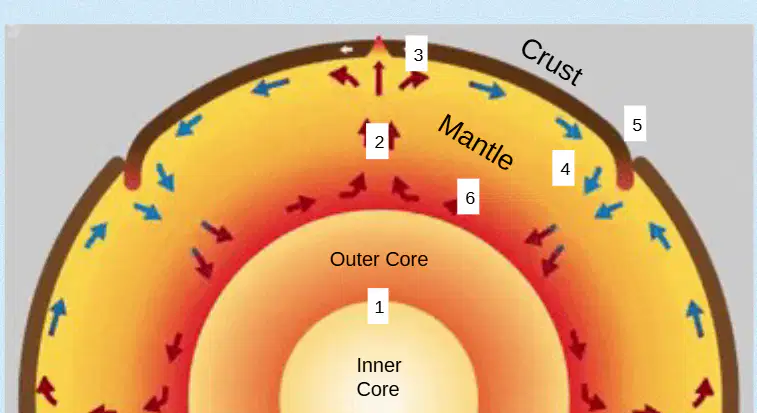
Match the following labels from the diagram to the correct part of the Earth's structure:
Outer Core
Outer Core
Mantle
Mantle
Crust
Crust
Mantle
Mantle
Crust
Crust
Besides convection currents, what other force contributes to tectonic plate movement?
Slab-pull force
Coriolis effect
Solar wind
Magnetic attraction
Tectonic plates differ in density depending on the material of the crust. For instance, _______ crust is denser than _______ crust.
oceanic; continental
continental; oceanic
igneous; sedimentary
sedimentary; metamorphic
When two plates converge, what happens to the denser oceanic crust?
It is pulled down by gravity as it subducts beneath the less dense crust.
It rises above the continental crust and forms mountains.
It remains at the surface and forms new land.
It splits evenly and both parts move upward.
The denser oceanic crust sinks deeper into the mantle under its own weight, pulling the rest of the plate with it. This process contributes to further convergence.
True
False
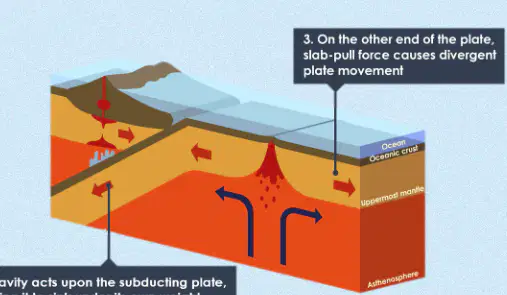
What force acts upon the subducting plate, causing it to sink under its own weight?
Gravity
Friction
Magnetism
Buoyancy
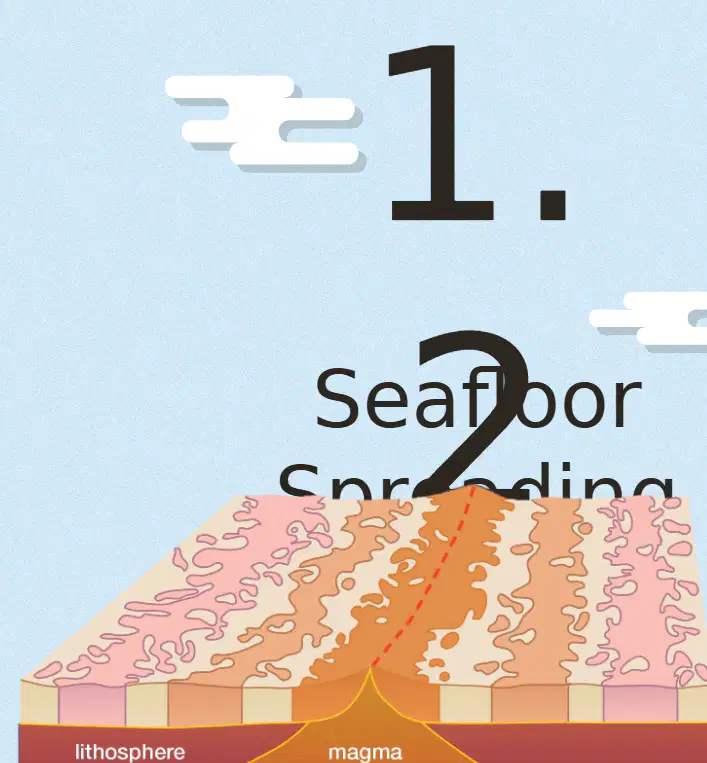
What is the process shown in the diagram called?
Subduction
Seafloor Spreading
Erosion
Weathering
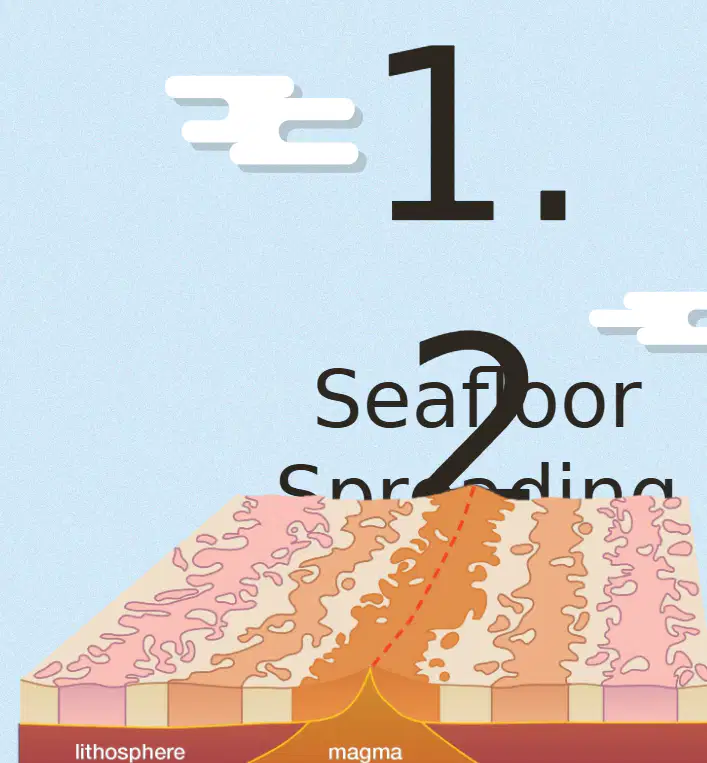
Fill in the blank: The layer labeled at the bottom of the diagram is called the _________
magma
crust
mantle
core
The process of seafloor spreading as shown in the diagram involves:
the formation of new oceanic crust at mid-ocean ridges and its movement away from the ridge
the subduction of oceanic crust beneath continental plates at trenches
the collision of two continental plates forming mountains
the erosion of the seafloor by ocean currents
What is seafloor spreading?
Seafloor spreading is a process where magma from deep within the Earth rises through mid-ocean ridges to create new oceanic crust.
Seafloor spreading is the process where ocean water evaporates to form new land.
Seafloor spreading is when continents move apart due to wind erosion.
Seafloor spreading is the process of underwater volcanoes creating islands far from mid-ocean ridges.
Where does seafloor spreading occur?
At convergent plate boundaries
At divergent plate boundaries
At transform boundaries
At subduction zones
What happens when magma from deep within the earth rises through the mid-ocean ridge?
New ocean crust is formed.
The ocean water evaporates.
Mountains immediately collapse.
The Earth's rotation speeds up.
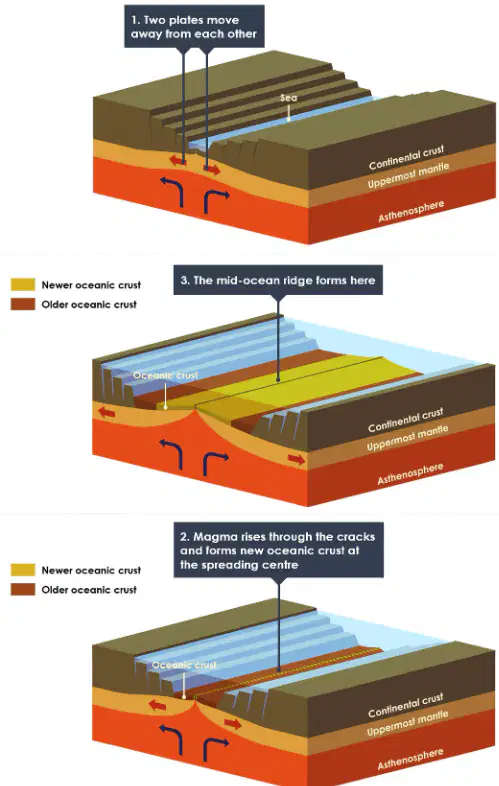
What forms at the location where two plates move away from each other?
The mid-ocean ridge forms.
A mountain range forms.
A deep ocean trench forms.
A volcano forms.
Arrange the following steps of seafloor spreading in the correct order:
Magma from deep within the earth rises through the mid-ocean ridge.
3
New ocean crust is formed.
1
Two plates move away from each other at divergent plate boundaries.
2
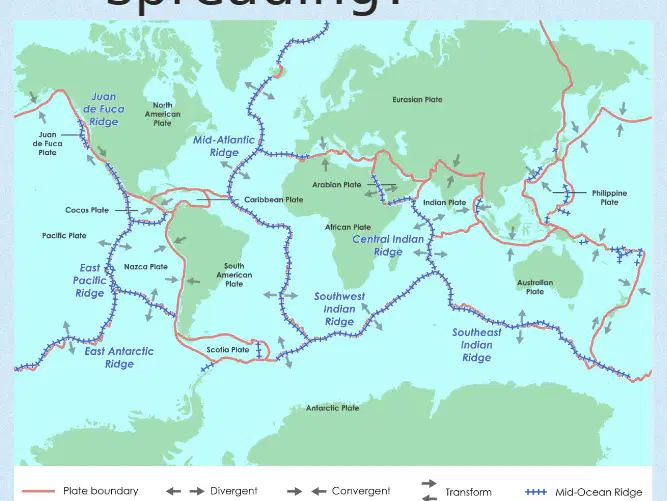
What is the evidence of seafloor spreading?
Formation of new oceanic crust at mid-ocean ridges
Erosion of continental crust
Formation of mountains on land
Melting of polar ice caps
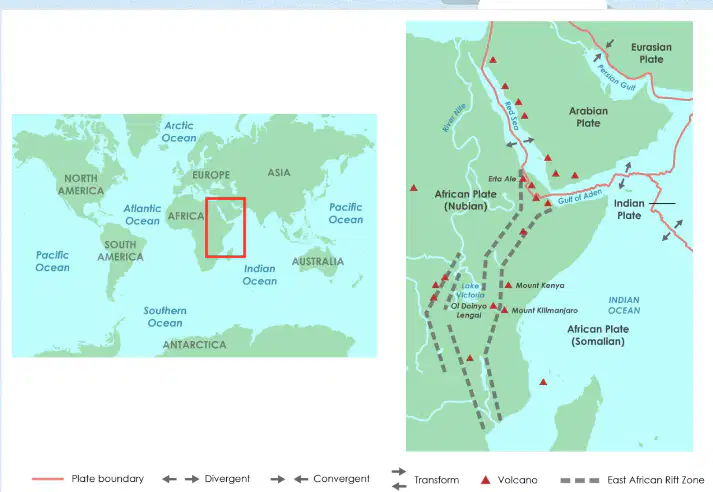
Besides occurring at oceanic-oceanic divergent boundaries, seafloor spreading can also occur where two _______ plates diverge.
continental
mantle
core
sedimentary
New oceanic crust is formed due to seafloor spreading when:
Magma rises at mid-ocean ridges and solidifies.
Sediments accumulate on the ocean floor over time.
Continental plates collide and create mountains.
Ocean water erodes the seafloor, exposing new crust.
The evidence of seafloor spreading supports the theory of plate tectonics by showing that:
new oceanic crust forms at mid-ocean ridges and moves outward, indicating plates are moving apart
mountain ranges are formed only by volcanic activity
the continents have always remained in the same position
earthquakes only occur at the center of tectonic plates
Fill in the blank: One way seafloor spreading supports the theory of plate tectonics is through evidence from the age of _______.
rocks
water
plants
fossils
Fill in the blank: Another way seafloor spreading supports the theory of plate tectonics is through evidence from limited _______ accumulation.
sediment
lava
ice
fossil
The evidence of seafloor spreading supports the theory of plate tectonics by:
showing that new oceanic crust forms at mid-ocean ridges and moves outward, confirming plate movement.
demonstrating that continents do not move and the seafloor remains unchanged.
proving that all tectonic activity occurs only on land, not under the ocean.
indicating that the Earth's crust is a single, unbroken shell.
Fill in the blank: One way seafloor spreading supports the theory of plate tectonics is through evidence from the age of _______.
rocks
water
plants
air
Fill in the blank: Evidence from limited _______ accumulation supports the theory of plate tectonics through seafloor spreading.
sediment
lava
fossil
crystal
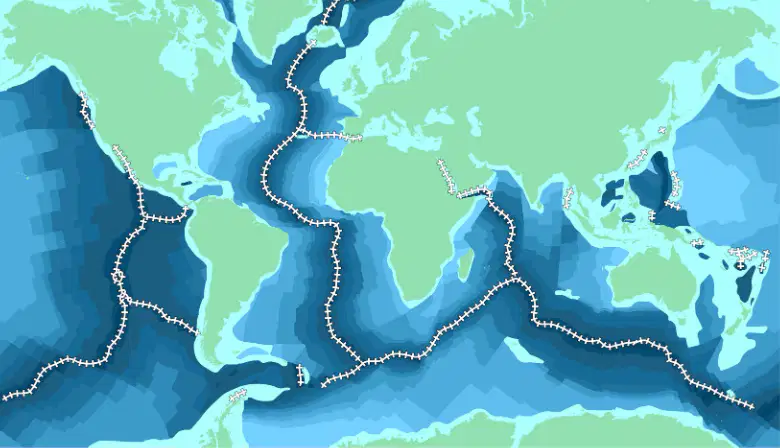
How does the evidence of the age of rocks at the seabed support the theory of plate tectonics?
Rocks near the mid-ocean ridge are older than those farther away
Rocks near the mid-ocean ridge are younger than those farther away
All rocks at the seabed are the same age
Rocks at the seabed do not show any pattern in age
Fill in the blank: Rocks nearer to the crest (centre) of the mid-ocean ridge are _________?
younger
older
heavier
more eroded
The rocks at the seabed get progressively older as they spread out from the mid-ocean ridge.
True
False
What happens at the crest of the mid-ocean ridge?
Magma rises and forms new seafloor
Old seafloor is destroyed
Rocks become older
No change occurs
According to the passage, the rocks nearer the crest of the ridge are _______ than the rocks further away.
younger
older
harder
softer
The continuous formation of new seafloor at the crest of the ridge pushes the older seafloor further from the crest of the ridge.
True
False
The pattern of seafloor spreading shows that:
plates move away from each other at mid-ocean ridges.
plates remain stationary over time.
plates move towards each other at mid-ocean ridges.
plates only move on land, not under the ocean.
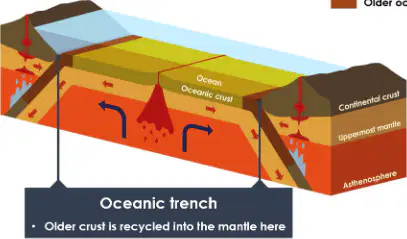
What happens to the older oceanic crust at ocean trenches?
It accumulates more sediment
It gets destroyed and is recycled back into the mantle
It forms new crust
It becomes continental crust
Why does not much sediment accumulate at ocean trenches?
Because the older oceanic crust gets destroyed and recycled back into the mantle at ocean trenches.
Because ocean trenches are too shallow to collect sediment.
Because strong ocean currents remove all sediment from trenches.
Because ocean trenches are made of material that repels sediment.
When new oceanic crust is formed at mid-ocean ridges, why does it not have much sediment accumulated on it?
Because the younger crust would not have existed long enough for much sediment to accumulate, as sediment accumulation takes place over time.
Because the mid-ocean ridges are too deep for sediment to settle.
Because ocean currents remove all sediment from new crust.
Because volcanic activity at ridges prevents any sediment from forming.
Oceanic crusts tend to be younger than continental crusts.
True
False
How does the evidence of seafloor spreading support the theory that tectonic plates move?
The evidence of seafloor spreading, shown by the formation of new crust at mid-ocean ridges and recycling of old crust at trenches, supports the theory that tectonic plates move.
Seafloor spreading shows that continents are shrinking due to erosion.
Seafloor spreading proves that all tectonic plates are stationary and do not move.
Seafloor spreading is only related to volcanic eruptions and not plate movement.

