wayground logo

Free Printable Worksheets

Font size

S
M
L
XL
Worksheets

HW2: 8.17

Total questions: 70

Worksheet time: 24mins

Name
Class
Date
1.
Changing the way matter looks without changing it into NEW matter is a:
a)
Chemical change
b)
Physical change
c)
Energy change
d)
BOTH a chemical and a physical change
2.
Question Image

For each of these concepts match its corresponding meaning.

a)

Density

1.

The amount of mass per unit of volume of an object

b)

Mass

2.

The amount of atoms in an object.

c)

Volume

3.

The amount of space an object takes up.

d)

Gravity

4.

A measurement of the pull on an object's mass.

e)

Water Displacement

5.

Method used to determine the volume of an irregularly shaped object - uses graduated cylinder.

3.
Question Image

Match each of these terms with its definition.

a)

Description of Matter.

1.

Property

b)

Action of Matter.

2.

Change

c)

Description of matter, indicates features of a sample of matter

3.

Physical Property

d)

Description of matter, depicts the ability of a sample of matter to participate in a reaction.

4.

Chemical Property

e)

Action of matter, results in the creation of a new substance.

5.

Chemical Change

4.
Question Image

Match each of these parts with its corresponding part.

a)

Outline of an object.

1.

Shape

b)

Amount of space something takes up.

2.

Volume

c)

Amount of amounts in an object.

3.

Mass

d)

Anything with mass and volume.

4.

Matter

e)

Exactly Measurable.

5.

Definite

5.
Changing the way matter looks without changing it into NEW matter is a:
a)
Chemical change
b)
Physical change
c)
Energy change
d)
BOTH a chemical and a physical change
6.
A property of matter that describes its ability to change into entirely new substances is called a(n)____________
a)
flammability
b)
reactivity
c)
nonflammability
d)
chemical property
7.
What do physical changes NOT change?
a)
the identity of the matter
b)
the amount of matter
c)
the state of matter
d)
the volume of the sample
8.
What makes chemical properties hard to observe?
a)
They cause change of state 
b)
you can't see them until they produce new materials
c)
Wearing protective glasses is required
d)
They happen too quickly
9.
Question Image

Match each of these terms with its definition.

a)

Description of Matter.

1.

Property

b)

Action of Matter.

2.

Change

c)

Description of matter, indicates features of a sample of matter

3.

Physical Property

d)

Description of matter, depicts the ability of a sample of matter to participate in a reaction.

4.

Chemical Property

e)

Action of matter, results in the creation of a new substance.

5.

Chemical Change

10.
What makes chemical properties hard to observe?
a)
They cause change of state 
b)
you can't see them until they produce new materials
c)
Wearing protective glasses is required
d)
They happen too quickly
11.
What do physical changes NOT change?
a)
the identity of the matter
b)
the amount of matter
c)
the state of matter
d)
the volume of the sample
12.
A property of matter that describes its ability to change into entirely new substances is called a(n)____________
a)
flammability
b)
reactivity
c)
nonflammability
d)
chemical property
13.
A description of objects that can be measured and observed.
a)
gas
b)
mustangs
c)
physical properties
d)
melting point
14.
Changing the way matter looks without changing it into NEW matter is a:
a)
Chemical change
b)
Physical change
c)
Energy change
d)
BOTH a chemical and a physical change
15.

Which of these is a physical property (Select all that apply)?

a)
reactivity
b)
 color
c)
combustion
d)
ability to burn
e)

state of matter

16.

Which of these is a chemical property (Select all that apply)?

a)
malleability
b)
texture
c)
combustion
d)
sour taste
e)

reactivity

17.

Which of these is a physical property (Select all that apply)?

a)
reacts with an acid
b)
explodes
c)
flammibility
d)
taste
e)

size

18.

Which are chemical properties (Select all that apply)?

a)
color
b)
hardness
c)
toxicity
d)
solubility
e)

flammability

19.
Which of the following is an example of a chemical change?
a)
sugar dissolving 
b)
a cake baking 
c)
chocolate melting 
d)
water freezing
e)

odor change

20.
Which of these phrases describes a chemical change?
a)
pouring milk into a glass
b)
melting an ice cube
c)
digesting food in your body
d)
bending an iron nail
21.
Which of these statements is true about characteristic properties of substances?
a)
they can depend on sample size
b)
they can only be physical properties
c)
they can only be chemical properties
d)
they can be physical properties or chemical properties
22.
What makes chemical properties hard to observe?
a)
They cause change of state 
b)
you can't see them until they produce new materials
c)
Wearing protective glasses is required
d)
They happen too quickly
23.
What do physical changes NOT change?
a)
the identity of the matter
b)
the amount of matter
c)
the state of matter
d)
the volume of the sample
24.
Changing the way matter looks without changing it into NEW matter is a:
a)
Chemical change
b)
Physical change
c)
Energy change
d)
BOTH a chemical and a physical change
25.
A physical property can be observed with your
a)
Eyes
b)
Ears
c)
Tastes
d)
All of the above
26.
A watermelon has more matter than a grape, so it has more
a)
mass
b)
eat
c)
solid
d)
greater
27.
Question Image

Match each of these terms with its definition.

a)

Description of Matter.

1.

Property

b)

Action of Matter.

2.

Change

c)

Description of matter, indicates features of a sample of matter

3.

Physical Property

d)

Description of matter, depicts the ability of a sample of matter to participate in a reaction.

4.

Chemical Property

e)

Action of matter, results in the creation of a new substance.

5.

Chemical Change

28.
Question Image

Identify which letter represents the correct length.

a)

B

1.

29mm

b)

C

2.

42mm

c)

E

3.

66mm

d)

F

4.

81mm

e)

G

5.

120mm

29.
Question Image

Identify which letter represents the correct length.

a)

A

1.

1.5cm

b)

C

2.

4.2cm

c)

D

3.

5.3cm

d)

F

4.

8.1cm

e)

G

5.

12cm

30.
Question Image

Identify which letter represents the correct length.

a)

A

1.

1.5cm

b)

C

2.

4.2cm

c)

D

3.

5.3cm

d)

F

4.

8.1cm

e)

G

5.

12cm

31.
Question Image

Match each of these TBB measurements with its correct mass.

a)

1.

536.8g

b)

2.

37.3g

c)

3.

105.6g

d)

4.

290.2g

e)

5.

263.5g

32.
Question Image

Match each of these terms with its definition.

a)

Measuring Tool used to determine mass (mg, g).

1.

TBB

b)

Measuring Tool used to determine volume (mL).

2.

Graduated Cylinder

c)

Measuring tool used to determine length (mm, cm).

3.

Metric Ruler

d)

Anything with mass and volume.

4.

Matter

e)

Amount of atoms in an object.

5.

Mass

33.

Multiple Choice: Who's the person MOST responsible for your academic success?

a)

My Teacher(s)

b)

My Parent(s)

c)

My Principal(s)

d)

Me

34.

What are the three states of matter?

a)

solid, volume, mass

b)

density, volume, mass

c)

solid, liquid, gas

d)

density, gas, volume

35.
Something that takes up space and has mass.
a)
volume
b)
matter
c)
mass
d)
density
36.
A state of matter that has a definite volume and shape.
a)
solid
b)
liquid
c)
gas
d)
matter
37.

The amount of space something takes up.
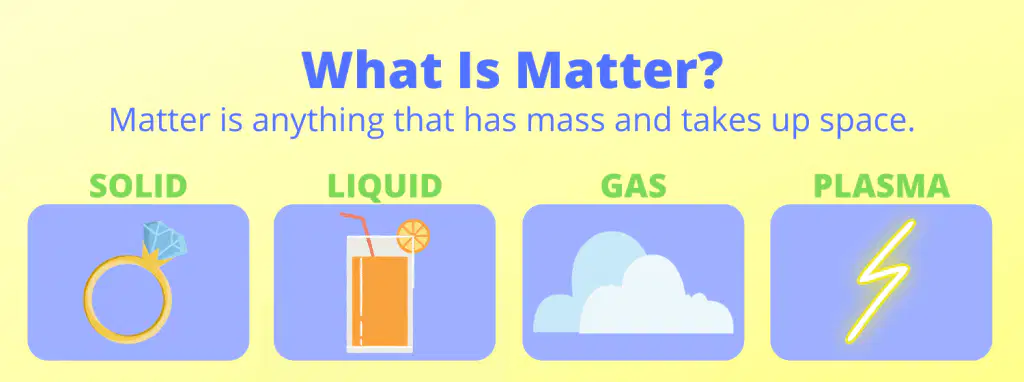
a)
density
b)
volume
c)
mass
d)
matter
38.

Matter is made of _________.

a)

solids

b)

gases

c)

atoms

d)

nutrients

39.
A description of objects that can be measured and observed.
a)
gas
b)
mustangs
c)
physical properties
d)
melting point
40.

A physical property can be observed with your ___.

a)
Eyes
b)
Ears
c)
Tastes
d)
All of the above
41.

An example of a physical property is ___ (select all that apply).

a)
flammability
b)
acidic
c)
color
d)
ability to rust
e)

shape

42.

Changing the way matter looks without changing it into NEW matter is a ___.

a)
Chemical change
b)
Physical change
c)
Energy change
d)
BOTH a chemical and a physical change
43.

A property of matter that describes its ability to change into entirely new substances is called a(n)___.

a)
flammability
b)
reactivity
c)
nonflammability
d)
chemical property
44.
What do physical changes NOT change?
a)
the identity of the matter
b)
the amount of matter
c)
the state of matter
d)
the volume of the sample
45.
What makes chemical properties hard to observe?
a)
They cause change of state 
b)
you can't see them until they produce new materials
c)
Wearing protective glasses is required
d)
They happen too quickly
46.
Which of these statements is true about characteristic properties of substances?
a)
they can depend on sample size
b)
they can only be physical properties
c)
they can only be chemical properties
d)
they can be physical properties or chemical properties
47.
Which of these phrases describes a chemical change?
a)
pouring milk into a glass
b)
melting an ice cube
c)
digesting food in your body
d)
bending an iron nail
48.
Which of the following is an example of a chemical change?
a)
sugar dissolving 
b)
a cake baking 
c)
chocolate melting 
d)
water freezing
49.
Example for physical property
a)
odor
b)
burns in air
c)
reacts with water to create hydrogen gas
d)
rust
50.

Example for chemical property. (select all that apply)

a)
color
b)
hardness
c)
toxicity
d)
solubility
e)

flammability

51.

Example for physical property. (select all that apply)

a)
reacts with an acid
b)

smell

c)
flammibility
d)
taste
e)

state of matter

52.

Example for chemical property. (select all that apply)

a)
malleability
b)
texture
c)

combustibility

d)
sour taste
e)

corrosiveness

53.

Example of a physical property. (select all that apply)

a)
reactivity
b)
 color
c)

combustibility

d)

flammability

e)

measurement

54.

Which category does density belong to?

a)
Physical Property
b)
Chemical Property
55.

When you observe a physical change, the substance ___.

a)

changes its chemical composition.

b)

gives off heat.

c)

does not change in composition.

d)

changes in color.

56.

Which of the following is NOT a physical change?

a)

Freezing water to make ice cubes

b)

Melting gold to make jewelry

c)

Burning gasoline in a lawnmower

d)

Boiling water for soup

57.

The process when a solid turns into a liquid ___.

a)

Evaporation

b)

Sublimation

c)

Freezing

d)

Melting

58.

The process when a gas turns into a liquid ___.

a)

Condensation

b)

Sublimation

c)

Freezing

d)

Evaporation

59.

The process when a liquid turns into a gas ___.

a)

Evaporation

b)

Melting

c)

Condensation

d)

Deposition

60.

The process when a solid turns into a gas ___.

a)

Sublimation

b)

Deposition

c)

Evaporation

d)

Melting

61.

The process when a gas turns into a solid ___.

a)

Deposition

b)

Weathering and Erosion

c)

Super freezing

d)

Sublimation

62.

Is this an example of a physical or chemical change?

a)

physical

b)

chemical

63.

Is this an example of a physical or chemical change?

a)

physical

b)

chemical

64.

Is this an example of a physical or chemical change?

a)

physical

b)

chemical

65.

Is this an example of a physical or chemical change?

a)

physical

b)

chemical

66.

Which of the following can be signs that a chemical change has occurred?

a)

color change

b)

formation of a gas (bubbles)

c)

energy change

d)

All of the above

67.

Is dissolving sugar a physical or chemical change?

a)

Physical Change

b)

Chemical Change

68.

Is exploding fireworks a physical or chemical change?

a)
physical change
b)
chemical change
69.

Identify what is happening in the picture as a chemical or physical change.

a)

Chemical change

b)

Physical change

c)

Both

70.

At daybreak, a wet field is warmed by the sun. What phase change is occurring in this photo?

a)

evaporation

b)

freezing

c)

condensation

d)

melting