
 Worksheets
Electrical System Protection and Overcurrent Quiz
Total questions: 100
Worksheet time: 50mins
What is the primary purpose of a fuse in an electrical system?
To increase the current flow in a circuit
To safely isolate a fault and prevent damage to equipment
To provide power to electrical devices
To reduce the voltage in a circuit
Which of the following best defines an overcurrent?
A current that is always less than the normal current
Excess current resulting from either a short circuit or an overload
A current that only flows during normal operation
A current that is always safe for equipment
According to the document, when does an overload current become harmful?
When it is less than the normal current
When it is continuous and sustained
When it is only momentary
When it is below the rated value
How does a short circuit current differ from an overload current?
A short circuit current is always less than an overload current
A short circuit current is not confined to normal conducting paths and can be several hundred times greater than normal current levels
An overload current is not harmful, while a short circuit current is always safe
Both are always confined to normal conducting paths
Which of the following scenarios is an example of a sustained overload?
A transformer starting up
A defective or overloaded motor operating for several seconds
A fuse operating under normal conditions
A conductor carrying less than its rated current
Why is it important to have adequate protection of electrical distribution systems, according to the document?
To increase the speed of electrical currents
To prevent severe damage to equipment and significant monetary loss due to machine or manufacturing plant downtime
To reduce the cost of electricity
To make the system more complex
What can be a consequence of short circuit currents in electrical systems?
Improved efficiency of the system
Destruction of cable trays, warping bus bars, and severe insulation damage
Reduced heat production
Lowered risk of equipment failure
If a conductor is subjected to short circuit currents, what is a likely result according to the document?
The conductor will cool down
The forces produced can be several hundred pounds per linear foot of the conductor
The conductor will become more efficient
The current will decrease to safe levels
What does the voltage rating of a fuse indicate?
The maximum current the fuse can carry indefinitely
The maximum circuit voltage in which the fuse can be safely applied
The minimum voltage required to operate the fuse
The average voltage the fuse can withstand
Which of the following best describes the continuous current rating of a fuse?
The maximum voltage the fuse can withstand
The current the fuse is intended to normally carry indefinitely
The maximum short circuit current the fuse can interrupt
The minimum current required to blow the fuse
What is the interrupting rating of a fuse?
The maximum voltage the fuse can handle
The maximum short circuit current that a fuse can safely interrupt without rupturing
The minimum current required to open the fuse
The average current the fuse can carry
A fuse is said to be current limiting if it:
Opens only under overload conditions
Operates quickly under short circuit conditions, typically in less than one half of a cycle
Can withstand high temperatures for long periods
Is used only in low voltage applications
Why is selective coordination important in distribution systems?
To ensure all protective devices open simultaneously
To prevent facility blackouts by ensuring only the protective device nearest the faulted circuit will open
To increase the voltage rating of the system
To reduce the cost of fuses
Which of the following is NOT a factor to consider when selecting the continuous current rating of a fuse?
Type of load
Application requirements
Code requirements
The color of the fuse
What is the main benefit of using a current limiting fuse in combination with a circuit breaker?
It increases the voltage rating of the breaker
It allows the breaker to open more slowly
It overcomes the breaker's limitation by reducing the peak short circuit current before the breaker opens
It reduces the need for maintenance
According to the text, what must be maintained between upstream and downstream continuous current ratings for a system to be selective?
A minimum ratio
A maximum voltage
A constant temperature
A fixed resistance
Who specifies the ratio that must be maintained between upstream and downstream continuous current ratings in a selective system?
The fuse manufacturer
The system operator
The electrician
The power company
Why does the required ratio between upstream and downstream continuous current ratings depend on the type of fuse?
Because different fuses have different characteristics and requirements
Because all fuses are identical
Because the voltage is always the same
Because the current never changes
Which organization is most predominant in assigning classifications to fuses based on safety and performance?
Underwriter’s Laboratories, Inc.
National Fire Protection Association
American National Standards Institute
International Electrotechnical Commission
What is the maximum voltage rating for a low voltage fuse according to U.L. classifications?
1000 volts
600 volts
200 volts
1200 volts
What is the main difference between UL class K5 and class H fuses, despite having the same physical dimensions?
Their color
Their interrupting ratings
Their price
Their installation method
If a class H fuse is used in place of a class K5 fuse and a short circuit occurs with a fault current exceeding 10,000 amperes, what is likely to happen?
The fuse will operate normally
The class H fuse will rupture, possibly injuring nearby personnel
The fuse will not fit in the fuse block
The circuit will remain unaffected
What feature is built into the end ferrules of class RK1 and RK5 fuses to prevent misapplication?
Color coding
Rejection feature
Size variation
Extra insulation
What does the "R" in the class designation of fuses indicate?
Reduced voltage
Rejection type fuse
Rapid response
Reusable fuse
A rejection type fuse with a minimum interrupting rating of 200,000 amperes will fit only into which type of fuse blocks?
Any standard fuse block
Fuse blocks intended to receive the modified end ferrule
Fuse blocks for class H fuses
Fuse blocks for low voltage fuses only
Explain why it is important to use the correct class of fuse in a circuit, particularly when considering interrupting ratings and rejection features.
To ensure the fuse fits aesthetically
To prevent misapplication that could lead to fuse rupture and potential injury, and to ensure only appropriate fuses are used in specific fuse blocks
To reduce the cost of maintenance
To allow for easier replacement of fuses
Which of the following best describes the main function of current-limiting fuses in electrical distribution systems?
To increase the current carrying capacity of the system
To provide safe and reliable protection by interrupting overcurrent
To lengthen the opening time of the circuit
To operate intricate moving mechanical parts
What are the two basic types of current-limiting fuses mentioned in the document?
Fast and slow fuses
Single element and dual element fuses
High and low voltage fuses
Glass and ceramic fuses
After a fuse has been used to clear a short-circuit or overload, what happens to it?
It is repaired and reused
It is replaced by a new, factory calibrated unit
It is left in the circuit
It increases its current carrying capacity
Which type of fuse is specifically mentioned as being used for special applications on electronic equipment such as power supplies?
Glass fuse
Semiconductor or Rectifier type fuse
Dual element fuse
Cartridge fuse
What is a key characteristic of the performance of fuses as described in the document?
Their performance depends on intricate moving mechanical parts
Their performance characteristics are reliable and do not depend on moving parts
Their performance decreases with age
Their performance is unpredictable
What does a single-element fuse consist of?
A tube filled with water
A link or several links in a tube filled with arc-quenching filler
A coil of wire in a glass tube
A ceramic body with a metal cap
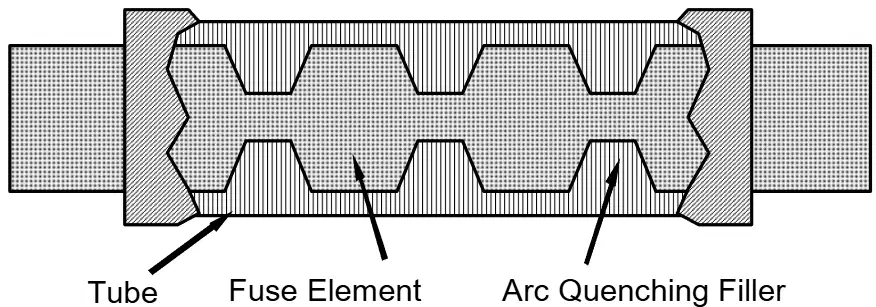
Which part of the single element fuse is responsible for interrupting the current when an overcurrent occurs?
Tube
Fuse Element
Arc Quenching Filler
End Cap
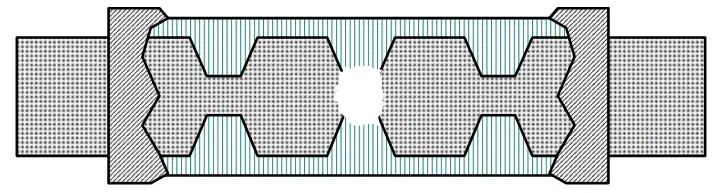
What happens to a fuse link during overload operation?
The fuse link melts after a prolonged overload current.
The fuse link instantly vaporizes.
The fuse link remains unchanged.
The fuse link cools down.
Which component aids the arc quenching process in a fuse during overload operation?
The surrounding filler
The fuse casing
The external wiring
The circuit breaker
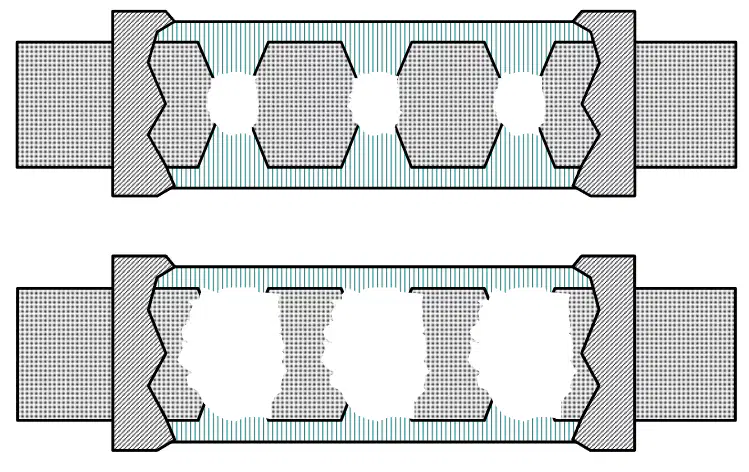
During a short circuit, what is the primary cause of the fuse opening operation?
Increase in the link temperature
Decrease in circuit voltage
Mechanical failure of the fuse
Manual intervention
How quickly can current limiting fuses operate during short circuit conditions?
Less than a half cycle
More than one second
About one minute
Several hours
Why are current limiting fuses effective in protecting system components during high short circuit currents?
They clear the circuit very quickly, minimizing damage.
They increase the current flow.
They delay the circuit interruption.
They reduce the voltage.
Explain the difference in the fuse link behavior between overload operation and short circuit operation.
Overload melts the link slowly, while short circuit melts several sections instantly.
Both overload and short circuit melt the link at the same rate.
Overload operation does not melt the link.
Short circuit operation cools the link.
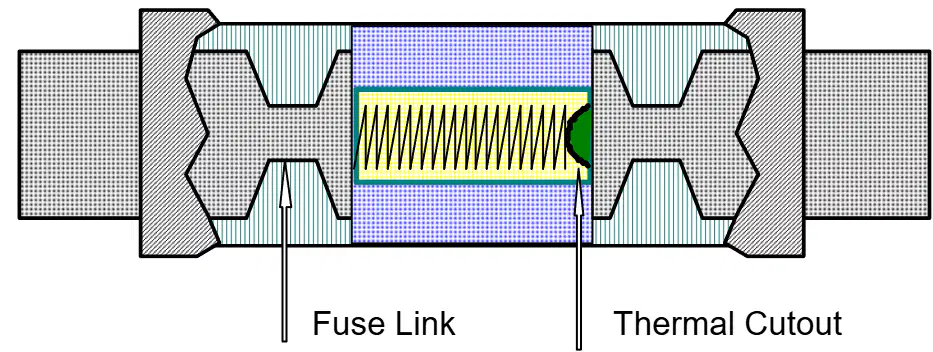
What is the primary function of the thermal cutout in a dual element fuse?
To provide a time delay on overloads such as motor starting current
To increase the fuse's voltage rating
To reduce the fuse's physical size
To allow continuous current flow regardless of overload
Which of the following best describes the construction of a dual element, time delay fuse?
It contains two fusible elements connected in series: a thermal cutout and a fuse link
It uses only a single fuse link
It has a built-in circuit breaker
It contains a resistor and a capacitor
What is the purpose of the fuse link element in a dual element fuse?
To open on heavier overloads and short circuit currents
To provide a visual indicator of fuse status
To regulate voltage
To cool the fuse during operation
Which of the following manufacturers produces a dual element fuse with the class RK5 and the name FRS-R?
Bussman (Fusetron)
Gould Shawmut
Bussman (KTS-R)
Gould Shawmut (Amp-Trap)
A dual element fuse's thermal cutout is designed to open on overcurrents up to what percentage of the fuse ampere rating?
500%
100%
50%
200%
Explain why dual element, time delay fuses are beneficial for motor starting applications.
They allow harmless motor starting currents to pass without opening the fuse, while still providing protection against sustained overloads and short circuits.
They increase the speed of the motor.
They reduce the voltage supplied to the motor.
They eliminate the need for any overload protection.
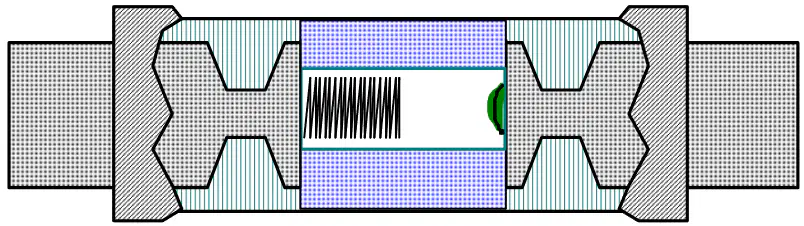
What is the primary function of the overload element in a fuse as described in the document?
To allow continuous current flow regardless of overload
To open the circuit when the center mass of copper reaches the melting point of the solder
To increase the current during overload conditions
To permanently connect the fuse link to the circuit
Which component in the overload element is responsible for pulling the connector out of place when the solder melts?
The fuse link
The spring
The filler material
The arc extinguisher
Why does the thermal cutout element have a built-in time delay?
To immediately break the circuit during any current surge
To permit harmless surge currents, such as motor starting current, to flow without opening the fuse
To increase the melting point of the solder
To reduce the voltage in the circuit
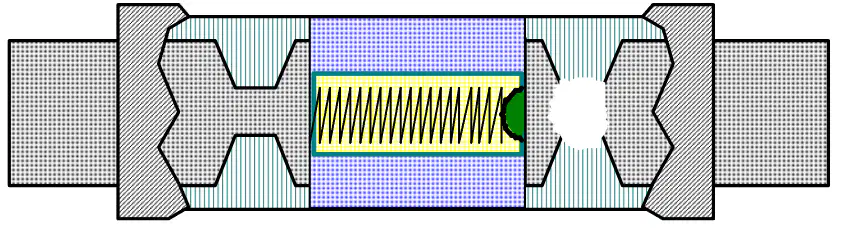
Which of the following best describes the function of the fuse link during a short circuit condition?
It increases the current to protect the circuit
It acts as a permanent connection
It vaporizes and, with the filler, helps extinguish the arc
It cools down the circuit components
Explain how the fuse element limits the effects of short circuit currents on system components.
By increasing the mechanical and thermal stress on components
By reducing the mechanical, thermal, and arcing stress which system components would have to withstand
By allowing the arc to persist longer
By permanently connecting the circuit
A motor circuit experiences a harmless start-up current surge. Why is a fuse with a thermal cutout element ideal for this application?
It immediately opens the circuit during any surge
It allows harmless surges to pass without opening the fuse, protecting the circuit from unnecessary interruptions
It increases the current during surges
It permanently disconnects the circuit during surges
What is the primary function of a circuit breaker?
To increase the current in a circuit
To automatically interrupt current flow when abnormal conditions occur
To provide continuous power supply
To store electrical energy
Which of the following is an advantage of using circuit breakers over fuses?
Circuit breakers are smaller in size
Circuit breakers can be reset after tripping and do not need to be replaced normally
Circuit breakers are less expensive than fuses
Circuit breakers are lighter in weight
Which of the following is NOT a disadvantage of circuit breakers compared to fuses?
Cost
Size
Handling and Weight
Ability to be used as a switching device
In which situation would fuses be preferred over circuit breakers?
When a disconnect means is required
When standard current ratings such as 20A or 30A are needed
When accurate current values such as 1.6A or 10.4A are required
When circuit breakers are adjustable
Explain why circuit breakers are preferred over fuses in motor control systems.
Because circuit breakers are cheaper than fuses
Because circuit breakers can be reset and used as a switching device, and provide a disconnect means
Because fuses are more reliable in motor control systems
Because circuit breakers are smaller in size
Which of the following methods is NOT mentioned as a way to accomplish the automatic circuit opening action of a circuit breaker?
Thermal release
Magnetic action
Chemical reaction
Hydraulic means
What is the primary function of thermal (heat) type air circuit breakers?
To increase voltage in a circuit
To provide protection against overcurrent
To cool down electrical components
To store electrical energy
What principle does a typical thermal circuit breaker operate on?
Magnetic attraction
Metal expanding when heated
Chemical reaction
Light emission
Which component in a thermal circuit breaker is responsible for tripping the latch when overheated?
Spring
Bimetallic strip
Contacts
Insulator
Why does the bimetallic strip in a thermal circuit breaker bend when heated?
Because it is made of a single metal
Due to different expansion rates of the two metals
Because it is cooled by a fan
Due to magnetic fields
At what voltages do thermal circuit breakers provide overload protection?
Up to 100 volts A-C and 50 volts D-C
Up to 600 volts A-C and 250 volts D-C
Up to 1200 volts A-C and 500 volts D-C
Up to 60 volts A-C and 10 volts D-C
Explain how the bimetallic strip in a thermal circuit breaker functions to open the contacts when excessive current flows for a prolonged period.
The bimetallic strip cools down and contracts, pulling the latch open.
The bimetallic strip heats up, bends due to different expansion rates of the metals, trips the latch, and opens the contacts.
The bimetallic strip generates a magnetic field that pushes the contacts apart.
The bimetallic strip melts and causes the contacts to separate.
Which of the following statements best describes a magnetic circuit breaker?
It has a thermal device to detect faults.
It is used for instantaneous action to open a faulted circuit.
It is only used for slow response to faults.
It is used to regulate voltage in a circuit.
What is missing from a magnetic circuit breaker that is present in some other types of circuit breakers?
Magnetic coil
Contacts
Thermal device
Spring

Refer to the diagrams labeled fig A and fig B. What does fig B illustrate about the state of the magnetic circuit breaker?
The circuit breaker is under normal conditions.
The circuit breaker is in a tripped position.
The circuit breaker is being installed.
The circuit breaker is being tested for continuity.
Why would an engineer choose a magnetic circuit breaker over a thermal circuit breaker in a specific application?
To provide delayed response to faults
To allow for manual reset only
To ensure instantaneous action to open a faulted circuit
To reduce the size of the circuit breaker

Based on the diagrams, what is the function of the spring in the magnetic circuit breaker mechanism?
To generate a magnetic field
To keep the contacts closed under normal conditions
To trip the breaker by opening the contacts when the latch is released
To provide electrical insulation
What are the two main components incorporated in a thermal-magnetic circuit breaker?
Thermal strip and magnetic coil
Resistor and capacitor
Diode and transistor
Inductor and fuse
What is the primary function of the thermal strip in a thermal-magnetic circuit breaker?
Provides instantaneous trip on high currents
Provides a time delay for momentary overloads
Increases the voltage
Reduces the current
Which component in a thermal-magnetic circuit breaker provides instantaneous trip on high or short circuit currents?
Bimetallic strip
Magnetic coil
Spring
Latch
How does the magnetic trip protect the bimetallic strip in a thermal-magnetic circuit breaker?
By increasing the current flow
By providing a time delay
By protecting it from excessive overheating
By reducing the voltage
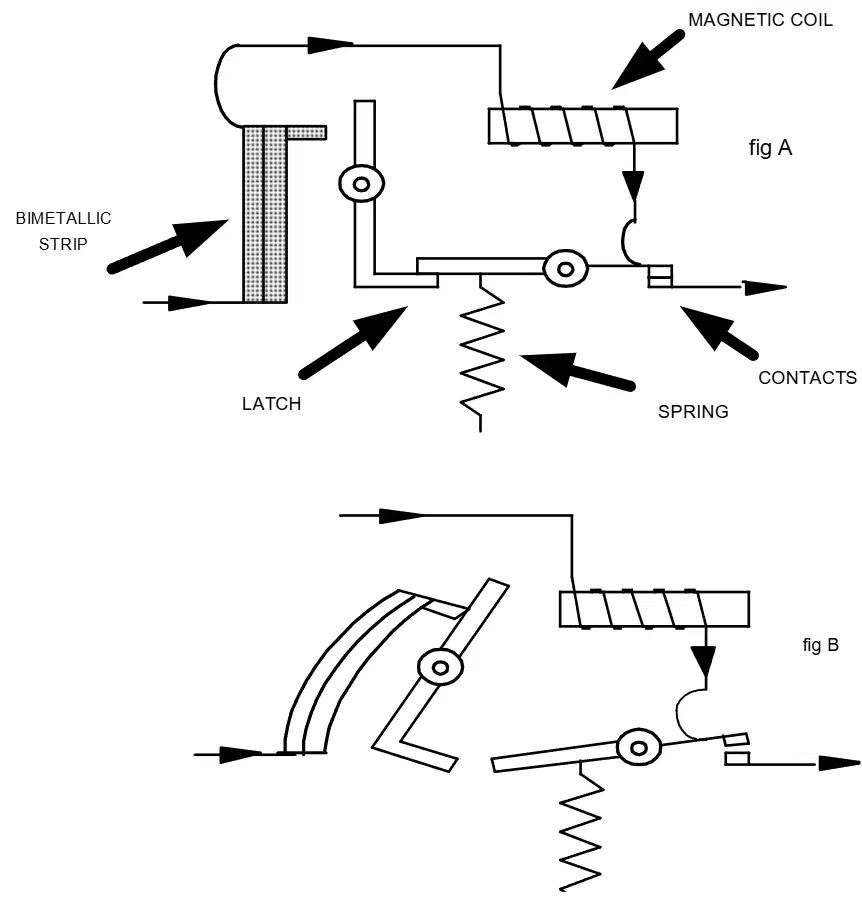
Based on the diagrams, what does Figure B illustrate in the context of a thermal-magnetic circuit breaker?
The normal operation of the circuit breaker
The installation process of the circuit breaker
The tripped position of the circuit breaker
The manufacturing process of the circuit breaker
Why is it important for a thermal-magnetic circuit breaker to have both a thermal and a magnetic trip mechanism?
To ensure the breaker is lightweight
To provide both delayed and instantaneous protection against different types of overloads
To reduce the cost of the breaker
To make the breaker waterproof
Which two elements are present in an ambient-compensated circuit breaker?
Overload bimetallic strip and compensating bimetallic strip
Magnetic coil and fuse
Overload relay and thermal fuse
Compensating spring and overload relay
What causes both elements in an ambient-compensated circuit breaker to bend?
Increase in ambient heat
Decrease in voltage
Increase in humidity
Decrease in current

In the ambient-compensated circuit breaker, what specifically causes the breaker to trip?
Excessive current through the overload strip causing it to bend more than the compensating strip
Any increase in ambient temperature
The compensating strip bending more than the overload strip
The spring losing tension
For what type of environment is the ambient-compensated circuit breaker especially designed?
Areas where high temperatures are encountered
Areas with high humidity
Areas with low voltage
Areas with frequent power outages
Why does an increase in ambient temperature alone not trip the ambient-compensated circuit breaker?
Both strips bend equally, so the breaker does not trip
The spring prevents the breaker from tripping
The magnetic coil absorbs the heat
The contacts are insulated from temperature changes
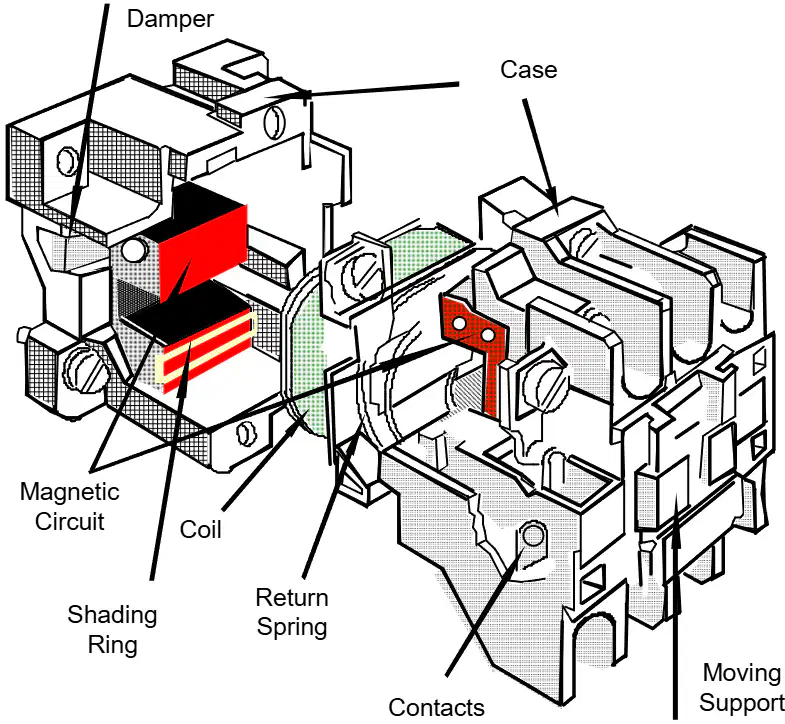
Which component in the diagram is responsible for returning the moving parts to their original position after activation?
Coil
Return Spring
Damper
Shading Ring
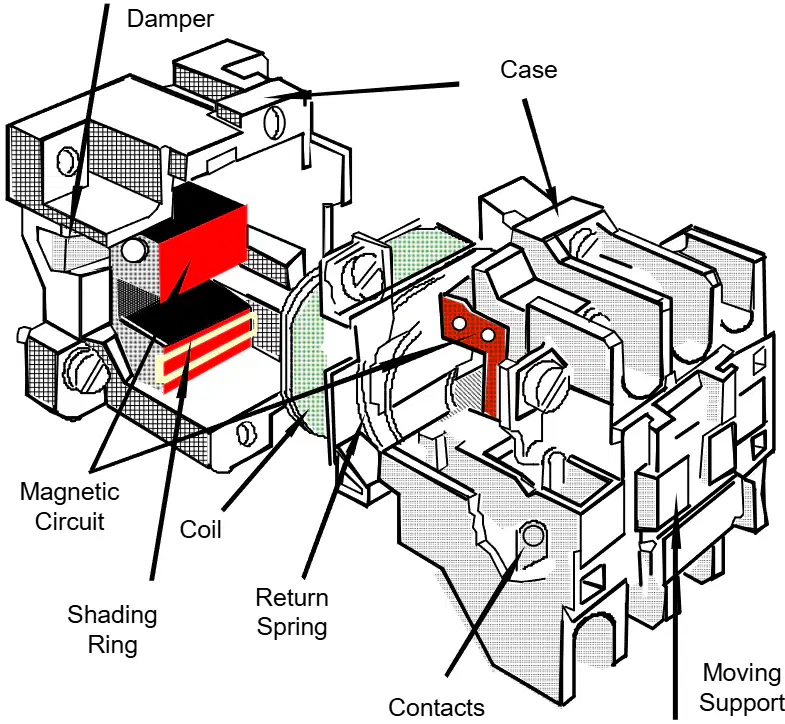
What is the primary function of the coil in the illustrated device?
To provide mechanical support
To generate a magnetic field
To return the contacts to their original position
To reduce electrical noise
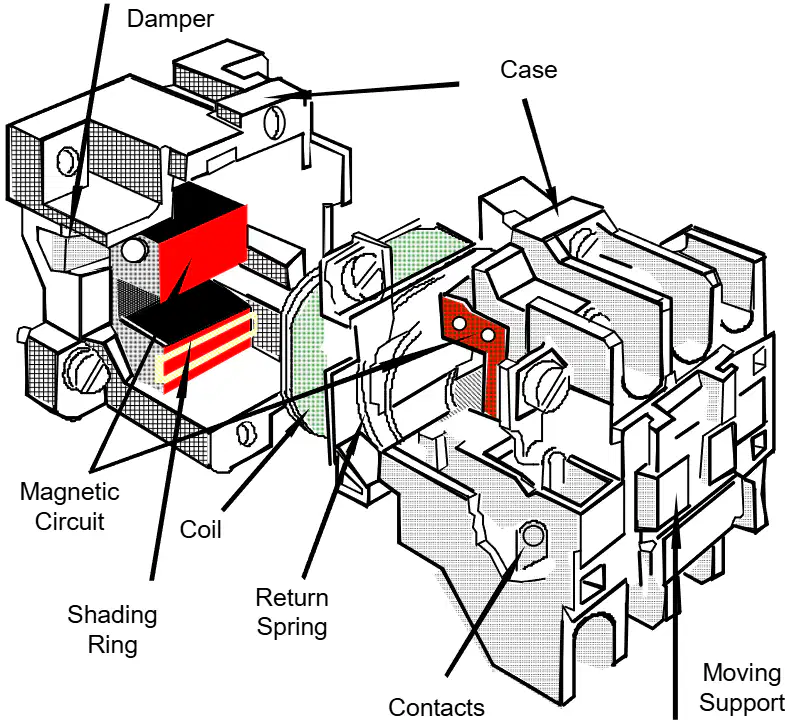
Which part in the diagram is most likely to be involved in reducing electrical arcing at the contacts?
Shading Ring
Damper
Case
Moving Support
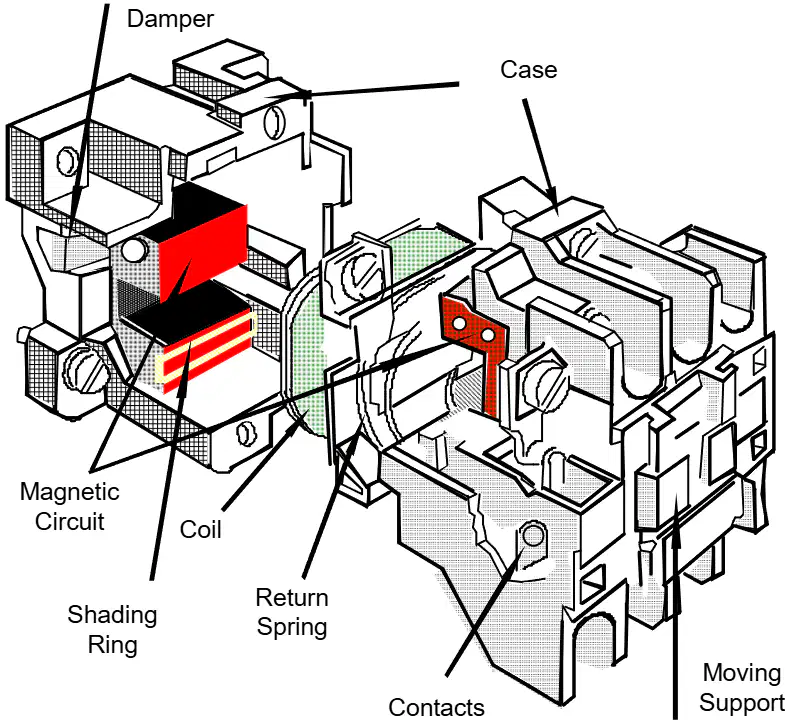
If the magnetic circuit in the device fails, what is the most likely immediate effect on the operation of the contacts?
The contacts will remain open or closed and not switch states
The return spring will break
The coil will overheat
The damper will stop functioning
What is the primary purpose of both relays and contactors?
To provide a means of automatic operation of a machine from a remote location.
To increase the speed of a machine.
To reduce the size of electrical circuits.
To store electrical energy.
Which circuit does a relay always belong to?
Control circuit
Power circuit
Lighting circuit
Ground circuit
What is the function of the case or housing in relays and contactors?
To contain all the parts and provide insulation necessary to isolate individual contacts.
To increase the voltage of the circuit.
To cool down the device.
To amplify the electrical signal.
Which of the following is NOT a type of contact found in relays and contactors?
Normally open contact
Normally closed contact
Reverse contact
Fixed contact
Why is a return spring important in the operation of relays and contactors?
It ensures the moveable core rapidly moves away from the stationary core when the coil is de-energized.
It increases the electrical resistance.
It provides additional power to the circuit.
It reduces the size of the device.
Explain how auxiliary contacts in a contactor can be used to control other circuits. (DoK Level 3)
Auxiliary contacts open and close at the same time as the main contacts, allowing them to be used to control various other circuits by providing additional switching functions.
Auxiliary contacts increase the voltage in the main circuit.
Auxiliary contacts are only used for decorative purposes.
Auxiliary contacts store electrical energy for later use.
What is the main feature of a contactor that distinguishes it from a manual starter?
The use of a resistor
The use of an electromagnet
The use of a capacitor
The use of a fuse
Which component of the electromagnet produces magnetic flux as a result of current flow?
Stationary core
Movable core
Coil
Armature
In an AC circuit, what limits the current in the coil of an electromagnet?
The resistance of the coil
The capacitance of the coil
The impedance of the coil
The voltage of the coil
Why is the stationary core of an electromagnet constructed of laminated steel?
To increase magnetic flux
To reduce Eddy currents
To increase resistance
To improve conductivity
Explain how the movement of the moveable core in an electromagnet results in the change of state of the contacts.
The moveable core generates heat, which melts the contacts.
The moveable core is attracted to the stationary core, pulling the contacts to change state.
The moveable core increases resistance, causing the contacts to open.
The moveable core emits light, signaling the contacts to change.
Which statement best describes the function of the stationary core in an electromagnet?
It produces current flow.
It concentrates magnetic flux and attracts the moveable core.
It insulates the contacts.
It increases the resistance of the coil.
What is another term often used to refer to the moveable core in an electromagnet?
Rotor
Armature
Stator
Conductor
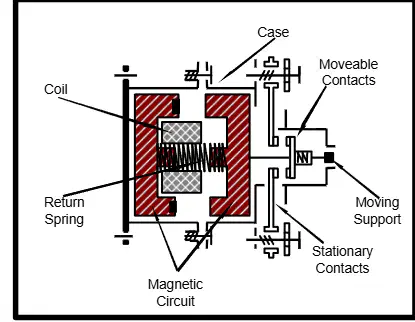
Which part of the contactor is responsible for returning the moveable part of the magnetic circuit to its original position?
Coil
Case
Return Spring
Stationary Contacts
What is the primary function of the main contacts in a contactor?
To provide insulation between the coil and the case
To carry heavy loads to motors, heaters, etc.
To return the moveable part to its original position
To isolate the stationary contacts from the magnetic circuit
Which terminal numbers are typically used for the main contacts in a contactor?
13 – 14
21 – 43
L1 – T1, L2 – T2, L3 – T3
A1 and A2
Why must the moveable and stationary contacts in a contactor be electrically insulated and isolated from each other, the magnetic circuit, and the coil?
To prevent mechanical wear
To ensure proper movement of the contacts
To avoid electrical short circuits and ensure safe operation
To reduce the weight of the contactor

