
 Worksheets
Scientific Experiments and Variables Worksheet
Total questions: 31
Worksheet time: 19mins
A student places bean plants in four different rooms with varying amounts of light: no light, low light, medium light, and bright light. After three weeks, she measures the average plant height in each room. Which conclusion is best supported by this setup?
The independent variable is the plant height, and the dependent variable is the light level.
The independent variable is the amount of light, and the dependent variable is the plant height.
The dependent variable is the amount of water given, and the independent variable is the amount of light.
The experiment cannot show a relationship between light and plant growth.
A teacher gives two groups of students different types of pencils (mechanical vs. wooden) and asks them to write an essay. She then measures the number of words each student writes.
Which of the following is the dependent variable in this experiment?
The number of words in the essay.
The type of pencil used.
The grade level of the students.
The length of time students were given.
A biologist tests the effect of fertilizer on tomato growth. She grows 20 plants with fertilizer and 20 without. She then measures the height of each plant after six weeks.
Which of the following would make the experiment more reliable?
Record only the tallest tomato plants in each group.
Repeat the experiment multiple times with new plants.
Test only one plant with fertilizer and one without.
Change the fertilizer type halfway through the experiment.
Students conducted a survey about favorite ice cream flavors. Out of 100 students, 40 chose chocolate, 35 chose vanilla, 20 chose strawberry, and 5 chose other flavors. Which conclusion is supported by these results?
More students prefer vanilla than strawberry.
Strawberry is the most popular flavor.
Chocolate and vanilla are equally popular.
Other flavors are as popular as chocolate.
A scientist states the following hypothesis: “Saltwater freezes at a lower temperature than freshwater.” She places equal amounts of freshwater and saltwater into a freezer and records the temperature at which each freezes.
What is the dependent variable in this experiment?
The freezing temperature of the water.
The amount of water in each container.
Whether the water is saltwater or freshwater.
The temperature of the freezer.
A student repeats an experiment three times to measure how quickly sugar dissolves in hot water vs. cold water. Why is repeating the experiment important?
To prove that the hypothesis is correct.
To ensure the results are consistent and reliable.
To change the outcome of the experiment.
To reduce the amount of data collected.

The graph below shows the number of hours teenagers spend on homework each week compared to their test scores. Based on the graph, what is the relationship between hours spent on homework and test scores?
Teenagers who spend more hours on homework tend to have higher test scores.
Teenagers who spend fewer hours on homework tend to have higher test scores.
There is no relationship between hours spent on homework and test scores.
Teenagers who spend more hours on homework tend to have lower test scores.
Which conclusion is best supported?
More time on homework tends to be related to higher test scores.
Students who do more homework always earn perfect scores.
Homework causes students to learn less.
There is no relationship between homework and scores.
A group of scientists found that greenhouse gases trap heat in Earth’s atmosphere. Later experiments confirmed the same conclusion. What does this example show about science?
A. Scientific knowledge can change when new evidence is found.
B. Once an idea is published, it cannot be questioned.
C. Scientific results do not need to be tested more than once.
D. Science is based only on opinions and beliefs.
A chemistry student places metal strips in different liquids to test how quickly they corrode. She records the time it takes for visible rust to appear. Which is the dependent variable in this experiment?
The type of metal strip used.
The type of liquid used.
The time until rust appears.
The size of the metal strip.
Astronomers study the brightness and temperature of stars. They notice that blue stars are generally hotter than red stars. If a newly discovered star is very blue, what is the most reasonable prediction?
It has a low surface temperature.
It has a very high surface temperature.
A scientist is testing a new type of fertilizer to see if it increases the height of tomato plants. She has three groups of plants: Group A receives no fertilizer, Group B receives the new fertilizer, and Group C receives a standard commercial fertilizer. All plants are grown in the same type of soil, receive the same amount of water and sunlight, and are kept at the same temperature. What is the independent variable in this experiment?
The amount of water and sunlight
The height of the tomato plants
The amount of soil in each pot
The type of fertilizer used on the plants
A student is investigating how the mass of a paper airplane affects its flight distance. She constructs five airplanes identical in shape and size, but with different amounts of clay added to each to vary the mass. She throws each airplane three times and records the distance of each flight. Which of the following best describes a controlled variable in this experiment?
The amount of clay added to each airplane
The flight distance of the airplanes
The number of times each airplane is thrown
The shape and size of the airplanes
An ecologist hypothesizes that the population of frogs in a pond is directly related to the amount of algae present. She records the amount of algae in the pond each week and counts the number of frogs. After several months, she finds that there is no consistent relationship between algae levels and the frog population. What is the most appropriate next step for the ecologist to take?
Report her findings and suggest further research to explore other factors.
Change her hypothesis to match the data she collected.
Conclude that there is no relationship between any environmental factors and the frog population.
Discard the data and start the experiment over.
A pharmaceutical company is testing a new drug. They give the drug to a group of 100 patients and a placebo (a sugar pill with no medicinal value) to another group of 100 patients. They measure the effectiveness of the drug by recording the improvement in patients' symptoms over a period of three months. Why is it important for the company to use a placebo group in this experiment?
To ensure that all patients receive some form of treatment.
To increase the total number of patients in the study.
To provide a baseline for comparison and control for the placebo effect.
To allow for the company to have an ethical way of testing the drug.
A biologist conducts an experiment to see if the type of soil affects the rate of plant growth. She plants identical seedlings in three different soil types and measures their height weekly for six weeks. She repeats this experiment for a total of four times. The main purpose of repeating the experiment is to:
Ensure that the results are the same every time.
Make the data easier to analyze.
Make the experiment more challenging.
Increase the reliability of the results.
A student collected data on the number of hours of sleep and the test scores of their classmates. The student's graph showed a general trend that as the hours of sleep increased, the test scores also increased. Which conclusion is best supported by the data?
There is a positive correlation between hours of sleep and test scores.
There is no relationship between sleep and test scores.
Sleeping more hours guarantees a higher test score.
Sleeping more causes higher test scores.
A scientist working on a cure for a disease publishes a paper with her findings. Another team of scientists in a different country attempts to replicate her experiment using the same methods, but they are unable to get the same results. What is a likely consequence of this situation?
The original scientist's findings will be immediately accepted by the scientific community.
The original scientist's findings will be questioned and may not be accepted until they can be replicated.
Which of the following scenarios best demonstrates the concept of scientific peer review?
A. A scientist checks their data and calculations multiple times to avoid errors.
B. A team of researchers publishes their findings in a scientific journal after other experts in the field have critiqued the paper.
C. A student in a lab asks another student for help with an experiment.
D. A scientist gives a presentation about her work at a public conference.
A group of geologists is studying earthquake patterns in a specific region. Based on the data they have collected over 50 years, they propose a model that can predict the probability of a major earthquake occurring in the next 10 years. What is the most reasonable prediction for a different region with similar geological features?
The new region will have a major earthquake at exactly the same time as the first region.
The new region is guaranteed to have no earthquakes in the next 10 years.
The geologists cannot make any prediction for the new region without 50 years of data from that specific region.
The new region will have the same probability of an earthquake as the first region.
A food scientist is investigating how the amount of sugar affects the rise of bread. He bakes several loaves of bread, each with a different amount of sugar, and records the final volume of each loaf. Which statement correctly identifies the dependent and independent variables?
The independent variable is the volume of the bread, and the dependent variable is the amount of sugar.
The independent variable is the amount of yeast, and the dependent variable is the amount of sugar.
Both the amount of sugar and the volume of the bread are independent variables.
The independent variable is the amount of sugar, and the dependent variable is the volume of the bread.

In an experiment to see which brand of gel pens ink writes the longest, The brand of pens is (a) while how long each brand lasts is the (b) .
The part of the experiment that you are measuring in is called a(n) (a)

Randall wants to know if the amount of salt in the water has an effect on his goldfish. What is the independent variable?
amount of water
number of goldfish
amount of salt
health of the goldfish
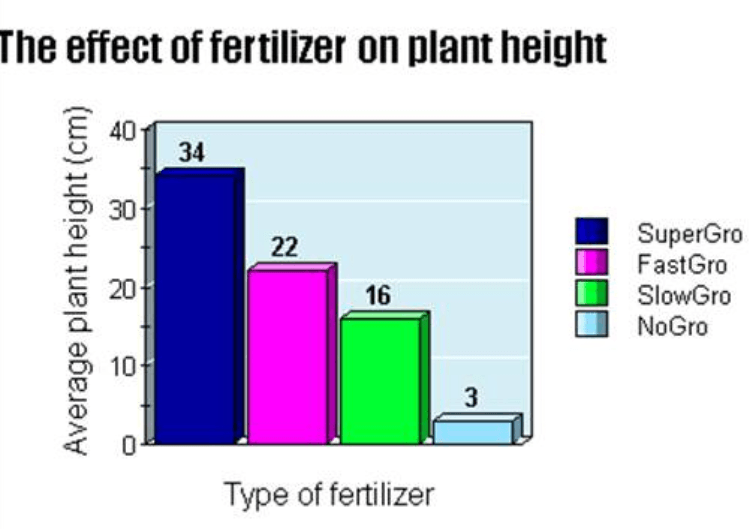
What is the label on the x axis?
Type of fertilizer
Average plant height
centimeters
The effect of plant height on fertilizer

Which is the best title?
Minutes of bubbles
How many bubbles are formed each minute
Minutes per bubbles
Making lots of bubbles
In the context of the scientific method, what does it mean to replicate an experiment?
To change the hypothesis and test again
To repeat the experiment to verify results
To alter the data to fit the hypothesis
To publish the findings in a journal

Which claim could be supported with this data?
I believe that Coco Puffs have the most iron.
Fruit loops are too sweet.
I think Cheerios are for babies.
I think that Corn Pops have the lowest amount of iron.

What can you conclude about the effect of the distance from the hoop (in meters) on the number of baskets made?
The farther away you are from the basket, the fewer baskets will be made.
The closer someone was to the basket, the fewer baskets he/she made.
There was no connection between the distance to the basket and the number of baskets made.

Students in a science class are performing an experiment measuring the height a ball will bounce based on the location it is dropped from. Select the true statements based on the data collected.
Drop height has no affect on bounce height.
Drop height does have an affect on bounce height.
The higher the drop location, the higher the ball bounced.
The ball bounced higher when dropped from lower locations.
The type of ball is the independent variable.
Jordan designs an experiment to test if giving bean plants extra fertilizer will make them grow faster. He predicts that plants with extra fertilizer will be taller. After six weeks, the plants with extra fertilizer average 18 cm tall, while the plants without fertilizer average 22 cm tall.
How could the results of his investigation be described in scientific terms?
The results of his investigation support his hypothesis.
The results of his investigation fail to support his hypothesis.
The results of his investigation prove his hypothesis is true.
The results of his investigation prove his hypothesis is false.

