
 Worksheets
Chem 01.3 Measurement
Total questions: 94
Worksheet time: 47mins
What is the SI unit for measuring length?
meters (m)
liters (L)
grams (g)
seconds (s)
Which of the following is NOT a common unit for measuring length?
centimeter (cm)
meter (m)
kilometer (km)
kilogram (kg)
Which tools are commonly used to measure length?
Ruler, meter stick
Thermometer, stopwatch
Beaker, pipette
Scale, balance
A student needs to measure the distance between two points on a desk. Which unit and tool should they most likely use?
Centimeter and ruler
Kilometer and thermometer
Gram and scale
Liter and beaker
What is the SI unit for measuring volume?
grams (g)
liters (L)
meters (m)
seconds (s)
Which of the following is NOT a common unit for measuring volume?
milliliters (mL)
cubic centimeters (cm³)
microliters (μL)
kilograms (kg)
Which tools are commonly used to measure the volume of a liquid in a laboratory?
Thermometers, rulers, balances
Graduated cylinders, pipettes, burettes
Beakers, tongs, crucibles
Barometers, voltmeters, ammeters
A student needs to measure 25 mL of a liquid accurately. Which tool should they use?
Thermometer
Graduated cylinder
Stopwatch
Ruler
Which of the following best defines volume?
The amount of mass in a sample of matter
The amount of space occupied by a sample of matter
The temperature of a sample of matter
The density of a sample of matter

What is the primary use of the tool shown in the diagram?
Measuring temperature
Measuring mass
Measuring volume
Measuring length
What is the volume, in liters, of a cube with sides of 10.00 cm each?
1.000 L
0.100 L
10.00 L
100.0 L
How many cubic centimeters are equivalent to 1.000 mL?
1.000 cm³
10.00 cm³
100.0 cm³
0.100 cm³
If 10.00 cm equals 1.000 dm, what is the volume in dm³ of a cube with sides of 1.000 dm?
1.000 dm³
10.00 dm³
0.100 dm³
100.0 dm³
Which of the following statements is correct based on the relationship between mL and cm³?
1.000 mL = 1.000 cm³
1.000 mL = 10.00 cm³
1.000 mL = 0.100 cm³
1.000 mL = 100.0 cm³
A container holds 1.000 L of water. Using the relationships provided, how many milliliters and cubic centimeters does this correspond to?
1,000 mL and 1,000 cm³
100 mL and 100 cm³
10,000 mL and 10,000 cm³
100 mL and 1,000 cm³
What is the meniscus?
The straight line formed by water in a container
The curved surface that water forms as it tries to climb up the surfaces of a container
The flat surface at the top of the liquid
The bubbles formed on the surface of water
When measuring the volume of a liquid, where should you read the meniscus?
At the top of the meniscus
At the side of the meniscus
At the bottom of the meniscus
At the middle of the meniscus
Why is it important to read the meniscus properly when measuring volume?
To ensure the measurement is accurate
To make the liquid look clearer
To avoid spilling the liquid
To change the color of the liquid
Which of the following best describes the shape of the meniscus in a container?
Flat and even
Curved surface
Pointed tip
Square edge
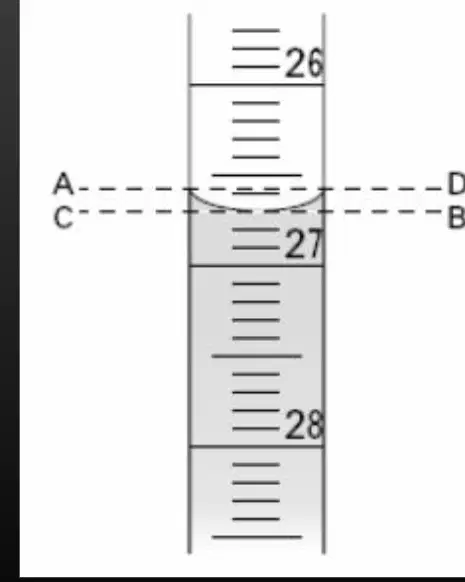
At which point should you read the volume of the liquid?
At line A
At line B
At line C
Which factor should be included when measuring the volume of a liquid to ensure accuracy?
The color of the liquid
The temperature at the time of measurement
The shape of the container
The taste of the liquid
Why can thermal expansion cause different volume measurements for the same amount of liquid at different temperatures?
Because the liquid evaporates at higher temperatures
Because the liquid changes color at different temperatures
Because the volume of the liquid changes with temperature
Because the container shrinks at lower temperatures
How does water’s density change as temperature changes?
It remains constant
It increases with temperature
It decreases with temperature
It changes depending on temperature
A student measures the volume of water at two different temperatures and gets different results. What is the most likely explanation?
The measuring instrument is faulty
The water was contaminated
Thermal expansion caused the volume to change
The student made a calculation error
What is the SI unit of mass?
Kilogram (kg)
Gram (g)
Pound (lb)
Newton (N)
Which of the following tools is commonly used to measure mass?
Thermometer
Digital scale
Stopwatch
Ruler
Which statement best describes the relationship between mass and weight on Earth?
Mass and weight are always equal.
Mass and weight are not related.
Mass and weight are directly proportional if gravity is constant.
Mass is always greater than weight.
Why is mass not the same as weight?
Mass depends on gravity, weight does not.
Weight is a measure of matter, mass is a force.
Mass is a measure of matter, weight is a force caused by gravity.
Mass and weight are both forces.
Which of the following is NOT a common unit of mass?
Milligram (mg)
Gram (g)
Kilogram (kg)
Liter (L)
What does temperature measure in a sample of matter?
The average kinetic energy of the particles
The total mass of the particles
The volume of the sample
The density of the sample
Which of the following is the SI unit for temperature?
Kelvin (K)
Celsius (°C)
Fahrenheit (°F)
Joule (J)
Which tools are commonly used to measure temperature in industrial settings?
Thermocouples and RTDs
Barometers and anemometers
Rulers and calipers
Voltmeters and ammeters
Why is kinetic energy important in the context of temperature?
It represents the energy of motion of particles, which temperature measures
It determines the color of a substance
It affects the electrical conductivity of a material
It is unrelated to temperature
If a scientist wants to measure temperature in Celsius, which symbol should they use?
°C
K
J
mL
What is the freezing point of water on the Fahrenheit scale?
32°F
0°C
273.15 K
100°C
On which temperature scale is the boiling point of water 100°C?
Celsius
Fahrenheit
Kelvin
Rankine
What is the boiling point of water on the Kelvin scale?
373.15 K
273.15 K
212°F
100°C
Which two temperature scales have the same increment system?
Celsius and Kelvin
Fahrenheit and Celsius
Kelvin and Fahrenheit
Celsius and Rankine
If the freezing point of water is 0°C, what is it in Kelvin?
273.15 K
100 K
32 K
373.15 K
A student claims that the difference between the boiling and freezing points of water is the same in Celsius and Kelvin. Is this correct? Explain your reasoning.
Yes, because both scales have the same increment system.
No, because Kelvin increments are larger.
No, because Celsius increments are smaller.
Yes, because both start at zero.
Which of the following statements is true about the increment system of Celsius and Kelvin temperature scales?
Celsius and Kelvin have different increment systems.
Celsius and Kelvin have the same increment system.
Celsius increments are twice as large as Kelvin increments.
Kelvin increments are half the size of Celsius increments.
What is the change in Kelvin that corresponds to a change of 1°C?
0.5 K
2 K
1 K
10 K
Why are there no degree symbols used with the Kelvin scale?
Because Kelvin is not a temperature scale.
Because Kelvin is an absolute scale.
Because Kelvin is only used in chemistry.
Because Kelvin is always negative.
What is the value of absolute zero in Kelvin?
100 K
273.15 K
0 K
-273.15 K
A scientist measures a temperature change of 5°C. What is the equivalent change in Kelvin?
1 K
0 K
10 K
5 K
Explain why absolute zero is significant in the study of gases.
It is the temperature where water freezes.
It is the temperature where a gas would occupy no volume.
It is the temperature where all substances melt.
It is the temperature where gases become solids.
What is the formula to convert Celsius to Kelvin?
K = °C + 273
K = °C - 273
K = °C × 273
K = °C ÷ 273
Which of the following statements about the Kelvin temperature scale is correct?
Kelvin cannot go below zero.
Kelvin can be negative.
Kelvin and Celsius are always equal.
Kelvin is always less than Celsius.
If the temperature is 25°C, what is the temperature in Kelvin?
298 K
273 K
25 K
248 K
Why is it incorrect to have a negative value for Kelvin?
Because Kelvin cannot go below zero.
Because Kelvin is always negative.
Because Kelvin is not a real temperature scale.
Because Kelvin is only used for negative temperatures.
A student calculates a temperature and gets -10 K. What should the student conclude?
They made a mistake in their calculation.
The temperature is correct.
Kelvin can be negative in some cases.
The value should be converted to Celsius.
What is the SI unit of energy?
Calorie (cal)
Watt (W)
Joule (J)
Newton (N)
Which tool is commonly used to measure energy in the form of heat?
Thermometer
Calorimeter
Barometer
Voltmeter
How much heat is required to raise the temperature of 1 gram of pure water by 1°C?
1 Joule
1 Calorie (cal)
1 Watt
1 Newton
A dietary Calorie (with a capital C) is equal to:
1 calorie
100 calories
1,000 calories
10,000 calories
If you have 2 calories, how many Joules do you have? (Use the conversion 1 cal = 4.184 J)
2.092 J
4.184 J
6.368 J
8.368 J
Which of the following is the correct conversion for 1 Joule to calories?
0.2390 cal
4.184 cal
1.000 cal
2.390 cal
What does accuracy refer to in the context of measurements?
How close a measurement is to the accepted or true value.
How often a measurement is repeated.
How far a measurement is from the standard.
How quickly a measurement is taken.
Which of the following best describes precision?
The degree of conformity to a standard.
The degree of refinement with which an operation is performed or a measurement is stated.
The speed at which a measurement is taken.
The cost of performing a measurement.
If a measurement is repeated multiple times and the results are very similar, what does this indicate?
High accuracy
High precision
Low accuracy
Low reliability
In a game of darts, what does hitting the bullseye represent?
Precision
Accuracy
Speed
Consistency
In the context of throwing darts, what does precision refer to?
How close your darts are to the bullseye.
How many darts you throw.
How close your darts are to one another.
How far you stand from the dartboard.
A student throws three darts and all land close together but far from the bullseye. What does this demonstrate?
High accuracy, high precision
Low accuracy, high precision
High accuracy, low precision
Low accuracy, low precision
What does the "experimental amount" refer to in a chemistry lab?
The value you measured yourself in the lab.
The value found in a textbook.
The average of all possible values.
The value calculated by your teacher.
What is the correct formula for calculating percent error?
percent error = |experimental amount - theoretical amount| / theoretical amount × 100
percent error = (experimental amount + theoretical amount) / 2 × 100
percent error = (theoretical amount - experimental amount) / experimental amount × 100
percent error = (experimental amount / theoretical amount) × 100
What do the vertical bars (| |) in the percent error formula represent?
Square root
Absolute value
Average value
Negative value
Why are there no units for percent error?
Because the units cancel out during division.
Because percent error is always zero.
Because it is always measured in grams.
Because it is a theoretical value.
Which of the following best describes the "theoretical amount" in a chemistry experiment?
The value you measure in the lab.
The value you estimate without calculation.
The value found in reference tables, textbooks, or other trusted sources.
The value you guess based on previous experiments.
A student measures an experimental amount of 9.5 g, while the theoretical amount is 10.0 g. What is the percent error? (Use the formula: percent error = |experimental amount - theoretical amount| / theoretical amount × 100)
0.5%
5%
10%
50%
What is one method used to account for error and the size of that error in experimental measurements?
Calculate the percent error of the value.
Ignore the error and use the measured value.
Repeat the experiment until there is no error.
Use only digital instruments.
Which of the following is NOT mentioned as a possible source of error in an experiment?
A clock being wrong
The scale at an angle
The sample not being pure
The experimenter’s handwriting
Why is it important to calculate percent error in scientific experiments?
To determine how close a measurement is to the true value
To make the experiment more complicated
To avoid using any measuring instruments
To ensure the experiment is repeated many times
Why is it important to be open to being wrong in science?
It helps you refine your techniques.
It makes your experiment less valuable.
It means your experiment is a failure.
It prevents you from learning new things.
What does noting sources of error in an experiment help you do?
Refine your techniques
Prove your experiment is perfect
Ignore mistakes
Make your experiment less reliable
According to the passage, why is it important for experiments to be repeatable and reproducible?
To ensure reliability and accuracy in scientific results
To make experiments more complicated
To avoid making mistakes
To finish experiments faster
What is the formula for calculating percent error?
percent error = |experimental amount - theoretical amount| / theoretical amount × 100
percent error = (experimental amount + theoretical amount) / 2 × 100
percent error = (theoretical amount - experimental amount) / experimental amount × 100
percent error = (experimental amount × theoretical amount) / 100
If the experimental value for the density of copper is 8.88 g/cm³ and the theoretical value is 8.92 g/cm³, what is the percent error?
0.448%
4.48%
0.0448%
8.92%
Which of the following best describes the purpose of calculating percent error in an experiment?
To determine how close an experimental value is to the accepted value
To find the average of two values
To convert units from grams to centimeters
To measure the volume of a substance
Given the calculation: |8.88 g/cm³ - 8.92 g/cm³| / 8.92 g/cm³ × 100, which step should be performed first?
Subtract 8.92 g/cm³ from 8.88 g/cm³
Multiply by 100
Divide by 8.92 g/cm³
Add 8.88 g/cm³ and 8.92 g/cm³
What is the formula to convert temperature from Kelvin (K) to Celsius (°C)?
°C = K + 273
K = °C + 273
°C = K - 273
K = °C - 273
If the temperature is 300 K, what is the equivalent temperature in Celsius?
573°C
27°C
273°C
127°C
Given the equation K = °C + 273, what is the value of °C when K is 300?
573
27
273
127
What is the main advantage of using a buret for measuring volume in laboratory experiments?
It is less expensive than other tools
It can measure to tenths of milliliters, making it more precise
It is easier to clean than other tools
It is used for heating substances
In which type of laboratory procedure are burets most commonly used?
Filtration
Titration
Distillation
Chromatography
Why is it important to use a precise measurement tool like a buret during titrations?
To ensure accurate and reliable results
To save time during the experiment
To reduce the amount of chemicals used
To make the experiment more colorful
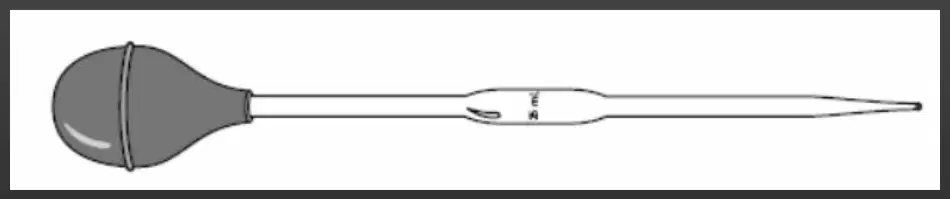
Which laboratory instrument is used for more accurate volume measurements?
Pipet or buret
Beaker
Test tube
Flask
What is the purpose of the suction bulb when using a pipet?
To withdraw air from the pipet while drawing up the liquid
To heat the liquid in the pipet
To measure the temperature of the liquid
To mix the liquid in the pipet
Why should you never pipet by mouth?
It is unsafe and can lead to ingestion of harmful substances
It is less accurate than using a suction bulb
It is slower than using a suction bulb
It is not allowed in most laboratories due to noise
A student needs to deliver a measured volume of liquid accurately. Which tool and procedure should they use according to the material?
Use a pipet fitted with a suction bulb
Use a beaker and pour by hand
Use a test tube and a dropper
Use a flask and swirl the liquid
Explain why pipets are made in many sizes and how this benefits laboratory work.
To deliver different measured volumes of liquids for various experiments
To make them easier to clean
To allow them to fit in any storage space
To make them more colorful
What is a graduated cylinder used for in a laboratory?
Measuring volume of liquids
Measuring mass of solids
Heating substances
Mixing chemicals
Why is a graduated cylinder called "graduated"?
Because it is used by graduates
Because it is marked with graduations
Because it is used for graduation ceremonies
Because it is made in one size only
Which of the following best describes the variety of graduated cylinders available?
They come in only one size
They come in several different sizes
They are always made of metal
They are only used for solids
If you need to measure the volume of a liquid accurately, which laboratory equipment would you most likely use?
Beaker
Graduated cylinder
Test tube
Bunsen burner

