Worksheets
States of Matter and Properties
Total questions: 97
Worksheet time: 2hrs 53mins
Matter is everything that occupies space
True
False
What are the three states of matter?
solid, volume, mass
density, volume, mass
solid, liquid, gas
density, gas, volume
Something that occupies space and has mass.
volume
matter
mass
density
A state of matter that has a definite volume and shape.
solid
liquid
gas
matter
The amount of space that something occupies
density
volume
mass
matter
You can measure ______ with grams.
mass
volume
conductivity
melting point
Solids have a defined _______________.
smell
shape
image
sound
Liquid matter takes the shape of _______.
a gas
water
a pet
its container
Water in its solid form is _____________.
a vapor
ice
a liquid
boiling
The amount of matter something contains is its ______________.
gas
solid
weight
mass
Matter is everything that occupies space
True
False

Liquids have a certain shape and their own volume. Liquids are something you can touch.
True
False
What are the states of matter?
solid, liquid, and juice
solid and liquid
solid and gas
solid, liquid, and gas

Which state of matter has particles that are very close together?
liquid
gas
solid

Solid
Liquid
Gas

Solid
Liquid
Gas
Something that occupies space and has mass.
volume
matter
mass
density
A type of matter that has its own shape and size
solid
liquid
gas
What can cause ice to change from solid to liquid?
The air.
The cold.
The shape.
The heat.
Which of the following is an example of a solid?
wind
water
rock
juice

Which form of matter fills space as it does in the balloon?
liquid
string
solid
gas
What happens when my water bottle in the freezer goes from a liquid state to a solid state?
fusion
evaporation
freezing
cutting
Water in its solid form is _____________.
a vapor
ice
a liquid
boiling
Liquid matter takes the shape of _______.
a gas
water
a pet
its container
Which of the following objects is a liquid?
Ice cube
Apple juice
Rubber ball
Plastic spoon
All of the following objects have a smooth texture, EXCEPT –
Balloon
Marble
Rock
Coca-Cola can
All of the following objects have a smooth texture, EXCEPT –
Balloon
Marble
Rock
Coca-Cola can
Which scientific tool would you use to determine the temperature of an object?
Magnifying glass
Ruler
Stopwatch
Thermometer
What happens when a chocolate bar is left in a car on a hot day?
It boils.
It evaporates.
It freezes.
It melts.
An example of a physical property is
flammability
acidic
color
ability to oxidize
Which state of matter has neither a definite shape nor a definite volume?
Solids do not have a definite shape or volume.
Liquids do not have a definite shape or volume.
Gases do not have a definite shape or volume.
Displacements do not have a definite shape or volume.

The illustration shows the spacing of particles in different types of matter. Which illustration is an example of the spacing of particles in solids?
illustration A
illustration B
illustration C
illustration D
Anything that occupies space and has mass is known as
liquid
air
matter
solid

Study the diagram and carefully read the description below the diagram. Gases have neither a definite shape nor a definite volume. Instead, they take the shape of their container. The particles of a gas spread out within the available space. Which diagram illustrates the particles of a gas?
Diagram A illustrates the particles of a gas.
Diagram B illustrates the particles of a gas.
Diagram C illustrates the particles of a gas.
None of these illustrate the particles of a gas.

5. In the diagram, State of Matter C is a gas. Which of the following statements is true about this state of matter?
Its particles can move freely throughout the container
It has a definite volume, but not a definite shape
It has a definite shape and volume
The particles are rigid and densely packed
Fusion is the change of state from
solid to gas.
liquid to gas.
solid to liquid.
liquid to solid.
It has no definite shape or volume, but takes the shape and volume of its containers, filling the available space. The particles move easily and separate from each other, expanding throughout the available space.
solid
liquid
gas
mass
It has a definite shape and volume. The particles are very close to each other (dense). They vibrate, but do not move from one place to another.
solid
liquid
gas
mass
It has a definite volume, but its shape changes according to the shape of its containers. The particles are close to each other, but they can separate and flow from one place to another.
solid
liquid
gas
mass

In which state of matter is this?
Solid
Liquid
Gas
ALL of them
What are three common phases of matter?
solid, liquid, and gas
atom, element, and molecule
mixture, solution, and compound
mass, volume, and temperature
The particles in a __________ have very little movement and the object keeps its shape and volume.
solid
liquid
gas
__________ have a definite volume and tend to take the shape of their container.
solids
liquids
gases
Comprimir means __________.
to press by pressure
to increase the temperature
to melt
to decrease the mass
Water vapor is a __________.
solid
liquid
gas
Gases __________.
have a fixed shape
are easily compressible
have particles that do not flow easily
have a definite volume

A material WITHOUT shape and WITHOUT volume is a -
solid
liquid
gas
A material with a definite shape and a definite volume is a -
solid
liquid
gas
A material that does NOT have a definite shape and has a definite volume is a -
solid
liquid
gas
If you fill a basketball with air particles, what is the proof that they are inside?
The basketball deflates
The basketball becomes more tense
The basketball does not change at all
What happens when you add sugar or salt to water?
Nothing
They sink to the bottom
They dissolve in the water
They evaporate from the water
1. This state of matter has a fixed volume, but its shape adapts to the container it is in.
plasma
solid
liquid
gas
2. This state of matter has a fixed volume and a fixed shape
plasma
solid
liquid
gas
3. Which of the following is the upward push that holds an ice cube floating on the surface of a glass of water?
volume
gravity
buoyance
magnetism
4. What is mass?
a. the weight of an object
b. the amount of matter in an object
c. the height of an object
d. the length of an object
5. A liquid is the least dense state of matter.
True
False
6. You cannot see the air you breathe; therefore, it is not matter.
True
False
7. To calculate a sample’s density, divide its mass by its weight.
True
False
8. Mass is measured in newtons.
True
False
9. Ice, liquid water, and water vapor are the three states of matter for water.
True
False
This state of matter has a volume and shape that conforms to the container that it is in
plasma
liquid
gas
solid
the building block of matter
Atom
Element
Compound
Mixture
two or more atoms that are held (bonded) together; can be two or more atoms of same type of element or different types of elements
atom
element
mixture
molecule
Water (H2O) is an example of a(n)
atom
element
compound
mixture
a positively charged particle in the nucleus of an atom
electron
neutron
nucleus
proton
Oxygen, O, is an example of a(n)
atom
element
compound
mixture
two subatomic particles that are located in the nucleus of an atom
electron and neutron
neutron and proton
proton and electron
two or more different elements chemically bonded together (in a set ratio)
Atom
Element
Compound
Mixture
Chex mix is an example of a(n)
atom
element
mixture
molecule
the region in the center of the atom where the protons and neutrons are located
electron
neutron
nucleus
proton
two or more substances that are physically combined (not chemically combined)
atom
element
mixture
molecule
a neutral particle in the nucleus of an atom
electron
neutron
nucleus
proton
most of an atom’s mass is concentrated here
electron cloud
energy level
nucleus
a substance that consists of only one type of atom; can be found on the periodic table
Atom
Element
Compound
Mixture
a negatively charged particle that occupies the space in an atom outside the nucleus
electron
neutron
nucleus
proton
the charge of the nucleus of an atom
negative
positive
uncharged

Of the three states of matter, particles are moving the fastest and are the farthest apart in a _________.
solid
liquid
gas

1.The state of matter with a fixed volume but no fixed shape is _______.
solid
liquid
gas

1.Particles cannot change position in a ________
solid
liquid
gas
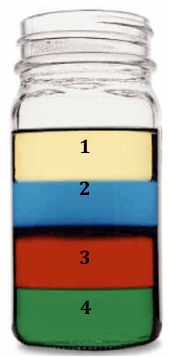
Density is a physical property that describes how much matter is in a certain amount of space. Which picture shows the highest density?


What state of matter is pictured above?
solid
liquid
gas

The smallest particle into which an element can be divided and still be the same element is a(n)
proton
neutron
electron
atom
What does cooler, denser material do?
float
sink
nothing
What happens to an object that is denser (more dense) than the liquid it is in?
floats
sinks
What happens to an object that is less dense than the liquid it is in?
floats
sinks
Why is a hot air balloon able to rise into the sky?
The hot air is less dense then the atmosphere, so it rises
The hot air is more dense then the atmosphere, so it rises
The hot air has the same density as the atmosphere, so it rises
What is density?
The amount of space an object takes up
The amount of matter in a given space
The amount of matter in an object
What is volume?
The amount of space an object takes up
The amount of matter in a given space
The amount of matter in an object