
 Worksheets
Algebra 1 - Unit 1: Basics of Algebra Topics
Total questions: 88
Worksheet time: 44mins
What is the topic for Day 1 in Algebra 1 Unit 1?
Properties of Real Numbers & Absolute Value
Solving Linear Equations
Graphing Quadratic Functions
Factoring Polynomials
What is the topic for Day 2 in Algebra 1 Unit 1?
Operations with Signed Numbers & Exponents
Linear Equations and Inequalities
Factoring Polynomials
Quadratic Functions
What is the topic for Day 3 in Algebra 1 Unit 1?
Order of Operations & Evaluating Expressions
Solving Linear Equations
Graphing Functions
Properties of Real Numbers
What is the topic for Day 4 in Algebra 1 Unit 1?
Simplifying Perfect Squares
Solving Linear Equations
Graphing Inequalities
Factoring Polynomials
What is the topic for Day 5 in Algebra 1 Unit 1?
Simplifying Radicals That Are Not Perfect Squares
Solving Linear Equations
Graphing Linear Functions
Factoring Quadratic Expressions
What is the topic for Day 6 in Algebra 1 Unit 1?
Review
Equations and Inequalities
Linear Functions
Polynomials
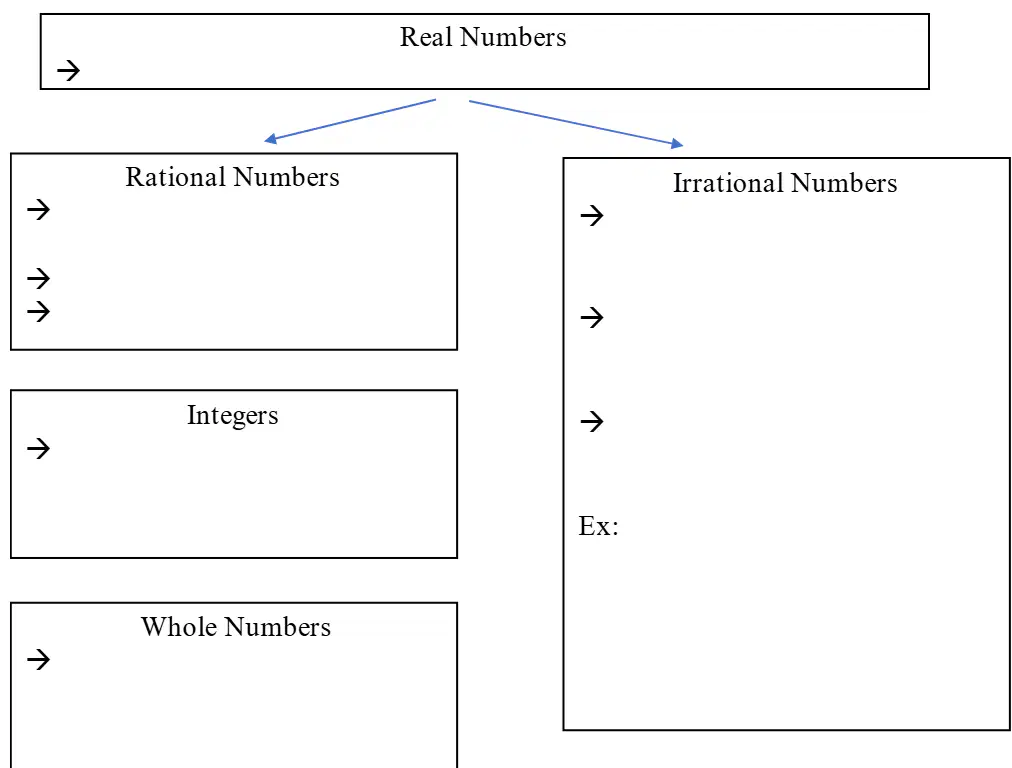
Fill in the blank: Real Numbers can be classified into two main categories: _______ and _______.
Rational Numbers, Irrational Numbers
Whole Numbers, Natural Numbers
Prime Numbers, Composite Numbers
Even Numbers, Odd Numbers
Fill in the blank: Rational Numbers include ________, ________, and ________.
Integers, Whole Numbers, Natural (Counting) Numbers
Prime Numbers, Composite Numbers, Odd Numbers
Irrational Numbers, Imaginary Numbers, Complex Numbers
Fractions, Decimals, Percents
Fill in the blank: Integers include ________ and ________.
Whole Numbers, Negative Numbers
Fractions, Decimals
Prime Numbers, Composite Numbers
Rational Numbers, Irrational Numbers
Fill in the blank: Whole Numbers include ________.
Natural (Counting) Numbers and 0
Only negative numbers
Fractions and decimals
Prime numbers only
Fill in the blank: Natural (Counting) Numbers include ________.
1, 2, 3, ...
0, 1, 2, ...
-1, 0, 1, ...
2, 4, 6, ...
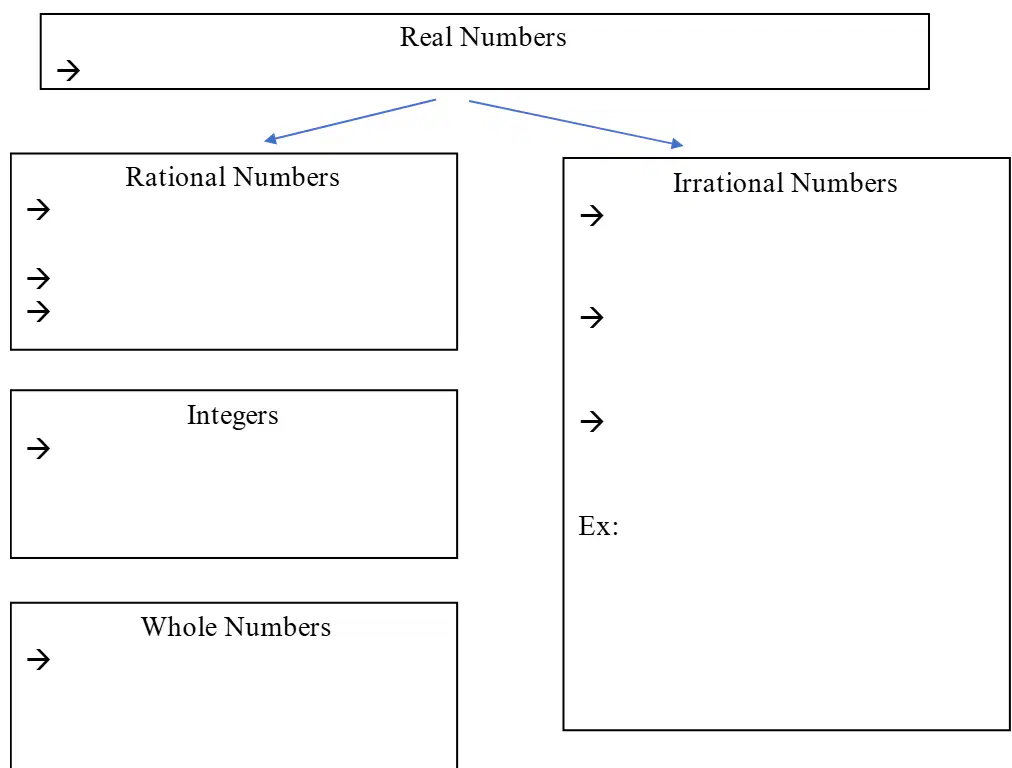
Fill in the blank: Irrational Numbers are real numbers that cannot be written as a ratio of two integers. Examples include ________, ________, and ________.
π (pi), √2, e
2, 4, 6
1/2, 3/4, 5/6
-3, 0, 7
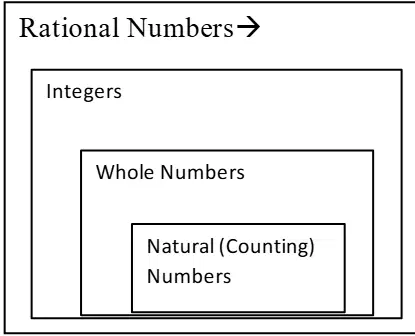
Fill in the blank: In the Venn diagram, Rational Numbers contain ________, which contain ________, which contain ________.
Integers, Whole Numbers, Natural (Counting) Numbers
Natural (Counting) Numbers, Whole Numbers, Integers
Whole Numbers, Integers, Natural (Counting) Numbers
Integers, Natural (Counting) Numbers, Whole Numbers
Commutative Property: COmmutative CO = ________________________________
Change Order
Change Operation
Change Output
Change Object
Associative Property: ASSOciative ASSO = ________________________________ Summary: If you change which 2 of the 3 numbers are in ( ) when all are being added or multiplied, you will get the same answer. Examples: Non-examples: (1 + 3) + 5 = (3 + 1) + 5, (4 · 5) + 6 = 4 · (5 + 6)
Associate or Grouping
Addition or Subtraction
Multiplication or Division
Commutative or Distributive
Distributive Property: Distribute: ____________________________________________________________ Summary: The number that is outside and touching the ( ) is given to all terms inside the ( ). Examples: Non-examples: 3 + (2 + 8) = 5 + 11, (4 + 5) – 2 = –8 + –10
a(b + c) = ab + ac
a(b + c) = ab + c
a(b + c) = a + b + c
a(b + c) = ab - ac
The number that gets added to anything without changing its identity is _______!
0
1
-1
10
The number that gets multiplied to anything without changing its identity is _______!
1
0
2
-1
A number “__________________” of the one given. When the inverse is added to the given number, they cancel out to make 0.
opposite
equal
double
square
Absolute Value is the ______________________ a number is away from 0.
distance
color
shape
weight
|5| = ________
5
-5
0
10
|2| = ________
2
-2
0
1
|-7| = ________
7
-7
0
-1
|-3| = ________
3
-3
0
-1
|4| = ________
4
-4
0
8
|-23| = ________
23
-23
0
-1
|0| = ________
0
1
-1
10
|-2| = ________
2
-2
0
-1
|65| = ________
65
-65
0
1
Fill in the blank with <, >, or =: |−9| _____ |9|
=
<
>
≤
Fill in the blank with <, >, or =: |−8| _____ −8
>
<
=
≤
Fill in the blank with <, >, or =: |−3| _____ 3
=
<
>
≠
|3| + |−7| = ________
10
4
-10
-4
|−2| − |−1| = ________
1
-1
0
2
Does an expression with an absolute value always have to give you a positive answer? Consider the following: |−12| = ________
12
-12
0
-1
Change subtraction to addition by distributing the negative! Remember the rules: 1) If the signs are the same, add and keep the sign. 2) If the signs are different, subtract and take the sign of the biggest number. 1. –3 + 19 = ______
16
-22
-16
22
Change subtraction to addition by distributing the negative! Remember the rules: 1) If the signs are the same, add and keep the sign. 2) If the signs are different, subtract and take the sign of the biggest number. 2. –4 – (–6) = ______
2
-10
-2
10
3. –8 + 21 = ______
13
-29
-13
8
4. (–3) – (–4) = ______
1
-7
7
-1
Change subtraction to addition by distributing the negative! Remember the rules: 1) If the signs are the same, add and keep the sign. 2) If the signs are different, subtract and take the sign of the biggest number. 5. 7 – 18 = ______
-11
25
-25
11
Change subtraction to addition by distributing the negative! 6. –9 – 24 = ______
-33
15
-15
33
A diver is 10 meters below the ocean surface. What is the new depth if the diver descends 2 meters lower?
-12 meters
-8 meters
-10 meters
-2 meters
The temperature is –6 degrees Fahrenheit. Find the new temperature if it rises 10 degrees.
4 degrees Fahrenheit
–16 degrees Fahrenheit
–4 degrees Fahrenheit
6 degrees Fahrenheit
A credit card balance is 452.37.Findthenewbalanceafterthefollowingthingshappen: 89.32 worth of merchandise is returned, a purchase of 34.76ismade,andapaymentof 200 is applied.
$306.93
$312.45
$289.81
$340.00
Remember the rules: 1) Multiply or divide the numbers 2) If the signs are the same, the answer is ______________________ 3) If the signs are different, the answer is ______________________
2) positive 3) negative
2) negative 3) positive
2) negative 3) negative
2) positive 3) positive
10. (–3)(7) =
-21
21
-10
10
11. (–5)(–6) =
30
-30
11
-1
12. –3(6) =
-18
18
-9
0
13. 144/12 =
12
10
14
16
14. –9/–3 =
3
-3
-6
6
12/–4 =
-3
3
-4
4

Label the parts of the exponent: 35 (with arrow pointing to 3 and 5)
3: base, 5: exponent
3: exponent, 5: base
3: product, 5: base
3: base, 5: product
53 =
125
15
25
100
17. 105 =
100000
10000
50000
1000
(1/3)2 =
1/9
1/6
2/9
1/3
19. (.5)3 =
0.125
0.25
0.05
0.375
20. (–5)^2 =
25
-25
10
0
21. −52 =
-25
25
-10
5
−24 =
-16
16
-8
8
23. (–2)4 =
16
-16
8
-8
Anything to the ________________ power will ALWAYS = ____________________!!!
1
0
2
-1
40 = _______
1
0
4
-1
25. ( (–3)0 ) = _______
1
0
-3
3
26. – −30 = _______
-1
0
1
3
Practice: Write each of the following as an expression with a positive exponent AND evaluate it! 27. (–6)–3 = _______
(−6)31=−2161
(−6)3 = -216
−1/(−6)3=1/216
(−6)−3 = -1/216
Practice: Write each of the following as an expression with a positive exponent AND evaluate it! 28. −5−1 = _______
-1/5
1/5
-5
5
Practice: Write each of the following as an expression with a positive exponent AND evaluate it! 29. 2−342 = _______
128
16
32
64
Write each of the following as an expression with a positive exponent AND evaluate it! 30. 9−2 = _______
921 = 811
92=81
−92 = -81
9−21=811
Practice: Write each of the following as an expression with a positive exponent AND evaluate it! 31. 1/(6−3) = _______
216
-216
1/216
36
Write each of the following as an expression with a positive exponent AND evaluate it! 2−64−2 = _______
4
1/4
16
8

The following phrase often helps us remember the pyramid: P__________________ E__________________ M_______ D__________ A__________ S______________. Fill in the blanks for the order of operations mnemonic (PEMDAS).
Parentheses, Exponents, Multiplication, Division, Addition, Subtraction
Parentheses, Exponents, Division, Multiplication, Addition, Subtraction
Parentheses, Exponents, Multiplication, Addition, Division, Subtraction
Parentheses, Exponents, Addition, Multiplication, Division, Subtraction
Solve using the order of operations: (3−2)2−6⋅4÷2 = _______
-10
2
-8
-12
Solve using the order of operations: 12÷3⋅2+(–1+5)2 = _______
20
16
12
24
Solve using the order of operations: 20÷(4−2)+52 = _______
27
25
30
35
Solve using the order of operations: 8 - 4 · 2(3 - 6) + 1 = _______
33
-15
21
17
Solve using the order of operations: 5 - (5 - 5) - -5 ÷ 5 = _______
6
0
1
-1
Solve using the order of operations: (−42)/(6−2+4) = _______
-2
2
-4
4
Solve using the order of operations: (72−52)/(2+3⋅2+4) = _______
2
4
6
8
Solve using the order of operations: −4−(2−3)3+9 / −32÷−9⋅6 = _______
-2
2
-6
1
____________________________ – a “phrase” in which at least one operation needs to be performed.
expression
variable
constant
statement
Evaluate the following expression with these values: a = -8, b = 6, d = -3, x = 4, y = 5, and z = -1. a²d = ________
-384
192
-96
384
Evaluate the following expression with these values: a = -8, b = 6, d = -3, x = 4, y = 5, and z = -1. a² + b² = ________
100
64
36
80
Evaluate the following expression with these values: a = -8, b = 6, d = -3, x = 4, y = 5, and z = -1. b² – y² = ________
11
-1
5
0
Evaluate the following expression with these values: a = -8, b = 6, d = -3, x = 4, y = 5, and z = -1. |d| – (–y) = ________
8
2
-8
-2
Evaluate the following expression with these values: a = -8, b = 6, d = -3, x = 4, y = 5, and z = -1. 9a – a² = ________
-136
-80
64
-72
Evaluate the following expression with these values: a = -8, b = 6, d = -3, x = 4, y = 5, and z = -1. x² + 3x + 5 = ________
33
27
25
21
Evaluate the following expression with these values: a = -8, b = 6, d = -3, x = 4, y = 5, and z = -1. a + b² – d² = ________
43
-7
25
-19
Evaluate the following expression with these values: a = -8, b = 6, d = -3, x = 4, y = 5, and z = -1. y² – 4y + (a – b) = ________
-9
-5
3
-1

