
Font size
 Worksheets
Matter Part 1
Total questions: 69
Worksheet time: 1hrs 5mins


Which colored particle is the electron?
blue
red
yellow
red and yellow
An atom has 29 protons, 29 electrons, and 35 neutrons. What is the mass number of the atom?
29
35
64
93

Because atoms are neutral, the number of protons is always _______ the number of electrons
greater than
less than
equal to
proportional to

What is the atomic number of this nucleus?
1
3
4
7

What is the net charge of this atom?
0
+1
-1
can't be determined
What is the mass number of this atom?
6
5
11
12
What is the atomic number of this atom?
6
5
11
12
Changing the number of _________ will change the name of the element.
neutrons
protons
electrons
quarks
Changing the number of __________ gives the atom a neutral charge or causes it to take on a positive or negative charge.
neutrons
protons
electrons
quarks
The three subatomic particles are
proton, neutron, electron
proton, nucleus, electron
protein, neutron, electricity
proton, neutral, electives
99.9% of the atom's mass is found where?
nucleus
protons
electron cloud
neutrons
What are valence electrons?
Any of an atom's electrons
Electrons located on the first energy level
Electrons not attached to any atom
electrons located on the outer energy level
How many electrons does Barium (Ba) have? Atomic Number 56.
13
2
71
56
What is group name of the most reactive metals?
Noble gases
Halogens
Alkali metals
Alkaline earth metals
Why are halogens so reactive?
They want to get rid of their only valance electron
They only need one more electron
They are non reactive, they have a full shell
How many valence electrons does a carbon atom have? Atomic number 6.
8
4
2
6
a grouping of elements based on similar properties, arranged by columns in the periodic table; also known as a group
family
period
row
isotope
How many electrons does calcium+2 have? Atomic Number 20.
20
18
40
22
how many neutrons does radium-228 have (atomic number 88)?
140
88
226
12

What type of model is this?
Bohr Model
Lewis Dot Diagram
Mendeleev Model
Moseley Model

What type of model is this?
Bohr Model
Lewis Dot Diagram
Mendeleev Model
Moseley Model
Nichandro's Model
How many electrons can fit on the first energy level?
2
8
18
32
Which of the following will have a higher electronegativity than arsenic (As)?
Carbon (C)
Neon (Ne)
Antimony (Sb)
Germanium (Ge)

Which of the following halogens has the greatest electronegativity?
Chlorine (Cl)
Bromine (Br)
Iodine (I)
Astatine (At)

What is one-half the distance between the nuclei of identical atoms that are bonded together?
atomic radius
atomic diameter
atomic width
atomic length
Which elements are usually not assigned electronegativity values?
Noble gases
Halogens
Alkaline Earth Elements
Representative elements
The early universe was extremely ________ & ________.
Hot/Damp
Dense/Hot
Dense/Cold
Hot/Bright

According to the Big Bang Theory, which graph best represents the relationship between time and the size of the universe?
A
B
C
D
Which description is considered most accurate regarding what actually happened during the Big Bang?
Two galaxies collided causing an immense explosion as stars crashed into one another
All of what would become the universe was concentrated in a single small point, or singularity, which rapidly expanded into what is now stars, planets, galaxies, matter, and energy.
All matter emerged from a massive black hole at the center of the universe.
Parts of the sun were ripped off by massive internal explosions and were thrown into space where they cooled to become other things, like plants, comets, and other galaxies.
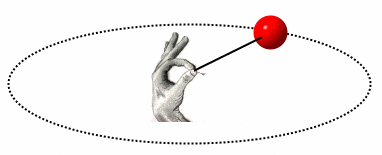
Which force in the Solar System is similar to the tension in the string?

What is the correct order for the formation of our solar system?
1,2,3,4
2,3,4,1
2,4,3,1
1,3,4,2
The natural Greenhouse Effect helps the Earth by keeping it ____________.
cold
friendly
icy
warm
Why can't we inhabit Venus?
It is too hot due to its thick atmosphere
It is too cold due to its thin atmosphere
It has too many rainstorms
Aliens live there and would fight is off!
Why does Earth need carbon dioxide in its atmosphere?
Choose ALL that apply.
to keep the heat close to Earth for warmth
to help plants photosynthesize
so organisms can breathe carbon dioxide
so that oceans can exist
What might happen if Earth didn't have an atmosphere?
we wouldn't be able to breathe
everything would go flying off into space
the Earth's rotation would stop
the seasons would be longer

The natural greenhouse gasses in the atmosphere are beneficial because...
They are not beneficial in any way
They are needed for cellular respiration to occur
They protect the planet from elements in space
They help maintain Earth's temperature at a warm level
Why was the formation of stars important?
It eliminated dark matter in the Universe
It allowed for new elements to be created
it stopped the universe from expanding

Which section is most likely the habitable zone due to temperature?
Section A
Section B
Section C
None are in the habitable zone for temperature.
No atmosphere on a planet means that?
There is no chance of oxygen and other gases.
No protection from solar radiation.
No protection from meteors.
All the above

Which planet will best support life?
Planet W
Planet X
Planet Y
Planet Z
In which characteristic does Earth differ from the other planets?
It has liquid water.
It is dense and small.
It is made up of rocky material.
It is surrounded by atmosphere
Which of the following is a reason life in the outermost planets is less likely than life on planets nearer the Sun?
They have too little mass.
They have too much mass.
Their surfaces are extremely hot.
Their surfaces are extremely cold.
The _______________ is a region with just the right temperature to sustain life.
Solar zone
Magnetic field
Orbital zone
Goldilocks zone
The Goldilocks Zone
is where bears live
is where a planet is too hot
is distance from a sun that water can survive in liquid form
is the tilt a planet needs in order to keep its temperature for life


How would you draw a Lewis dot diagram for Magnesium?



