
 Worksheets
2025 Intro to Anatomy Review
Total questions: 30
Worksheet time: 15mins
Which body system is responsible for producing and releasing hormones?
digestive system
endocrine system
respiratory system
skeletal system
Which body system helps protect against diseases and harmful invaders?
digestive system
respiratory system
lymphatic system
muscular system
If a scientist is measuring the length of a person’s femur bone, this would be considered part of
anatomy
physiology
Arrange the following biological structures in order from the simplest to the most complex: (1) tissue, (2) cell, (3) system, (4) organ, (5) mitochondria, (6) organism.
5, 2, 1, 4, 3, 6
2, 5, 1, 4, 3, 6
5, 2, 4, 1, 3, 6
2, 1, 5, 4, 3, 6
Which of the following structures is located in the ventral cavity?
spinal cord
heart
brain
vertebrae
Which of the following organs would be found within the abdominal cavity?
stomach
ovaries
lungs
brain
Which of the following is the largest body cavity that contains all the others?
abdominal
cranial
ventral
pelvic
Match the following life function to the example that correctly describes it.
Maintaining boundaries
a mouse has a litter of babies
Movement
the nutrients from your lunch are absorbed into the blood
Responsiveness
skeletal muscles are used to walk across the room
Digestion
as you run, sweat forms on your forehead
Metabolism
glucose is combined to form glycogen for energy storage
Given the DNA sequence: GCTTAGCGA. What would be the complementary DNA strand?
GCTTAGCGA
CGAATCGCT
CGAAUCGCU
GCUTTAGCA
Which of the following pairs is INCORRECTLY matched?
osmosis -> the diffusion of water across a membrane
replication -> the process of copying DNA before cell division
active transport -> the movement of molecules from high to low concentration using energy
cytokinesis -> the division of the cytoplasm after mitosis
Which of the following is a major tissue type found in the human body?
cartilage
connective
bone
blood vessel
Which type of tissue forms the inner lining of the stomach?
nervous
vascular
epithelial
muscular
In which body system does the process of gamete formation primarily occur?
reproductive
respiratory
circulatory
muscular
During the summer, you place a filter over your air vent to keep dust out while allowing cool air to flow into your room. What type of membrane does the filter act like?
visceral membrane
osmotic membrane
semipermeable membrane
parietal membrane
Which of the following membranes is located deepest/closest to the internal organs?
Parietal Serosa
Serous Fluid
Visceral Serosa
Blood
Which of the following body parts is superior to the heart?
liver
brain
kidneys
stomach
Which of the following body parts is lateral to the heart?
teeth
stomach
lungs
eyes
Which of the following body parts is distal to the shoulder?
neck
elbow
hip
chest
If a body is divided into left and right halves by a vertical cut, what is the name of this anatomical plane?
median/midsagittal
coronal
horizontal
oblique
The suffix itis means
To grow
Abnormal Condition
Water
Inflammation of
The prefix a means
Without
Pain
Cell
Process
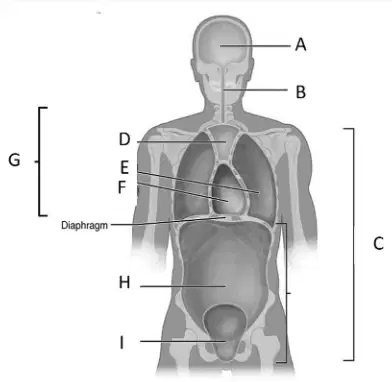
Which body cavity is labeled A in the diagram below?
Cranial cavity
Thoracic cavity
Abdominal cavity
Pelvic cavity
Which body cavity is represented by label B in the diagram below?
Cranial cavity
Thoracic cavity
Vertebral cavity
Pelvic cavity
Which body cavity is represented by label C in the diagram below?
Cranial cavity
Thoracic cavity
Abdominal cavity
Ventral cavity
Which body cavity is represented by label D in the diagram below?
Cranial cavity
Superior mediastinum cavity
Abdominal cavity
Pelvic cavity
Which body cavity is represented by label E in the diagram below?
Pleural cavity
Superior Mediastinum cavity
Abdominal cavity
Pelvic cavity
Which body cavity is represented by label F in the diagram below?
Pleural cavity
Mediastinum cavity
Abdominal cavity
Pericardial cavity
Which body cavity is represented by label G in the diagram below?
Pleural cavity
Thoracic cavity
Abdominal cavity
Pericardial cavity
Which body cavity is represented by label H in the diagram below?
Abdominal cavity
Thoracic cavity
Abdominal cavity
Pericardial cavity
Which body cavity is represented by label I in the diagram below?
Abdominal cavity
Thoracic cavity
Pelvic cavity
Pericardial cavity

