
 Worksheets
007_Postmodern Architecture Quiz Bee
Total questions: 50
Worksheet time: 1hrs 15mins
Postmodernism began to flourish in:
1940s
1950s
1970s–1980s
2000s
Postmodern architects criticized Modernism for being:
Too decorative
Too romantic
Too sterile and impersonal
Too symbolic
One key characteristic of Postmodern architecture is:
Plain glass façades
Brutalist concrete
Playful use of historical references
Pure functionalism
Charles Jencks famously declared Modern architecture dead in:
1929
1945
1972 (demolition of Pruitt-Igoe housing)
1990
Robert Venturi’s Complexity and Contradiction in Architecture argued for:
Minimal purity
Embracing complexity, irony, and pluralism
Gothic revival
Pure function
The phrase “Less is a bore” was coined by:
Le Corbusier
Mies van der Rohe
Robert Venturi
Frank Gehry
Michael Graves’ Portland Building is often cited as:
Gothic Revival
One of the first major Postmodern office buildings
Rococo palace
Minimalist modern
Philip Johnson’s AT&T Building (Sony Tower) is famous for:
Glass curtain walls
Chippendale-style pediment top
Brutalist concrete mass
Dome roof
Which building in New Orleans by Charles Moore embodies colorful Postmodern design?
Farnsworth House
Piazza d’Italia
Ronchamp Chapel
Fallingwater
Postmodern architecture often uses color to:
Hide structure
Create playful visual effects
Strengthen concrete
Reduce ornament
Postmodern façades often combine:
Steel and glass only
Classical motifs with modern materials
Gothic tracery
Rococo stucco
Which architect is known for whimsical Disney Headquarters in Burbank, CA?
Venturi
Michael Graves
Gehry
Rogers
Deconstructivism developed as a radical branch of:
International Style
Postmodernism
High-Tech
Neoclassicism
Frank Gehry’s Guggenheim Museum Bilbao is associated with:
International Style
Rococo
Deconstructivism
Gothic revival
Gehry often uses which material in sculptural forms?
Brick
Concrete
Titanium or stainless steel
Timber
Postmodernism often communicates meaning through:
Silence
Symbols, irony, and cultural references
Pure geometry
Absence of decoration
Which American city saw many playful Postmodern experiments in the 1980s?
Boston
Chicago
New Orleans
San Francisco
The term “Double coding” in Postmodern architecture refers to:
Two construction phases
Combining messages for both elite and popular audiences
Structural reinforcement
Repetition of modules
Which architect designed the Vanna Venturi House, often called the first Postmodern house?
Graves
Johnson
Robert Venturi
Gehry
Postmodernism declined in the late 20th century with the rise of:
Rococo
Neoclassicism
Global modernism and digital design
Romanesque revival
Postmodern architecture emerged in the:
1930s
1950s
1970s–1980s
2000s
Postmodernism reacted against:
Rococo
Gothic
Modernism’s austerity
High-Tech
Postmodern architecture often reintroduced:
Historical references and ornament
Pure functionalism
Minimalism only
Brutalism
The author of Complexity and Contradiction in Architecture (1966) was:
Robert Venturi
Philip Johnson
Frank Gehry
Charles Jencks
Venturi’s design philosophy included:
“Less is a bore”
“Form follows function”
“Truth to materials”
“Ornament is crime”
Michael Graves’ Portland Building is an example of:
International Style
Postmodernism
Brutalism
Rococo
Philip Johnson’s AT&T Building (Sony Tower) in New York is famous for its:
Glass box façade
Chippendale-style broken pediment top
Brutalist concrete massing
Dome
Deconstructivism is a later offshoot of:
Gothic revival
Postmodernism
Neoclassicism
High-Tech
Frank Gehry’s Guggenheim Museum in Bilbao is an example of:
Rococo
Brutalism
Deconstructivism
Gothic Revival
Postmodernism valued:
Minimal purity
Structural exposure only
Playfulness, pluralism, and symbolism
Strict classical orders
What is a key characteristic of Postmodernism in architecture?
Focus on large glass facades
Strict adherence to modernist principles
Blending pre-modern elements with eclectic designs
Emphasis on minimalism and functionality
What is the main focus of the Vanna Venturi House designed by Robert Venturi?
Strict modernist aesthetics
Challenging Modernist standards
Emphasizing functionality above all
Utilizing only glass and steel
What does the term 'Postmodernity' refer to?
A rejection of all historical styles
A focus on technological advancements in architecture
The economic and cultural state after Modernity
A style of architecture that emerged in the 1920s
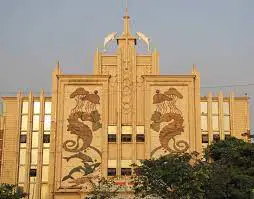
All of these followings are an example of a typical Art Deco facade, EXCEPT,


The form of Vanna Venturi House was inspired by this classical architectural feature
Acroterion
Entablature
Classical Column
Broken Pediment

The Dancing House is the best example of a characteristic in Postmodern building, which is ..............
an application of metamorphism
an application of ergonomics
an application of anthropomorphism
an application of algorithm
Which of the following is a characteristic of postmodern architecture?
Focus on utility
Minimalist design
Use of ornament and reference
Strict geometric forms
All of these followings are categorized as Hi-Tech style, EXCEPT,


Who are the architects behind this creation? (shown in the image)
Herzog & Meuron
Rogers & Piano
Foster & Koolhaas
Skidmore, Owings and Merrill
Which ONE of these following Postmodern buildings shown an example of anthropomorphism?


Which of these building designed by Walter Gropius?


It is the architecture of the 21st century. No single style is dominant. The architects during this era worked in several different styles, from postmodernism, high-tech architecture and new interpretations of traditional architecture to highly conceptual forms and designs. It is called?
a. Postmodern architecture
b. Baroque architecture
c. Contemporary architecture
d. None
Postmodernism became a style in the late 1970s
True
False
Postmodern architects turned towards the past, quoting past aspects of various buildings and melding them together to create a new means of designing buildings.
True
False
Postmodern architecture often disregarded the context in terms of the materials, forms and details of the buildings around it—the cultural context.
True
False
Where was Postmodernism born?
México
United States
Europe
Asia
The move away from modernism’s functionalism is well illustrated by Venturi’s adaptation of Mies van der Rohe’s famous maxim “Less is more” to " (a) "
The postmodernist architects often considered the general requirements of the urban buildings and their surroundings during the building’s design.
True
False
The characteristics of postmodernism allow its aim to be expressed in diverse physical ways. Select the one that does NOT belong.
use of sculptural forms,
use of ornament
anthropomorphism
materials which perform trompe l'oeil
use of iconic flat roofs

The use of ornament is perfectly shown in this building
Hans Hollein’s Abteiberg Museum
Frank Gehry’s Venice Beach house
Michael Graves' Portland Municipal Services Building ("Portland Building")
Carlo Scarpa's Brion Cemetery

