
 Worksheets
Cosmos
Total questions: 93
Worksheet time: 1hrs 23mins
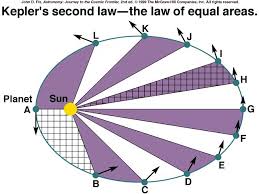
What will result in the most eccentric elliptical orbit
when the focal points are closest together
when the focal points are on top of one another
then the focal points are farthest apart

Which point is a FOCUS?
A
B
C
D
E
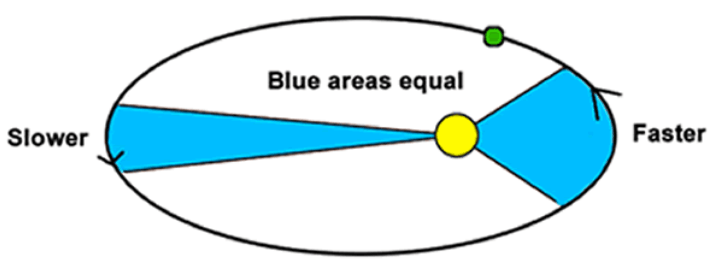
According to Kepler's Second Law, where in it's path does a planet move the fastest?
At the perihelion
At the aphelion
At the top of the semi-minor axis
The speed is constant.
In a circular orbit, the speed/velocity ___ change.
does
does not
where are you coming up with this information?
When a planet appears to move backwards, it is called...
impossible
retrograde motion
we never talked about this
an illusion

Kepler's First Law states
objects attract other objects with a force that is directly proportional to the product of their masses
the square of the ratio of the periods of any two planets revolving around the Sun is equal to the cube of the ratio of their average distance from the Sun
An imaginary line joining a planet and the sun sweeps out an equal area of space in equal amounts of time.
Planets move about the Sun in an elliptical orbit with the Sun at one of the foci.

Kepler's Second Law states
objects attract other objects with a force that is directly proportional to the product of their masses
the square of the ratio of the periods of any two planets revolving around the Sun is equal to the cube of the ratio of their average distance from the Sun
An imaginary line joining a planet and the sun sweeps out an equal area of space in equal amounts of time.
Planets move about the Sun in an elliptical orbit with the Sun at one of the foci.

Kepler's Third Law states
objects attract other objects with a force that is directly proportional to the product of their masses
the square of the ratio of the periods of any two planets revolving around the Sun is equal to the cube of the ratio of their average distance from the Sun
An imaginary line joining a planet and the sun sweeps out an equal area of space in equal amounts of time.
Planets move about the Sun in an elliptical orbit with the Sun at one of the foci.

Which of the following most accurately describes the movement of the Earth around the Sun?
The Earth moves at a constant speed around the Sun.
The Earth moves faster when it is closest to the Sun.
The Earth moves slowest when it is closest to the Sun.
The Earth's speed varies dependent upon the phase of the moon.


Planets orbit the Sun in a shape called a(n)
circle
ellipse
focus
perihelion

An ellipse is drawn around two points called:

What has an eccentricity of zero?
#1: A perfect circle
#2: A slightly elliptical path
#3: A very elliptical path
All elliptical paths
What has the greatest eccentricity of its orbital path?
#1: A perfect circle
#2: A slightly elliptical path
#3: A very elliptical path
All elliptical paths have eccentricities of zero (e = 0)
The value of eccentricity can range from ________ to ________.
0.1 to 0.9
-1 to 0
0 to 100
0 to 1
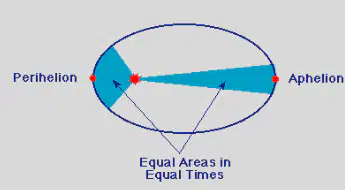
Kepler's 2nd Law deals with:


The diagram below shows a moon revolving around a planet in an elliptical orbit. At which position is the moon traveling fastest?
location 1
location 2
location 3
location 4

The diagram below shows a moon revolving around a planet in an elliptical orbit. At which position is the moon traveling slowest?
location 1
location 2
location 3
location 4
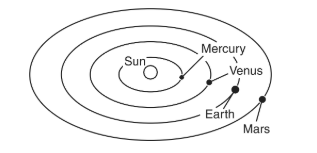
Which planet will take the least amount of time to revolve around the Sun?
Mercury
Venus
Earth
Mars

Which planet will take the most amount of time to revolve around the Sun?
Mercury
Venus
Earth
Mars

Which statement best describes Kepler’s 2nd Law of Planetary Motion?
Planets revolve around the sun over equal areas in equal time intervals.
Planetary orbits are in the shape of an ellipse.
A planet’s orbital period is proportionate to its distance from the sun.

Kepler’s 2nd Law states that the area swept out by a planet’s motion will be the same regardless of where it is in its orbit. A comet moves much faster when it is closer to the Sun than when it is further out from the Sun. What is the primary cause in the change of the comet’s orbital velocity?
Jupiter's gravitational field.
The sun's solar wind.
The sun's gravitational field.
Saturn's magnetic field.
According to Kepler's 3rd law, the square of the time it takes for an object to orbit, T, is directly related to the cube of the distance, r, between the object and what it is orbiting.
What this means is that if a satellite moves away from what it is orbiting,
the area it covers during its orbit is changing per unit of time
it must be speeding up in its linear speed
it is slowing down as its radius (distance) is increasing
Kepler's 3rd law tell us that __ would be dependent on __.
orbital period ; distance
distance ; orbital period
Kepler’s 3rd law states the square of the orbital period is proportional to the cube of the orbital radius. (T2=D3)
If a planet's orbital radius is doubled, what happens to the length of a year on that planet?
SOLVE USING Kepler’s 3rd Law: (T2=D3)
A planet orbits the Sun (or any star) in 4.4 Earth years. What is its distance from the Sun (star) in AU?
2.1 AU
2.7 AU
3.2 AU
3.9 AU
SOLVE USING Kepler’s 3rd Law: (T2=D3) *Same problem as prior...
A planet orbits the Sun (or any star) in 4.4 Earth years. What is its distance from the Sun (star) in MILES?
1.9 x 10⁸ miles
2.2 x 10⁸ miles
2.5 x 10⁸ miles
2.9 x 10⁸ miles
SOLVE USING Kepler’s 3rd Law: (T2=D3) *Same problem as prior...
A planet orbits the Sun at a distance of 7.8 AU. What is its orbital period (time) in Earth YEARS?
21.8 Earth Years
20.2 Earth Years
18.8 Earth Years
11.4 Earth Years
small body made of rock and metal that orbits the sun typically in the inner solar system
asteroid
asteroid belt
revolve
astronomical unit
large body that orbits around the sun
planet
dwarf planet
moon
Earth's axis
huge planet made mostly of elements heavier than hydrogen and helium, such as as oxygen, carbon, nitrogen, and sulfur. There are two known ice giants in the solar system, Uranus and Neptune
ice giant
asteroid
dwarf planet
Kuiper Belt
large, massive, low-density planet composed primarily of hydrogen, helium, methane, and ammonia in either gaseous or liquid state
gas giant
planet
comet
asteroid belt
the gases surrounding a star or planetary body held in place by gravity
atmosphere
orbit
meteoroid
dwarf planet
a planet that is composed primarily of silicate rocks or metals. Within the solar system, the terrestrial planets are the inner planets closest to the sun, i.e. Mercury, Venus, Earth and Mars
terrestrial planet
solar system
asteroid
comet
spherical shell of comet-like bodies believed to surround the sun far beyond the orbits of the outer most planets
Oort cloud
atmosphere
solar system
planet
the amount of time it takes for a given object to complete one orbit around another object
orbital period
Oort cloud
terrestrial planet
gas giant
average distance between the Earth and the sun
astronomical unit
elliptical revolution
ecliptic
terrestrial planet
which is the biggest planet of the solar system
JUPITER
SATURN
MERCURY
URANUS
_________ is the only star in the solar system
SUN
sun
IS A DWARF PLANET WHICH WAS DEMOTED BY THE POSITION OF PLANET IN THE YEAR 2006
EARTH
MOON
PLUTO
MERCURY
NAME THE SPOT IN JUPITER WHICH IS CONTINOUSLY GOING ON FROM 100S OF YEARS
THE GREAT RED SPOT
the great red spot
__________ planet is known as the morning star and the evening star
earth
mars
saturn
venus
Which planet in the Solar System is known for having the most extensive ring system?
Jupiter
Saturn
Uranus
Neptune
What is the LARGEST planet in the solar system
Neptune
Saturn
Earth
Jupiter
Which Planet Goes in the Blank?
Jupiter
Milky Way
Mars
Jupiter
Which planet is the closest to the sun?
Mercury
Venus
Earth
Mars
Which best describes the sun?
Small, cold, and rocky
It has craters or large holes on it
A large hot ball of burning gas
It has a shiny surface that reflects light
Which of the following models correctly shows how the Earth, Sun, and Moon move?


Mercury, Earth, Venus, and Mars are known as the... ______________________
Little Planets
Sunny Planets
Inner Planets
Outer Planets
The sun is a star that provides energy. What is also true about the sun?
It is the largest planet
It is bright during the day and dark at night
It's made of gas
It's the same size as the Earth
Which of the following are in the correct order?
Sun, Mars, Venus, Earth, Mercury
Sun, Mercury, Earth, Venus, Mars
Sun, Mercury, Venus, Earth, Mars
Sun, Mars, Earth, Mercury, Venus
Which planets go in the blanks?
Jupiter, _____________, Uranus, ________________
Saturn, Neptune
Neptune, Saturn
Mars, Pluto
Saturn, Pluto
Which planets go in the blanks?
_______, Jupiter, _______, Uranus, Neptune
Mars, Saturn
Earth, Uranus
Neptune, Saturn
Neptune, Mars

How can this Earth-Sun-Moon model be improved to be more accurate?
Make Earth larger
Make the moon larger
Move the moon farther away from the Earth
Move the Earth farther away from the sun

What is missing from this Earth- Sun-Moon model?
Planets
Stars
Gravity
Moon
What is the smallest planet in the Solar System?
Mercury
Mars
Venus
Earth
Which planet is known as the 'Red Planet'?
Jupiter
Mars
Saturn
Venus
What is the main component of the Sun?
Liquid water
Solid rock
Burning gas
Ice

