
 Worksheets
Lipids: Properties, Structure, Classification, Types, Functions
Total questions: 100
Worksheet time: 50mins
What are lipids?
A) A group of diverse macromolecules consisting of fatty acids and their derivatives that are insoluble in water but soluble in organic solvents.
B) A type of carbohydrate found in plants.
C) Proteins that help in digestion.
D) Nucleic acids that store genetic information.
Lipids are essential constituents of the diet because of their _________.
high energy value
ability to form enzymes
role in DNA replication
function as hormones
Lipids consist of fats, oils, hormones, and certain components of membranes that are grouped together because of their hydrophobic interactions.
True
False
Which of the following are essential for the fat-soluble vitamins and the essential fatty acids found with the fat of the natural foodstuffs?
Carbohydrates
Lipids
Proteins
Nucleic acids
Fats combined with proteins (lipoproteins) are essential constituents of the ________ and ________ of the cell.
cell membranes; mitochondria
nucleus; ribosomes
cytoplasm; lysosomes
golgi apparatus; endoplasmic reticulum
Lipids occur naturally in living beings like plants, animals, and microorganisms that form various components like ________, hormones, and energy storage molecules.
cell membranes
bones
enzymes
nucleic acids
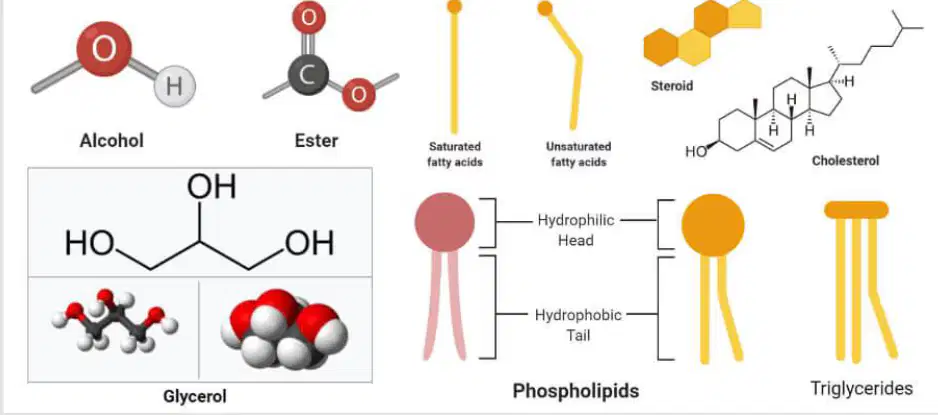
Match the following types of lipids with their structures:
Structure with hydrophilic head and hydrophobic tail
Phospholipids
Structure with three fatty acid chains
Triglycerides
Structure with four fused rings
Steroid
Lipids may be either ______ or non-crystalline solids at room temperature.
liquids
gases
metals
fibers
Which of the following statements about pure fats and oils is correct?
They are colored and have a strong odor
They are colorless, odorless, and tasteless
They are soluble in water
They have ionic charges
Lipids are energy-rich organic molecules.
True
False
Are lipids soluble in water?
True
False
Lipids are soluble in which of the following?
Water
Alcohol
Salt solution
Sugar solution
Solid triglycerides (Fats) have high proportions of ______ fatty acids.
saturated
unsaturated
trans
cis
Liquid triglycerides (Oils) have high proportions of ______ fatty acids.
unsaturated
saturated
trans
branched
What is the process called when triglycerols react with water to form their carboxylic acid and alcohol?
Hydrolysis
Esterification
Oxidation
Hydrogenation
Saponification is the process where triacylglycerols are hydrolyzed by alkali to produce soap.
True
False
The carbon-carbon double bonds in unsaturated fatty acids can be hydrogenated to produce ______ fatty acids.
saturated
aromatic
branched
polyunsaturated
What is the term applied to any fat or oil that develops a disagreeable odor due to hydrolysis and oxidation reactions?
Rancid
Emulsified
Clarified
Hydrogenated
Lipids are made of which elements?
Carbon, Hydrogen, and Oxygen
Nitrogen, Sulfur, and Phosphorus
Calcium, Potassium, and Sodium
Iron, Magnesium, and Zinc
Unlike polysaccharides and proteins, lipids are not ________.
polymers
hydrophobic
macromolecules
organic molecules
Lipids are made from two molecules: ________ and ________.
Glycerol and Fatty Acids
Glucose and Amino Acids
Nucleotides and Phosphates
Monosaccharides and Disaccharides
A fatty acid is saturated if every possible bond is made with a ________ atom, such that there exist no C=C bonds.
Hydrogen
Oxygen
Nitrogen
Carbon
Which of the following statements is true about unsaturated fatty acids?
They do not contain C=C bonds.
They contain C=C bonds.
They are made only of glycerol.
They have no hydrocarbon chain.
Monounsaturated fatty acids have how many C=C bonds?
One
Two
Three
None
Polyunsaturated fatty acids have more than one C=C bond.
True
False
What are simple lipids?
Lipids that yield fatty acids and glycerol or long-chain alcohols upon hydrolysis
Lipids that yield only carbohydrates upon hydrolysis
Lipids that do not yield any products upon hydrolysis
Lipids that yield only proteins upon hydrolysis
Fats and oils are both called ________ because they are esters composed of three fatty acids joined to glycerol, trihydroxy alcohol.
triacylglycerols
phospholipids
steroids
monoglycerides
What is the main difference between fats and oils at room temperature? Choose the correct answer:
Fats are always liquid and oils are always solid
Fats are solid and oils are liquid at 25°C
Fats and oils have the same physical state at room temperature
Fats are proteins and oils are carbohydrates
The differences in melting points between fats and oils reflect differences in the degree of ________ of the constituent fatty acids.
unsaturation
hydration
oxidation
polymerization
What is a wax? Choose the correct answer:
An ester of long-chain alcohol (usually mono-hydroxy) and a fatty acid
A type of protein
A carbohydrate
A short-chain alcohol
The acids and alcohols normally found in waxes have chains of the order of ________ carbon atoms in length.
12-34
2-6
40-60
70-100
What are compound lipids?
Lipids that yield fatty acids, glycerol, and other groups upon hydrolysis
Lipids that yield only proteins upon hydrolysis
Lipids that yield only carbohydrates upon hydrolysis
Lipids that do not yield any products upon hydrolysis
Phospholipids may be classified as ________ or ________ depending upon the alcohol group present.
glycerophospholipids or sphingophospholipid
glycolipids or lipoproteins
steroids or terpenes
triglycerides or waxes
Glycolipids may also be ________ or ________ depending upon the alcohol group present (glycerol or sphingosine).
glyceroglycolipids or sphingoglycolipid
phospholipids or sterolipids
triglycerides or diglycerides
lipoproteins or glycoproteins
Hydrolysis products of simple and compound lipids are called derived lipids. Which of the following are included in derived lipids?
Fatty acid, glycerol, sphingosine, and steroid derivatives
Proteins and carbohydrates
Nucleic acids and vitamins
Sugars and starches
Steroid derivatives are phenanthrene structures that are quite different from lipids made up of _________.
fatty acids
amino acids
nucleotides
monosaccharides
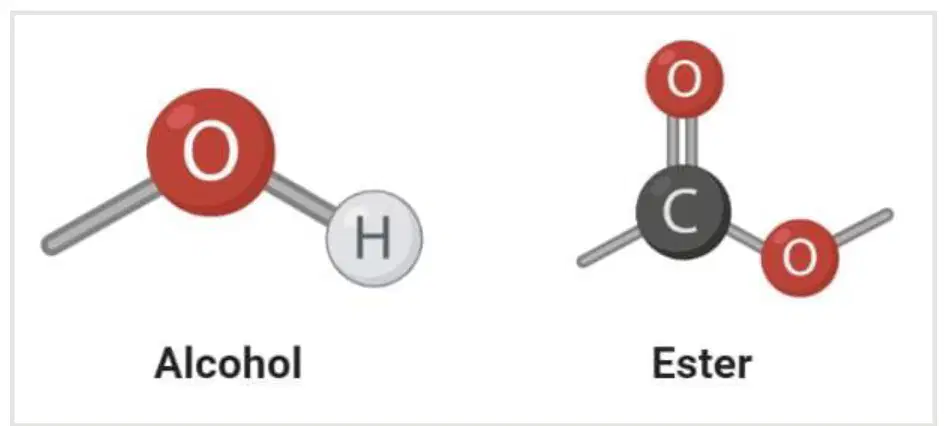
Which molecule contains a carbon atom double-bonded to an oxygen atom and single-bonded to another oxygen atom?
Alcohol
Ester
The most important and frequently occurring alcohol found in lipids is _________.
glycerol
ethanol
methanol
propanol
Glycerol is a small organic molecule consisting of three hydroxyls (OH-) groups.
True
False
Fats and oils are esters of fatty acids and ________, whereas waxes are esters of fatty acids and long-chain alcohols.
glycerol
glucose
amino acids
starch
The esters of fatty acids are formed after the ________ reaction between the fatty acids and the alcohol molecules.
dehydration
hydrolysis
oxidation
reduction
What are triglycerides?
A) A type of protein
B) A type of lipid which is an ester of three fatty acids with glycerol
C) A type of carbohydrate
D) A type of nucleic acid
Triglycerides are the main constituents of body fat in humans, other vertebrates, and _________.
vegetable fats
animal bones
mineral oils
synthetic fibers
What are triglycerides composed of?
Two fatty acids and one glycerol
Three fatty acids and one glycerol
Three glycerols and one fatty acid
Two glycerols and two fatty acids
In naturally occurring triglycerides, the fatty acid chains mostly contain how many carbon atoms?
10, 12, or 14
16, 18, or 20
22, 24, or 26
8, 10, or 12
True or False: The three fatty acids involved in the condensation reaction are usually identical, and their chain length is the same.
True
False
Even-numbered carbon atoms present in animals and plants indicate the pathway of their biosynthesis from ________.
two-carbon acetyl CoA
three-carbon pyruvate
four-carbon succinate
five-carbon ribose
Simple triglycerides might also have identical fatty acids forming ________.
homotriglycerides
heterotriglycerides
phospholipids
diglycerides
Why are triglycerides insoluble in water?
The charges in triglycerides are evenly distributed around the molecules, which prevents the formation of hydrogen bonds with water molecules, making them insoluble in water.
Triglycerides contain many polar groups that interact strongly with water, making them insoluble.
Triglycerides are ionic compounds that dissolve only in organic solvents, not in water.
Triglycerides have a high affinity for water molecules, causing them to dissolve easily.
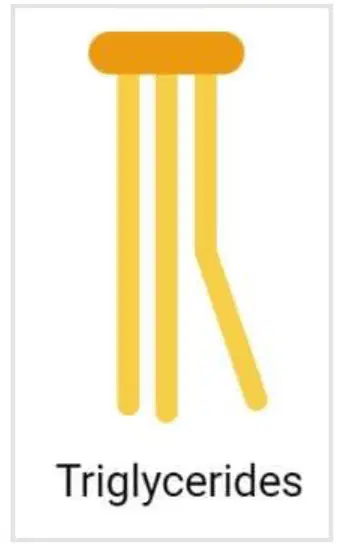
Functions of Triglycerides: Triglycerides are important macromolecules as they store most of the ______ in the body.
energy
water
protein
calcium
Where are triglycerides stored before being released into the bloodstream?
fat cells
red blood cells
muscle fibers
liver cells
Functions of Triglycerides: The fat stored in the body forms a layer of ______ beneath the skin, which helps to maintain the body temperature.
insulation
muscle
cartilage
epithelium
Functions of Triglycerides: Triglycerides also aid in the absorption and transport of ______-soluble vitamins in the body.
fat
water
protein
carbohydrate
What are Fatty acids? Fatty acids are organic molecules that are long-chained carboxylic acids with ______ carbon atoms.
4-36
1-10
20-50
100-200
What are Fatty acids? The hydrocarbon chains in fatty acids are either ______ or unsaturated, depending on the bonds between the carbon atoms.
saturated
branched
aromatic
cyclic
If all carbon-carbon bonds are single, the acid is ________.
saturated
unsaturated
aromatic
alkynic
If one or more carbon-carbon double bonds are present, the acid is:
Saturated
Unsaturated
Branched
None of the above
Naturally occurring fatty acids are mostly:
Branched
Unbranched
Aromatic
None of the above
Fatty acids are stored as an energy reserve (fat) through an ester linkage to ________ to form triglycerides.
glycerol
glucose
amino acids
cholesterol
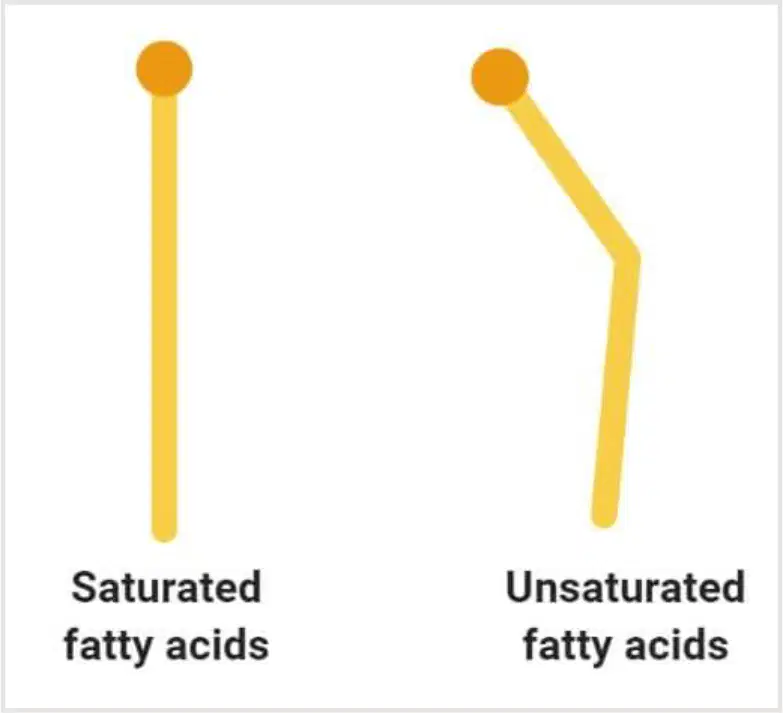
Which type of fatty acid has only single carbon-carbon bonds?
Saturated fatty acids
Unsaturated fatty acids
What are the simplest form of fats that are unbranched linear chains of CH2 groups linked together by carbon-carbon single bonds with a terminal carboxylic acid?
Saturated fatty acids
Unsaturated fatty acids
Phospholipids
Steroids
The term 'saturated' is used to indicate that the maximum number of hydrogen atoms are bonded to each carbon atom in a molecule of fat.
True
False
What is the general formula for saturated fatty acids?
CnH2n+1COOH
CnH2n-1COOH
CnH2n-3COOH
CnH2n+3COOH
Fatty acids obtained from an animal source are mostly even-numbered linear chains of saturated fatty acids.
True
False
Saturated fatty acids usually have a higher melting point than their counterparts.
True
False
Saturated fatty acids are mostly solid and are found in animal fat like butter, meat, and whole milk. But some saturated fatty acids are also found in vegetable sources like vegetable oil, coconut oil, and peanut oil.
True
False
Unsaturated fatty acids are more complex fatty acids with bent hydrocarbon chains linked together by one or more carbon-carbon double bonds with a terminal carboxylic acids group.
True
False
The term 'unsaturated' indicates that the carbon atoms do not have the maximum possible hydrogen atoms bound to carbon atoms.
True
False
Due to the presence of double bonds, the cis and trans conformation of unsaturated fatty acids are important. The unsaturated fatty acids found in the human body exist in the ______ conformation.
cis
trans
linear
branched
Unsaturated fatty acids have a lower melting point as compared to saturated fatty acids, and thus they exist in the liquid state at room temperatures.
True
False
Most vegetable oils and fish oils are some of the important sources of ______ fatty acids.
unsaturated
saturated
trans
essential
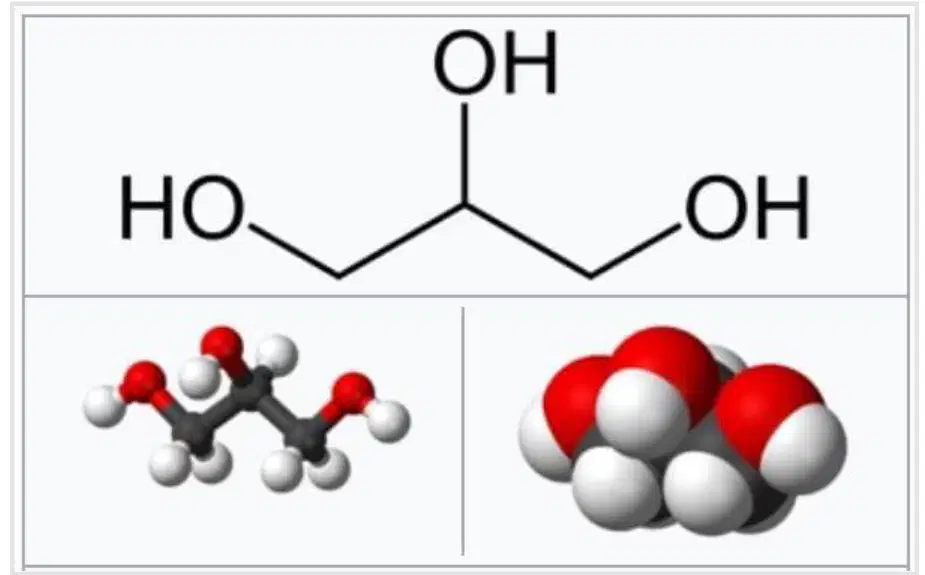
Glycerol is a simple organic compound with how many hydroxyl groups?
Three
One
Two
Four
What is the process called in which ester bonds are formed between glycerol and fatty acids?
Esterification
Hydrolysis
Polymerization
Oxidation
Which of the following statements is TRUE about glycerol?
It is a colored, odorous liquid
It forms the backbone of many lipids
It is not involved in energy production
It contains only one hydroxyl group
The lipid molecules formed from three fatty acids and a single glycerol molecule are termed as ________.
triacylglycerols or triglycerides
phospholipids
steroids
waxes
The process of condensation in the formation of ester bonds is termed esterification.
True
False
A phospholipid is an organic molecule consisting of fatty acids, a phosphate group, and a ________ group that forms the main component of various cellular membranes. Fill in the blank.
glycerol
glucose
amino
sulfur
Which part of the cell membrane is primarily responsible for the selective transport of molecules in and out of the cell?
Protein channels
Phospholipid bilayer
Carbohydrate chains
Nucleus
The phosphate group forms the ________ head, whereas the fatty acids form the ________ tails in phospholipids. Fill in the blanks.
hydrophilic; hydrophobic
hydrophobic; hydrophilic
hydrophobic; hydrophobic
hydrophilic; hydrophilic
True or False: The head and tail regions in phospholipids are joined by a glycerol molecule.
True
False
What enables the passage of biomolecules through the lipid bilayer of the cell membrane?
Only hydrophobic interactions
Only hydrophilic interactions
Both hydrophobic and hydrophilic interactions
No interactions
The hydrophilic head of the phospholipid contains a negatively charged ________ group with an unidentified alkyl group. Fill in the blank.
phosphate
sulfate
hydroxyl
carboxyl
The hydrophilic region of a phospholipid might or might not be polar or charged.
True
False
As water is a polar molecule, the hydrophilic head of the phospholipid immediately forms ________ interaction with the water molecule.
electrostatic
hydrophobic
covalent
van der Waals
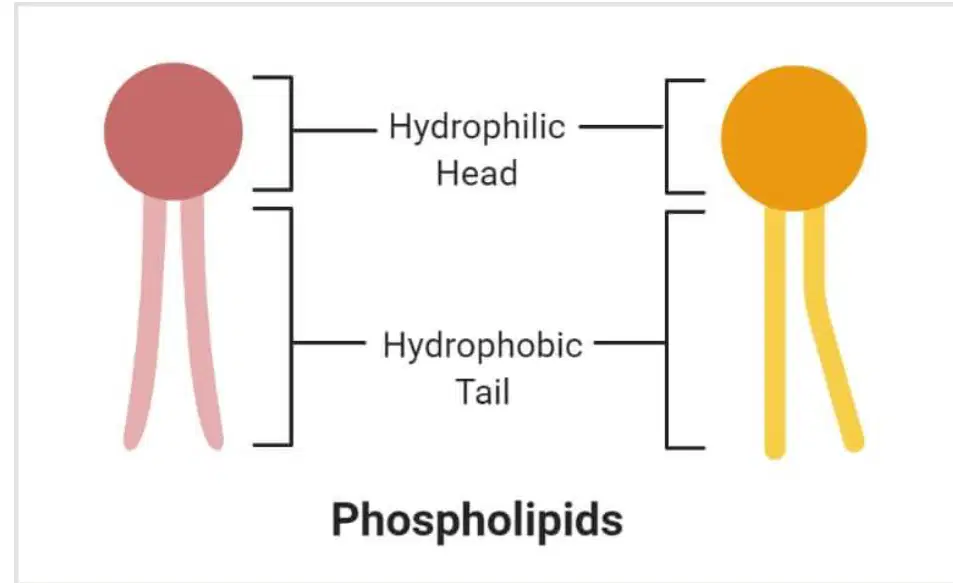
Refer to the diagram of phospholipids. Which part of the phospholipid is hydrophobic?
A) Head
B) Tail
C) Both head and tail
D) Neither head nor tail
The hydrophobic part of the phospholipid bilayer is also termed the water-fearing portion that consists of long non-polar fatty acid tails.
True
False
Fill in the blank: The hydrophobic tails of phospholipids are tucked towards the _______ of the membrane to shield them from water.
interior
exterior
surface
outside
Which of the following statements is true about hydrophobic tails in the phospholipid bilayer?
They interact easily with water molecules.
They are charged molecules.
They interact with other hydrophobic molecules but not with water molecules.
They are found on the outside of the membrane.
The main function of hydrophobic interactions in the phospholipid bilayer is to:
Maintain the integrity of the membrane by keeping the lipid tails together
Allow water to freely pass through the membrane
Facilitate the transport of ions across the membrane
Provide energy for cellular processes
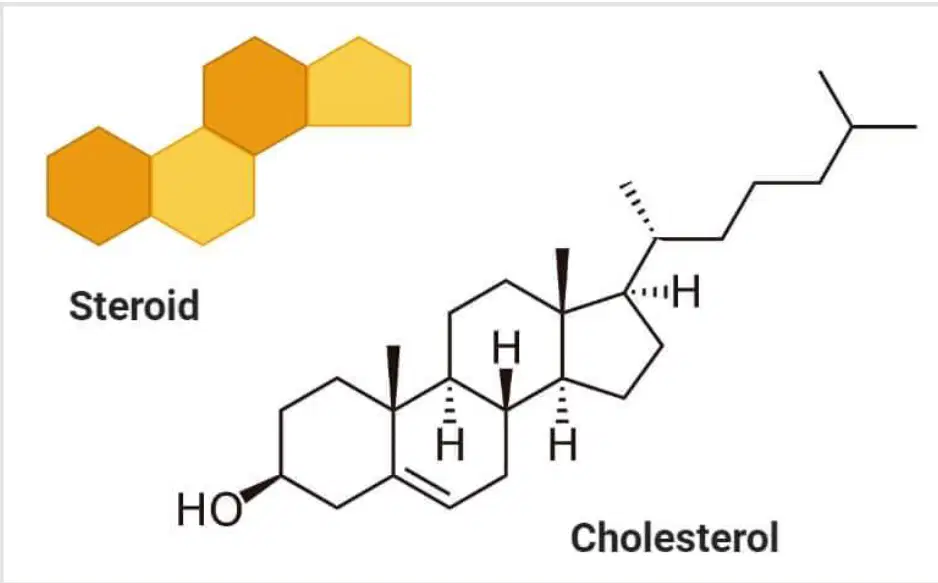
Sterols are a type of lipids composed of steroid alcohols occurring naturally in which of the following?
Only animals
Only plants
Plants, animals, fungi, and several bacteria
Only fungi
What is the most important and familiar type of sterol that plays an essential role in cell membrane structure and functions?
Cholesterol
Ergosterol
Stigmasterol
Lanosterol
Cholesterol acts as a precursor to fat-soluble vitamins like Vitamin D and hormones.
True
False
Cholesterol is formed of how many linked hydrocarbon rings forming the bulk of the steroid structure?
Four
Three
Five
Six
The hydroxyl group in cholesterol joins with which of the following?
Other hydroxyl groups
Carbonyl oxygen of phospholipids
Both A and B
None of the above
In humans, which organ makes up 100% of all cholesterol required for the body?
Liver
Kidney
Heart
Lungs
Cholesterol is considered essential for the regulation of membrane fluidity in animals.
True
False
What does cholesterol increase in the cell membrane?
The permeability of the cell membrane to sodium and potassium ions.
The fluidity of the cell membrane at high temperatures.
The thickness of the cell membrane.
The number of protein channels in the membrane.
Fill in the blank: Biological lipids are a chemically diverse group of compounds, and the biological functions of the lipids are as diverse as their ________.
chemistry
location
temperature
origin
In the body, fats serve as an efficient source of energy and are also stored in the ________ tissues. These also serve as an insulating material in the subcutaneous tissues and around certain organs.
adipose
muscular
epithelial
nervous
Which of the following are major structural elements of biological membranes?
Phospholipids and sterols
Proteins and carbohydrates
Nucleic acids and vitamins
Sugars and minerals

