wayground logo

Free Printable Worksheets

Font size

S
M
L
XL
Worksheets

6. Neuroscience Revision Quiz BMS191

Total questions: 65

Worksheet time: 1hrs 18mins

Name
Class
Date
1.
What is the largest part of the brain?
a)
Cerebrum
b)
Cerebellum
c)
Brainstem
d)
Diencephalon
2.
What is the thin layer of gray matter that composes the outer layer of the cerebrum?
a)
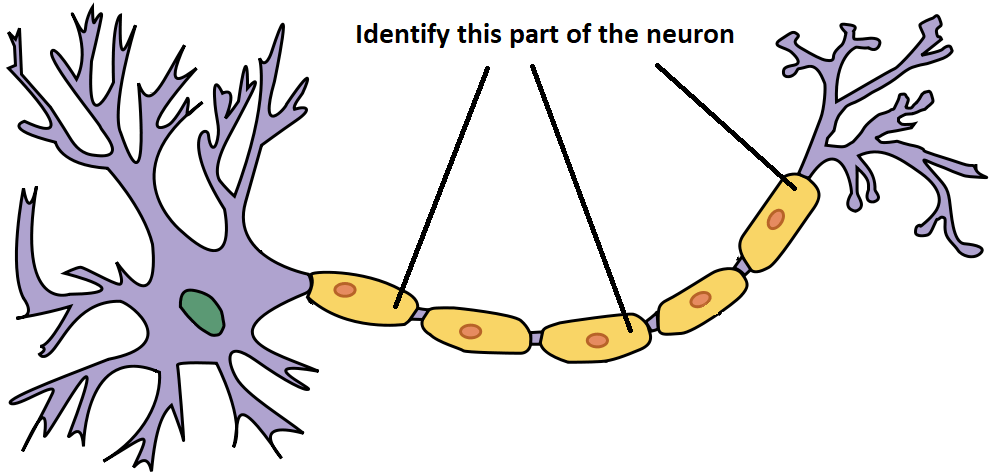
Cerebral cortex
b)
Corpus callosum
c)
Falx cerebri
d)
Choroid plexus
3.
What are the ridges/elevations on the surface of the brain?
a)
Sulci
b)
Fissures
c)
Gyri
d)
Hippocampus
4.
What are the shallow grooves on the surface of the brain?
a)
Sulci
b)
Fissures
c)
Gyri
d)
Hippocampus
5.
Which lobe is this?
a)
Frontal
b)
Parietal
c)
Occipital
d)
Insula
6.
Which lobe is this?
a)
Frontal
b)
Parietal
c)
Occipital
d)
Insula
7.
Which lobe is this?
a)
Temporal
b)
Parietal
c)
Occipital
d)
Insula
8.
Which lobe is this?
a)
Insula
b)
Parietal
c)
Occipital
d)
Temporal
9.
Which lobe allows us to judge the consequences of our behaviors?
a)
Frontal
b)
Occipital
c)
Temporal
d)
Insula
10.
Which lobe allows us to process what we are hearing?
a)
Frontal
b)
Parietal
c)
Temporal
d)
Occipital
11.
Which lobe allows us to process what we are seeing?
a)
Occipital
b)
Parietal
c)
Temporal
d)
Insula
12.
What is white matter composed of?
a)
Unmyelinated axons and cell bodies
b)
Bundles of myelinated axons
13.

What part of the brain deals with the thalamus and hypothalamus?

a)

Brain Stem

b)

Cerebellum

c)

diencephalan

d)

cerebrum

14.
Which structure is E?
a)
midbrain
b)
thalamus
c)
pons
d)
hypothalamus
15.

1. Label C

a)

cerebellum

b)

cerebrum

c)

brain stem

16.

Brain stem consist of

a)

mid brain

b)

pons

c)

medulla oblongata

d)

cerebellum

17.

This part of the brain coordinates movement and balance.

a)

Cerebrum

b)

Cerebellum

c)

Amygdala

d)

Hippocampus

e)

Prefrtonal Cortex

18.

1.There are….......... meningeal layers that surround the brain.

a)

1

b)

2

c)

3

d)

4

19.

The sub- arachnoid space contains?

a)

Csf

b)

Meningeal arters

c)

Dural sinuses

d)

Arachnoid

20.

The inner layer is called as

a)

Pia

b)

Dura

c)

All the above

d)

None

21.

The middle layer is called as

a)

Dura

b)

Arochonid

c)

None

d)

All

22.

The outer layer is know as

a)

Pia

b)

Dura

c)

None

d)

All

23.
Fluid filled cavities in the brain
a)
longitudinal fissures
b)
transverse fissures
c)
ventricles
24.
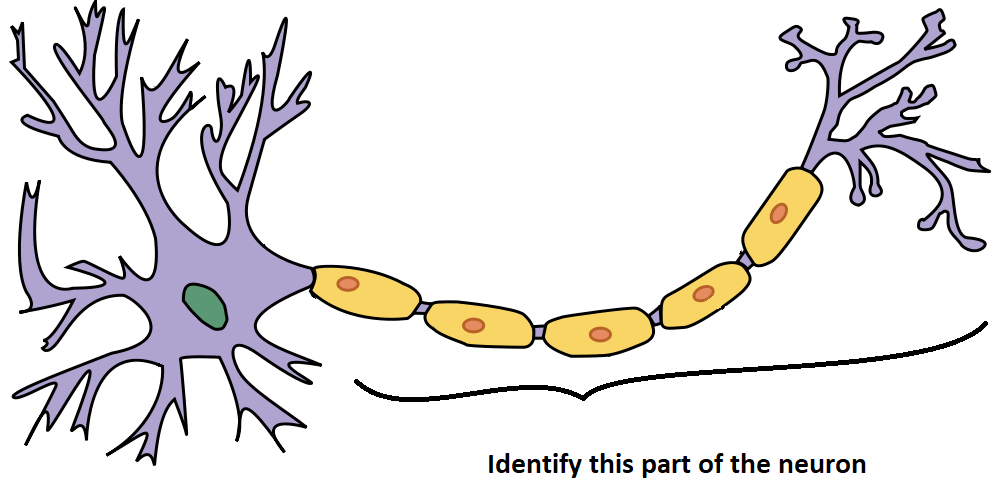
Impulses that travel down a myelinated neuron move faster than if it was unmyelinated.
a)
True
b)
False
c)
I'm not sure
25.
a)

Nucleus

b)

Cell Body

c)

Axon

d)

Node of Ranvier

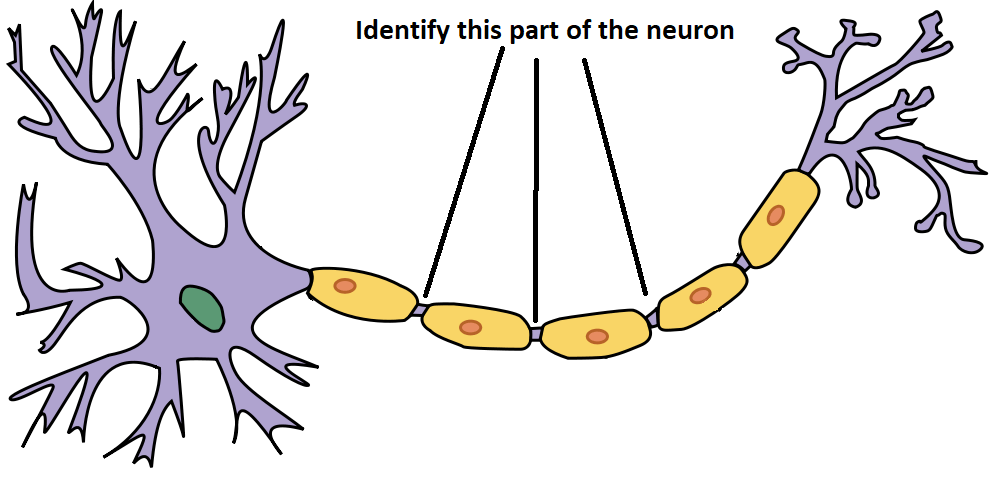
26.
a)

Nucleus

b)

Cell Body

c)

Axon

d)

Node of Ranvier

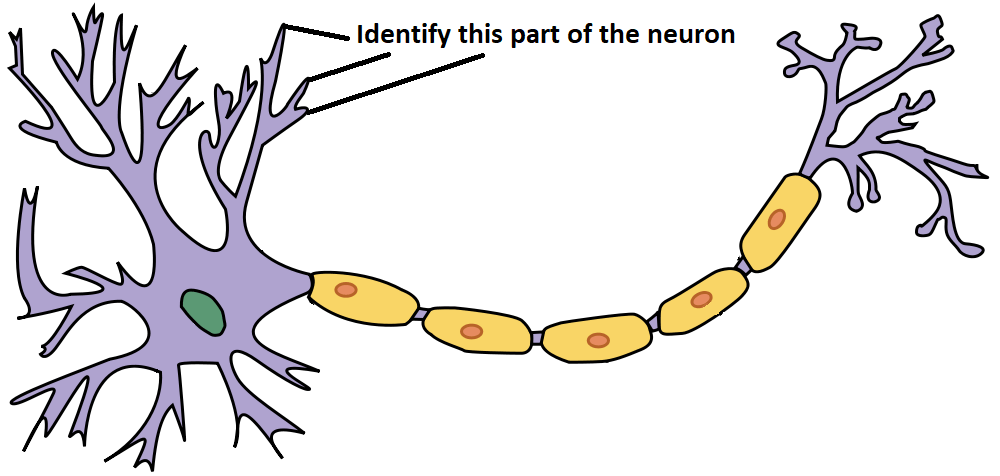
27.
a)

Dendrites

b)

Axon Terminals

c)

Myelin Sheath

d)

Schwann Cells

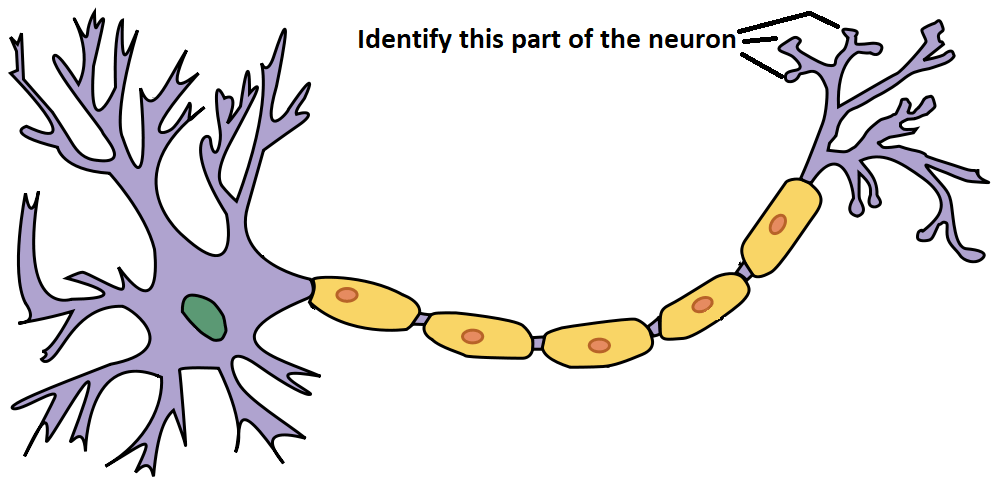
28.
a)

Dendrites

b)

Axon Terminals

c)

Myelin Sheath

d)

Schwann Cells

29.
a)

Dendrites

b)

Axon Terminals

c)

Schwann cells/Myelin Sheath

d)

Cell body

30.

Transmit impulses away from the cell body

a)

afferent/sensory neurons

b)

axons

c)

dendrites

d)

astrocytes

31.

Transmit impulses toward from the cell body

a)

afferent/sensory neurons

b)

axons

c)

dendrites

d)

astrocytes

32.
The sodium potassium pump restores the resting potential. By which process does this work? 
a)
Osmosis
b)
Diffusion
c)
Facilitated diffusion
d)
Active transport
33.
When a neuron is resting, the inside of the axon has a ____________ charge.
a)
positive
b)
negative
34.
In resting potential, neurons have more _________ on the outside of the cell membrane.
a)
K+
b)
NaCl
c)
Na+
d)
Cl-
35.
In resting potential, neurons have more ____________ on the inside of the cell membrane.
a)
NaCl
b)
Na+
c)
K+
d)
Cl-
36.
Which ions are involved in an action potential?
a)
Na; Cl
b)
Na; K
c)
K; Cl
d)
Na; Ca
37.
Which is the correct order of events in depolarisation then repolarisation? 
a)
Sodium channels close, potassium channels open
b)
Sodium channels open, potassium channels open, 
c)
Sodium channels open, potassium channels close
d)
Potassium channels open, sodium channels open
38.
At which point on the diagram does depolarisation of the axon occur? 
a)
A
b)
B
c)
C
d)
D
39.
A membrane potential becoming less negative is called
a)
hyperpolarization
b)
depolarization
c)
repolarization
d)
polarization
40.

What number(s) on the graph represents the THRESHOLD level of stimulus?

a)

1 and 5

b)

2

c)

3

d)

6

41.

What is the region where nerve cells meet called?

a)

Synapse

b)

Cleft

c)

Junction

d)

Axon terminal

42.

Which letter represents a neurotransmitter?

(a)  

43.

Which letter represents a vesicle?

(a)  

44.

Which letter represents a neurotransmitter receptor?

(a)  

45.

Which letter represents a voltage-gated calcium channel?

(a)  

46.

Which number represents the post-synaptic membrane?

(a)  

47.

Which number represents the pre-synaptic membrane?

(a)  

48.

Which number represents the synaptic cleft?

(a)  

49.

Which letter OR number represents the axon terminal?

(a)  

50.

A nerve impulse is transmitted in which direction

a)

1 to 2 to 3

b)

3 to 2 to 1

51.

What happens in an axon terminal when an action potential arrives at the presynaptic membrane?

a)

sodium ions diffuse in

b)

sodium ions diffuse out

c)

calcium ions diffuse in

d)

calcium ions diffuse out

52.

What happens when calcium ions diffuse into an axon terminal?

a)

vesicles release neurotransmitter by exocytosis

b)

voltage-gated sodium channels open

c)

voltage-gated sodium channels close

d)

neurotransmitter is pumped from the post-synaptic membrane

53.

How does neurotransmitter cross the synaptic cleft?

a)

exocytosis

b)

simple diffusion

c)

carrier mediated transport

d)

osmosis

54.

What causes sodium ion channels on the postsynaptic membrane to open?

a)

arrival of an action potential at the channel

b)

enzymatic digestion of the neurotransmitter bound to the channel

c)

binding of the neurotransmitter to the channel itself

d)

binding of calcium ions to the channel itself

55.

What causes sodium ion channels on the postsynaptic membrane to close?

a)

arrival of an action potential at the channel

b)

enzymatic digestion of the neurotransmitter bound to the channel

c)

binding of the neurotransmitter to the channel itself

d)

binding of calcium ions to the channel itself

56.
Which letter represents the Cervical Region of the spinal cord and vertebral column?
a)
A
b)
B
c)
C
d)
D
57.
Which letter represents the Thoracic Region of the spinal cord and vertebral column?
a)
A
b)
B
c)
C
d)
E
58.
Which letter represents the Lumbar Region of the spinal cord and vertebral column?
a)
A
b)
B
c)
C
d)
D
59.
What is known as a quick, automatic response to a stimulus?
a)
Reaction
b)
Reflex
c)
Procedural Memory
d)
After-image
60.
In this picture, the red line represents a(n)
a)
motor neuron
b)
sensory neuron
c)
receptor
d)
interneuron
61.
In this picture, the green line represents 
a)
motor neuron
b)
sensory neuron
c)
interneuron
d)
receptor
62.
In this picture, the blue line represents a(n)
a)
interneuron
b)
motor neuron
c)
sensory neuron
d)
effector
63.
_____ neurons carry messages to the central nervous system
a)
Motor
b)
Inter
c)
Sensory
d)
Fun
64.
_____ neurons carry  messages away from the central nervous system.
a)
Motor
b)
Inter
c)
Sensory
d)
Flower
65.
A network of spinal nerves
a)
roots
b)
plexus
c)
cauda equina
d)
CNS