
 Worksheets
World Geography – Regions WG 3a – Cloze Notes
Total questions: 35
Worksheet time: 18mins
What are regions?
Regions are areas of the earth’s surface that share unifying characteristics.
Regions are the names of different countries.
Regions are only found in oceans.
Regions are types of weather patterns.
Regions can be defined by which types of characteristics?
Physical or cultural characteristics.
Economic or political boundaries.
Randomly assigned numbers.
Personal preferences.
Regional labels may reflect what?
People’s changes in perceptions.
The exact physical boundaries of a region.
Only government-defined areas.
Permanent and unchanging features.
Which of the following is a physical region located in North Africa?
Sahara Desert
Taiga
Rainforest
Great Plains
Where are taiga forests primarily located?
Siberia, Russia
Amazon Basin, South America
Sahara Desert, Africa
Great Plains, North America
Rain forests are located around the world near the ________.
equator
poles
mountains
desert
The Great Plains is a region of flat land in which part of the United States?
Central United States extending into Canada
Western United States near the Pacific Coast
Eastern United States along the Atlantic Ocean
Southern United States near the Gulf of Mexico
The Low Countries are:
Belgium and the Netherlands
France and Spain
Germany and Poland
Italy and Greece
What are polders?
Areas of reclaimed land from the sea.
Large natural lakes.
Mountainous regions.
Deserts formed by wind erosion.
Which of the following is a cultural region based on language?
Latin America
Francophone World
Both A and B
None of the above
Most people in Latin America speak ________. People in Brazil speak ________.
Spanish; Portuguese
Portuguese; Spanish
French; Spanish
Spanish; French
The Francophone World is a group of countries or areas where people speak which language?
French
Spanish
German
Italian
Chinatowns are ethnic neighborhoods or areas where people of the same ethnicity live. Which of the following is an example of an ethnic neighborhood?
Little Saigon in Los Angeles (Vietnamese)
Little Havana in Miami (Cuban)
Both A and B
None of the above
Kurdistan is an area in Iran, Iraq, Turkey, and Syria where Kurdish people live. Kurdish people do not have their own country. What is an ethnic group without a country called?
A stateless nation
A sovereign state
A federation
A city-state
Which of the following is a major religion in North Africa and the Middle East?
Islam
Buddhism
Hinduism
Roman Catholicism
Which of the following is a major religion in Southeast Asia?
Islam
Buddhism
Hinduism
Roman Catholicism
Which of the following is a major religion in India?
Islam
Buddhism
Hinduism
Roman Catholicism
Most people in Latin America are:
Muslims
Buddhists
Hindus
Roman Catholics
The Wheat Belt is a region in the U.S. where ______ is grown.
grain
cotton
rice
corn
The European Union is an economic union in ______. Most countries in ______ are members of the EU.
Europe
Asia
Africa
South America
The North Atlantic Treaty Organization is a group of countries in Europe with the purpose of ______.
defending democracy
promoting communism
expanding trade routes
controlling natural resources
Which country in Africa is not a member?
Morocco
Nigeria
Egypt
Kenya
The Middle East is also called ______.
Southwest Asia
Northern Europe
Central America
Southeast Africa
The Sun Belt is a region located in the ______ United States.
southern
northern
eastern
western
The population in the Sun Belt region has grown since the invention of the ______.
air conditioner
television
refrigerator
telephone
The Rust Belt is a region in the ______ United States.
northeastern
southwestern
northwestern
southeastern
Heavy Industry such as steel and automobile manufacturing was located in which region?
The Rust Belt
The Sun Belt
The Silicon Valley
The Great Plains
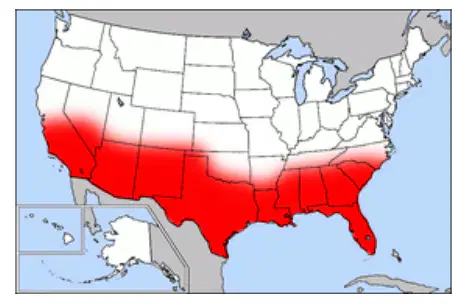
Which region of the United States is shown in red on the first map?
Sun Belt
Rust Belt
Wheat Belt
Francophone World
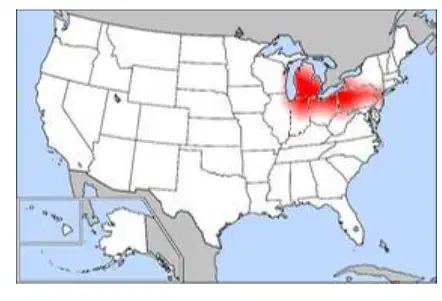
Which region of the United States is shown in red on the second map?
Sun Belt
Rust Belt
Wheat Belt
Francophone World
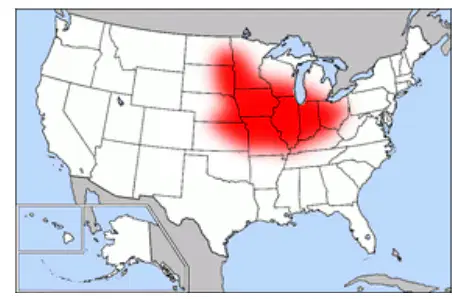
Which region of the United States is shown in red on the third map?
Sun Belt
Rust Belt
Wheat Belt
Francophone World

Which world region is highlighted in blue on the fourth map?
Sun Belt
Rust Belt
Wheat Belt
Francophone World
Rainforests are ______ and ______ forests near the equator. This is called a ______ climate.
hot, wet, Tropical Wet
cold, dry, Polar
temperate, dry, Mediterranean
cool, wet, Tundra
Rainforests are full of ______, ______, and ______.
thick green plants, tall trees, animals
sand dunes, cacti, camels
icebergs, penguins, seals
grasses, zebras, lions
Which of the following countries has rainforests?
Brazil
Canada
Russia
Australia
Which of the following countries does NOT have rainforests?
Congo
Indonesia
Brazil
Canada

