
 Worksheets
Paediatric Imaging
Total questions: 52
Worksheet time: 31mins
Have distraction, immobilisation and __________ tools ready to go when preparing the imaging room.
radiation protection
measuring
sterilisation
lighting
For infants aged 0-6 months, it is important to maintain a ______ and soothing tone.
calm
loud
sarcastic
funny
For infants aged 0-6 months, ensure that any movements are ______ and gentle.
slow
fast
rough
jerky
Infants aged 0-6 months may be soothed by a pacifier.
True
False
Infants aged 0-6 months can get cold quickly.
True
False
Age specific needs: 6–12 month Children in this age group are quite easily _________
distracted
focused
isolated
aggressive
Age specific needs: 6–12 month Try using:
Tapping the LBD
Singing
Clapping
Writing
Children in this age group are likely to need restraint and holding.
0-6 months
6-12 months
1-3 years
3-5 years
For children aged 1-3 years, the window of opportunity is _____
short
long
closed
irrelevant
For children aged 1-3 years, make sure your room is adequately prepared and patient is _____ before starting to position the patient.
prepped
asleep
hungry
dressed
Children aged 1-3 years generally respond well to b (a) .
For children aged 3–5 years, give them choices on things that won’t affect the examination.
Choosing what chair to sit on
If they want to do the examination standing up or sitting down
When they want to do the examination
How many candles do they want to blow out for a CXR
For children aged 5-12 years, it is important to ask
what happened
who their parents are
their parents about what occurred
how many eggs they ate today
For children aged 5-12 years, parents will still be present but may be ______ involved.
less
more
always
never
Which of the following statements is true regarding the respect adolescents should be given in a healthcare setting?
They should be given less respect than adults
They should be afforded the same respect that you would give an adult patient
They do not require respect
Only their parents should be respected
Adolescents must have their right to (a) respected.
At what age should all girls be checked for pregnancy status according to age-specific needs?
10 and up
12 and up
15 and up
18 and up
Parents can still be present for adolescent patients but are less involved.
True
False
Which of the following modalities may require sedation and anaesthetic to ensure that a child stays still for an extended period of time?
CT
MRI
Interventional Radiology
Nuclear Med
General Radiography
Which of the following are commonly used methods of sedation or anaesthesia in paediatric imaging?
Feed and sleep
General anaesthetic
Chloral hydrate
Ibuprofen
Antihistamine
Which of the following are commonly used methods of sedation or anaesthesia in paediatric imaging?
Nitrous sedation
Oxygen therapy
IV Sedation
Nitroglycerin
Children have a longer life span ahead of them compared to adults and their cells are dividing at a rapid rate. Therefore, it can be said that children are considerably more sensitive to the carcinogenic effects of ionising radiation.
True
False
Neonates and immunocompromised patients are particularly susceptible to what?
Infection
Dehydration
Fractures
Allergies
For patients less than 1 year old, what is the usual position for a chest X-ray?
supine
prone
erect
lateral decubitus
For patients aged 1 year to 4-5 years, which position is preferred for a chest X-ray?
AP preferably Erect / Sitting
PA Lateral Decubitus
Supine
Oblique Prone
For patients aged 5 years and older, which positions can be used for a chest X-ray?
AP or PA depending on patient ability.
Only lateral position is used.
Only supine position is used.
Only prone position is used.
What should you do with the detector to reduce repeats?
Place the detector directly under the patient.
Increase the distance between the detector and the patient.
Use a smaller detector for all patients.
Turn the detector off during exposure.
To reduce repeats, use an exposure suitable for ________ and ________.
the examination and patient size
the room and equipment
the time of day and temperature
the technician and location
What type of image would always be done initially for abdominal imaging?
Supine image
Erect chest image
Lateral skull image
PA hand image
A Chest XR and Abdominal XR is usually performed on one image for smaller children
True
False
What are the possible positions for imaging the pelvis depending on clinical history, patient presentation, and age of patient?
Supine or AP standing
Prone or lateral
Only supine
Only standing
What is a common indication for imaging of hips?
(a)
From what age is XR used and considered the standard for looking at DDH?
1 month
3 months
5 months
12 months
Gonad shielding is recommended when imaging the pelvis.
True
False
What are the standard projections for pelvis imaging?
AP Pelvis & Frog Leg Lateral Hips
Lateral Pelvis & AP Hips
Prone Pelvis & Lateral Hips
Only AP Pelvis
Individual hips are rarely performed in pelvis imaging.
True
False
Paediatrics often inhale, swallow, ingest and tread on foreign bodies. Imaging is used to confirm which of the following?
Location
Type
Depth
All of the above
Identifying foreign bodies such as button batteries and magnets is critical and can be considered an emergency.
True
False
______ is often the easiest position for lower extremity assessment.
Supine
Prone
Sitting
Standing
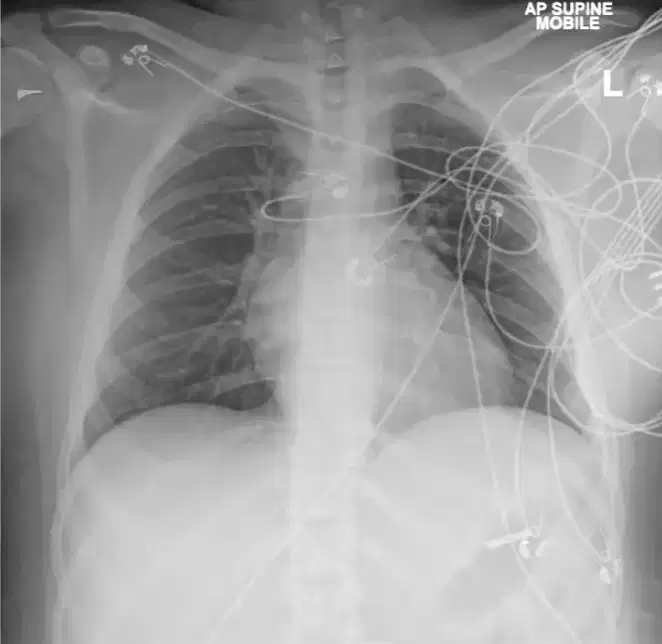
This is an image of a paediatric patient with a foreign body.
What should be changed in this image if it has to be repeated?
(a)
With an erect abdomen xr, how may it be performed for paediatric patients?
Standing up
On a chest chair
Supine
Kneeling
How is a Bone age XR taken?
Hand & Forearm
L Hand & Wrist (2cm up forearm)
R Hand & Wrist (2cm up forearm)
Hand, Wrist & Forearm
What is considered a high risk Foreign body?
Button battery in oesophagus
Large object (>6cm long/ >2.5cm wide)
2 magnets
1 magnet + metal object
Sharp object in oesophagus
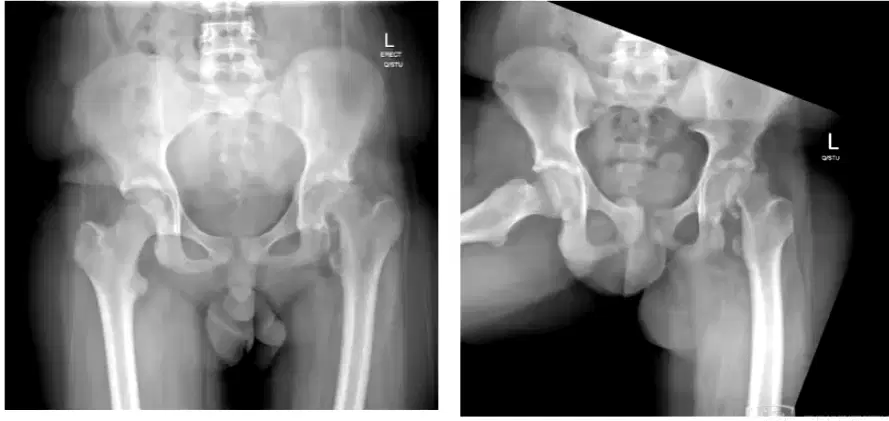
What is the pathology?
(a)
The use of feed and sleep as a sedation method is typically used for children aged
<3 months
0-6 months
<1 month
<5months
The use of chloral hydrate as a method of sedation is used for children aged
3 months - 3 years
>3months
0 - 3 years
1 - 6 years
How many hours of fasting is required for children that require general anaesthetic?
1 - 2 hours
1 hour
4 - 6hours
6 - 8 hours
IV sedation is a (a) form of sedation
Milk is considered food and water is not
True
False
Clear apple juice is considered food.
True
False
Nitrous sedation requires a ___ hour fast
2
3
4
5
The best way to immobilise is to
hold them flat against the detector
lock the hinge joints
angle the tube to suit their direction
strap using belts

