
 Worksheets
LF (1)
Total questions: 105
Worksheet time: 53mins
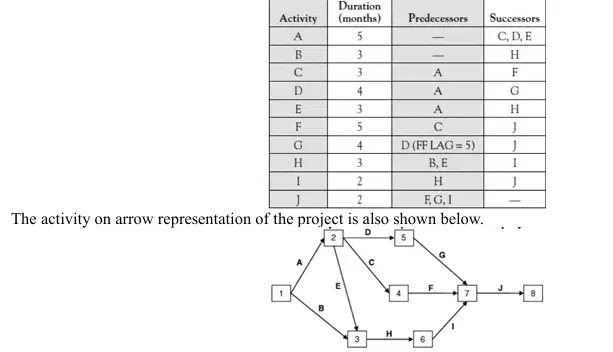
A project consists of 10 activities as outlined in the table below. All relationships are finish-to-start unless otherwise noted.
The critical path for the project is?
BHIJ
ACFJ
AEHIJ
ADGJ
A room is 35 ft × 25 ft in plan. Ceiling height is 14 ft. Openings for doors and windows total 85 ft2. The following data is given for plastering and painting operations.
Plaster and paint crew:
1 supervisor $30/hr
1 laborer $12/hr
2 painter $18/hr
Plastering productivity = 50 ft2/L.H.
Painting productivity = 150 ft2/L.H.
The estimated labor cost for plastering and painting the room (walls and ceiling) is most nearly:
$1,020
$1,690
$1,280
$1,460
A horizontal curve is to be constructed for a paved rural road in a location where the recommended superelevation is 8%. For snow and ice conditions, the recommended value for the side friction coefficient is 0.12. The pavement is 20 ft wide with 4-ft shoulders. The tangents of the proposed curve are perpendicular. The design speed for the roadway is 60 mph. The minimum length of the curve (ft) is most nearly:
1,500
1,200
2,200
1,900
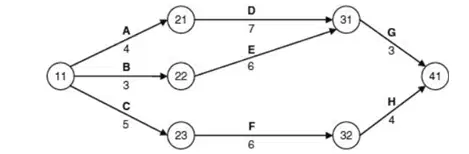
An activity on arrow network for a project is shown below. Numbers adjacent to arrows are activity durations (weeks). Assume project start date is week 0. The early start date (week) for activity G is:
9
12
11
10
A horizontal circular curve has PC at coordinates (ft) 4123.64 N, 1064.32 W. Curve radius = 1,030 ft. The tangent at the PC has bearing S42°30′W. The length of curve = 646.35 ft. The coordinates of the PI are:
3897.84 N, 1310.73 W
3877.23 N, 1290.12 W
4349.44 N, 817.91 W
4370.05 N, 838.52 W
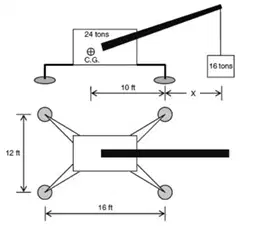
A crane is used to lift a load of 16 tons as shown. The crane cabin has a ballasted weight of 24 tons. The allowable soil pressure is 2,800 lb/ft2. If the crane is supported by 4 outriggers, as shown, the minimum contact area (ft2) of the outrigger pads is most nearly:
9.0
14.3
20.3
12.3
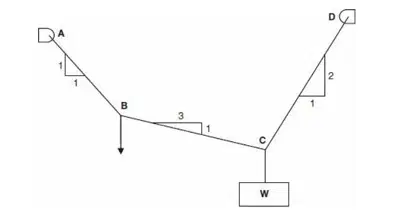
A hoisting mechanism uses a cable system as shown below. If the load W = 3 tons, the effort required (lb) at point B is most nearly:
1715
2065
2350
1345
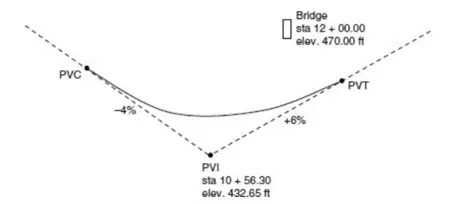
A parabolic vertical curve joins a grade of −4% to a grade of +6%. The PVI is at station 10 + 56.30. Elevation of the PVI is 432.65 ft. The curve passes under a bridge structure at station 12 + 00.00. The elevation of the bottom of the bridge girders is 470.00 ft. The minimum vertical clearance under the bridge is 14 ft 6 in. The required length of the curve (ft) is most nearly:
2,265
2,065
1,865
1,665
A stadium hosts an event with an audience of 40,000. Approximately 30% of the audience members are expected to use an adjacent light rail station following the event. It is anticipated that about 90% of the stadium empties in the first hour after the conclusion of the event. A dedicated pedestrian walkway connects the stadium to the light rail station. The effective width of the walkway is 32 ft. Assume that the PHF (based on peak 15-min flow) for the walkway is 0.88. The peak flow rate (ped/min/ft) on the walkway during the first hour is most nearly:
6.4
4.8
7.2
5.6
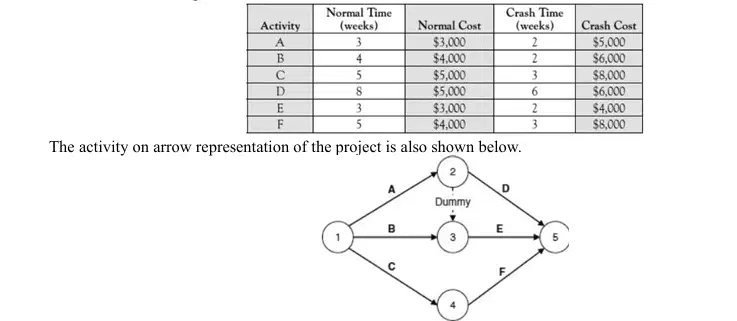
The tasks within a project, and their duration and cost data are shown below. Both normal completion time and crashed completion time (by allocating additional resources) are shown in the table.
For every week of early completion, the bonus is $1,000, and for every week that the project is late, the penalty is $800. If the revised target completion time is 9 weeks, the net cost for completing the project is most nearly:’
$22,000
$26,000
$25,000
$24,000
A 6-lane freeway through rolling terrain (rural) has12-ft lanes, interchanges every 1.25 mi and has 8-ft-wide shoulders. Traffic studies have resulted in the following data: AADT = 65,000 veh/day. The traffic stream includes 8% trucks, 3% buses and 5% RVs. K = 0.12 Peak hour factor, based on 15-min traffic counts, is 0.9. During peak flow, directional split = 60/40. The LOS for the peak direction of the freeway is most nearly:
D
B
A
C
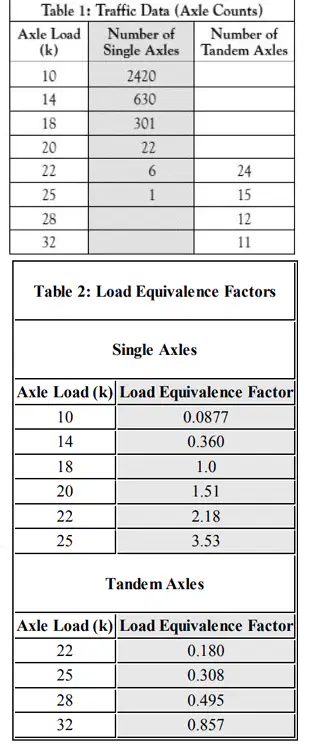
A 4-lane divided highway (2 lanes in each direction) currently has ADT of 23,000 vehicles (each way). Approximately 12% of the traffic consists of trucks. Traffic is expected to grow by a 4% annual rate over the next 20 years. Table 1 shows data collected from a weigh station during a typical day for 1,078 trucks.
Using the Asphalt Institute Load Equivalence Factors (LEF) shown in Table 2, the design 20-year 18- k ESAL (W18) is most nearly:
23 × 10^6
15 × 10^6
20 × 10^6
9 × 10^6
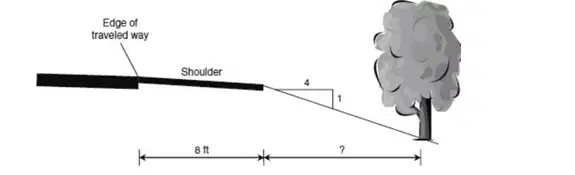
A 2-lane rural freeway segment has 12-ft lanes and an 8-ft shoulder. A cut slope of 1V:4H exists adjacent to the shoulder as shown. The ADT is 16,000 and the design speed is 65 mph. The minimum width (ft) measured from the edge of the shoulder, which should be free of any obstructions, is most nearly:
18
38
46
26
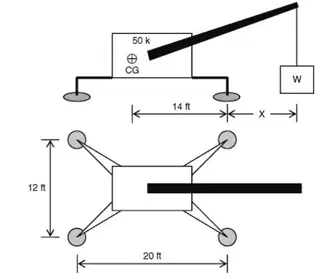
A crane is used to lift a load of W = 40 tons, as shown. The crane cabin has a ballasted weight of 50 k. Center of gravity is at CG. The allowable soil pressure is 3,800 lb/ft2. If the crane is supported by four outriggers as shown, the maximum lateral offset X (ft) is most nearly:
8
17
5
25
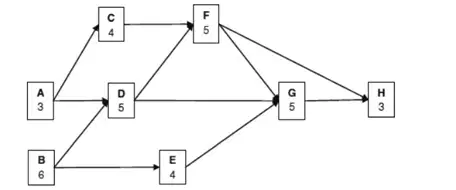
The activity on a node diagram for a project is shown below. All durations are in weeks. All relationships are finish to start unless noted otherwise. The free float (weeks) of activity A is:
3
2
1
0
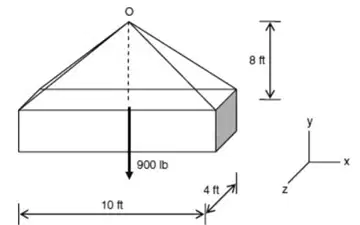
A crate weighing 900 lb is being lifted by four cables attached to the corners as shown below. The attachment point for the cables (O) is 8 ft directly above the center of gravity of the load. Tension in each cable (lb) is most nearly:
412
225
270
342
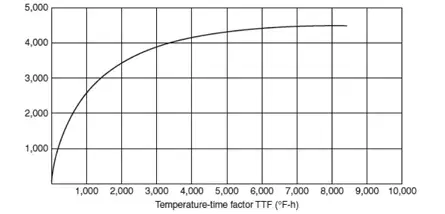
Specifications for a construction job state that wall forms can be removed once the concrete reaches a compressive strength of 3,400 psi. The maturity curve (Nurse-Saul) for the concrete is shown in the figure below. The cement hydration is assumed to cease below a temperature of 30°F. The average temperature of the concrete during the curing process is 70°F. The number of hours that the contractor has to wait before removing forms is most nearly:
60
36
24
48

The following table shows ordinates of a mass haul diagram for a highway construction project. The free haul distance is 300 ft. Overhaul cost is $3.70/station-yd.
The total cost of overhaul is most nearly:
$35,000
$40,000
$45,000
$50,000
A job requires specially engineered fill to be hauled from storage to the job site and then placed and compacted. Given the following information the installed cost ($/yd3) of the fill is most nearly:
Compacted volume required at job site = 15,000 yd3
Distance from storage to job site = 32 mi
Average truck speed = 32 mph
Truck capacity (net) = 50,000 lb
Truck load time = 25 min
Truck unload time = 10 min
Truck operating cost = $80 per hr
Cost of fill at storage facility = $3 per ton
Compacted unit weight of fill = 140 lb/ft3
Cost to place & compact fill = $0.50 per yd3
22
23
15
27
Whenever a masonry wall is constructed, a limited access zone is to be established. Which of the following is true?
The width of the limited access zone shall be wall height plus 4 ft.
The limited access zone shall run to the same length on both sides of the wall.
If provided along the entire length of the wall, the width of the limited access zone is based on the judgment of the contractor.
The width of the limited access zone shall be wall height plus 2 ft.
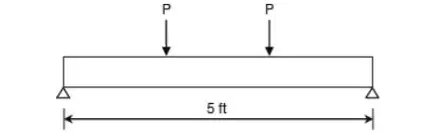
A 6-in.-square unreinforced-concrete beam is loaded in third-point loading on a simple span of 5 ft. The test is conducted at 28 days after the concrete beam is cast. If the failure occurs by flexural cracking within the middle third of the beam when load P = 800 lb, the 28-day compressive strength (lb/in.2) of the concrete is most nearly:
6,500
3,500
4,500
5,500
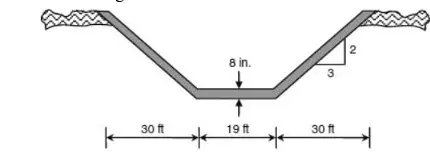
A 450-ft-long canal (trapezoidal section: 19-ft-bottom width, 3H:2V side slopes) is to be lined with concrete to a nominal thickness of 8 in. Material waste is estimated to be 5%.
Concrete cost = $98/yd3
Concrete pour rate = 8 yd3/hr
Surface finishing compound is purchased in 5-gal containers costing $40 each
Coverage of surfacing compound = 300 ft2/gal
The total material cost ($) is most nearly:
95,000
85,000
105,000
75,000
An excavator has a bucket capacity of 3.0 yd3. Its operation cycle consists of the following phases: (a) excavation time = 45 sec, (b) travel time (two-way) = 4 min, and (c) transfer time (to trucks) = 45 sec. The excavator transfers the excavated material to a fleet of trucks that carry the material offsite. The following data is given:
Overall efficiency factor for the excavator = 90% Truck capacity = 15 yd3
Truck cycle time (transfer + two-way travel + dumping) = 90 min
The quantity of excavated material = 2,600 yd3 (loose)
The number of trucks needed to balance the production of the excavator, assuming 8-hr workdays, is most nearly:
2
3
4
5
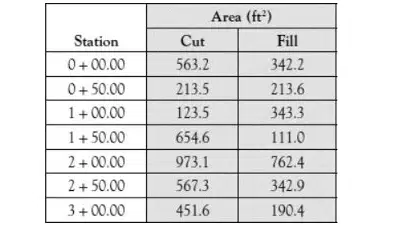
The table below shows areas of cut and fill sections at locations 50 ft apart. Assume shrinkage = 12% and bulking = 25%. The cumulative earthwork volume between stations 0 + 0.00 and 3 + 0.00 is most nearly:
1,400
1,800
2,200
2,600
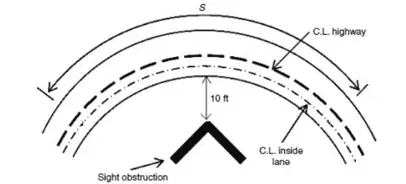
A 2-lane highway has a circular horizontal alignment with centerline radius of 750 ft. Lanes are 12 ft wide. An obstructing structure exists 10 ft from the inside edge of the roadway as shown below. The safe design speed (mph), based on adequate horizontal sightline offset, on the curve is most nearly:
50
45
35
40
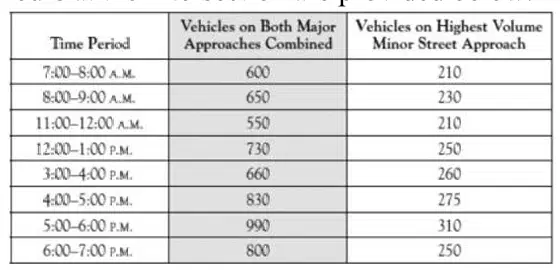
An agency is investigating installing a signal at an intersection in a large city where the 85th percentile speeds are 40 mph on both approaches. The intersection has two lanes in the major direction and one lane in the minor direction. Recent traffic counts from the high-volume hours at the intersection are provided below:
Warrants 1 & 2
Warrant 2 only
Warrants 1 & 3
Warrants 2 & 3
A 6-lane highway has the following characteristics:
Level terrain
Lane width = 11-ft lanes
Average spacing between accessing driveways = 600 ft
Right shoulder width = 6 ft
Clear distance to nearest obstruction in median = 4 ft
Directional hourly volume = 3,440 veh/hr
The traffic stream includes 8% trucks, 3% buses, and 2% RVs.
Peak hour factor, based on 15-min traffic counts, is 0.88.
Drivers are mostly commuters.
The LOS for the peak direction of the highway is most nearly:
B
C
D
F
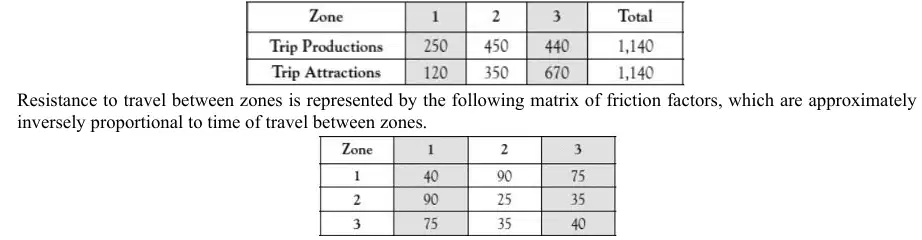
A study area is divided into three socio-economic zones, whose trip production and trip attractions are tabulated below: (1st table)
The number of trips produced by zone 3 and attracted to zone 2, according to the first iteration of the gravity model, is most nearly:
110
130
150
170
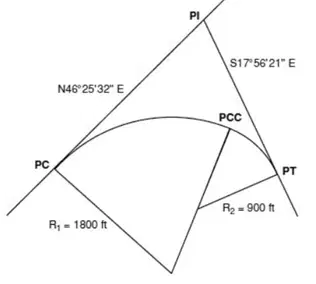
A horizontal compound curve connects two tangents as shown below. The bearing of the back tangent is N46°25′32″ E, and the bearing of the forward tangent is S17°56′21″ E. The curve radii to be used are R1 = 1,800 ft and R2 = 900 ft. The PC is located at station 138 + 34.12 and the PI at station 158 + 12.98.
The station of the PCC is most nearly:
151 + 03.32
145 + 12.54
147 + 05.23
148 + 50.61
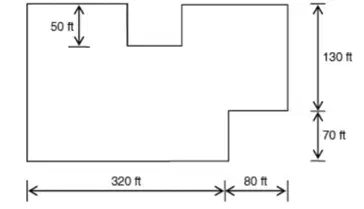
A grade beam 3 ft wide × 2 ft deep must be poured around the perimeter of a building whose plan is shown below. The trench excavated for the grade beam has to have 1V:1H side slopes. Excavation is accomplished by a trackhoe, having productivity of 9 yd3/hr. Assume an 8-hr workday.
The number of days to complete the excavation activity is most nearly:’
4
5
6
7
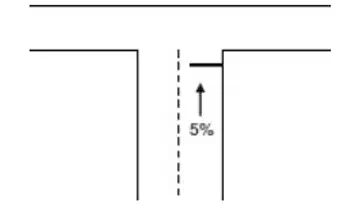
A highway with a straight alignment slopes down to a stop line as shown. The design speed of the highway is 45 mph. The stopping sight distance (ft) is most nearly:
230
395
360
195
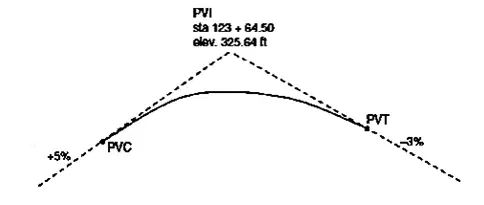
A parabolic vertical curve is being designed to connect two grades with G1 = +5% and G2 = −3%. If PVC is at station 117 + 50.00, the elevation (ft) of the PVT is most nearly:
313.02
309.45
311.12
307.21
An excavation trench is 5 ft deep, 6 ft wide, and 95 ft long. According to OSHA standards, how many ladders are required to provide egress from the trench?
4
3
2
1
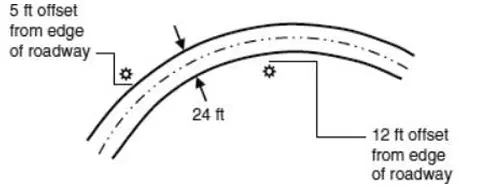
The centerline of the local horizontal alignment of a two-lane highway is a circular curve with radius = 915 ft. The length of curve is 600 ft. Trees are located adjacent to the highway, as shown. Assume standard lane width = 12 ft. The safe design speed (mph) based on adequate sight distance is most nearly:
60
50
45
55
A landfill accepts municipal solid waste from town A (population 20,000). The landfill has been in operation for 6 years and has remaining capacity of 1,000,000 yd3. A new subdivision (population 5,000) is developed and populated. The waste generation rate is 5 lb/capita-day. The average compacted density in the landfill is 40 lb/ft3. The reduction in the service life (years) of the landfill due to the addition of the new subdivision is most nearly:
12
10
8
6
An excavator having a capacity of 3 yd3 operates 8 hr in a workday. A single cycle of operation consists of excavation, travel (two-way), and transfer of excavated material. Cycle time for the excavator is 8 min. Efficiency factors are:
Site 0.90
Equipment & Operator 0.72
The daily excavation production (yd3/day) is most nearly:
115
130
160
145
A contractor needs to bring in 4,200 yd3 of select soil to replace unsuitable subgrade material for a new highway. The borrow site is located 2.6 miles away with an average round trip travel/loading/dumping time of 30 min. The soil has a unit weight of 125 lb/ft3 and the dump truck drivers are on 10-hr workdays. The minimum number of 10-ton (net capacity) trucks needed to complete the job within 8 working days is:
4
5
6
7
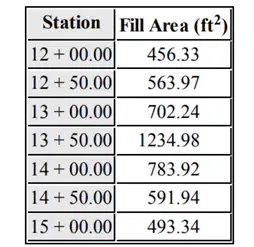
An embankment is to be constructed by placing fill in a 300-ft-long section of a site. Areas of fill sections 50 ft apart are shown in the following table. The total volume of earthwork (yd3) between stations 12 + 0.00 and 15 + 0.00 is most nearly:
8,060
16,100
8,940
17,880
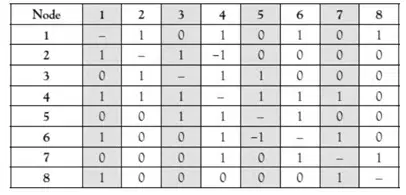
A traffic network within a city planning zone is described by the following matrix. Nodes are numbered 1 through 8.
The number of links in the network is most nearly:
17
14
16
15
A 2-lane Class I highway in rolling terrain has the following characteristics:
Lane width = 12 ft,
shoulder width = 6 ft
40% no passing zones
2-directional flow rate = 2,800 pc/hr
Directional split = 70/30
10% trucks and buses, 6% RV
PHF = 0.85
For the design direction of the highway, the average travel speed has been calculated as 42 mph and the percent-time spent following has been calculated as 63%.
The level of service for the design direction is:
B
C
D
F
A parabolic vertical curve joins a grade of −5% to a grade of +3%. The PVC is at station 53 + 12.50 and the PVI is at station 60 + 09.00. Elevation of the PVI is 365.57 ft. The curve passes under a bridge structure at station 55 + 05.20. The bottom elevation of the bridge is 405.20 ft. The vertical clearance under the bridge (ft) is most nearly:
12.5
14.9
13.4
14.2
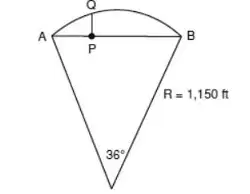
A horizontal curve has a radius of 1,150 ft as shown below. A point P on the major chord is located such that AP = 215 ft. The length of the chord offset PQ at point P (ft) is most nearly:
43
52
48
21
A parking lot is open during the hours of 8 A.M. to 6 P.M. During this time, exactly 360 cars were parked on the lot; 10% for 1 hr, 15% for 2 hr, 20% for 3 hr, 30% for 4 hr, and the remaining for the entire day. On average, 15% of the spacesare vacant and the operational efficiency factor is 80%. The space-hr demand and number of parking spaces in the lot are most nearly:
1,690 space-hr and 170 spaces
1,990 space-hr and 200 spaces
1,990 space-hr and 250 spaces
1,690 space-hr and 240 spaces

A 3-legged intersection is shown below. The minor street approach to the intersection has two lanes, is controlled by a STOP sign, has a grade of +4% heading into the intersection, and serves 15% trucks during the peak hour. The major street has a basically flat grade, a speed limit of 45 mph, and serves 20% trucks during the peak hour. The median is 6 ft wide.
The critical gap for the left turn movement from the minor street during the peak hour is most nearly:
8.5 sec
7.1 sec
7.5 sec
7.8 sec
A 4-leg intersection in an urban location had 15 recorded accidents (all types) during 2005. During this year, the average daily volumes entering the intersection from the four approaches were 1,900, 1,270, 1,620, and 930 vehicles. The intersection’s accident rate (per hundred million entering vehicles) is most nearly:
720
7.2
72
7,200
In order to meet current demand, a 1-mi segment of an urban highway must be widened by two lanes. The cost of the improvement will be compared to a phased program of expansion. Immediate development would cost $4,200,000 with annual maintenance costs of $40,000. A phased program would involve an initial investment of $2,000,000 and an estimated expenditure of $3,200,000 in 10 years. Annual maintenance cost under the phased program is estimated to be $28,000 for the first 10 years and $36,000 following that. Assume a perpetual period of service for each system and MARR of 7%. The ratio of the cost for a phased program relative to the single investment program is most nearly:
1.17
1.17
0.85
1.04
The architect for a warehouse building has proposed a design change to ensure compatibility with local building codes. The revised SOW is to substitute one layer of 5/8-in.-thick sheet rock with two layers of ½-in.-thick fire code (FC) GWB and to provide insulation within the wall cavity.
The building plan dimensions are: 180 ft × 200 ft
Floor-to-ceiling height: 12 ft
Openings: eight 6 ft 0 in. wide × 10 ft 0 in. high openings
Labor rates
Carpenter foreman (working) = $50.00 fully burdened
Carpenter (journeyman) = $40.00 fully burdened
Laborer = $25.00 fully burdened
Work crew 4 carpenters 2 laborers 1 working foreman
Work crew productivity (based on 8 hr/day)
GWB installation = 960 ft2/L.H.
Insulation = 1,920 ft2/L.H.
Material costs (add 10% waste factor for all materials)
4 ft 0 in. × 10 ft 0 in. × ½ in. GWB (FC) = $0.285/ft2
4 ft 0 in. × 10 ft 0 in. × 5/8 in. GWB = $0.255/ft2
Insulation $0.45/ft2
Contractor’s overhead 10%
Contractor’s profit 5%
The complete cost ($) of the change order for the revised SOW is most nearly:
4,200
9,800
3,300
7,800
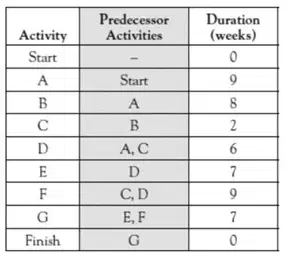
A certain project includes the activities summarized in the table below. The start date of the project is week 0. The project duration (weeks) is most nearly:
41
44
36
32
A temporary road closure (not exceeding 20 min during the daytime) is established around a 1,250-ft long work zone (including a buffer space) on a freeway. The distance (ft) from the centerline of the work zone to the location of the ROAD WORK AHEAD sign is most nearly:
6,800
5,800
4,800
7,800
According to OSHA, lifelines shall be secured above the point of operation to an anchorage or structural member capable of supporting a dead weight (lb) of at least:
4,000
4,500
5,000
3,200
The Arrhenius function for concrete maturity is given below:
t20 = ∑𝑒−𝐸 𝑅 ( 1 𝑇𝑖 −1 𝑇0 ) ∆𝑡
where t20 = time required, when curing at 20°C, to reach an equivalent maturity
E = activation energy = 41.5 kJ/mol for T ≥ 20°C
R = universal gas constant = 8.3144 J/(mol-K)\
Ti = average concrete temperature during time interval Δt, K
T0 = reference temperature = 293 K If the average concrete temperature during curing is 28°C
the equivalent age (days) after 3 days of curing is most nearly:
2.2
4.1
3.7
4.7
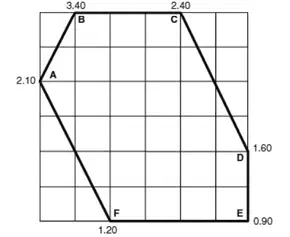
An excavation plan is outlined in the following figure. Each grid square is 50 ft × 50 ft. The numbers are depth of cut (ft) at indicated locations. The total volume of cut (yd3) is most nearly:
5,500
5,000
4,500
6,000
An existing landfill, in the shape of a truncated pyramid, is rectangular at the base with plan dimensions 4,000 ft × 2,500 ft. The free-standing sides slope 3H:1V. The height of the landfill is 12 ft. The top of the landfill must be covered with cover soil to a depth of 18 in. The amount of cover soil (yd3) required is most nearly:
525,000
650,500
712,200
821,435
A roller is used to compact soil to a specific density. The roller can achieve this target density for a 6-in. layer of material in four passes. The following specifications are given:
Width of roller drum = 8.0 ft
Forward speed of roller = 3 mph
Overall efficiency of roller = 80%
Soil shrinkage = 15%
The material delivery rate (bank measure) to the site is 950 yd3/hr.
The number of rollers required to keep up with this material delivery rate is most nearly:
1
2
3
4
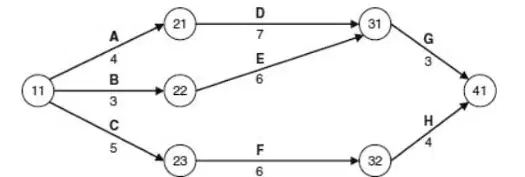
An activity on an arrow network for a project is shown below. Numbers adjacent to arrows are activity durations (weeks). The total float (weeks) for activity G is:
0
1
2
3
A new earth haul project requires moving 323,000 ft3 (bank measure) of excavated material to a location 12 mi away. A bidding contractor had completed a similar project (size and scope) 2½ years ago. The proposed price for the job on record was $525.00 per dump-truck load. Annual construction inflation factor is 3.2%. The contractor uses a fleet of dump trucks with 26-yd3 capacity (heaped). The excavated material has a swell factor of 25%. The contractor’s bid ($) should be most nearly:
353,000
262,000
302,000
326,000
It is proposed to drive a concrete pile using a pile hammer with energy of 50,000 ft lb. The minimum factor of safety against bearing capacity failure is equal to 6.0. The superstructure load transmitted to the pile is expected to be 40 tons. The ENR pile driving equation gives the static (ultimate) bearing capacity of a pile based on a pile driving test as:
Q𝑢𝑙𝑡 = 𝑊𝐻 𝑆 +1.0 / 𝑆 +1.0
where :
Qult = ultimate capacity (lb)
W = weight of the ram (lb)
H = height the ram falls (in.)
S = pile set (in. per blow)
The required blow count (blows per ft) to achieve a design capacity of 40 tons is most nearly:
50 blows per ft
35 blows per ft
28 blows per ft
8 blows per ft
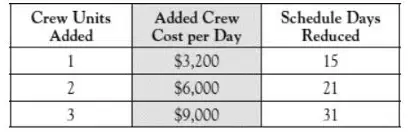
A contract has 90 days remaining until completion. Early completion will be paid $18,000 bonus per day that the duration is shortened. Activities on the critical path are targeted for “crashing.” Critical activities can be accelerated by allocating additional crew units. Additional cost and schedule reduction are shown in the table below. If crews must be added as a complete unit, the net bonus is maximized by the addition of how many crews?
1 additional crew unit
2 additional crew unit
None of the crashing schemes are profitable
3 additional crew unit
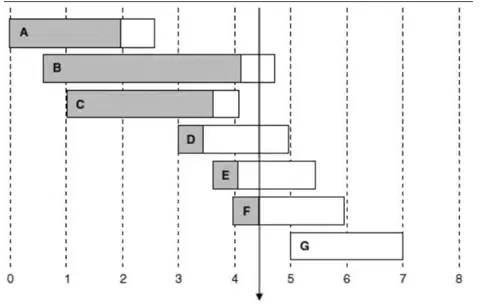
A construction project is broken down into seven stages (A-G). The sequencing of these stages is represented by a Gantt chart, as shown. The time axis is marked in units of (5-day) weeks. The Gantt chart shows current completion levels (shaded in gray) superimposed on the initially planned timeline. The current status of the project at 4 weeks 2 days is shown. Which of the following statements is true?
All activities in stage E must be completed before the initiation of stage G.
The only stage that is on or ahead of schedule is G
Of ongoing or completed stages, those with the lowest levels of completion are C and D.
Stages A and D are behind schedule.
For a municipality in New York State, the recommended side friction coefficient under icy conditions is 0.08. For a ramp with design speed = 40 mph and 4% superelevation, the minimum curve radius (ft) is most nearly:
880
1,000
1,050
1,200

A concrete mix contains cement, moist sand, and moist coarse aggregate in the following proportions by weight: 1:1.8:2.6. The following specifications are given:
The water content (gal/sack) of the concrete is most nearly:
8.5
7.1
6.1
7.9
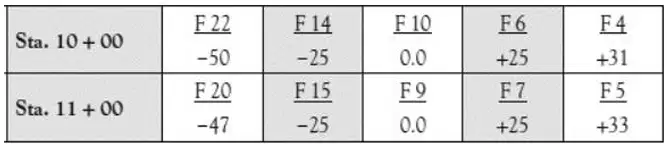
Construction of a 50-ft-wide roadway requires fill between station 10 + 0.00 and station 11 + 0.00. The table below shows required depth of fill (ft) at various horizontal offsets (ft) from the centerline of the roadway alignment. Earthwork is to be calculated by the average end area method. The volume of fill (yd3) is most nearly:
3,500
14,000
7,000
2,600
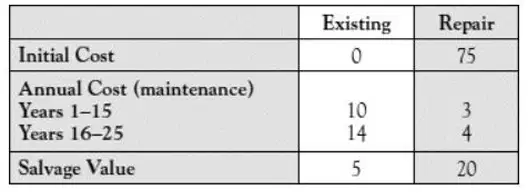
A local municipality must make a determination about the feasibility of repairing a bridge. The estimated useful life of the bridge is 25 years. The MARR is 8%. The relevant cost estimates are shown below. All costs are shown in thousands of dollars.
1.05
1.10
0.95
0.90
A parabolic vertical curve is to connect a tangent of +5% to a gradient of −4%. If the PVI is at station 123 + 32.50 and the tangent offset at the PVT is 17.65 ft, the station of the PVC is most nearly:
117 + 12.25
119 + 40.28
119 + 24.21
121 + 36.39
If the driver perception time of 2.5 sec is assumed, the braking distance (ft) for a car on a 2% upgrade traveling at 40 mph is most nearly:
167
307
145
177
A car accelerates uniformly from rest to its peak speed of 70 mph. The acceleration rate is 8 mph/sec. After cruising at maximum speed, the vehicle must brake to a complete stop, decelerating uniformly at 10 mph/sec. If the total distance traveled is exactly 0.5 miles, the average running speed (mph) is most nearly:
51
54
57
48
A vertical curve is being designed to connect two grades with G1 = +2.1% and G2 = −1.5%. If the design speed is 65 mph, the minimum length of vertical curve (ft) to satisfy AASHTO safe stopping distance criteria is most nearly:
600
700
800
900
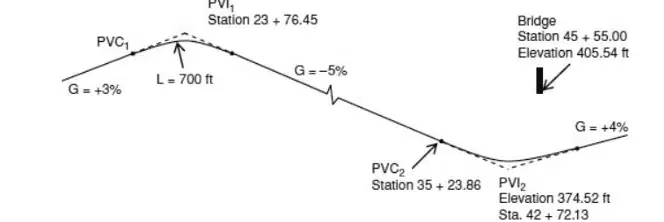
arabolic crest curve is followed by a sag curve. The two curves are connected by a tangent section, as shown. A bridge structure is located at station 45 + 55.00. The elevation of the low point on the bridge is 405.54 ft. The design speed (mph) of a truck (assume driver’s eye elevation = 7.6 ft), based on adequate sight distance under the bridge overpass on curve number 2, is most nearly:
85
80
65
75
A circular horizontal curve connects two tangents with a deflection angle of 42°50′. The roadway is a two-lane highway with 12-ft lanes. The centerline of the roadway has a radius of 1,245 ft. The design speed = 50 mph. PC for the centerline circular curve is at sta. 23 + 32.56. It is proposed to insert a pair of symmetric spirals at the PC and the PT. The minimum length of spiral (ft) is most nearly:
120
140
160
180
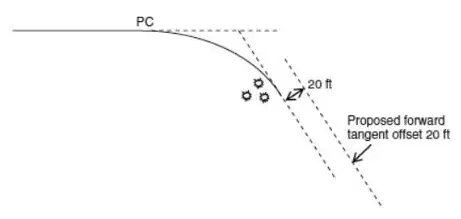
A circular horizontal curve has PC at 12 + 43.56. Degree of curve = 4°. Deflection angle between tangents is 56°24′45″ (right). In order to provide adequate horizontal sightline offset at the design speed, it is proposed to shift the forward tangent by a parallel offset of 20 ft, while maintaining the PC, as shown in the figure. The new degree of curve is most nearly:
4.1
3.9
3.8
3.7
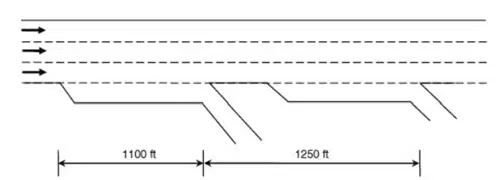
A 3-lane freeway interchange in a suburban area has a 1-lane diverging ramp. The adjusted peak-hour volume just downstream from the diverge of interest is 4,100 passenger cars, while the adjusted peak-hour volume on the off-ramp is 500 passenger cars. The deceleration lane is 1,100-ft long, the ramp free-flow speed is 54 mph, and the ramp has a +3% grade. An off ramp 1,250 ft downstream of the diverge of interest serves an adjusted peak hour volume of 450 passenger cars.
2,800
2,900
2,950
3,050
A horizontal circular curve is to connect a back-tangent bearing S42°30′W to a forward tangent bearing N70°W. If the degree of curve is 3°45′ and the tangents intersect at station 50 + 22.30, the deflection angle for station 57 + 00.00 is most nearly:
31°50′56″
21°40′28″
41°32′15″
27°40′24″
A vertical curve is being designed to connect two grades with G1 = +2.1% and G2 = −1.5%. If the design speed is 65 mph, the minimum length of vertical curve (ft) to satisfy AASHTO safe stopping distance criteria is most nearly:
800
650
600
700
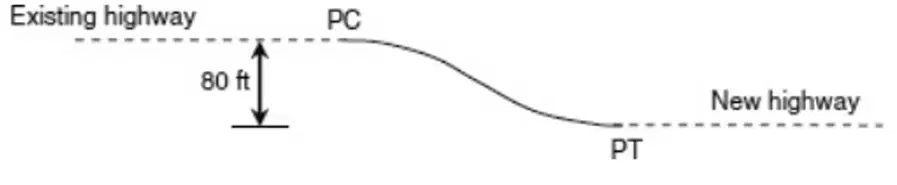
A new highway with a design speed of 50 m ph is to be connected to an existing highway by a pair of reverse 2° curves. The new highway is parallel to the existing highway, offset 80 ft to the right.
1,250
480
960
630
A traffic stream has mean headways of 2.4 sec. If the jam density is 64 veh/mi, the optimum speed is 50 mph, and the flow is 1,500 veh/hr, then the capacity of the highway (veh/hr) is most nearly:
1,600
1,640
1,720
1,530
An excavator has a bucket capacity of 2.8 yd3. Its operation cycle consists of the following phases: (a) excavation time = 45 sec, (b) travel time (two-way) = 4 min, and (c) dumping/transfer time = 30 sec. Assume an overall efficiency factor for the excavator = 85%.
The quantity of material to be excavated (bank measure) = 50,000 ft3. The material has the following properties:
Swell = 20%
In situ unit weight = 120 lb/ft3
Water content = 30%
Assuming 8-hr workdays, the number of days required to complete the job is most nearly:
9
10
11
13
Dump trucks with a capacity of 16 yd3 are used to dispose of excavated materials from a site. The distance from the dump-site is 4 mi and the average speed of the dump trucks is 30 mph. The bucket capacity of the power shovel is 3 yd3; power shovel excavation rate is 10 yd3/min (bank measure); the transfer time to the dump trucks (per 3-yd3 load) is 40 sec; and a dump time (per 3-yd3 load) is 30 sec. The excavated material has a swell of 10%. The factors affecting the job site productivity of the dump truck are: 0.80 for equipment idle time and 0.70 for operator efficiency.
If a fleet of dump trucks is used to haul the excavated material, the number of trucks needed is most nearly:
3
4
5
6
Normal weight concrete (unit weight = 145 lb/ft3) is placed at a rate of 12 ft/hr into 18-ft-high column forms. The blended cement mix contains 30% fly ash but no retarders. Average concrete temperature during curing is 50°F. The maximum lateral design pressure (lb/ft2) for the design of forms is most nearly:
2,300
2,760
2,150
2,600
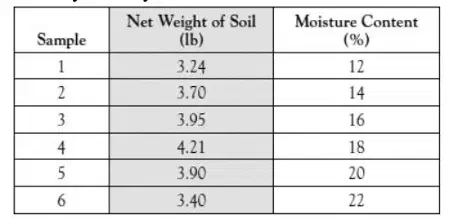
Results from a standard Proctor compaction test of six soil samples from a borrow pit are tabulated below. The natural moisture content of the excavated material is 12%. The fill location requires 1.5 million yd3 of soil compacted to a minimum 90% of the maximum Proctor dry density.
1.65 million
1.42 million
1.72 million
1.53 million
According to OSHA, the limiting exposure (dB) to impulse or impact peak noise level is most nearly:
140
120
100
80
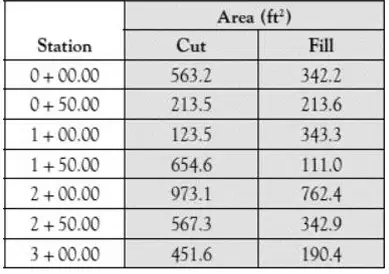
The following table shows areas of cut and fill sections at locations 50 ft apart. Assume shrinkage = 12% and bulking = 25%. Cumulative earthwork (yd3) between stations 0 + 0.00 and 3 + 0.00 is most nearly:
1,340
1,850
2,200
2,500
The total duration of a project was estimated as follows:
522 working days at 6 days per week and 10 hr a day of work.
30 days (10 hr per day) for contingencies such as bad weather, which would be worked on weekends and holidays.
The labor agreement defines the regular work day as an 8-hr-long week-day. Labor cost for premium time is 50% for hours during the week, and 80% for weekend work.
What is most nearly the overall labor premium rate for the project?
1.34
1.28
1.25
1.31
A 14-ft-high wall is placed at a rate of 4 ft/hr. Concrete is lightweight (135 pcf) made with Type I cement and a retarding admixture. The average concrete temperature is 60°F. The lateral design pressure exerted by the fresh concrete is most nearly:
900
725
750
870
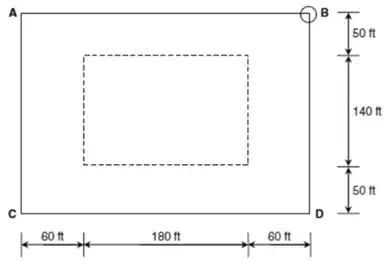
A building construction site is represented by the following rectangle ABCD. The original elevation of the water table at the site is 325.8 ft (above sea level). The dashed line shows the limits of proposed construction. The bottom elevation of the mat foundation for the building is 325.65 ft. Steady state pumping from a 9-in.-diameter well at point B is to be used to lower the GWT. The transmissivity of the underlying aquifer is 250 ft2/hr. During construction, the GWT must be lowered to at least 5 ft below the bottom of the foundation and no higher than an elevation of 324.0 ft within the limits of the site.
The minimum steady-state pumping rate (gal/min) required is most nearly:
3,000
2,000
1,500
1,000
A concrete mix has the following components:
Cement = 160 lb
Wet sand (moisture content = 5%) = 290 lb
Wet coarse aggregate (moisture content = 3%) = 420 lb
Added water = 56 lb Air = 3% (by volume)
The following specifications are given:
Cement specific gravity = 3.15
SSD sand (m.c. = 0.7%) specific gravity = 2.70
SSD coarse aggregate (m.c. = 0.5%) specific gravity = 2.60
The unit weight of the concrete (lb/ft3) is most nearly
140
142
144
146
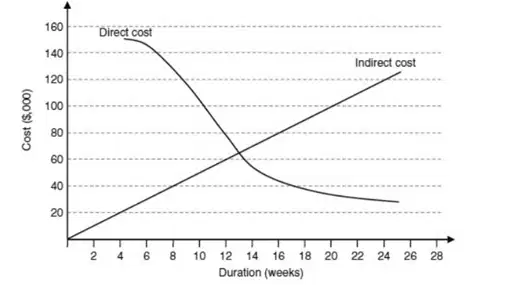
All costs for a construction project are classified as either direct costs (material, labor, etc.) or indirect costs (leasing and rental costs, utilities, etc.). The estimated variation of these cost categories vs. project duration (weeks) is shown. The optimum project duration (weeks) is most nearly:
10
13
16
19
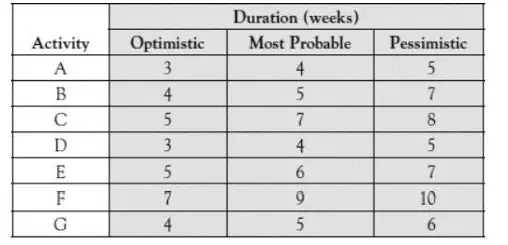
As part of the PERT analysis of a project, durations are estimated for activities A through G and summarized in the table below. The critical path for the project is ACEF.
The probability (%) that the project will be completed in less than 25 weeks is most nearly:
20
22
12
18
A contractor has the following options for a project lasting 18 months:
Option A: Monthly rental of excavation equipment at $15,000 per month + operating costs $2,000/month
Option B: Purchase equipment for $200,000
Maintenance costs = $8,000/month
Resale value of equipment after 18 months = $120,000
Nominal interest rate = 10% p.a.
The benefit-cost ratio of option B (purchasing) is most nearly:
0.95
1.55
1.25
1.95
A 5-story structure steel frame is to be constructed. Story height is 12 ft. The maximum tolerance for out-of-plumbness of the columns (in.) at the fourth floor is most nearly:
0.25
0.65
0.95
1.15
The safety log for a steel fabrication yard is shown below:
Total number of full-time employees = 400
Average number of hours worked during the year = 1,970
Total number of deaths = 0
Total number of cases with days away from work = 13 cases
Total number of days away from work = 120 days
Total other recordable cases 18 = cases
What is most nearly the annual total recordable case rate, as defined by OSHA?
8
5
31
18
A 6-in.-diameter × 12-in.-height concrete cylinder fails at a transverse load of 55,000 lb at 28 days in a split cylinder test. The 28-day compression strength (lb/in.2) of the concrete is most nearly:
6,200
3,200
5,200
4,200
A temporary road closure (not exceeding 20 min during the daytime) is established around a 1,250-ftl ong work zone (including a buffer space) on a freeway. The distance of the ROAD WORK AHEAD sign (ft) from the centerline of the work zone is most nearly:
4,800
5,800
6,800
7,800
A 6-lane freeway through mountainous terrain has ADT of 52,500 veh/day. The traffic stream includes 8% trucks, 3% buses, and 5% RVs. The FFS is estimated as 70 mph and the PHF = 0.9. Directional split is 60/40 and K = 0.12. The LOS for the peak direction of the road is most nearly:
B
C
D
E
A 2-lane highway has a posted speed limit of 50 mph. The alignment consists of a dangerous curve where the maximum posted speed is 20 mph. What is the distance (ft) upstream of the low speed limit section where a warning sign must be posted?
175
200
150
1225
A 12-ft-high × 60-ft-long × 12-in.-thick free standing wall is to be constructed using wall forms that are 12-ft high × 20 ft long.
Labor cost for erecting forms = $4.30/ft2 (new) and $1.30/ft2 (reuse)
Labor cost for dismantling forms = $1.05/ft2
Cost of concrete (assume 10% waste) = $120/yd3
Cost of reinforcement = $25/yd3
The cost of building the wall ($) is most nearly:
8,600
9,000
8,100
8,100
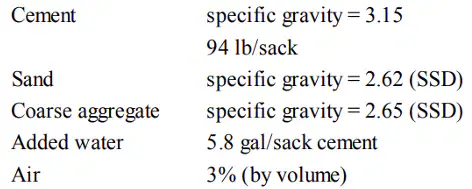
A concrete mix has proportions 1:1.6:2.6 (cement: sand: coarse aggregate) by weight. The following specifications are given:
The quantity of cement (lb/yd3) is most nearly:
690
650
670
630
The coordinates (ft) of the PC and PI for a circular horizontal curve are given below: PC: 1232.56 N, 123.32 E PI: 509.72 N, 172.11 W The degree of curve = 4° The curve deflects to the left. The coordinates of the PT (ft) are:
256.21 N, 121.72 W
130.18 S, 275.45 E
1157.28 S, 811.83 W
1149.62 N, 619.67 E
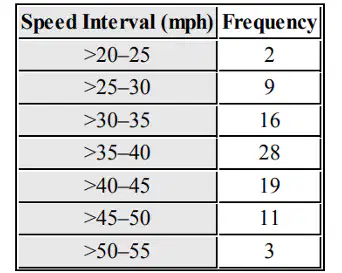
Spot speed measurements are taken for vehicles passing a given point on an urban road. Results are grouped (5-mph intervals) as shown in the table below.
46
40
50
45
An excavator has a bucket capacity of 2.8 yd3. Its operation cycle consists of the following phases: (a) excavation time = 45 sec, (b) travel time (two-way) = 4 min, and (c) dumping/transfer time = 30 sec. Assume an overall efficiency factor for the excavator = 85%. The quantity of excavated material = 50,000 ft3 (bank measure). The material has the following properties:
Swell = 20%
Unit weight = 120 lb/ft3
Water content = 30%
The number of days required to complete the job, assuming 8-hr workdays, is most nearly:
10
11
12
13
A pavement-based dual loop detector is used to monitor speeds of a stream of vehicles in one travel lane. The following speeds (mph) were recorded: 45, 51, 58, 47, 50, 53, 51, 42, 61, 51 The traffic flow rate during this period is estimated to be 1,450 vphpl. The mean headway (sec) is most nearly:
2.1
2.5
2.3
1.9
A transition curve is to be used to implement a change in cross-section from a normally crowned section to a fully superelevated section. The outer lane is to be rotated from the normally crowned section to a straight level section at the tangent-to-spiral (T.S.) station. The roadway section is rotated about the centerline. The following information is given:
Degree of curve (D) = 2.5°
Two 11-ft lanes
Design superelevation = 0.08 ft/ft
Grade = +1.50%
Crown = 0.015 ft/ft
P.I. station = 100 + 0.00
Deflection angle between tangents = 56°35′48″
Length of spiral = 230 ft
The station (ft) of the T.S. is most nearly:
88 + 00
87 + 25
88 + 50
86 + 50
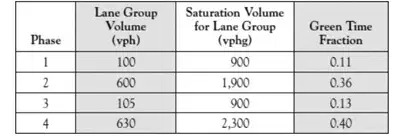
What is the recommended length of cycle for a 4-phase signal with 3-sec lost time per phase, with the following critical movements?
160 sec
160 sec
125 sec
105 sec
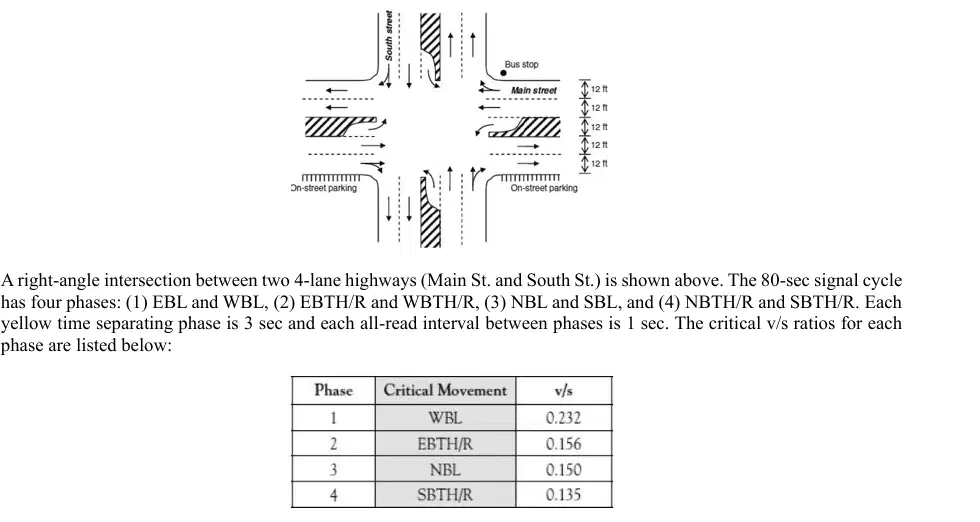
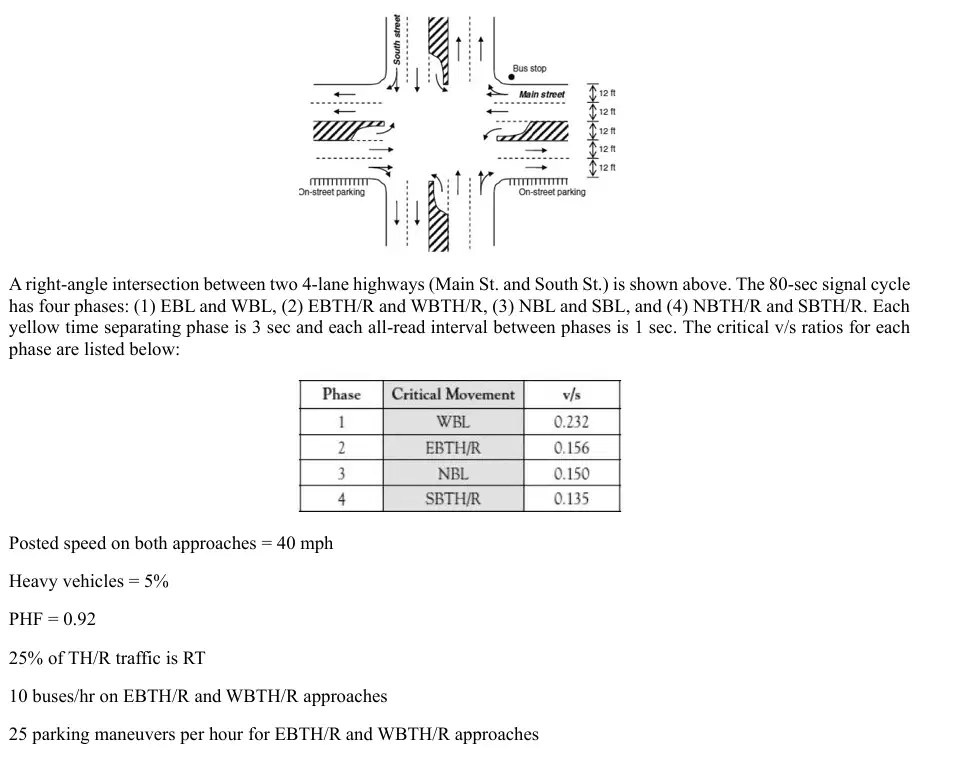
The saturation flow (vph) for the WBTH/R lane group is most nearly:
3,210
2,860
2,650
3,030
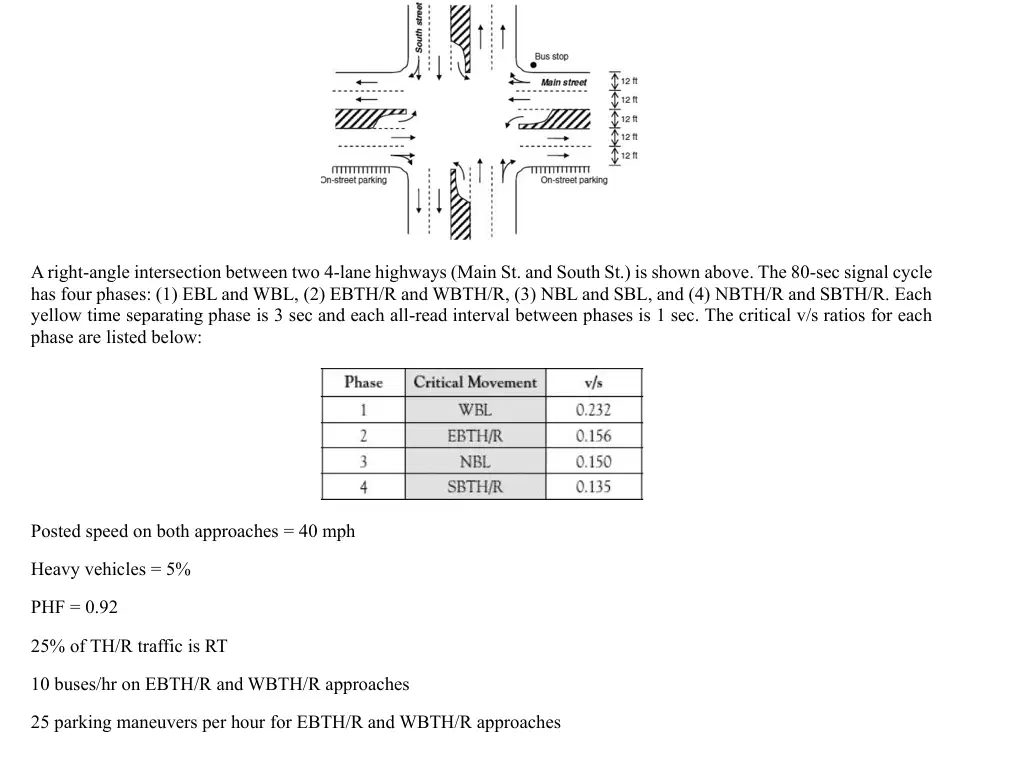
(See figure and data associated with problem 510 (43)) The minimum clearance interval (sec) for the intersection is most nearly:
4.0
4.5
5.8
5.3
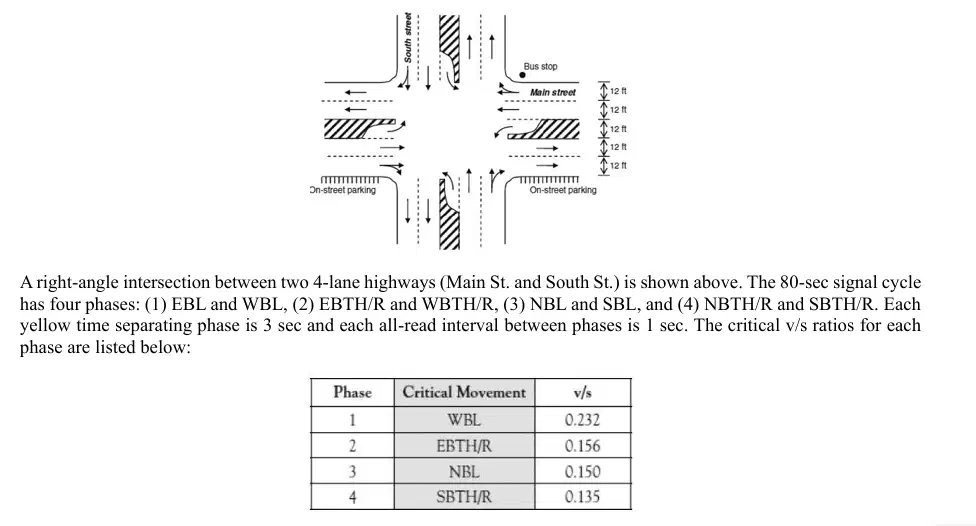
(See figure and data associated with problem 510 (43)) The minimum green time for the north-south signal phase, based on pedestrian volume, is most nearly:
19 sec
16 sec
22 sec
25 sec

