
 Worksheets
Diversity in Australia
Total questions: 42
Worksheet time: 21mins
what are some aspects of diversity in Australia?
Gender, socioeconomic status, ethnicity, religion, disability, personality, sexual orientation, age group
Only ethnicity and religion
Only gender and age group
Only language spoken
What percentage of the Australian population was born in Australia according to the 2016 Census?
67%
54%
73%
80%
According to the passage, which two countries had the most common overseas-born populations in Australia after Australia itself?
China and India
England and New Zealand
United States and Canada
Italy and Greece
What is ancestry an indication of?
The country a person was born in
The cultural group a person most closely identifies with
The language a person speaks
The religion a person follows
In 2016, there were over 300 separately identified languages spoken in Australian homes. More than one-fifth (21%) of Australians spoke a language other than English at home.
True
False
In 2016, what was the main religion reported in Australia?
Islam
Christianity
Buddhism
Hinduism
Which religious group had the second largest population in Australia in 2016 after Christianity?
Islam
Buddhism
Hinduism
No religion
One benefit of growing the population through migration is:
Increased cultural diversity
Decreased economic growth
Reduced workforce
Lower innovation
Australia would be like what if everyone had the same beliefs and looked, thought and behaved the same way?
It would lack diversity and individuality.
It would be more creative and innovative.
It would have a wide range of cultures.
It would encourage different perspectives.
Things you would miss if Australia was not a diverse nation include:
A variety of cultural foods and festivals
A single language spoken everywhere
No international influences in daily life
Limited range of traditions and customs
Cultural discrimination can harm young people by affecting their sense of self and wellbeing. Which of the following is a consequence of cultural discrimination on young people?
It can lead to feelings of isolation and low self-esteem.
It always improves their confidence.
It guarantees academic success.
It has no impact on their wellbeing.
Views of prejudice change as people mature in which of the following ways?
They become more understanding and less biased.
They become more rigid and prejudiced.
They remain exactly the same throughout life.
They become indifferent to all differences.
Diversity has added to Australian culture by:
introducing new foods, traditions, and perspectives
reducing the number of cultural festivals
limiting the variety of languages spoken
making everyone follow the same customs
The Australian Human Rights Commission can help if you are treated unfairly at work by:
Investigating complaints and providing advice on discrimination issues
Offering free legal representation in all court cases
Providing financial compensation directly to employees
Hiring employees for new jobs
Human rights are important because they:
protect individuals' freedoms and ensure equality
allow governments to have unlimited power
only apply to certain groups of people
are optional guidelines for behavior
What does equity mean in the context of health inequities in Australia?
A) Treating everyone as equals
B) Giving more to the rich
C) Ignoring differences
D) Only helping the poor
How does socioeconomic status affect health inequities in Australia?
People with lower socioeconomic status are more likely to suffer from lifestyle diseases such as heart disease, cancer, and stroke.
People with higher socioeconomic status have worse health outcomes.
Socioeconomic status has no effect on health.
Only children are affected by socioeconomic status.
Which occupation is more likely to suffer from stress and diseases associated with a sedentary lifestyle?
A) Office workers
B) Manual workers
C) Farmers
D) Athletes
People with access to a higher level of education tend to have a ________ health status.
higher
lower
unstable
unknown
The greater the access to health care, the greater the health status.
True
False
People who live in cities tend to have greater access to which of the following?
Health care
Socioeconomic status
Level of education
All of the above
What is the role of government economic and social policies in health inequities?
To reduce health inequities
To increase health inequities
To ignore health inequities
To only help the wealthy
Racism in Australian society can create health inequities due to which of the following?
Conflict
Loss of self-esteem
Reduced access to health services
All of the above
What is sex discrimination? Fill in the blank: Sex discrimination is when you are treated unfairly or harassed because you are a ______ or because you are a ______.
woman; man
child; adult
student; teacher
employer; employee
What is pregnancy discrimination? Fill in the blank: Pregnancy discrimination is when you are treated unfairly or harassed or not given the same opportunities because you are _______.
pregnant
married
employed
retired
What is race discrimination? Fill in the blank: Race discrimination is when you are treated unfairly or harassed because of your ______, colour, ethnic background, ethno-religious background, descent or nationality.
race
age
gender
height
What is age discrimination? Fill in the blank: Age discrimination is when you are treated unfairly or harassed because of your ______, for example, because people think you are too old, too young or middle aged.
age
height
gender
nationality
What is homosexual discrimination? Fill in the blank: Homosexual discrimination is when you are treated unfairly or harassed because you are ______ or ______, or someone thinks you are lesbian or gay.
lesbian; gay
male; female
young; old
rich; poor
What is disability discrimination? Fill in the blank: Disability discrimination is when you are treated unfairly or harassed because you have a ______, or someone thinks you have a ______.
disability; disability
disease; disease
injury; injury
illness; illness
What is transgender (transsexual) discrimination? Fill in the blank: Transgender (transsexual) discrimination is when you are treated unfairly or harassed because you are ______ or others think you are ______.
transgender; transgender
male; female
young; old
rich; poor
Brainstorm what you could do if you were the victim of discrimination or harassment in the following context: In a social setting.
Remove yourself from the situation and seek support from friends or authorities.
Ignore the situation and hope it goes away.
Confront the person aggressively in public.
Pretend it never happened and avoid talking about it.
Advocating for the rights of a person who was a victim of race discrimination can be done by:
Reporting the incident to relevant authorities or organizations.
Ignoring the situation to avoid conflict.
Discouraging the victim from speaking out.
Supporting discriminatory practices.
Discrimination can affect a person’s sense of self by:
Lowering their self-esteem and self-worth.
Improving their confidence and self-image.
Making them feel more accepted in society.
Increasing their sense of belonging.
Using inclusive language and advocating for the rights of others is important because:
It promotes respect and equality for everyone.
It only benefits a specific group of people.
It discourages open communication.
It limits opportunities for collaboration.
Provide a definition for the term 'Racial vilification'.
Racial vilification refers to any public act that could incite hatred, serious contempt, or severe ridicule of a person or group because of their race.
Racial vilification refers to the celebration of cultural diversity in public spaces.
Racial vilification refers to the promotion of racial harmony through education.
Racial vilification refers to the enforcement of equal employment opportunities regardless of race.
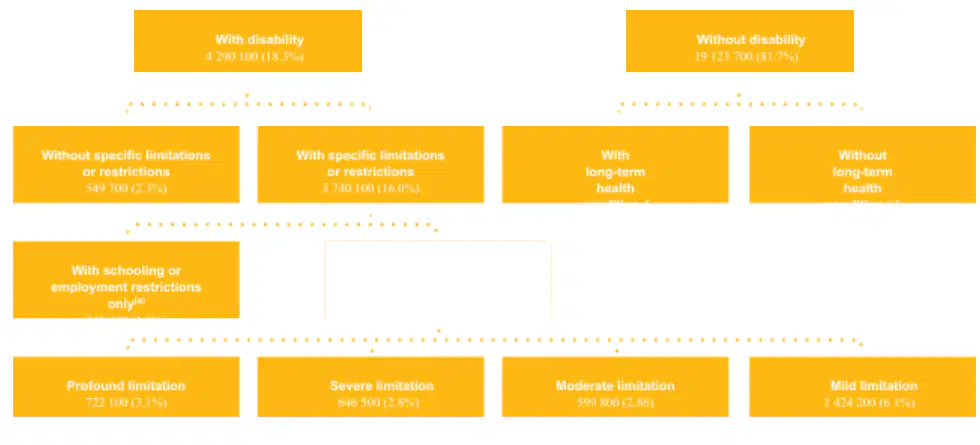
According to the 2015 Survey of Disability, Ageing and Carers, what percentage of Australians reported living with a disability?
10%
18.3%
25%
50%
What is the definition of a disability as described in the worksheet?
A condition that ‘gets in the way’ of a person’s undertaking of core activities, that is, activities that are associated with self-care, mobility and communication.
A temporary illness that does not affect daily activities.
A condition that only affects a person’s ability to work.
A minor inconvenience that does not impact self-care, mobility, or communication.
People with disabilities have specific needs under the heading: Health. Which of the following best describes these needs?
Access to appropriate healthcare services and facilities
Exclusive use of traditional medicine only
No need for specialized health services
Limited access to health information
People with disabilities have specific needs under the heading: Education. Which of the following best describes these needs?
Accessible learning materials and inclusive teaching methods
Standardized testing without accommodations
Segregated classrooms for all students
Limited access to educational resources
People with disability commonly experience which type of discrimination?
Barriers to access and negative attitudes
Excessive financial support
Special privileges in all areas
Complete social acceptance
A sporting club that caters specifically for people with disabilities is known as:
Paralympic Sports Club
General Fitness Club
Youth Soccer League
Senior Citizens Tennis Club
Overcoming adversity often involves which of the following?
Perseverance and problem-solving
Ignoring the problem
Giving up immediately
Blaming others

