
 Worksheets
Learners Permit Practice Test 3
Total questions: 21
Worksheet time: 11mins
"Passenger restrictions apply to operator's license holders who have received their license on or after August 1, 2008 for what length of time?"
3 months.
12 months.
6 months.
As of August 1, 2008, what is the nighttime curfew for 16 and 17-year olds?
10 pm to 6 am.
11 pm to 5 am.
12 am to 5 am.
The first thing that a drink of alcohol effects is:
Vision.
Judgment and skills.
Balance.
"Reaction time is slower after:"
Drinking alcohol.
Sleeping.
Working hard.
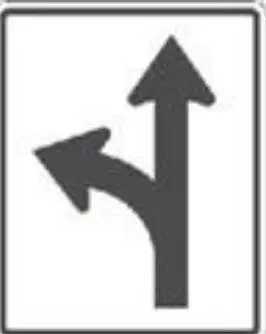
This sign means you:
Can go straight ahead.
Are approaching a divided highway.
Can turn left or go straight ahead.
Children on bicycles should be given even more space by motor vehicle operators because:
They do not have the same physical reflexes as an adult.
They are smaller and more difficult to see.
Both. They are smaller and more difficult to see and they do not have the same physical reflexes as an adult.
A bicyclist should do which of the following when making a left-hand turn:
Signal and move to the left side of the lane before turning.
Stay on the right side and turn left from there.
Make a U-turn from the right side of the road.
Stop and walk the bicycle across the intersection.
"You may not park within how many feet of a fire hydrant?"
5 feet.
15 feet.
10 feet.
To make a right turn, you should:
Speed up to provide more room for the vehicle behind to pass.
Turn right from any lane.
Turn from the right lane.
To make a left turn, you should:
Make the turn from the center lane.
Make the turn from the left lane.
Make the turn from any lane, providing you signal well in advance.
A broken yellow line between two lanes of traffic means:
Both lanes of traffic are going in the same direction.
Passing is permitted when it's safe.
Passing is not permitted.
Signs or lane markings that indicate a No Passing Zone tell you that:
There are oncoming cars passing in your direction.
Passing is permitted only in daylight hours.
You can't see far enough ahead to pass.
If weather or light conditions require you to have your lights on:
Use your parking lights.
Use your high beams.
Use your low beams.
The blind spots where trucks will not be able to see you are:
Directly behind the body.
The immediate left of the cab.
Your vehicle has a mechanical problem. You should:
Signal and pull into the slow lane.
Stop in your lane and put on your hazard lights.
Put on your hazard lights and pull off the road.
There's an emergency vehicle with flashing lights and siren coming. You should:
Slow down and keep moving.
Maintain your speed.
Pull over to the right and stop.
You see pedestrians near the road. You should:
Sound your horn and maintain speed.
Speed up to clear the area quickly.
Slow down and pass with caution.
In work zones, you should:
Follow the driver in front of you closely.
Pass the driver in front of you as soon as you can.
Avoid tailgating and keep a safe following distance.
Fines for speeding or other illegal behavior in work zones:
Can be double normal fines.
Are generally not enforced.
Can be argued in a court.
If there are no reduced speed limit signs clearly posted within a work zone:
You should obey the normal posted speed limit.
You should drive 15 mph slower than the posted speed limit.
You should drive 15 mph faster than the posted speed limit.
When driving through a work zone:
You do not need to obey traffic signs.
Traffic patterns usually remain the same.
Traffic patterns can change daily.

