
 Worksheets
Understanding Matter and Its Changes
Total questions: 190
Worksheet time: 5hrs 37mins
What are the three states of matter?
gas, liquid, crystal
solid, liquid, plasma
solid, liquid, gas
plasma, vapor, foam
Which state of matter has a definite shape and volume?
Solid
Gas
Plasma
Liquid
What is the process called when a solid turns into a liquid?
Freezing
Condensation
Sublimation
Melting
What happens to the particles in a gas when it is heated?
The particles in a gas expand but do not change their speed when heated.
The particles in a gas slow down and collide less frequently when heated.
The particles in a gas move faster and collide more frequently when heated.
The particles in a gas become denser and settle at the bottom when heated.
Which of the following is a physical change?
Melting ice into water
Dissolving sugar in water
Boiling water to steam
Breaking a glass bottle
What is the term for the change from gas to liquid?
Evaporation
Condensation
Precipitation
Sublimation
What is the density of an object that has a mass of 20 grams and a volume of 5 cm³?
10 g/cm³
2 g/cm³
5 g/cm³
4 g/cm³
Which state of matter has the most energy?
Liquid
Plasma
Gas
Solid
What is sublimation?
Sublimation is the transition of a substance from solid to gas without becoming liquid.
The process of a gas turning into a solid directly.
The evaporation of a liquid into a gas.
The melting of a solid into a liquid.
What is the main characteristic of liquids?
Definite shape and no ability to flow.
Definite volume and ability to flow.
Definite volume and fixed shape.
Indefinite volume and fixed shape.
Which of the following is a chemical change?
Rusting of iron
Boiling water
Dissolving sugar in water
Melting of ice
What happens during condensation?
Liquid water evaporates into water vapor.
Water vapor is absorbed by soil.
Water vapor freezes into ice crystals.
Condensation is the process where water vapor turns into liquid water.
What is the formula for calculating density?
Density = Volume / Mass
Density = Mass + Volume
Density = Mass / Volume
Density = Mass x Volume
What is the property of gases that allows them to fill a container?
Gases are incompressible and maintain a fixed volume.
Gases have strong intermolecular forces that keep them in place.
Gases only occupy the space at the bottom of a container.
Gases expand to fill their container due to high kinetic energy and minimal intermolecular forces.
What occurs during evaporation?
Liquid water freezes into ice.
Molecules transition from gas to liquid phase.
Molecules transition from liquid to gas phase.
Heat is absorbed from the surroundings.
What is the term for a change that does not alter the chemical composition of a substance?
Chemical change
Physical change
Nuclear change
Biological change
What is the density of water?
0.5 g/cm³
1.5 g/cm³
2 g/cm³
1 g/cm³
What happens to the volume of a gas when it is compressed?
The volume of a gas remains the same when it is compressed.
The volume of a gas decreases when it is compressed.
The volume of a gas increases when it is compressed.
The volume of a gas fluctuates randomly when it is compressed.
Which state of matter has particles that are tightly packed together?
Liquid
Gas
Plasma
Solid
What is the process called when a liquid turns into a solid?
Condensing
Melting
Evaporating
Freezing

Scientists find two substances. One is a toxic chemical. The other is a safe chemical. Both chemicals are liquids at room temperature. As a test, the scientists transfer the same amount of energy OUT OF the two containers and find that only the toxic chemical changes phase. How is the toxic chemical different from the safe chemical?
weaker attraction between its molecules than the safe chemical. Its molecules now move in place.
weaker attraction between its molecules than the safe chemical. Its molecules now move around each other.
stronger attraction between its molecules than the safe chemical. Its molecules now move away from each other.
stronger attraction between its molecules than the safe chemical. Its molecules now move in place.
Cesar and Ming were investigating a see-through container of water. Water can be a solid, liquid, or gas. At first, Cesar and Ming said the water molecules were moving in place. Later , the water molecules were moving around each other. What change did they observe to the water?
At first, the water was a gas. Later, it was a liquid.
At first, the water was a liquid. Later, it was a solid.
At first, the water was a solid. Later, it was a liquid.
At first, the water was a liquid. Later, it was a gas.
A company uses a substance that is a solid under normal conditions. This substance will be used in extreme conditions, which could make the substance’s molecules move faster and cause a phase change. How would this phase change occur, and how would the molecules of the substance be affected under these extreme conditions?
Energy would be transferred . . .
OUT of the substance, and its molecules would move away from each other.
OUT of the substance, and its molecules would move around each other.
INTO the substance, and its molecules would move around each other.
INTOthe substance, and its molecules would move in place.

The image above shows information about two different substances in sealed containers. At room temperature, both substances are liquids. A scientist transfers the same amount of energy into both substances. One substance changes phase, but the other does not. Which chemical changed phase, and why did it change?
Substance A changed phase because its molecules were able to move fast enough to overcome the attraction between them. Its molecules now move away from each other.
Substance A changed phase because the weak attraction between its molecules allowed them to move faster. Its molecules now move away from each other.
Substance B changed phase because the molecules were able to move fast enough to overcome the attraction between them. Its molecules now move away from each other.
Substance B changed phase because the strong attraction between molecules made their movement slower. Its molecules now move in place.
Refrigerators are able to transfer energy out of a substance. At first, the substance is a gas. The refrigerator changes the phase of the substance by transferring energy out of it. How does this change affect the substance’s molecules?
After the phase change, the molecules move . . .
slower, and they move away from each other.
slower, and they move around each other.
faster, and they move around each other.
faster, and they move in place.

Maggie left a sealed jar of water outside her home. Water can be a solid, liquid, or gas. When she put it outside, the water was a solid. Twelve hours later, the water had changed phase and was a liquid. What happened to the water molecules?
Before the student left, the molecules were moving in place. After, the molecules were moving around each other.
Before the student left, the molecules were moving around each other. After, the molecules were moving away from each other.
Before the student left, the molecules were moving around each other. After, the molecules were moving in place.
Before the student left, the molecules were moving away from each other. After, the molecules were moving around each other.

Divers found two substances on the bottom of the ocean. At room temperature, both substances are liquid. Scientists then transferred the same amount of energy out of both substances. When a scientist checked again, Substance 1 had changed phase, but Substance 2 had not. How are Substances 1 and 2 different?
weaker attraction between its molecules than Substance 2. Its molecules now move in place.
weaker attraction between its molecules than Substance 2. Its molecules now move around each other.
stronger attraction between its molecules than Substance 2. Its molecules now move away from each other.
stronger attraction between its molecules than Substance 2. Its molecules now move in place.
Tom measured the temperature of a pond near his house. Before he left for school, the water in the pond was 15°C. When he came home from school, the temperature of the pond was higher than it was in the morning. What happened to the water molecules while he was at school?
The molecules got closer together.
The molecules started moving faster.
The water lost cold molecules.
The molecules became larger.

A scientist had a container of two substances. The image shows these substances. At room temperature, both substances are liquids. The same amount of energy was transferred INTO both substances. After a few hours, one of the substances had changed phase, while the other did not. Which substance would most likely change phases, and explain why?
The substance #1 changed because the molecules were able to move fast enough to overcome the attraction between them. Its molecules now move away from each other.
The substance #1 changed because the strong attraction between molecules made their movement slower. Its molecules now move around each other.
The substance #2 changed because the weak attraction between molecules let them move faster. Its molecules now move away from each other.
The substance #2changed because the molecules were able to move fast enough to overcome the attraction between them. Its molecules now move in place.

A scientist has two substances that she is testing in her lab: a pink substance and a green substance. At room temperature, both substances are liquids. The scientist transferred the same amount of energy into both substances. She finds only the pink substance changed phase. How is the pink substance different from the green substance?
The pink substance has a . .
weaker attraction between its molecules than the green substance. Its molecules now move away from each other.
weaker attraction between its molecules than the green substance. Its molecules now move in place.
stronger attraction between its molecules than the green substance. Its molecules now move away from each other.
stronger attraction between its molecules than the green substance. Its molecules move around each other.

An Earth scientist brought an unknown substance from underground back to her lab. The substance was in the gas phase and was put into a sealed tank as shown above. She slowed down the molecules inside the tank and the substance changed phase. How did she do this, and how did it affect the molecules?
She transferred energy . . .
into the substance, and the molecules moved around each other.
into the substance, and the molecules moved away from each other.
out of the substance, and the molecules moved around each other.
out of the substance, and the molecules moved in place
Detectives find two substances at a crime scene. One is a poison, and the other is a cleaning chemical. At room temperature, both substances are liquids. To test the substances, the detectives transfer the same amount of energy into both substances, but only the cleaning chemical changes phase. How is the cleaning chemical different from the poison?
The cleaning chemical has a . .
weaker attraction between its molecules than the poison. Its molecules now move in place.
weaker attraction between its molecules than the poison. Its molecules now move away from each other.
stronger attraction between its molecules than the poison. Its molecules now move away from each other.
stronger attraction between its molecules than the poison. Its molecules now move around each other.
Cesar and Ming were investigating a see-through container of water. Water can be a solid, liquid, or gas. At first, Cesar and Ming said the water molecules were moving in place. Later , the water molecules were moving around each other. What change did they observe to the water?
At first, the water was a gas. Later, it was a liquid.
At first, the water was a liquid. Later, it was a solid.
At first, the water was a solid. Later, it was a liquid.
At first, the water was a liquid. Later, it was a gas.
A student left a jar of water outside his home. Water can be a solid, liquid, or gas. When he put the jar outside, the water was liquid. Twelve hours later, the water had changed phase and was a gas. What happened to the water molecules?
When the student left the jar outside, the molecules were moving around each other. Later, the molecules were moving in place.
When the student left the jar outside, the molecules were moving away from each other. Later, the molecules were moving around each other.
When the student left the jar outside, the molecules were moving in place. Later, the molecules were moving around each other
When the student left the jar outside, the molecules were moving around each other. Later, the molecules were moving away from each other.
How is the kinetic energy of molecules changing when the molecules move faster?
The kinetic energy . . .
is not changing.
depends on the molecules.
is decreasing.
is increasing.
17. Sammy's superball is made of synthetic rubber. When are the synthetic rubber in her superball moving?
The synthetic rubber molecules are . . .
only moving when the superball is bouncing.
only moving when the superball is in the toy box.
always moving.
never moving.
Does the attraction in a substance change when it changes phases?
Yes, attraction changes with phase change.
No, a substances attraction will stay the same even if the phase changes.
The way molecules in a substance move around relative to each other
Kinetic Energy
Molecule
Phase
Freedom of Movement

The energy that an object has because it is moving
Molecule
Refute
Density
Kinetic Energy

A pull between two molecules that is always the same for a substance
Kinetic Energy
Molecular Attraction
Molecule
Mixture
A noticeably different form or state of the same substance
Mixture
Phase
Mass
Density
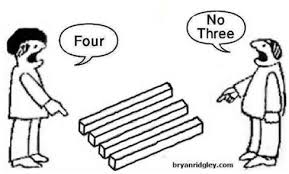
To provide evidence that goes against a claim
Mixture
Refute
Claim
Sclae

A cook had a jar containing a sweet food and a jar containing a sour food. The image above shows the sweet and sour foods. At room temperature, both foods are liquids. The same amount of energy was transferred out of both substances. Later, one of the foods had changed phase while the other had not. Which food changed phase, and how did it change?
The sweet food changed because the molecules were able to move fast enough to overcome the attraction between them. Its molecules now move away from each other.
The sweet food changed because the strong attraction between molecules made their movement slower. Its molecules now move in place.
The sour food changed because the weak attraction between molecules let them move faster. Its molecules now move away from each other.
The sour food changed because the molecules were able to move fast enough to overcome the attraction between them. Its molecules now move in place.

A student left a sealed jar of water outside her home. Water can be a solid, liquid, or gas. When she put it outside, the water was a liquid. Twelve hours later, the water had changed phase and was a soldi. What happened to the water molecules?
Before the student left, the molecules were moving in place. After, the molecules were moving around each other.
Before the student left, the molecules were moving around each other. After, the molecules were moving away from each other.
Before the student left, the molecules were moving around each other. After, the molecules were moving in place.
Before the student left, the molecules were moving away from each other. After, the molecules were moving around each other.
Lily is doing a science experiment with a substance in a sealed jar. At first, the substance’s molecules are moving in place. What will happen to Lily’s substance if she transfers energy into the substance and causes a phase change?
After the phase change, the substance’s molecules will move . . .
faster, and the substance will be a liquid.
faster, and the substance will be a gas.
slower, and the substance will be a solid.
slower, and the substance will be a liquid.
What happens to molecules when their kinetic energy decreases?
They move slower.
They move faster.
They get heavier.
It depends on the type of molecules.
Jose's go cart is made of steel. When are the steel molecules in his bicycle moving?
The aluminum molecules are . . .
only moving when Jamil is riding his bicycle.
only moving when Jamil is not riding his bicycle.
always moving.
never moving.
A property of a material that tells you how much of the material will dissolve in a liquid
temperature
solubility
condensation
thermal energy
A substance changing from a liquid to a gas
evaporation
condensation
melting point
boiling point
A measure of the average kinetic energy of the particles in an object; tells you how hot (or cold) something is
boiling point
gas
liquid
temperature
One of the 3 forms (solid , liquid , and gas) in which matter exists is referred to ____________.
evaporation
density
states of matter
temperature

A substance changing from a gas to a liquid
condensation
evaporation
melting point
bonding
The temperature where a material changes from a solid to a liquid
heat wave
boiling point
evaporation
melting point

The energy of moving molecules. All substances have this because they are made of molecules that are moving
substance
bonding
thermal energy
solar
Two or more atoms bonded together
solvent
mixture
element
molecule

A pure substance made of only one kind of atom
element
molecule
compound
mixture
The temperature where a material changes from a liquid to a gas
boiling point
melting point
room temperature
thermal
A property of a material that tells you how easily the material catches on fire
solubility
heat
flammability
potential
A property of a material that tells you how closely packed together the particles of the material are
bonded
density
substance
atom
Smallest unit of matter that retains the properties of an element is called _________.
tiny
molecule
particle
atom
Gas --> Liquid
Particles are moving away from each other -> particles are moving around each other
Particles are moving in place -> particles are moving around each other
Particles are moving away from each other -> particles are moving in place
Particles are moving in place -> particles particles are moving in place
Solid --> liquid
Particles are moving away from each other -> particles are moving around each other
Particles are moving in place -> particles are moving around each other
Particles are moving away from each other -> particles are moving in place
Particles are moving in place -> particles particles are moving in place
Gas--> solid
Particles are moving away from each other -> particles are moving around each other
Particles are moving in place -> particles are moving around each other
Particles are moving away from each other -> particles are moving in place
Particles are moving in place -> particles particles are moving in place
You are looking at a substance that started as an ice cube but melted in to water. What happened to the molecules?
Particles are moving away from each other -> particles are moving around each other
Particles are moving in place -> particles are moving around each other
Particles are moving away from each other -> particles are moving in place
Particles are moving in place -> particles particles are moving in place
You are looking at a substance that started as water and evaporated into water vapor. What happened to the molecules?
Particles are moving away from each other -> particles are moving around each other
Particles are moving in place -> particles are moving around each other
Particles are moving away from each other -> particles are moving in place
Particles are moving around each other -> particles are moving away from each other

Scientists are able to change oxygen in the gas state to oxygen as a liquid. How do they do that?
They add energy and increase the temperature
They reduce energy and decrease the temperature
Refrigerators are able to transfer energy out of a substance. At first, the substance is a liquid. The refrigerator changes the phase of the substance by transferring energy out of it. How does this change affect the substance’s molecules?
After the phase change, the molecules move . . .
slower, and they move away from each other.
slower, and they move in place.
faster, and they move around each other.
faster, and they move in place.
the way molecules in a substance move around relative to each other
phase
phase change
freedom of movement
temperature
a pull between two molecules that is always the same for a substance
freedom of movement
molecular attraction
temperature
molecule
a noticeably different form or state of the same substance
molecule
condensation
evaporation
phase
a measure of the average kinetic energy of the molecules of a substance
phase
molecule
temperature
scale
When I am looking at the lake on Titan in 2007 and then again in 2009 when it disappeared, I am observing the _______ scale.
Macro
Molecular
Energy
When I am looking at the molecules of a phase change in the simulation I am observing on the _________ scale.
Macro
Molecular
Energy
Cesar and Ming were investigating a see-through container of water. Water can be a solid, liquid, or gas. At first, Cesar and Ming said the water molecules were moving in place. Later, the water molecules were moving around each other. What change did they observe to the water?
At first, the water was a gas. Later, it was a liquid.
At first, the water was a liquid. Later, it was a solid.
At first, the water was a solid. Later, it was a liquid.
At first, the water was a liquid. Later, it was a gas.

Two different cars, the Model S and Model T, use different substances in their engines. The image above shows the two substances. At room temperature, both substances are liquids. A car mechanic transferred the same amount of energy out of the two containers, but only one substance changed phase. Which car’s substance changed phase, and how did it change?
The Model T’s substance changed phase because the attraction of the molecules was able to overcome their slower movement. Its molecules now move in place.
The Model T’s substance changed phase because the strong attraction between the molecules made their movement slower. Its molecules now move in place.
The Model S’s substance changed phase because the weak attraction between the molecules allowed them to move faster. Its molecules now move around each other.
The Model S’s substance changed phase because the attraction was able to overcome the slower molecules. Its molecules now move away from each other.

Substance A and B are both liquid. Which will become a gas more easily if energy is added?
Substance A because its molecules will be able to move fast enough to overcome the attraction between them. Its molecules now move away from each other.
Substance B because its molecules will be able to move fast enough to overcome the attraction between them. Its molecules now move away from each other.
Substance A because the weak attraction between its molecules allowed them to move faster. Its molecules now move away from each other.
Substance B because the weak attraction between its molecules allowed them to move faster. Its molecules now move away from each other.

At room temperature, both substances are liquids. A scientist transfers the same amount of energy into both substances. One substance changes phase, but the other does not. Which chemical changed phase, and why did it change?
Substance A because its molecules will be able to move fast enough to overcome the attraction between them. Its molecules now move away from each other.
Substance B because its molecules will be able to move fast enough to overcome the attraction between them. Its molecules now move away from each other.
Substance A because the weak attraction between its molecules allowed them to move faster. Its molecules now move away from each other.
Substance B because the weak attraction between its molecules allowed them to move faster. Its molecules now move away from each other.

Which of the following is not a method for heat transfer
Radiation
Insulation
Conduction
Convection
How does heat energy reach the Earth from the Sun
Convection
Radiation
Conduction
Insulation
What is the definition of CONDUCTION?
When heat is transferred from objects like rays of light or electromagnetically.
a hot liquid or air that expands, becomes less dense, and rises or becomes more dense, and sinks.
When thermal energy transfers by collisions between particles.
When heat transfers through the heater or AC in your house.
What is the definition of CONVECTION
When heat transfers through waves.
When heat transfers from objects that are touching.
The transfer of thermal energy in a fluid (liquid/gas) by movement of warm / cool fluids.
Heat traveling from the sun
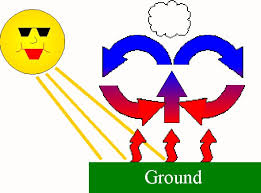

Conduction
Convection
Radiation
When you pull your Totino's Pizza rolls out of the oven and the pan is so hot it burns your hand because you forgot your protective mit. The energy move to your hand from the pan to your hand through ...
Conduction
Radiation
Convection
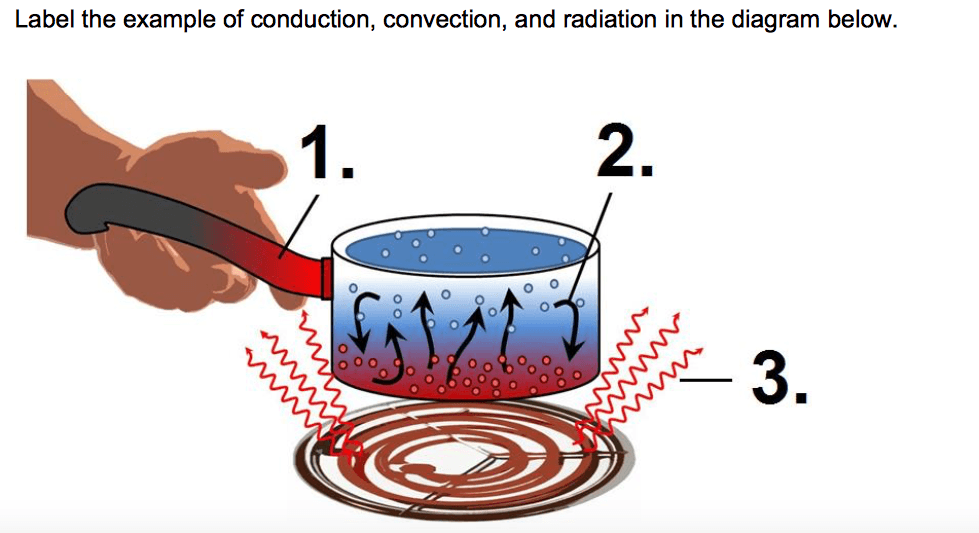
What type of thermal energy transfer is number 1 pointing to?
Convection
Conduction
Radiation
Insulation
The heat you feel when you put your hands ABOVE a fire.
conduction
convection
radiation
My spoon is hot after leaving it on the pot that was on the stove.
conduction
convection
radiation
This is responsible for making macaroni rise and fall in a pot on the stove.
conduction
convection
radiation
The heat my snake feels from the heat lamp above him.
conduction
convection
radiation
Why the dog lays down next to the wood stove.
conduction
convection
radiation
Why the kettle on the stove gets hot.
conduction
convection
radiation
Metals are great at allowing heat to flow through, we call these.
conductors
insulators
Rubber is not good at allowing heat to flow through, we call these.
conductors
insulators
How does heat move?
In many directions
from warm places to cooler places
from cold places to warm places
Both B and C
All of the following are good conductors of heat EXCEPT
Copper
Iron
Plastic
Aluminum
A change in which a substance undergoes changes in its physical properties is called _____.
chemical change
physical change
irreversible change
biological change
Browning of an apple after it is cut is an example of ____.
physical change
chemical change
reversible change
biological change
When Magnesium ribbon is burnt in oxygen, the product obtained is ___.
Magnesium chloride
Magnesium sulphate
Magnesium carbide
Magnesium oxide
When Magnesium ribbon is ignited using a candle flame, it burns with a __________.
sparkling red light
dull yellow light
bright green light
brilliant white light
Which of the following is a physical change?
Rusting of iron
Melting of wax
Burning of coal
Curdling of milk
Which of the following is a chemical change?
Twinkling of stars
Cutting of fruits
Cooking of vegetables
Boling of water
A chemical change may involve ____________.
change in color only
change in temperature only
evolution of gas only
all of the above
Which of the following is/are true when milk changes to curd?
(i) Its state is changed from liquid to semi solid
(ii) It changes color
(iii) It changes taste
(iv) The change cannot be reversed.
Choose the correct option from the ones given below:
(i) and (ii) are correct
(ii) and (iii) are correct
(i), (iii) and (iv) are correct
All are correct
Which of the following is incorrect for a chemical reaction?
Heat may be given out but never absorbed
Sound may be produced
A color change may take place
A gas may be evolved
Which of the following is false?
When a candle burns, both physical and chemical changes take place.
Stretching of a rubber band is not a physical change
Melting of ice is a physical change
Dissolving common salt in water is not a chemical change
The gas that we use in the kitchen is liquefied petroleum gas (LPG). In a cylinder, it exists as a liquid. When it is released from the cylinder it becomes a gas (Change A), and then it burns (Change B). Which of the following is true?
Process A is a Physical Change
Process B is a Chemical change
Both processes A and B are chemical changes
Both (a) and (b) are True
Anaerobic bacteria digest the animal waste and produce biogas (Change A). The gas is burnt as fuel (Change B). The following statements pertain to these changes. Choose the correct one.
Process A –Physical Change
Process B- Chemical change
Both process A and B are chemical changes
Both process A and B are physical change
A physical change is named as such because __________.
it involves changes in physical properties of a substance
it is accompanied by a transfer of energy
it is a reversible process
it involves the formation of new products
A change in which the original substance can be regained by a change in conditions is called _____________.
a reversible change
a physical change
a chemical change
both (a) and (b)
Expansion on heating and contraction on cooling of metals are examples of ___________.
chemical changes
physical changes
irreversible changes
permanent changes
Melting and boiling point are ______________ properties of a substance.
physical
chemical
structural
external
“Adding salt to water changes the taste of water.” Which of the following statements is true regarding this change?
It is a chemical change because a new substance is formed.
It is a physical change because the original substance can be recovered
It is a chemical change because the salt cannot be recovered.
It is a physical change because there is a slight change in colour.
Pooja took a candle in a vessel and heated the vessel. Even though the candle did not burn, it changed its shape and state. What kind of change is this?
Irreversible change
Physical change
Chemical change
Permanent change
Which of the following is a physical change?
Burning of kerosene
Lighting an electric bulb
Heating sugar in a pan
Heating sulphur with iron filings to a red-hot state

On the basis of the following diagrams/pictures, answer the question given thereafter. Which of the following changes represent a chemical change?
Only (i)
Only (ii)
(i) and (ii)
Neither
Which of the following is a example of physical change ?
burning of wood
photosynthesis
melting of ice-cream
ripening of fruit

What does the picture represent ?
physical change
chemical change

Observe the picture and choose the correct option.
Irreversible physical change
Reversible physical change
Choose the picture that shows chemical change.


In physical change , the substance formed has different properties than the original substance.
True
False
A chemical change may involve
Evolution of gas
Change in temperature
Change in colour
All of the above
When a candle burns, both physical and chemical changes occurs.
True
False
Which of the following is an example of a physical change?
a bike rusting
toast burning
butter melting
food spoiling
Which of the following is an example of a chemical change?
a penny tarnishing
a mirror being scratched
hair being cut
water being boiled
Which of the following examples provides evidence of a PHYSICAL change?
Wood is burned and releases ash and smoke
Iron rusts over time
When mixed, baking soda and vinegar form gas bubbles
Boiling water bubbles when heated

A white tablet is dropped into water. The water becomes cloudy and bubbles are produced. What type of change has occurred?
Physical change
Chemical change
No change
Which observations prove a chemical change occurred
Dissolving and expected color change
Mixing and dissolving
State of matter change and boiling water bubbles
Unexpected color change and temperature change
What is physical change?
How two chemicals react with one another when combined
A property that we can measure or observe with our 5 senses or other tools
When two chemicals react with one another to form a new substance
When a change occurs but it does not result in the formation of a new substance
Which of these is a clue that a chemical change is happening?
Fizzing or bubbling
Color changes
Creation/loss of heat
All of these are clues that a chemical change is happening.

Which of the following is a sign that a chemical reaction (or change) has occurred?
change in shape
melting
formation of a gas
dissolving

Frying an egg to make an omelette is a _______________ change
Reversible change
Irreversible change

Students mixed two liquids in a beaker and listed their observations. Based on these observations, which statement contains the best evidence that a chemical reaction occurred?
There is a change in shape.
There is a change in volume.
The two liquids mix into a solution.
The two liquids form a new substance.
Which statement best describes evidence that a chemical reaction occurs as a cake bakes?
The water in the cake batter evaporates.
The cake rises as gas bubbles form in the baking cake.
The cake takes the shape of the container in which it is baked.
The water in the cake batter is used to keep the cake moist as it bakes.
Frank has an eraser. It has a mass of 4 g, and a volume of 2 cm3. What is its density?
Jack has a rock. The rock has a mass of 14 g and a volume of 2 cm3. What is the density of the rock?
7 cm3
An object has mass of 500 gram and volume of 1000 cm3. The density of the object is ...
2000 kg/m3
5000 kg/m3
500 kg/m3
50 kg/m3


Look at the picture!
The volume of the rock is measured with the method as shown at picture. If the object has a mass of 160 gram, so the density of the object is ....
2 gram/cm3
4 gram/cm3
8 gram/cm3
12 gram/cm3

Observe the picture for mass and volume measurement. Based on the picture, the object has density of ...
79 g/cm3
0,79 g/cm3
7,9 g/cm3
790 g/cm3

Based on the picture, we can calculate the density of the rock.
The density of the rock is ...
6000 kg/m3
4000 kg/m3
2400 kg/m3
670 kg/m3
What is the volume of 143 gram of an object if it has a density of 11 g/cm3?
13 g
13 cm3
0.075 g
What is the volume of 55 grams of an object if it has a density of 11 g/cm3?
605 cm3
5 cm3
66 cm3
0.2 cm3
An object has mass of 360 gram. If the density of object is 1,8 gram/cm3, so the volume of the object is ...
20 cm3
200 cm3
400 cm3
648 cm3
What is the mass of a 100 mL liquid if it has a density of 3 g/mL?
300 g
33.3 g
.03 g
103 mL
What is the mass of a 25 cm3 liquid if it has a density of 5 g/mL?
125 g
5 g
30 g
.2 mL
An aluminum cube has a side of 20 cm. If the density of aluminum is 2700 kg/m3, so the mass of the cube is ....
21.6 kg
540 kg
13,5 kg
135 kg
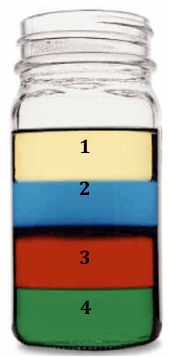

Which box has a higher density?
A
B
They are the same
Calculate the density in the following question: A flower pot has a mass of 95 g and a volume of 92 mL.
1.03 g/mL
0.97 g/mL
1.01 g/mL
0.99 g/mL
An object has a volume of 6 cm3 and a mass of 42 g. What's it's density?
7 g/cm3
48 g/cm3
42 g/cm3
6 g/cm3

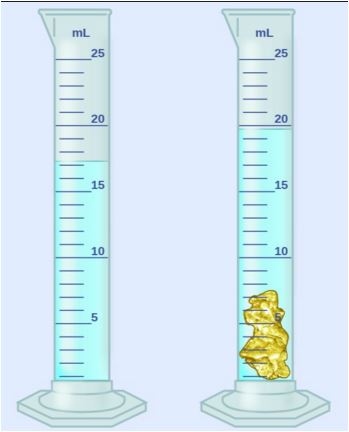

The volume of the water is 40 mL. An object was placed inside the graduated cylinder and it now reads 65 mL. The mass of the object is 125 g. What is the DENSITY of the object?
25 mL
5 mL


The density of a material is 2 g/cm3. The volume is 24 cm3 . What is the mass?

There are 4 objects listed with their densities. Which of the following will float on water? (SELECT 2)
Object A:
0.7 g/cm3
Object B:
1.2 g/cm3
Object C:
0.25 g/cm3
Object D:
11.4 g/cm3
What is the process called when a solid turns into a liquid?
Freezing
Evaporating
Melting
Condensing
What happens to the particles in a solid when it is heated?
The particles in a solid expand and fill the container.
The particles in a solid move faster and may eventually become a liquid.
The particles in a solid remain stationary and do not change.
The particles in a solid move slower and become denser.
Which state of matter has particles that are loosely packed and can flow?
Solid
Liquid
Gas
Plasma

