
 Worksheets
Cellular Metabolism—A&P
Total questions: 50
Worksheet time: 25mins
A constant supply of ______ is needed for the body’s metabolism.
energy
water
oxygen
protein
Information from ______ is required to construct proteins, including the necessary enzymes for reactions.
DNA
RNA
Glucose
Lipids
Metabolic reactions are of two types: Anabolic and ______ reactions.
Catabolic
Photosynthetic
Hydrolytic
Oxidative
Anabolic reactions involve:
Breaking down larger molecules
Constructing larger molecules from smaller ones
Releasing energy
None of the above
Catabolic reactions involve:
Constructing larger molecules from smaller ones
Breaking down larger molecules, releasing energy
Requiring energy
None of the above
These reactions occur by ______ , removing a molecule of water to join two smaller molecules.
dehydration synthesis
hydrolysis
oxidation
reduction
Polysaccharides, lipids, proteins, and nucleic acids are constructed via which process?
Hydrolysis
Dehydration synthesis
Digestion
Respiration
Nucleotides are joined to make ______ acids.
nucleic
amino
fatty
sulfuric
The reaction of ______ occurs when a molecule of water is inserted into a polymer to split it into smaller molecules.
hydrolysis
condensation
oxidation
reduction
Hydrolysis is responsible for:
A) Digestion
B) Growth
C) Protein synthesis
D) Respiration
Enzymes control the rates of all the metabolic reactions of the cell.
True
False
Enzymes are complex proteins that function to lower the ______ energy of a reaction.
activation
potential
thermal
kinetic
Enzymes are called ______.
catalysts
hormones
vitamins
substrates
Each enzyme is specific, acting on only one kind of ______.
substrate
product
hormone
vitamin
The speed of enzymatic reactions depends on the number of enzyme and ______ molecules available.
substrate
lipid
water
oxygen
What is a sequence of enzyme-controlled reactions called?
Metabolic pathway
Chemical reaction
Energy cycle
Protein synthesis
Small organic cofactors are called ______, which activate an enzyme to work.
coenzymes
apoenzymes
prosthetic groups
holoenzymes
Enzymes (proteins) can be denatured by heat, pH extremes, chemicals, electricity, radiation, and by other causes that render them nonfunctional.
True
False
What is the capacity to do work called?
Power
Energy
Force
Motion
Most metabolic reactions in the human body use ______ energy.
chemical
light
sound
mechanical

ATP molecules contain three ______ in a chain connected by high energy bonds.
phosphates
sugars
amino acids
fatty acids
Energy is stored in the last ______ bond of ATP.
phosphate
hydrogen
carbon
oxygen
When energy is released, ATP becomes ______, ready to be regenerated into ATP.
ADP
AMP
NADH
Glucose
Write the chemical equation for cellular respiration as shown in the worksheet.
C6H12O6 + 6O2 → 6CO2 + 6H2O + energy
C6H12O6 + 6CO2 → 6O2 + 6H2O + energy
6CO2 + 6H2O → C6H12O6 + 6O2 + energy
C6H12O6 + 6H2O → 6CO2 + 6O2 + energy

Refer to the diagram of cellular respiration. What is the first part of cellular respiration called?
Citric Acid Cycle
Electron Transport Chain
Glycolysis
Photosynthesis
Glycolysis occurs in the ______ and does not require oxygen (is anaerobic).
cytosol
mitochondria
nucleus
endoplasmic reticulum
Which of the following is NOT a product of glycolysis?
2 pyruvic acid molecules
2 ATP
High-energy electrons
2 CO2
The electron transport chain produces the most ATP during cellular respiration.
True
False
What is the net gain of ATP from glycolysis?
2 ATP
4 ATP
1 ATP
0 ATP
What is needed for aerobic respiration to occur within the mitochondria?
Nitrogen
Oxygen
Carbon dioxide
Glucose
The citric acid cycle generates carbon dioxide, 2 ATP, and _________?
high-energy electrons
oxygen gas
glucose
fatty acids
Which process generates 32-34 ATP from 1 glucose molecule?
Glycolysis
Electron transport chain
Citric acid cycle
Fermentation
Deoxyribonucleic acid (DNA) contains the genetic code needed for the synthesis of each protein (including enzymes) required by the cell.
True
False
A gene is a portion of a DNA molecule that contains the genetic information for making a single protein. The complete set of instructions is the _______.
genome
chromosome
enzyme
ribosome
The DNA molecule twists to form a _______ and may be millions of base pairs long.
double helix
single strand
triple coil
quadruple spiral
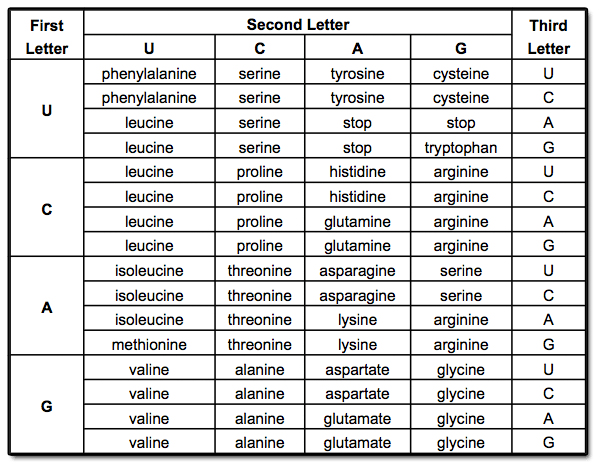
The genetic code is the sequence of base pairs of a gene that specifies an order of _______ to make a particular protein.
amino acids
fatty acids
nucleotides
sugars
The process of protein synthesis requires two sequential steps. Name them.
Transcription and translation
Replication and transcription
Translation and replication
Mitosis and meiosis
DNA molecules cannot leave the nucleus but protein synthesis occurs in the cytoplasm or on rough ER.
True
False
The genetic information is copied to _______ that can leave the nucleus.
RNA
DNA
Ribosome
Protein
RNA molecules are single-stranded and contain _______ rather than deoxyribose, and _______ rather than thymine.
ribose, uracil
glucose, cytosine
fructose, adenine
galactose, guanine
Messenger RNA (mRNA) molecules are synthesized in the nucleus in a sequence complementary to the DNA template in a process called _______.
transcription
translation
replication
mutation
Each amino acid corresponds to a triplet of DNA nucleotides; a triplet of nucleotides in the matching mRNA is called a _______.
codon
intron
exon
anticodon
What is the process called in which mRNA moves out of the nucleus and associates with ribosomes in the cytoplasm where the protein will be constructed?
translation
replication
transcription
mutation
In the cytoplasm, a second kind of RNA, called ________, has a triplet of nucleotides called the anticodon, which is complementary to nucleotides of the messenger RNA codon.
transfer RNA (tRNA)
ribosomal RNA (rRNA)
messenger RNA (mRNA)
small nuclear RNA (snRNA)
The ribosome contains enzymes needed to join the amino acids together by _______ .
dehydration synthesis
hydrolysis
oxidation
reduction
As the amino acids are joined, the new protein molecule folds into its unique shape.
True
False
A gene that has been transcribed and translated into a protein is said to be _______.
expressed
mutated
replicated
deleted

What are the proper complementary base-pairs?
A - T and C - G
A - G and C - T
A - C and T - G
G - T and C - A

