
Font size
 Worksheets
3D Printing Unit 1 Study Guide
Total questions: 86
Worksheet time: 43mins
What is the main focus of Chapter 01 in the document?
Introduction: What is 3D printing?
History of 3D Printing
3D Printing Technology
3D Printing Processes
What topic is covered in Chapter 05?
3D Printing Materials
3D Printing Applications
3D Printing Benefits & Value
3D Printing Technology
Which chapter would you refer to for learning about the benefits and value of 3D printing?
Chapter 07
Chapter 03
Chapter 01
Chapter 05
What is another name for 3D Printing?
Subtractive Manufacturing
Additive Manufacturing
Multiplicative Manufacturing
Reductive Manufacturing
According to the text, how is 3D Printing perceived in terms of its potential impact?
Smaller than the Internet
Larger than the Internet
Equal to the Internet
Unrelated to the Internet
What is the primary method of production in 3D printing?
Subtractive process
Moulding process
Additive process
Casting process
Which sectors are seeing an increase in the application of 3D printing?
Only industrial sectors
Only consumer sectors
Industrial, maker, and consumer sectors
Only maker sectors

What does 3DPI aim to provide its audience with?
Entertainment content
Reliable background on 3D printing
Financial news
Sports updates
What is the basic principle behind 3D printing?
It is a subtractive manufacturing process.
It is an additive manufacturing process.
It is a traditional manufacturing process.
It is a manual manufacturing process.
Which of the following technologies is mentioned as having a significant impact on human history?
The typewriter
The steam engine
The printing press
The telegraph
What is one potential impact of 3D printing mentioned in the text?
It will reduce the need for digital technology.
It will end traditional manufacturing.
It will decrease environmental awareness.
It will limit design possibilities.
How does 3D printing build parts?
By removing material from a solid block
By assembling pre-made parts
By adding material in layers
By compressing materials together
What is a major limitation of traditional manufacturing processes?
They rely heavily on automated processes.
They are based on human labor and "made by hand" ideology.
They use advanced robot technology.
They are cost-effective for complex parts.
What do traditional manufacturing technologies require?
Adding material to a smaller block.
Subtracting material from a larger block.
Using only digital tools.
Eliminating the need for assembly.
What is a common issue with traditional design and production processes?
They are inexpensive and efficient.
They impose unacceptable constraints.
They eliminate the need for tooling.
They are ideal for all applications.
What is a key advantage of 3D printing compared to subtractive manufacturing processes?
It wastes up to 90% of the original material.
It requires more assembly requirements.
It adds material layer by layer, reducing waste.
It is more expensive due to complex features.
How does 3D printing contribute to environmental efficiency?
By using more energy than traditional methods.
By utilizing up to 90% of standard materials.
By increasing the weight of products.
By requiring more assembly time.
What does 3D printing offer in terms of design?
Limited design freedom.
Increased assembly requirements.
Unprecedented design freedom.
Higher prohibitive costs.
What has made 3D printing more accessible to small companies and individuals?
Decrease in material costs
Smaller, less capable 3D printers available for under $1000
Increase in demand for 3D printed products
Government subsidies for 3D printing
What is one effect of the exponential adoption rate of 3D printing technology?
Decrease in the number of 3D printing companies
Reduction in the variety of materials used
Emergence of more systems, materials, applications, services, and ancillaries
Increase in the cost of 3D printers
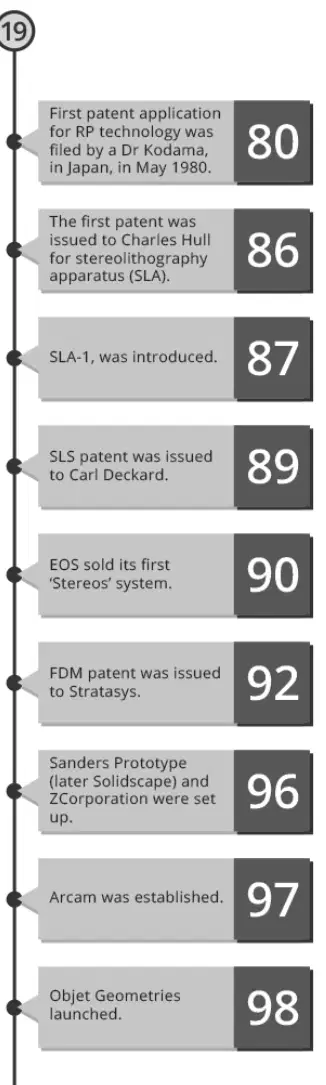
When did the earliest 3D printing technologies first become visible?
Late 1970s
Late 1980s
Early 1990s
Early 2000s
Who filed the first patent application for Rapid Prototyping technology?
Charles Hull
Carl Deckard
Dr Kodama
Stratasys
What was the original purpose of Rapid Prototyping technologies?
Mass production
Creating prototypes for product development
Educational purposes
Medical applications
In what year was the first patent for stereolithography apparatus (SLA) issued?
1980
1983
1986
1990
Who invented the SLA machine and co-founded 3D Systems Corporation?
Dr Kodama
Carl Deckard
Charles Hull
Stratasys
In what year was 3D Systems' first commercial RP system, the SLA-1, introduced?
1985
1987
1989
1992
Who filed a patent for the Selective Laser Sintering (SLS) RP process in 1987?
Scott Crump
Carl Deckard
Chuck Hull
Adrian Bowyer
Which company was later acquired by 3D Systems after being licensed the SLS technology?
EnvisionTec
DTM Inc
Stratasys
ExOne
What technology did Scott Crump file a patent for in 1989?
SLS
SLA
FDM
SLM
Who founded EOS GmbH in Germany?
Hans Langer
Michael Feygin
William Masters
Emanuel Sachs
What process did EOS focus on for their R&D?
Ballistic Particle Manufacturing
Laminated Object Manufacturing
Laser Sintering
Solid Ground Curing
Which company was acquired by EOS for their direct metal laser sintering process?
Electrolux Finland
3D Systems
Stratasys
Ballistic Particle Manufacturing
Who originally patented the Ballistic Particle Manufacturing (BPM) process?
William Masters
Michael Feygin
Itzchak Pomerantz
Emanuel Sachs
Which of the following companies remain from the early 3D printing market?
3D Systems, EOS, Stratasys
Electrolux, BPM, LOM
SGC, 3DP, Electrolux
EOS, BPM, SGC
What was the primary focus of 3D printing technologies when they were first introduced?
Consumer products
Industrial applications
Educational tools
Medical devices
Which term is used as an umbrella for all 3D printing processes?
Rapid Tooling
Rapid Casting
Additive Manufacturing
Direct Manufacturing
Which company introduced SLM technology in 2000?
EnvisionTec
ExOne
MCP Technologies
Sciaky Inc
In what year was ExOne established?
1997
2000
2002
2005
What were the two specific areas of emphasis in 3D printing during the mid-noughties?
High-end systems and concept modelers
Low-cost systems and mass production
Medical applications and jewelry design
Software development and material science
Which sectors have seen applications of 3D printing due to years of R&D and qualification?
Aerospace, automotive, medical, and fine jewelry
Education, agriculture, and retail
Fashion, entertainment, and sports
Construction, energy, and telecommunications
What was the focus of 3D printers known as 'concept modelers'?
Improving concept development and functional prototyping
Mass production of consumer goods
Creating large-scale architectural models
Developing new materials for printing
What was the main goal for 3D printing technology according to industry insiders in the past?
To create 3D printers for industrial use only
To develop 3D printers under $5000
To make 3D printers faster than traditional methods
To limit 3D printing to professional users
What was a significant event in the 3D printing market in 2007?
The introduction of the first 3D printer under $1000
The launch of Desktop Factory as a successful product
The release of the first system under $10,000 by 3D Systems
The widespread adoption of 3D printing in homes
What happened to Desktop Factory in 2008?
It became the leading 3D printer manufacturer
It was acquired by 3D Systems and vanished
It successfully launched its product to the market
It expanded its operations globally
In what year did the RepRap phenomenon begin to gain visibility?
2004
2007
2009
2010
Who conceived the RepRap concept of an open source, self-replicating 3D printer?
Vik Oliver
Rhys Jones
Dr. Bowyer
Makerbot Industries
What was the first commercially available 3D printer based on the RepRap concept?
Makerbot
BfB RapMan
Replicator
Ultimaker
Which company was closely involved in the development of RepRap before departing from the Open Source philosophy?
Makerbot Industries
BfB Industries
Ultimaker
3D Systems
What is the ethos of the RepRap community regarding 3D printing?
Commercialization
Open Source developments
Proprietary technology
Exclusive patents
Which year saw the introduction of alternative 3D printing processes at the entry level of the market?
2010
2011
2012
2013
What technology does the B9Creator utilize?
FDM technology
DLP technology
SLA technology
SLS technology
Which company acquired Makerbot in 2013?
3D Systems
Stratasys
Ultimaker
Formlabs
What is one of the impacts of 3D printing on the industrial sector?
Decreased production costs
Increased manual labor
Limited consumer potential
Reduced innovation
What is the starting point for any 3D printing process?
A 3D digital model
A physical prototype
A 2D sketch
A printed document
Which software is commonly used in the industry for creating 3D digital models?
3D CAD
Photoshop
Illustrator
AutoCAD
What materials are routinely used for industrial prototyping and production applications in 3D printing?
Wood and paper
Functional plastics, metals, ceramics, and sand
Glass and rubber
Leather and fabric
What is the only widely used material at the entry level of the 3D printing market?
Metal
Glass
Plastic
Wood
Which materials are being researched for 3D printing in addition to traditional ones?
Bio materials and different types of food
Wood and stone
Glass and rubber
Leather and fabric
What is one of the basic limitations of 3D printing in terms of materials and applications?
It can only use metal materials.
There is no 'one solution fits all'.
It is limited to creating small objects.
It can only use plastic materials.
Which process is employed by the majority of entry-level 3D printers?
Powder sintering
Resin solidification
Deposition
Jetting of fine droplets
What materials are commonly extruded in the deposition process of 3D printing?
Nylon and ceramic
PLA or ABS
Metal and glass
Resin and wax
What is one advantage of 3D printing mentioned in the text?
It requires no software updates.
It can produce detailed and intricate objects.
It is a plug and play process.
It eliminates the need for file preparation.
According to the text, what is a challenge associated with 3D printing?
Lack of demand for 3D printed parts.
Simplicity of the design process.
Time-consuming file preparation and conversion.
Absence of intricate designs.

What does the printer use to form layers in 3D printing?
Liquid resin.
Powdered metal.
Filament through a heated extruder.
Solid blocks of material.
What is one of the finishing operations required for 3D printed parts?
Support removal
Assembly
Welding
Drilling
Which of the following is NOT typically a finishing touch for 3D printed objects?
Sanding
Lacquer
Painting
Welding

What is required to perform traditional finishing touches on 3D printed parts?
Automation
Skill and/or time and patience
High temperature
Chemical solvents
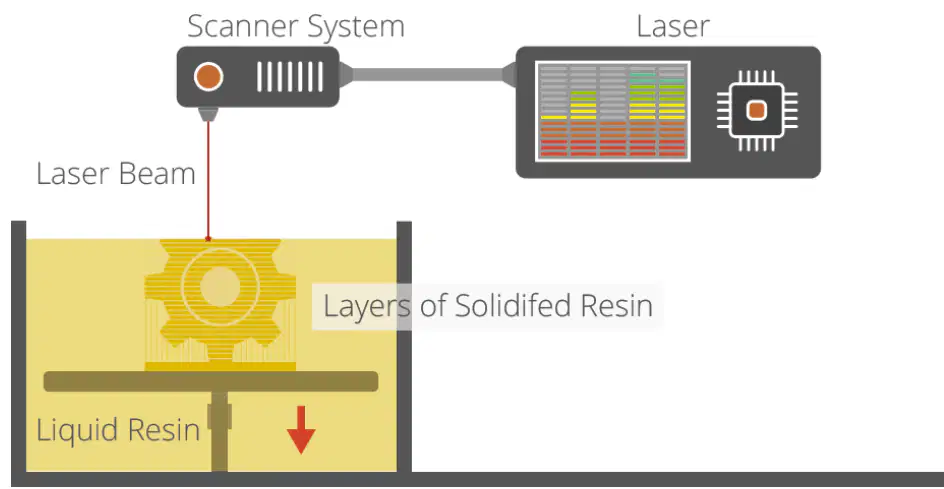
What is Stereolithography (SL) primarily recognized as?
The first 3D printing process
A type of metal casting
A method of painting
A chemical reaction process
What type of material does Stereolithography (SL) use in its process?
Photopolymer resin
Metal powder
Ceramic clay
Wood pulp
How does the photopolymer resin harden in the Stereolithography process?
By exposure to air
By heating
By reacting with a laser
By cooling
In the Stereolithography process, what happens after a layer is completed?
The platform rises
The platform drops
The laser turns off
The resin is replaced
What is a necessary step in the stereolithography (SL) process for parts with overhangs or undercuts?
Automatic removal of support structures
Manual removal of support structures
No need for support structures
Use of metal support structures
What does the curing process in stereolithography involve?
Cooling the part in a freezer
Exposing the part to intense light
Submerging the part in water
Heating the part in a microwave
Which of the following is a limitation of stereolithography?
Lack of surface finish
High material cost
Post-processing steps required
Limited color options
What does DLP stand for in the context of 3D printing?
Digital Light Processing
Direct Laser Printing
Dynamic Light Projection
Digital Laser Production
What is a major difference between DLP and stereolithography (SL) in 3D printing?
DLP uses a more conventional light source
DLP requires more resin
SL uses a deformable mirror device
SL is faster than DLP
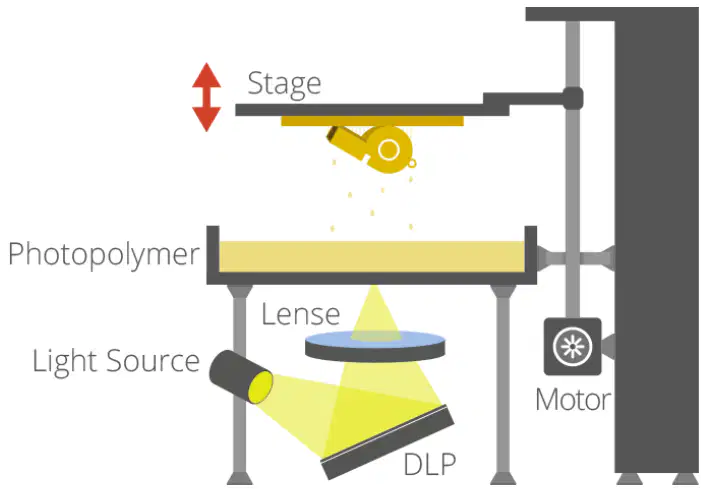
What is one advantage of DLP over SL in 3D printing?
Requires a shallow vat of resin
Produces less accurate parts
Has higher running costs
Needs more support structures
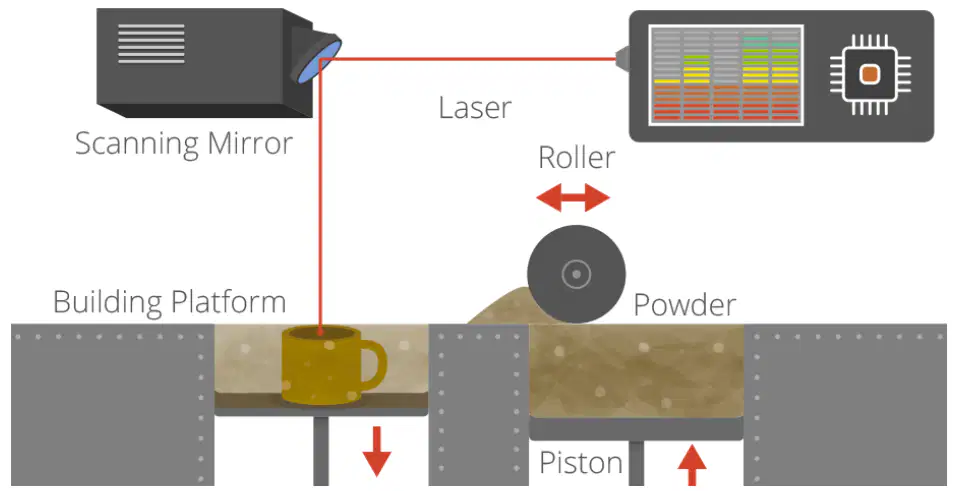
What is the primary function of the laser in the laser sintering process?
To cool the powdered material
To trace and fuse the powdered material
To add color to the material
To remove excess material
In laser sintering, what happens to the powder bed after each layer is completed?
It is removed from the machine
It is heated to a higher temperature
It drops incrementally
It is cooled rapidly
What is one of the key advantages of the laser sintering process?
It requires no cooling time.
It allows for the creation of complex shapes.
It uses a lower powered laser.
It produces parts with a better surface finish than SL or DLP.
Why is the build chamber completely sealed during the laser sintering process?
To prevent the escape of gases.
To maintain a precise temperature.
To reduce the cost of materials.
To improve the surface finish of parts.
What is a historical issue associated with the laser sintering process?
Excessive material waste.
High energy consumption.
Porosity in the parts.
Limited material options.
How does metal sintering differ from plastic sintering in the laser sintering process?
Metal sintering requires a lower powered laser.
Metal sintering requires higher in-process temperatures.
Metal sintering produces parts with better surface finish.
Metal sintering has shorter cooling times.
What is the most common and recognizable 3D printing process that utilizes the extrusion of thermoplastic material?
Stereolithography (SLA)
Selective Laser Sintering (SLS)
Fused Deposition Modelling (FDM)
Digital Light Processing (DLP)
Which company originally developed and registered the trade name for Fused Deposition Modelling (FDM)?
MakerBot
Stratasys
Ultimaker
3D Systems
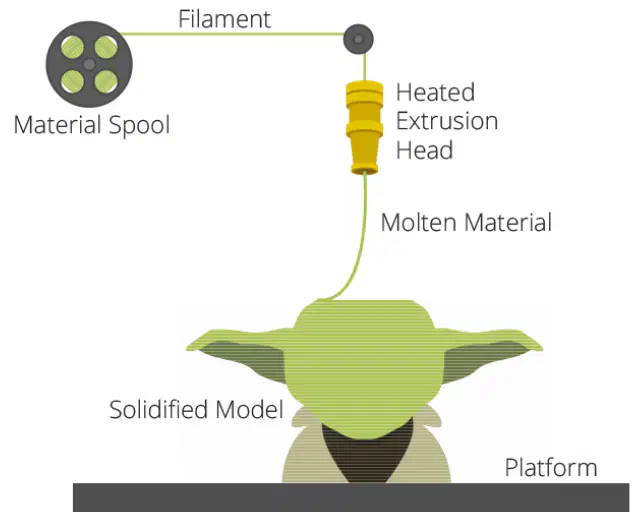
What is the alternative name for Fused Deposition Modelling (FDM) that is used for entry-level 3D printers?
Stereolithography (SLA)
Freeform Fabrication (FFF)
Selective Laser Sintering (SLS)
Digital Light Processing (DLP)

