
Font size
 Worksheets
Clinical Decision Making and Nursing Process
Total questions: 39
Worksheet time: 25mins
What goes into decision making for a nurse?
The patient
The evidence
Your experience
Family preferences
Clinical judgement is...
thought process that allows the ability to memorize medical facts
thought process that is a method of conducting laboratory tests
the though process of judging what the patient needs based off of what they think they need for themselves, using subjective data as a guideline
the thought process that allows healthcare providers to arrive at a conclusion based on objective and subjective information about a patient
Decision making skills and clinical expertise/judgement + client preferences + evidence=?
(a)
What are steps of nursing process?
Assessment, Treatment, Follow-up, Review, Evaluation
Assessment, Diagnosis, Implementation, Monitoring, Feedback, Evaluation
The assessment part of the nursing process includes:
Gathering data
Giving the patient's problem a name
Prioritization of clients needs
Action phase
The assessment phase is not a continuous collection of data.
True
False
What are examples of subjective data?
Patient states, "I am having trouble catching my breath."
Patient appears to be short of breath.
Family member mentioned a history of tachypnea.
Patient is using pursed lip breathing.
Which are examples of objective data?
Patient blood pressure is 158/98.
Patient reports feeling dizzy.
Family member reports family history of hypertension.
Patient appears to be short of breath.
What is a primary source of data?
Client Family Member
Primary Care Provider
Attending nurse
The client
Which nursing process step includes giving the problem a name?
Diagnosis
Assessment
Implementation
Contacting the patient primary care doctor
(a) are licensed to treat.
Medical diagnosis are (a) focused.
This type of nursing diagnoses is focused where the problem is present.
Actual
Risk
Health Promotion
Syndrome
This type of nursing diagnoses is a cluster of nursing diagnoses that can occur together
Syndrome
Health promotion
Risk
Actual
Components of a nursing diagnosis include:
Diagnostic label
Etiology
Defining Characteristics
Patient family history
The nursing process step planning includes:
formulating client goals
formulating physician's goals for client
formulating plan to get patient home asap
giving the problem a name
Which is the best example of developing a goal?
The nurse will assist client's call light within five minutes leading up until the end of the shift.
The patient will report 2/10 pain or lower upon discharge.
The patient will have lower BP by end of shift.
The patient will walk by end of shift.
Which are the best examples of a developing a goal?
The patient will eat dinner.
The patient will report decreased pain.
The patient will eat 50% of their dinner on 9/5/2025.
The patient will be able to walk 15 feet unassisted by discharge.
Implementation includes:
Action phase
Client goals formulated
Goal met
Evaluation
Which type of nursing intervention can be done independently?
Turning patient every two hours
Creating a physical therapy plan
Giving patient medication that they have an order for
Giving patient medication without physician order
A nursing intervention is...
Actions nurse performs to achieve patient goals
What is an example of collaborative nursing intervention?
Working with dietary to create a healthier diet to fit a newly diabetics lifestyle.
Turning the patient every two hours.
Prescribing the patient to get 2mL of oxygen every hour.
Working with respiratory therapy to ensure patient is receiving the best care fit to their needs.
What is an example of an effective nursing intervention?
Patient will be given ibuprofen.
The patient will be offered a cool compress and dimmed lights when reporting pain 3/10 or greater during shift.
Giving the patient a glass of water during shift.
Nursing Interventions need to be:
Congruent with clients values, beliefs, culture
Congruent with hospital's environment
Congruent with other therapies and standards of care
Based on current best nursing research evidence
Writing a nursing intervention
is client-centered
has specific, concise action
lists only top 3-5 priority interventions
is general to the patient population
The evaluation phase of the nursing process deciphers...
Evaluation ends after patient is discharged.
True
False
The nursing process is not repeated after the evaluation phase if the patient did not meet goals.
True
False
Possible evaluation conclusions
Goal was met
Goal was not met
Goal was partially met
Goal was discontinued
Evaluation statement includes
date, time of evaluation
conclusion statement about goal-met partially met, not met
supporting statement giving results of how client did, did not achieve goal
nurse signature
The nursing process is repeated if client does not meet evaluation goal.
True
False
The nursing plan of care:
keeps record of care
supports communication with others for better continuity of care
is unnecessary considering we have the nursing process
electronic or written
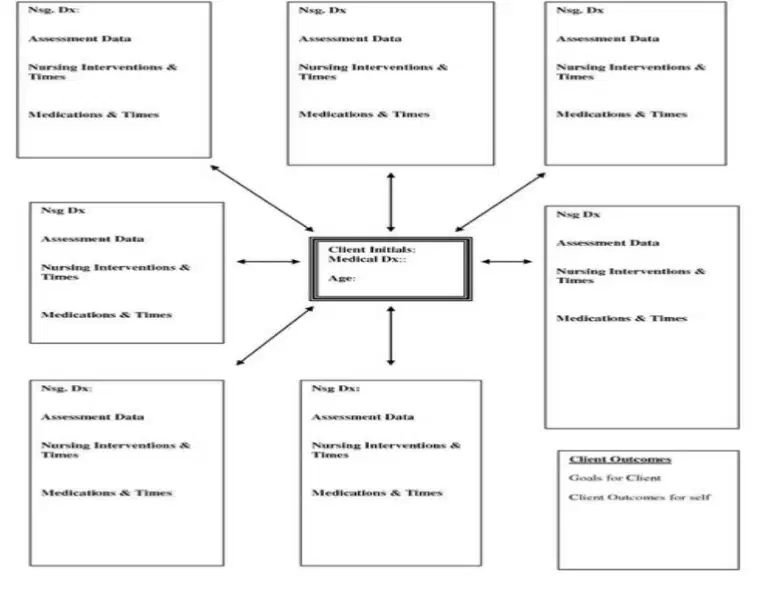
This nursing care plan is formatted as a
concept map
four column structure
pyramid of needs
box method
Prioritizing care
allows nurses to complete easiest tasks first
helps nurses manage time
establishes order
allows for nurses to take multiple breaks a day
ABC stands for
(a)
Ways we can prioritize
Patient DOB
ABCs
Maslow's
Client preferences
The nurse is caring for a client with cancer receiving chemotherapy. what is a priority action in the care of the client?
Monitor stools
Encourage fluid intake
Monitor urine output
Encourage the client to cough and deep breath
Low priority is at the bottom of Maslow's Hierarchy of Needs
True
False
The nurse is caring for a client in a full
body cast. Which intervention is the
highest priority?
Position client for maximum comfort
Education family on patient plan of care
Monitor for changes in patient's vital slings
Provide the patient a tablet to communicate with family

