
Font size
 Worksheets
Gr 6 Cumulative 2025-26 Adaptive HW
Total questions: 60
Worksheet time: 37mins
Matter is _______________________________.
The amount of matter in an object.
The amount of space an object occupies.
Anything that has mass and volume.
True or False: The music student can see the teacher in the video?
True
False
What was observed in the room with no light?
music teacher sees herself
music teacher sees the music student
music student sees himself
music student sees the music teacher
What was observed in the room with light?
music teacher sees herself
music teacher sees the music student
music student sees himself
music student sees the music teacher
What the teacher notice when she looks up while in the hallway?
The ceiling is dirty
The light is off
There is a camera
There is a bright light
What is between the student and teacher in the video?
Three-way mirror
One-way mirror
Glass window
Metal wall
What does the teacher do in front of the one-way mirror to show us that the student can't see her?
Shines a light
Shouts at the student
Waves her hand
Knocks on the one-way mirror
Which part of the video is important for us to focus on to learn more about a one-way mirror?
The instruments
The furniture
The color of the walls
Only one room has light
Which part of the video is important for us to focus on to learn more about a one-way mirror?
He plays two different guitars
There are whiteboards on the wall
The student is older
The hallway is dark
Which room in the video could a reflection be seen?
Dark room
Room with light
Neither room
Which room in the video could we not see a reflection?
Dark room
Room with light
Neither room
Organize these options into the right categories
Light on in one room
Light off in one room
Student only sees his reflection
Teacher sees student
Student plays guitar
Teacher is younger than student
The room has a chair
What happens when there is light in both rooms of the box model?
Can see reflection and see through the one-way mirror
Can see only see reflection
Can only see through the one-way mirror
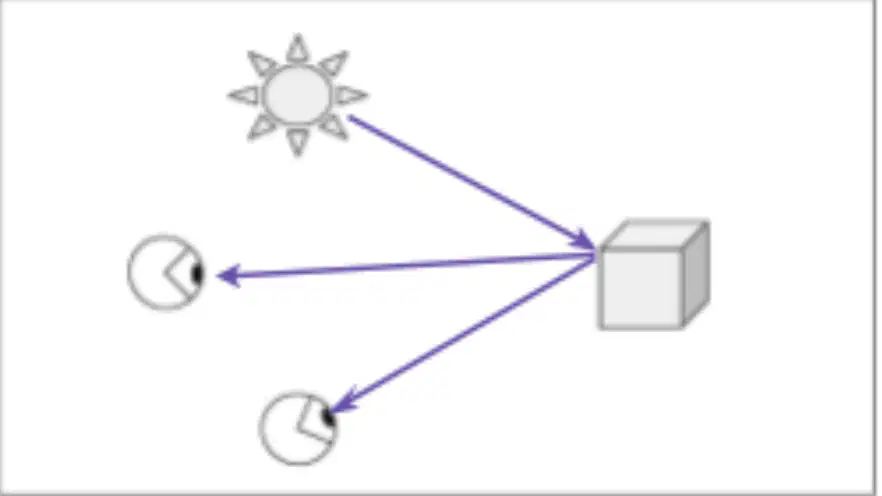
What does the eye see?
Can see the box clearly
Can barely see the box
Can't see anything

What does the eye see?
Can see the box clearly
Can barely see the box
Can't see anything
In order to see an object....
light has to reflect off it to your eyes.
light has to reflect off your eyes to the object
light has to shine out of your eyes
True or False: The music student can see the teacher in the video?
True
False
What symbol do we use to show the flow of light?
wiggly line
straight arrow
circular lines

What does reflect mean?
To bounce off
To pass/go through
to make/create
to represent a real world situation
Example of a light source (luminous object)
sun
glass
the moon
a medium that allows SOME light to pass through
transparent
translucent
opaque
gas
Which is material is transparent?
a medium that allows ALL light to pass through
transparent
translucent
opaque
liquid
a medium that allows NO light to pass through
transparent
translucent
opaque
solid
What does reflect mean?
To bounce off
To pass/go through
to make/create
to represent a real world situation
Which is material is transparent?
Which of these would you expect to reflect the most light?
mirror
one-way mirror
glass
vegetable oil
Which of these would you expect to transmit the most light?
mirror
one-way mirror
glass
vegetable oil

What does Transmit mean?
To bounce off
To go/pass through
To represent a real world situation
To create/make

What is a One-Way Mirror made of?
Same as a Window, just Glass
It is a mirror on one side and a window on the other
It is made with a full backing of silver
It is part 'glass' and part 'silver'
A surface which allows most or all light to pass through is
transparent
translucent
opaque

What tool would we use to measure light?
Calculator
Light Meter
Ruler
A Scale

What happens to light when it hits a one-way mirror?
light only reflects
light mostly transmits
light transmits & reflects
Which of the following models shows only light reflecting off an object?


Which of the following models shows only light transmitting through an object?
Which of the following models shows light being both reflected and transmitted?
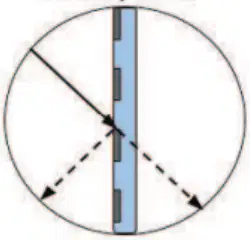
What happens when light hits the SILVER rectangles on the one-way mirror?
It reflects back
It transmits through
What happens when light hits the blue GLASS rectangles on the one-way mirror?
It reflects back
It transmits through
It bounces off
When we draw our light arrows, where do they need to START?
The object we see
The light source
Our eyes
What is the primary function of a one-way mirror?
To allow light to pass through both ways
To reflect light on one side and allow light to pass through on the other
To block all light
To magnify objects
Which material would you expect to be translucent?
Frosted glass
Clear glass
Wood
Metal
What happens to light when it hits a transparent material?
It is absorbed
It is reflected
It passes through
It is scattered
Which of these materials is most likely to be opaque?
Clear plastic
Frosted glass
Wood
Water
What happens to light when it hits a translucent material?
It is completely absorbed
It is completely reflected
It is partially transmitted and scattered
It passes through without any change
Which tool would be most appropriate to measure the intensity of light?
Thermometer
Light Meter
Barometer
Voltmeter
What is the effect of a light source on an opaque object?
It creates a shadow
It passes through the object
It reflects completely
It becomes invisible
What happens to light when it hits a translucent material?
It is completely absorbed
It is completely reflected
It is partially transmitted and scattered
It passes through without any change
Which tool would be most appropriate to measure the intensity of light?
Thermometer
Light Meter
Barometer
Voltmeter
What is the effect of a light source on an opaque object?
It creates a shadow
It passes through the object
It reflects completely
It becomes invisible

Which structure is represented by the letter "G"?
Sclera
Retina
Blind Spot
Optic Nerve
Which structure is represented by the letter "E"?
Sclera
Lens
Optic Nerve
Retina

The part called the lens is indicated by the number ?
1
2
3
4
5
What is colored part of the eye that controls light entering
Lens
Retina
Optic Nerve
Iris
What sends electrical signals from the retina to the brain.
Sclera
Retina
Optic Nerve
Iris
What part of the eye that contains rods and cones and turns light into electrical signals for your brain
Iris
Retina
Pupil
Sclera
What is the dark part of the eye where light actually enters
Pupil
Retina
Iris
Lens

What is the line pointing towards?
Lens
Retina
Optic Nerve
Pupil

